The longest novel on record is Marcel Proust's À la recherche du temps perdu, known in English as In Search of Lost Time or Remembrance of Things Past. Guinness World Records lists it at an estimated 9,609,000 characters, counting every letter and every space. That comes to about 1.27 million words in the original French: fourteen novels of ordinary length, or about 81 hours of reading at an average pace.
It holds the record, but it is not the longest book. At least three novels have more words, the great oral epics outrun every novel, and one web serial has passed 15 million words and is still going. Which of them is "the longest" depends on what you count, and the lists that rank them rarely say. Here is the record, the rivals with their word counts as cited, where the counts disagree, and what the numbers mean for anyone writing a book of ordinary size.
The record: In Search of Lost Time
Proust published the novel in seven parts, from Swann's Way in 1913 to Time Regained in 1927. He died in November 1922, so the last three parts, The Prisoner, The Fugitive and Time Regained, came out after his death. Guinness calls it a 13-volume work, which tells you how little "volume" means: the parts are usually counted as seven, and Gallimard's Pléiade edition binds the whole novel in four.
Counting characters sidesteps an argument that word counts cannot. French is full of elisions such as l'homme and aujourd'hui, and counting tools disagree about whether each is one word or two. A character count does not care. The word figure usually quoted, 1,267,069, is a count of the French text; every English translation has its own total.
The Guinness entry states the figure and stops there. It does not say why longer candidates are left out, and some of them are a good deal longer.
Longest novels by word count
Ranked by the word counts most often cited. Each figure is someone's count of one text in one language, so read them to the nearest 50,000.
| Novel | Words | Published | Reading time |
|---|---|---|---|
| NovelDevta, Mohiuddin Nawab (Urdu) | WordsAbout 2,450,000 (estimate) | Published1977–2010, monthly | Reading timeAbout 157 hours |
| NovelArtamène ou le Grand Cyrus, Madeleine and Georges de Scudéry (French) | Words1,954,300–2,100,000 | Published1649–1653, 10 volumes | Reading time125–135 hours |
| NovelMen of Good Will, Jules Romains (French) | WordsAbout 2,000,000 | Published1932–1946, 27 volumes | Reading timeAbout 128 hours |
| NovelIn Search of Lost Time, Marcel Proust (French) | Words1,267,069 | Published1913–1927, 7 parts | Reading timeAbout 81 hours |
| NovelClarissa, Samuel Richardson (English) | Words934,596–970,000 | Published1747–1748, 7 volumes | Reading timeAbout 60 hours |
| NovelMiss MacIntosh, My Darling, Marguerite Young (English) | WordsAbout 750,000 (estimate) | Published1965, 1 volume | Reading timeAbout 48 hours |
| NovelWar and Peace, Leo Tolstoy (Maude translation) | Words563,500 | Published1869 | Reading timeAbout 36 hours |
| NovelLes Misérables, Victor Hugo (Hapgood translation) | Words559,207 | Published1862 | Reading timeAbout 36 hours |
Artamène is longer by either of its counts. Its ten volumes came out between 1649 and 1653 and fill 13,095 pages. The title pages name Georges de Scudéry, but the book is usually attributed to his sister Madeleine. It was not reprinted after the seventeenth century, partly because of its length, and the full text went online only in the early 2000s. The two figures in circulation show how loose these numbers are: 1,954,300 from running a word counter over that online text, about 2.1 million in French press reports.
Men of Good Will is a sequence. Jules Romains published its 27 volumes between 1932 and 1946, about two million words over 7,386 pages. A 1976 New York Times piece called it the "longest important novel", a phrase that leaves room for argument. Whether a roman-fleuve, a long run of novels with recurring characters, counts as one book is the oldest dispute on this list, and it applies to Proust's seven parts as well.
Devta ran in a magazine for 33 years. Mohiuddin Nawab's Urdu novel appeared monthly in Pakistan's Suspense Digest from February 1977 to January 2010, and it is often described as the longest continuously published story. Its length is an estimate, and sources cannot agree whether the collected edition runs to 49 volumes or 56.
The longest novel in English
Clarissa is the usual answer. Samuel Richardson's epistolary novel, told entirely in letters, came out in seven volumes: the first two in December 1747, the rest in 1748. The Standard Ebooks edition, set from a nine-volume text of 1902, counts 934,596 words, and other sources round it up to about 970,000. Either way it is about three quarters the length of Proust and two thirds longer than War and Peace.
Most other claims to the English title are made in pages, and pages measure an edition, not a novel. Type size, margins and trim size decide how many there are.
| Novel | Pages | Note |
|---|---|---|
| NovelSironia, Texas, Madison Cooper (1952) | PagesOver 1,700 | NoteWritten over 11 years |
| NovelPoor Fellow My Country, Xavier Herbert (1975) | Pages1,463 | NoteOften called the longest Australian novel |
| NovelA Suitable Boy, Vikram Seth (1993) | Pages1,349 (1,488 in paperback) | NoteAmong the longest novels published in one volume |
| NovelJerusalem, Alan Moore (2016) | Pages1,266 US, 1,180 UK | NoteThe UK edition uses smaller type |
| NovelMiss MacIntosh, My Darling, Marguerite Young (1965) | Pages1,198 | NoteThe manuscript ran to 3,449 pages |
| NovelAtlas Shrugged, Ayn Rand (1957) | Pages1,168 | NoteThe manuscript passed 600,000 words |
| NovelDucks, Newburyport, Lucy Ellmann (2019) | Pages1,022–1,040 | NoteMostly one sentence; shortlisted for the Booker |
Jerusalem shows the problem in one row: the same text loses 86 pages when it is set in smaller type. Sironia, Texas has the highest page count in the table, yet a page count alone cannot rank it against Clarissa, which is measured in words. If someone tells you a novel is the longest in English, ask which edition they counted.
Longer than any novel
Drop the requirement that the book be a novel, or that it be printed, and the numbers grow by orders of magnitude.
| Work | What it is | Length |
|---|---|---|
| WorkEpic of Manas | What it isKyrgyz oral epic | LengthAbout 500,000 lines in one version, roughly 2–2.5 million words |
| WorkMahabharata | What it isSanskrit epic | LengthOver 100,000 couplets, about 1.8 million words |
| WorkEpic of King Gesar | What it isTibetan oral epic | LengthAbout 120 volumes and over a million verses in one Chinese compilation |
| WorkThe Wheel of Time | What it isFantasy series by Robert Jordan and Brandon Sanderson, 1990–2013 | LengthAbout 4.3 million words in 15 novels |
| WorkPerry Rhodan | What it isGerman weekly science fiction booklets, since 1961 | LengthReached its 3,000th issue in 2019 |
| WorkThe Wandering Inn | What it isWeb serial by pirateaba, since 2016 | LengthOver 15 million words, still growing |
| WorkMarienbad My Love | What it isNovel by Mark Leach | Length17 million words, by the author's description |
| WorkYongle Encyclopedia | What it isChinese imperial compendium, 1408 | LengthAbout 370 million characters in 11,095 volumes |
| WorkEnglish Wikipedia | What it isOnline encyclopedia | LengthOver 5 billion words in more than 7 million articles |
The epics are the old answer. The Mahabharata is about ten times the length of the Iliad and the Odyssey combined, and it is built as a frame story, tales told inside tales. Manas and Gesar were carried by performers rather than books, so their length is the length of whichever version someone wrote down. Gesar has no canonical text at all.
The serial is the new answer. The Wandering Inn has posted chapters since 2016. At 260 words a minute its 15 million words take more than 960 hours to read, an hour a day for over two and a half years. Its print and audiobook editions split it into numbered books, so even its publishers treat it as a series. Mark Leach's Marienbad My Love is a different case: the 17-million-word figure comes from the author, and the Guinness record still belongs to Proust.
Reference works leave everything else behind. The Yongle Encyclopedia, finished in 1408 by more than 2,000 scholars, was the largest general encyclopedia for six centuries, until Wikipedia passed it in late 2007. Fewer than 400 of its volumes survive. Reading the English Wikipedia at eight hours a day would take more than a century.
If you meant the biggest book rather than the longest, that is a separate Guinness record: a 429-page book made in Dubai in 2012 that measures 5 by 8.06 meters and weighs about 1,500 kilograms. It is a record for size, not length.
Why no two lists agree
Every list of long books, this one included, is built from figures that were measured in different ways. Five differences account for most of the disagreement:
- The unit. Guinness counts characters, most lists count words, and older claims count pages or volumes. A ranking that mixes them compares nothing.
- The language. Proust's 1,267,069 words are French words. Translations reach their own totals, and no two translations match.
- The tool. Word counters split hyphens, dashes and elisions differently, which is how Artamène ends up with two counts 150,000 words apart.
- The edition. Page counts belong to a printing. The same is true of words when an author revised the text between editions.
- The boundary. Seven parts, 27 volumes, 33 years of magazine installments, a serial still being written: every list decides what counts as one book, and few say where they drew the line.
Every word count measures one edition, in one language, with one counting tool.
A million words at the desk
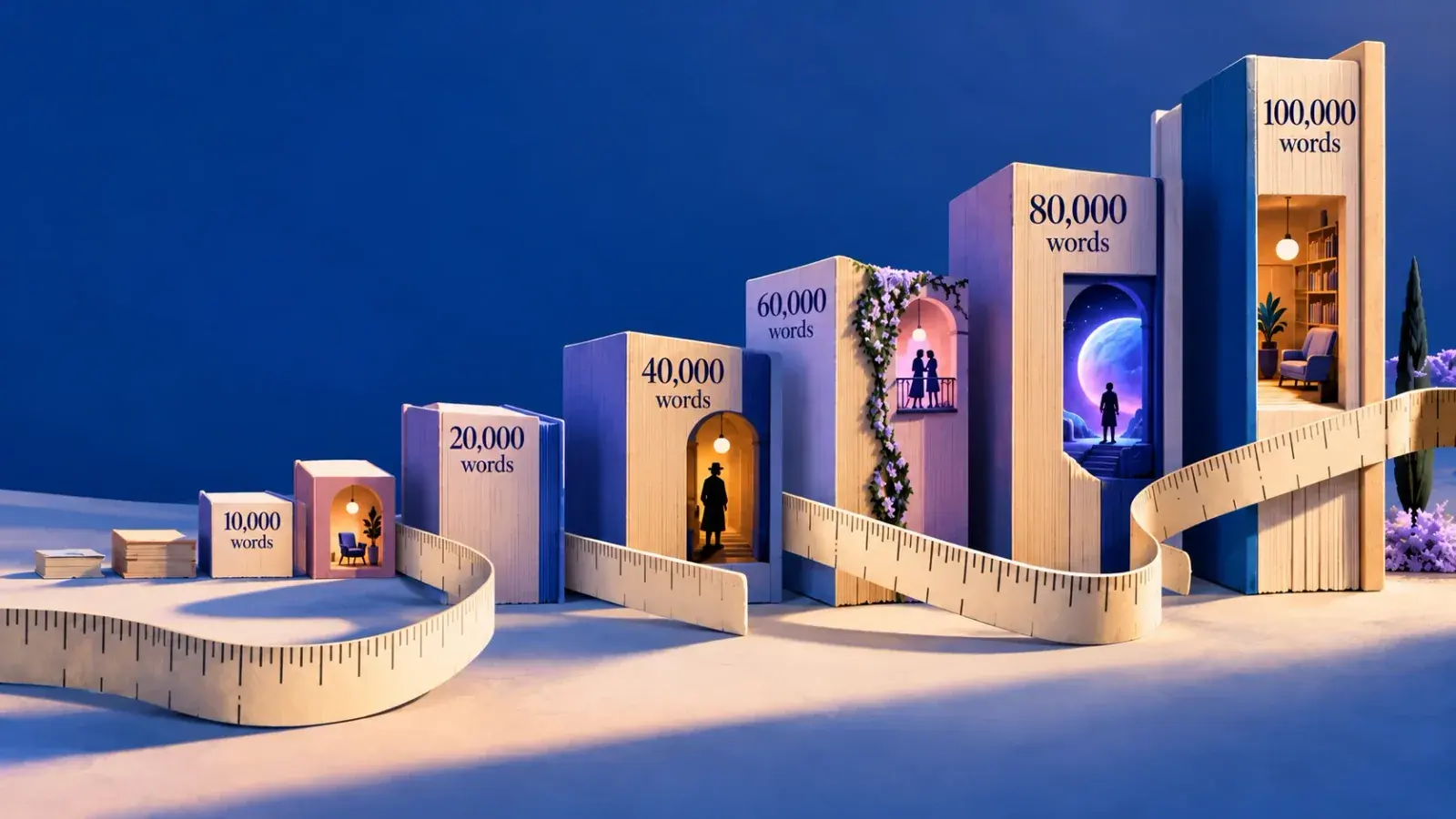
Most novels are a small fraction of any of these. Agents ask for roughly 70,000 to 100,000 words for most adult fiction, a range set out in how many words is a novel. Take 90,000 as a typical length and Proust's novel equals 14 of them, Devta 27.
The time behind these books is the more useful number for a writer. Marguerite Young began Miss MacIntosh, My Darling in 1945, expecting to need two years, and finished in 1964. Her manuscript ran to 3,449 pages. Madison Cooper spent 11 years on Sironia, Texas. Writing 1,000 words a day, every day, you would need about three and a half years to draft as many words as Proust's novel holds, before a single revision.
Length on that scale brings bookkeeping that a short novel never needs: a minor character renamed in volume two, a chapter cut and then wanted back. A series bible keeps names, dates and places straight across books. In Strokes, a long book can be a project folder with one document per chapter, and version history keeps earlier drafts, so a cut can be undone a chapter at a time.
For the ordinary end of the scale, see the word counts of famous books, from Dr. Jekyll and Mr. Hyde to War and Peace. The reading times here use 260 words a minute. The piece on average reading speed explains where that figure comes from.