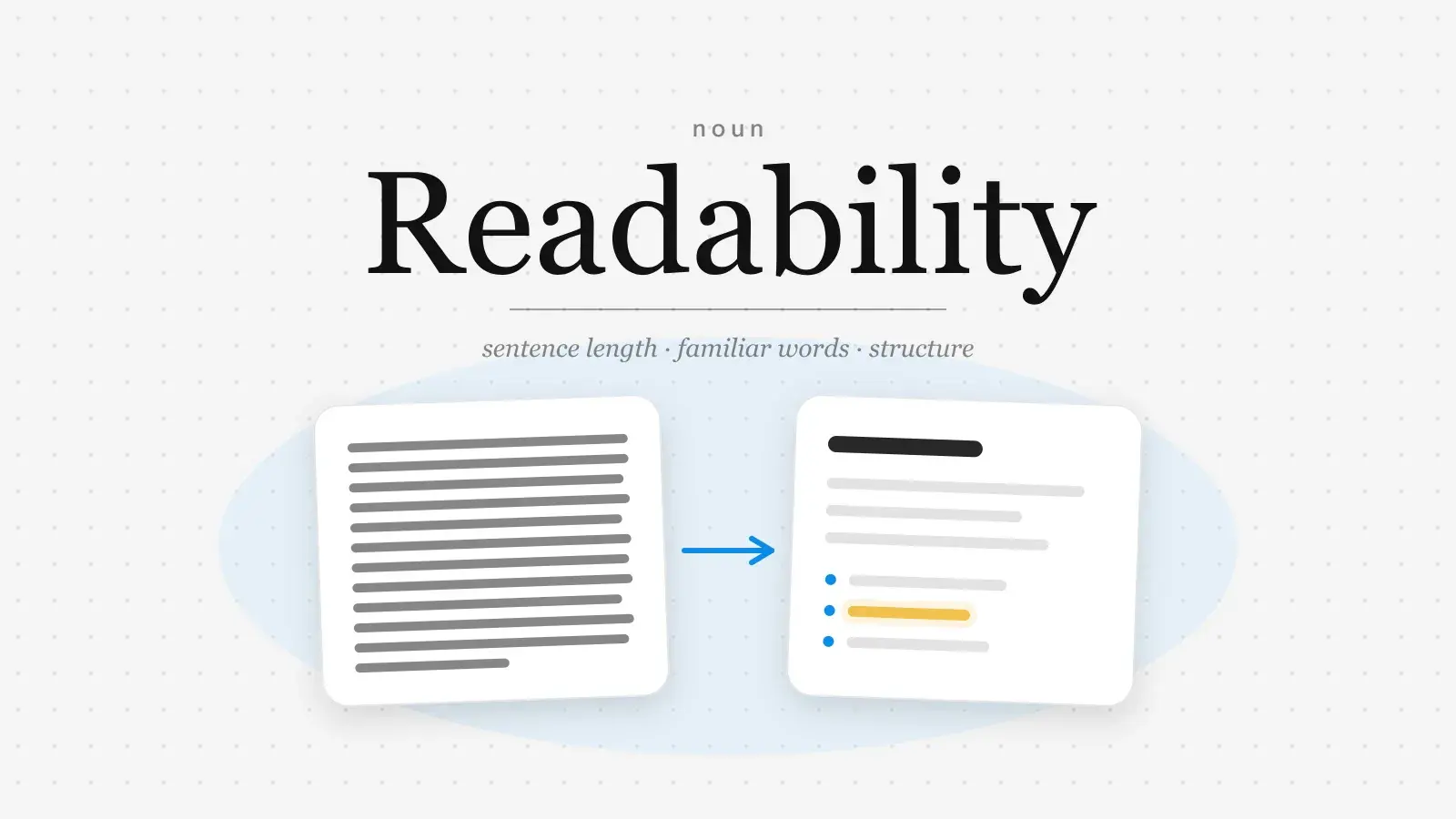
Readability is how easily a reader can get through a text and come away with its meaning. It depends on how long the sentences are, how familiar the words are and how the text is organized on the page. A readable text is not a simple one. It is one that does not make the reader work harder than the ideas require.
The word is often used to mean a number, because tools have scored readability for decades. The number is useful. It is also only part of the story.
How it is measured
Most readability scores look at two things: how many words a sentence has on average, and how long the words are, counted in syllables or checked against a list of common words. They count; they do not read.
| Score | What it counts | How to read the result |
|---|---|---|
| ScoreFlesch Reading Ease | What it countsSentence length and syllables per word | How to read the result0 to 100; higher is easier. Scores in the 60s and 70s read as plain English. |
| ScoreFlesch-Kincaid Grade Level | What it countsThe same two inputs, on a different scale | How to read the resultA US school grade; lower is easier. |
| ScoreGunning Fog | What it countsSentence length and the share of words with three or more syllables | How to read the resultYears of schooling a reader needs; lower is easier. |
| ScoreDale-Chall | What it countsSentence length and words outside a list of familiar ones | How to read the resultA grade-level style score; lower is easier. |
Because they count, the scores have blind spots. A sentence of short, familiar words in a confusing order scores well. A long sentence that flows scores badly. Headings, lists and paragraph breaks, which do more for a reader than almost anything else, are invisible to them, and so is whether the text is about anything at all. Treat a score as a smoke detector: a low Reading Ease is a reason to look, not a verdict.
What makes text readable
The levers are the ones the scores approximate, plus the ones they miss.
Reads easily
- Sentences of varied length, with few over about 25 words
- The everyday word where it means the same thing: use, not utilize
- One idea per sentence, one topic per paragraph
- A concrete subject and a strong verb: who did what
- The point first, then the qualifications
- Headings and lists that let a reader find their place
Reads slowly
- Long sentences with clauses nested inside clauses
- Abstract nouns doing the work of verbs: the implementation of, the provision of
- Several ideas packed into one sentence and left for the reader to separate
- Passive constructions that hide who acted
- Qualifications first, the point at the end
- An unbroken page with no signposts
Structure deserves more credit than it gets. Readers skim before they read, and a page with headings, short paragraphs and the occasional list tells them where they are. A long document without that scaffolding is hard going even when every sentence is fine.
Why it matters
Every extra second a reader spends untangling a sentence is a chance to stop reading. Readability is a form of respect for the reader's time, and it is good for the writer too: a sentence that resists being made plain is often a sentence whose idea is not clear yet. Making text readable is a way of finding out what you think.
Readability is not the same as tone of voice, and the two are easy to confuse. Tone is who the text sounds like; readability is how much effort it takes. A text can be plain and still sound unmistakably like you, and a formal text can be perfectly readable. The failure mode of any blunt "simplify this" instruction, whether you give it to a person or to a model, is that it flattens tone along with difficulty. You get short sentences that sound like a leaflet.
Readability in Strokes
When a paragraph has grown dense, select it, press ⌘K and ask for the specific fix rather than "simplify": split the long sentences, swap the abstractions for plain words, keep the wording where it already works, and leave the tone alone. A request like this is precise enough for a model to follow.
Ask for changes
Make this paragraph easier to read. Split any sentence over 25 words.
Replace abstract nouns with verbs where you can. Keep my phrasing
wherever it already reads well, and do not change the tone.
Because the change lands in context, with the paragraphs around it, you can read the new version where it sits and hear at once whether it still sounds like you. If it does not, ask again with a tighter instruction.
Related terms: tone of voice, style guide.