When to use it
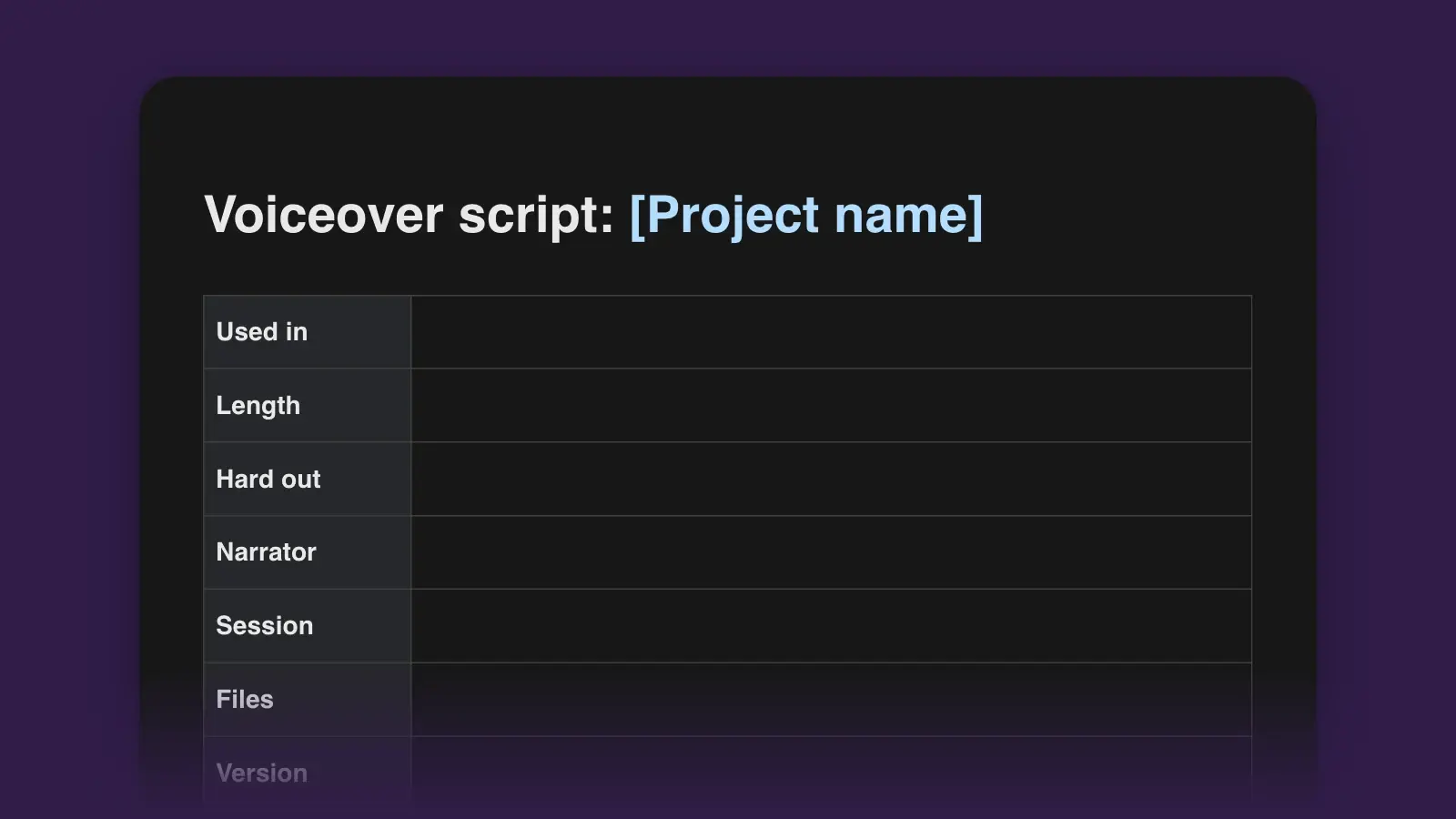
- Narration for explainer, product and training videos, recorded apart from the edit
- Radio and streaming audio spots with a hard out at 15, 30 or 60 seconds
- E-learning modules and audio guides full of names and terms to get right every time
- Phone menus and on-hold messages
- Audiobook chapters, with one pronunciation guide for the whole book
How to use this template
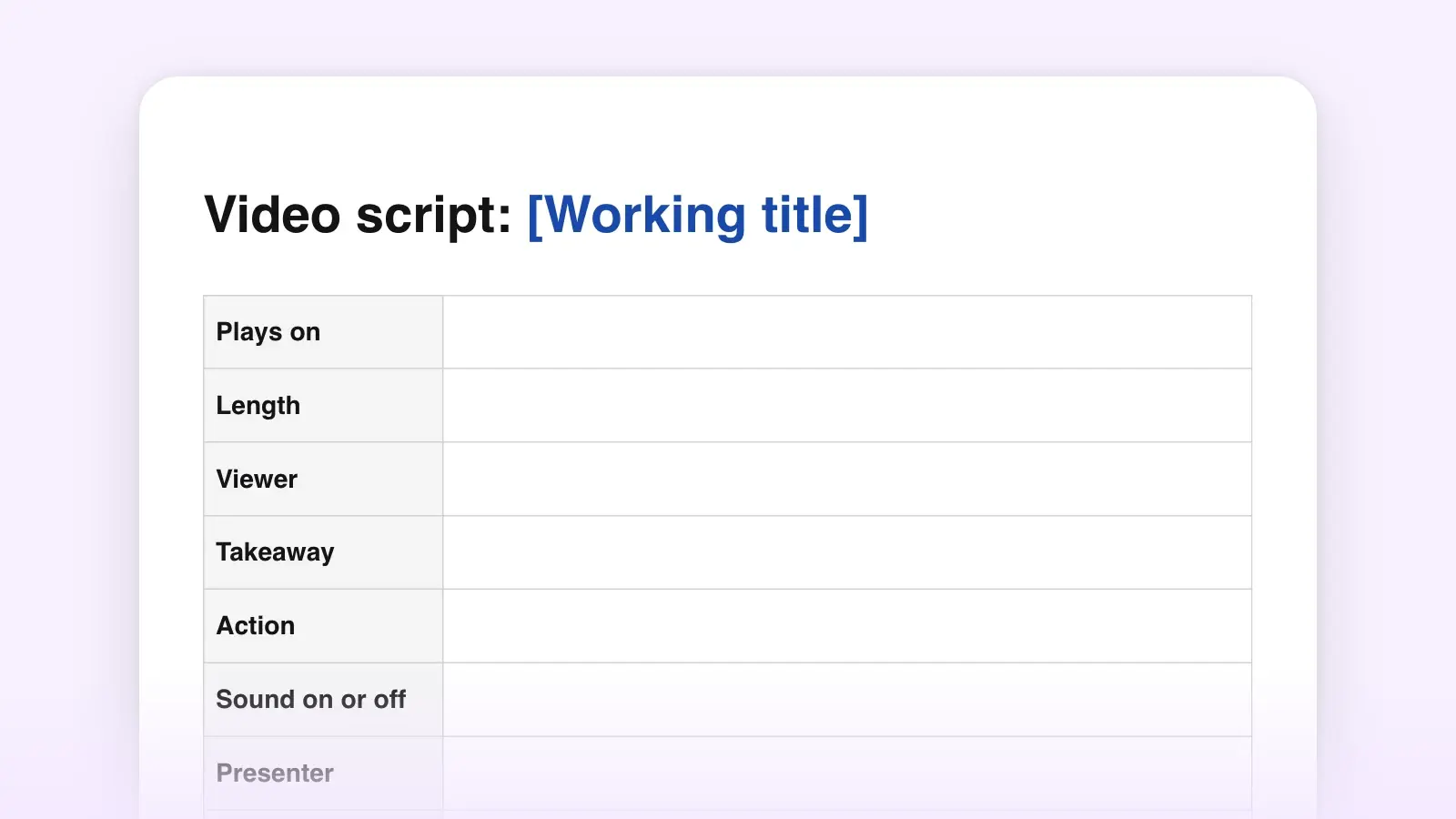
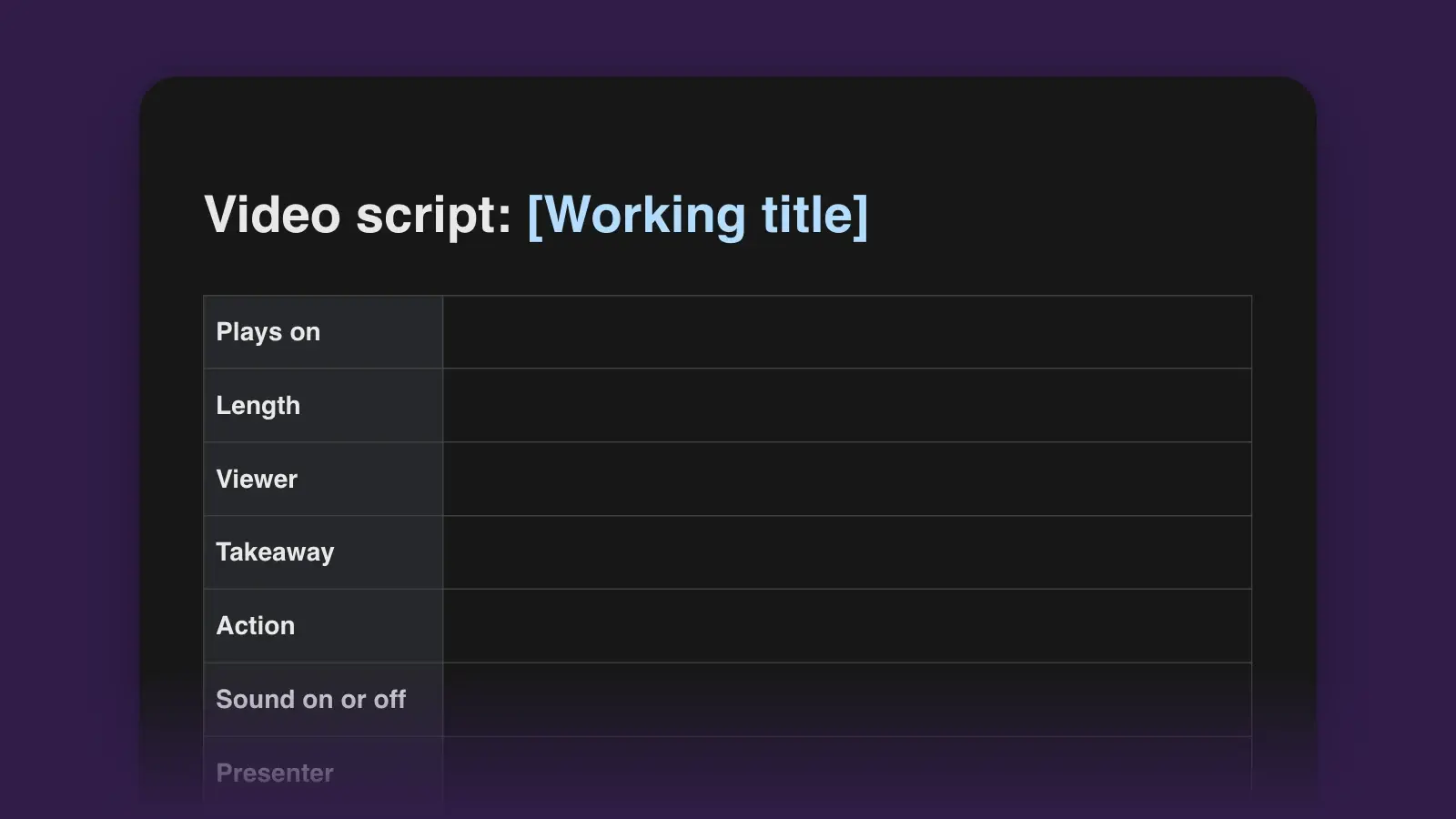
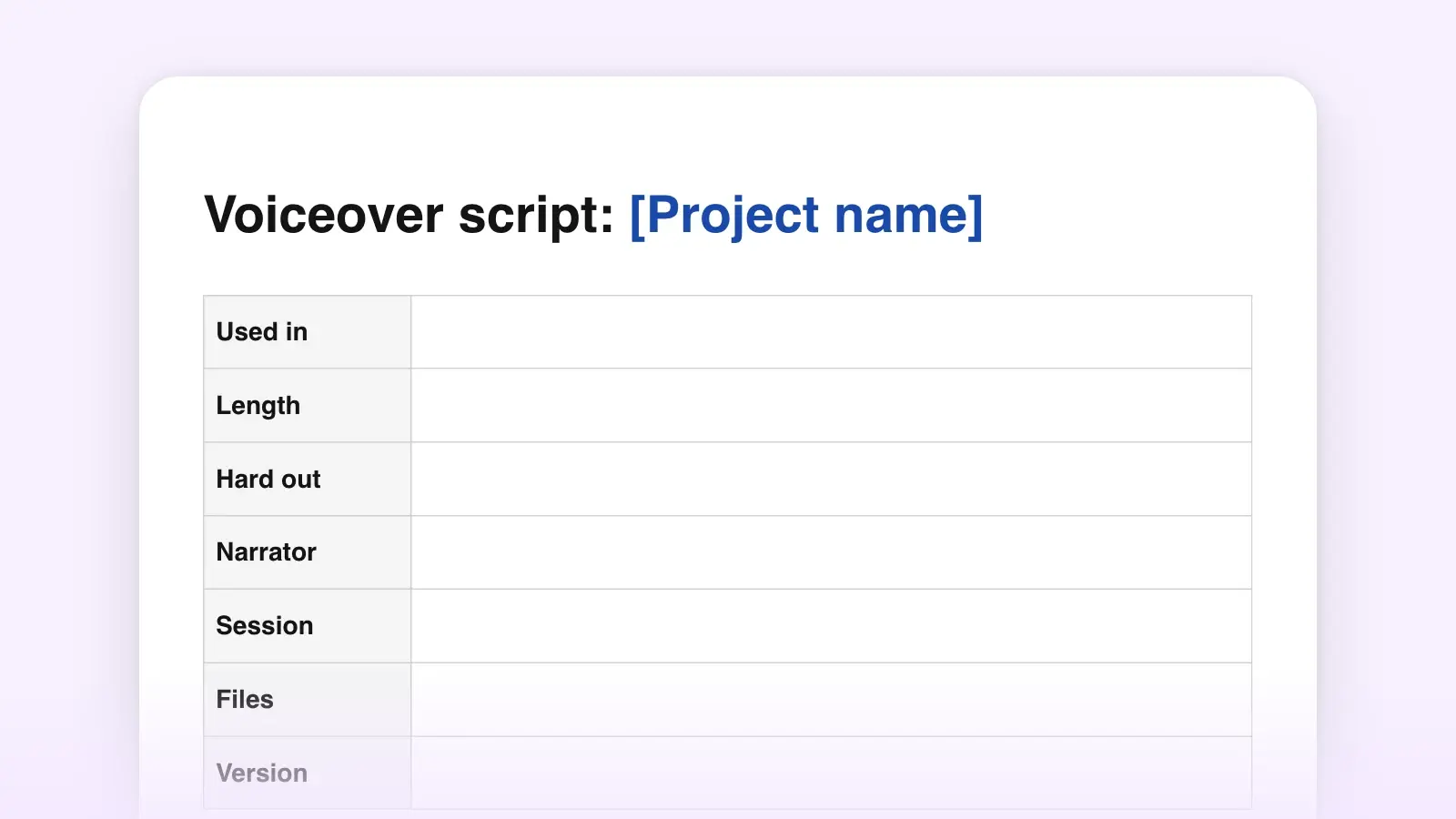
A voiceover script has one reader: the narrator at the microphone. So it carries only what they need, which is the words, how each line should sound, how to say the hard names and how long the whole thing may run. If the narration goes over a video, plan the picture first in the video script template, then copy the audio column into this one for the session.
- Write the direction before the script
Narrators read the direction first, and they read it literally. “Energetic” can mean a game-show host or a running coach; “a coach at halftime, down by three” means one thing. Describe the listener and the person the voice should sound like, and the tone of voice follows from there.
- Build the pronunciation guide as you write
Every brand, person, place, acronym and word with two accepted pronunciations gets a row. Fill in the “Checked with” column honestly, so the narrator knows which entries came from the source and which are your best guess.
- Budget seconds, then words
Split the running time across the sections in the pacing plan, then turn seconds into words with the table below. The pace note on each section tells the narrator where to slow down, which is usually wherever the listener has to do something.
- Mark it up, time it, number it
Add the pause marks and the one stressed word per line, then read the script aloud with a stopwatch and write the real times in. The numbers let anyone ask for a pickup in four words: “Line six, stress Thursday.” If you add a line later, call it 6a instead of renumbering, so earlier notes still point at the right line.
Writing a pronunciation guide
A pronunciation guide is the spoken cousin of an editor's style sheet: one decision per word, made once and kept. Broadcasters take it seriously enough to staff it. The BBC's Pronunciation Unit, a team of phoneticians, has researched names and words for anyone at the BBC since the early 1940s.
Respell each word with hyphens between the syllables and the stressed syllable in capitals, the convention Wikipedia's respelling key uses (prə-NUN-see-AY-shən). Add “rhymes with” or “not …” when the obvious reading is wrong. For people, nothing beats a ten-second voice memo of them saying their own name. Use the International Phonetic Alphabet only if your narrator reads it.
| Word | Write it as | Why it needs a row |
|---|---|---|
| WordWorcester, Massachusetts | Write it asWUSS-ter | Why it needs a rowThe spelling suggests three syllables; locals often say something closer to WISS-tuh |
| WordAoife (a first name) | Write it asEE-fa | Why it needs a rowIrish spelling that English readers guess wrong |
| WordNguyen (a family name) | Write it asAsk | Why it needs a rowFamilies say it differently; spelling won't tell you |
| Worddata | Write it asDAY-tuh or DAT-uh | Why it needs a rowBoth are correct, so pick one for the whole project |
| WordYour client's product | Write it asTheir own pronunciation | Why it needs a rowCheck their ads or ask; never guess |
How many words fit your time
Conversational American English runs at about 150 words a minute, the figure the National Center for Voice and Speech gives. Voiceover moves around that number depending on the job. Newsreaders go faster: one study of radio news measured BBC English bulletins at an average of 168. So if a 30-second script has 95 words, that is 190 a minute, faster than the news, and it will sound like the small print.
| Length | Careful (120 a minute) | Conversational (140–150) | Brisk (160) |
|---|---|---|---|
| Length0:15 | Careful (120 a minute)30 words | Conversational (140–150)35–38 words | Brisk (160)40 words |
| Length0:30 | Careful (120 a minute)60 words | Conversational (140–150)70–75 words | Brisk (160)80 words |
| Length0:60 | Careful (120 a minute)120 words | Conversational (140–150)140–150 words | Brisk (160)160 words |
| Length2:00 | Careful (120 a minute)240 words | Conversational (140–150)280–300 words | Brisk (160)320 words |
| Length5:00 | Careful (120 a minute)600 words | Conversational (140–150)700–750 words | Brisk (160)800 words |
Use the careful pace for anything the listener acts on while listening: phone menus, safety instructions, software steps in an e-learning module. Explainers, documentaries, audio guides and corporate narration sit at the conversational pace. Promos and retail spots can run brisk, but write to the low end of the column and let the narrator speed up. Squeezing a long script into a short slot is the most common reason a read sounds rushed.
A filled-in example: a library phone menu
Phone menus are voiceover at its most practical: the listener is waiting for one piece of information and holding a phone to their ear. The library and its staff are invented.
Direction: Friendly and unhurried, like the person at the front desk. Callers hear this through a phone speaker, so no music under the voice.
Say it: Aoife = EE-fa (from her own voice memo).
- Thank you for calling Fernwood Public Library. /
- We're open ten a.m. to eight p.m., / Monday through Thursday, // and ten to five on Fridays and Saturdays.
- To renew a book or check your account, / press ONE.
- For story time and other events, / press TWO.
- To reach the reference desk, / press THREE.
- To leave a message for our branch manager, / Aoife Brennan, / press FOUR.
- To hear these options again, / press NINE.
Each option comes before its number, so the caller knows whether they want it before they have to remember a digit. The hours are written the way they are said, the one name a narrator could stumble on is in the guide with its source, and the capitals land on the word the caller acts on. The last line gives them a way back.
Tips for a script that reads well aloud
- Write numbers the way they are said. “$1,250” can be read as twelve fifty, twelve hundred and fifty dollars or one thousand two hundred fifty. Choose one and write it out. The same goes for abbreviations: St. is Street or Saint, and Dr. is Doctor or Drive.
- Spell web addresses as speech. “Example dot com slash start” leaves nothing to interpret. Drop the https, and usually the www.
- Give each line one breath. If you run out of air reading a line, so will the narrator. Mark where the breath goes or split the sentence. The usual rules of readability apply twice over, because a listener can't go back and reread.
- Stress one word per line at most. When half the script is in capitals, the narrator has to guess which ones you meant.
- Time the required wording on its own. A disclaimer or legal line can't be cut to fit, so agree the exact words with whoever owns them and budget its seconds before you write the rest.
- End each printed page on a full sentence. If the narrator reads from paper, a page turn in mid-sentence ends up on the recording.
Other script templates
For a radio or TV spot, the commercial script template covers the 30- and 60-second versions. When the picture and the words have to be approved together, use the two columns of the A/V script template. For a show with hosts and guests rather than a single narrator, start from the podcast script template and the guide on how to write a podcast script.
Frequently asked questions
How many words is a 30-second voiceover?
About 60 to 80 words: 60 for a careful read, 70 to 75 at a conversational pace and 80 for a brisk spot. Leave a second or two for music or a logo at the end, and time the narrator's actual read before you lock the script.
How do you write pronunciation in a voiceover script?
Respell the word with hyphens between syllables and the stressed syllable in capitals, as in WUSS-ter for Worcester. Add a rhyme or a 'not' when the obvious reading is wrong, and for people's names attach a recording of them saying it. Use the International Phonetic Alphabet only if your narrator reads it.
What do slashes mean in a voiceover script?
They mark pauses. In this template one slash is a short pause, about a breath, and two slashes are a longer one. Studios and narrators use slightly different marks, so keep a markup key in the script that says what each one means.
Can I use this template for an audiobook?
Yes, with changes. Use one copy per chapter, since ACX, Audible's audiobook production marketplace, asks for each chapter in its own file, and keep one pronunciation guide for the whole book with every character name and invented word. The time column matters less; use the direction column for character voices and scene changes. Check the current requirements of the platform you are producing for.