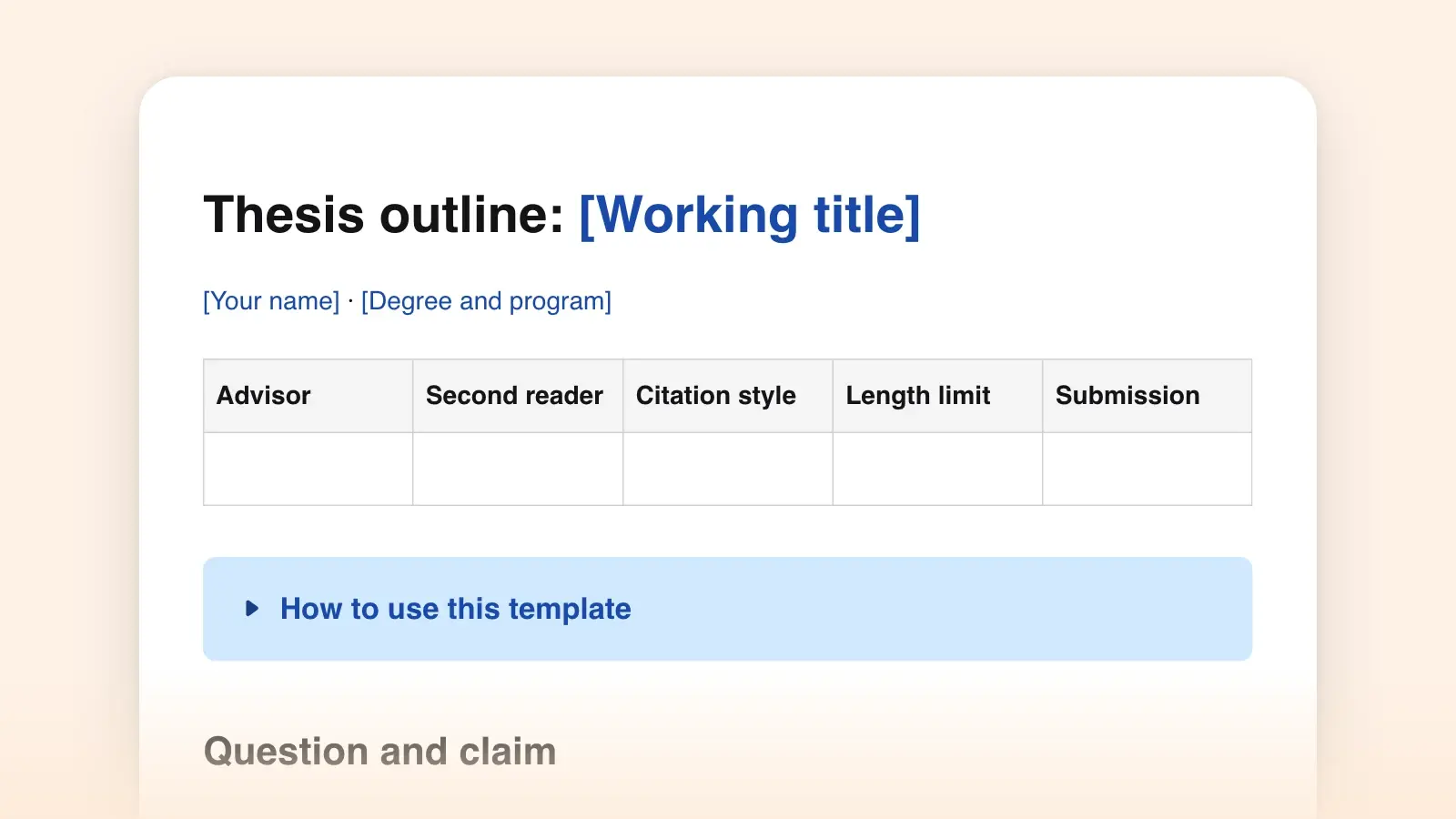
When to use it
- A master's thesis in the sciences or social sciences, organized as introduction, literature review, methods, results, discussion and conclusion
- An undergraduate honors or senior thesis that needs a plan your advisor can sign off on
- A humanities thesis built from argument-driven chapters, once you swap the middle chapters for claims
- A prospectus or committee meeting where you have to show the chapter plan
- A stalled thesis, outlined again from what is already written to see what is missing
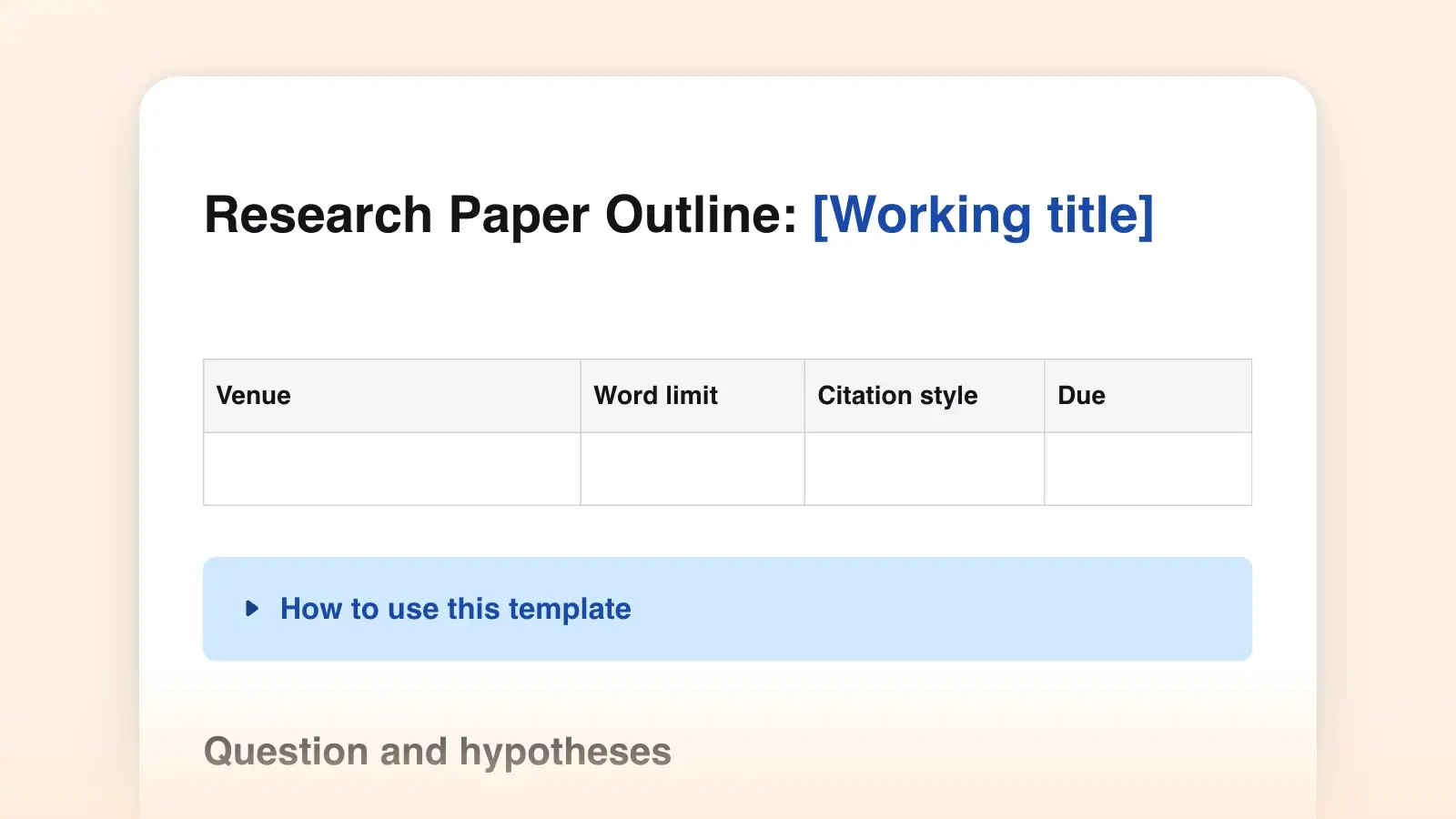
How to use this template
- Write the question and the claim first
Fill in the research question and main claim before you touch a chapter. "Bike lanes and local business" is a topic, and a thesis built on a topic sprawls because every chapter can wander off on its own. "Did retail sales change on the three streets that got protected bike lanes?" is a question with an answer, and it already hints at the chapters. The claim can be provisional, an expected finding you will test. Write it down anyway. If the question won't come, the research question examples show weak and strong versions side by side.
- Match the chapters to your field
The template uses the six-chapter shape common in empirical theses: the IMRaD order of a journal article, with a literature review and a conclusion added. Before you commit, open three recent theses from your department in your library's repository and note how they divide the chapters and how long each one runs. That tells you the local norm faster than any guide, this one included. Formatting, front matter and length limits come from your graduate school's handbook, so read it now rather than the week before submission.
- Break every chapter into numbered sections
A chapter title names a topic. The sections under it (1.1, 1.2, 1.3) show the order of the argument, and they are what an advisor can actually respond to. Write each section heading as a phrase that says what the section does, and add a sentence of content where you already know it. Fill the literature review table by debate rather than by author: each row is a question scholars disagree about, and the last column is the opening your thesis steps into. Keep an annotated bibliography as you read, and the key sources column is half done before you start it.
- Set page targets, then send it to your advisor
Fill in the writing plan, working back from the submission deadline. Page targets keep one chapter from eating the others, and dates give your advisor something to hold you to. Send the outline, with your questions, before you draft. Moving a section in an outline takes a minute. Moving it in a 60-page draft takes a weekend of rewritten transitions.
Pick the right chapter structure
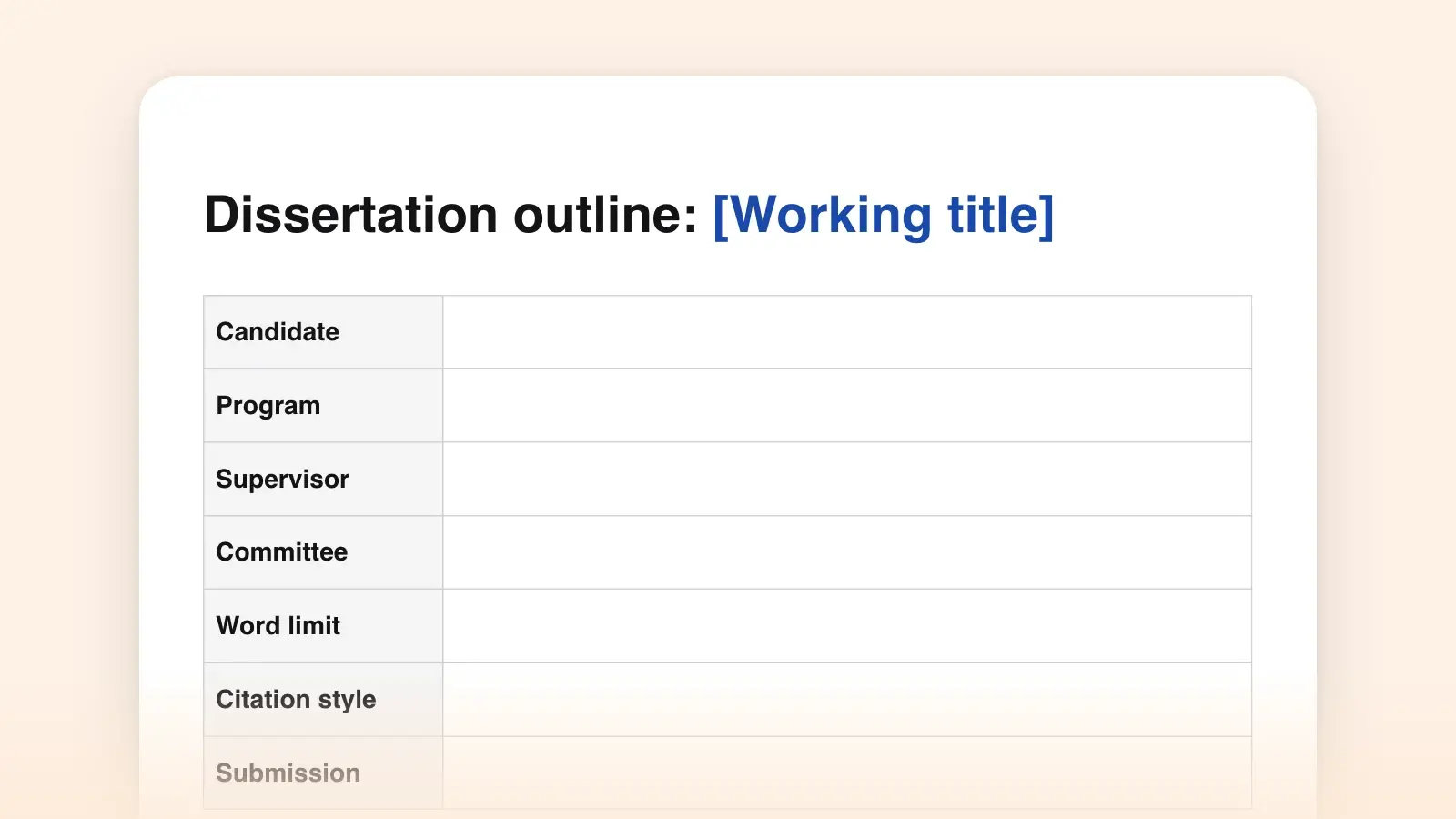
Thesis structure varies by field and by university, and some programs require one shape. These are the three you are most likely to meet. For a doctorate, the dissertation outline template covers the longer version.
| Structure | Common in | Chapters |
|---|---|---|
| StructureEmpirical | Common inSciences, social sciences, education, health | ChaptersIntroduction, literature review, methodology, results, discussion, conclusion |
| StructureArgument-driven | Common inHistory, literature, philosophy and other humanities | ChaptersIntroduction (question, argument, sources, approach), body chapters that each advance one part of the argument, conclusion |
| StructureThesis by publication | Common inPrograms that accept journal articles as chapters | ChaptersIntroduction and review, each paper as a chapter, a discussion that ties the papers together |
To adapt the template for an argument-driven thesis, keep the top sections, the front matter and the back matter, and change the middle. Fold the literature review into the introduction as a section on the scholarly conversation. Shrink the methodology chapter to a section on sources and approach. Then replace chapters 3 to 5 with one chapter per part of your argument, each titled with the claim it makes. The second example below shows the result.
For a thesis by publication, the introduction and the closing discussion do the work of turning separate papers into one argument. Check your program's rules on how many papers count, whether they must already be accepted, and how co-authored work is declared.
Front matter order is set by your graduate school. UNC Chapel Hill's thesis and dissertation guide, for one, lists the title page, copyright page and abstract first, then the optional dedication, acknowledgments and preface, then the table of contents and the lists of tables, figures, abbreviations and symbols. Your school's list may differ, so follow its guide over this template. Write the abstract last; the guide to writing an abstract covers what goes in it.
Two filled-in thesis outline examples
Both outlines are invented and filled in to the section level. The first is an empirical master's thesis; the second is an argument-driven honors thesis in English.
Working title: Lanes and Ledgers: Retail Sales Before and After Protected Bike Lanes in a Mid-Size City
Research question: Did retail sales on the three downtown streets that got protected bike lanes in 2021 change relative to similar streets that did not?
Main claim (provisional): Sales on the lane streets held steady against the comparison streets, which weakens the argument, made at three council hearings, that losing parking would hurt shops.
- Introduction. 1.1 The 2021 council fight over parking on Elm, Fifth and Harbor. 1.2 The gap: claims on both sides, no sales data. 1.3 Question and two hypotheses. 1.4 Who can use the answer: planners and business associations. 1.5 Chapter map.
- Literature review. 2.1 How street redesigns change who comes to a street. 2.2 What earlier sales studies measured, and what they missed. 2.3 Shopper surveys versus sales records. 2.4 Framework: comparing changed and unchanged streets over time.
- Methodology. 3.1 Design: a difference-in-differences comparison, 2018 to 2024. 3.2 Data: quarterly sales tax receipts by block, from the city finance office. 3.3 How the comparison streets were chosen. 3.4 Analysis, and checks on the result. 3.5 Limits: the pandemic years distort the baseline.
- Results. 4.1 Trends before the lanes. 4.2 Change after the lanes, street by street. 4.3 Restaurants versus shops.
- Discussion. 5.1 What the sales data say about the parking argument. 5.2 Where this agrees and disagrees with chapter 2. 5.3 What a planner can and cannot take from three streets.
- Conclusion. 6.1 The answer in one paragraph. 6.2 Contribution. 6.3 Next question: foot-traffic counts.
The results sections are the thinnest, on purpose. Until the analysis is done, results headings are guesses about what you will find, so keep them short and expect to rewrite them.
Working title: Owing: Debt as a Test of Character in Dickens, Trollope and Eliot
Research question: How do three Victorian novelists use debt to judge their characters?
Main claim: In all three novels, debt matters less as a plot device than as a test. What a character does about money owed shows who they are.
- Introduction. 1.1 Debt and debtors' prisons in Victorian England. 1.2 The scholarly conversation on money in the novel. 1.3 Argument and approach: close reading of three novels. 1.4 Chapter map.
- Debt as inheritance: Little Dorrit. 2.1 A family raised inside the Marshalsea. 2.2 Amy's unpaid work as the debt no one counts. 2.3 Release from prison without release from the past.
- Credit as performance: The Way We Live Now. 3.1 Melmotte's fortune as a story others agree to believe. 3.2 Borrowers who never mean to pay. 3.3 The investors who chose to believe.
- The debt no one sees: Middlemarch. 4.1 Lydgate's household bills and the shame of asking. 4.2 Bulstrode's loan and its price. 4.3 Debt as the end of a vocation.
- Conclusion. 5.1 What the three tests share. 5.2 Where the pattern breaks. 5.3 Money and judgment in later fiction.
Each body chapter is titled with a claim, not just a novel's name. A committee member who reads only the table of contents can follow the argument, which is roughly what happens the night before a meeting.
Mistakes that weaken a thesis outline
Start with the headings. A section heading that only labels gives your advisor nothing to push back on. Here are three sections from the bike lane outline next to their label-only versions:
Sections that argue
- 2.2 What earlier sales studies measured, and what they missed
- 3.3 How the comparison streets were chosen
- 5.1 What the sales data say about the parking argument
Sections that only label
- 2.2 Previous studies
- 3.3 Sample
- 5.1 Discussion of results
- A literature review sorted by author. "Smith found this, Jones found that" summarizes without arguing. Sort by debate, as the chapter 2 table does, and each section ends at the gap your thesis fills.
- Aims with nowhere to go. Trace each aim in section 1.3 forward to a method in chapter 3, a result in chapter 4 and a point in chapter 5. An aim that drops out partway gets cut, or gets the sections it is missing.
- New material in the conclusion. The conclusion answers the question and points to what comes next. A new finding belongs in the results or the discussion.
- An outline that never changes. Update it when the data surprise you and send the new version to your advisor, so the two of you are not reviewing different theses.
Frequently asked questions
What is the difference between a thesis and a dissertation?
In the US, a thesis is usually the project that ends a master's or undergraduate honors degree, and a dissertation is the doctoral one. In the UK and many Commonwealth countries the terms are reversed: a PhD produces a thesis, and taught master's and undergraduate degrees end with a dissertation. The outline works the same way for both.
Do I need a separate literature review chapter?
In most empirical theses, yes. In the humanities the review is often folded into the introduction and then argued with chapter by chapter. If recent theses from your department have no standalone review, you probably don't need one, but confirm it with your advisor.
Should I write the abstract or the introduction first?
Write the abstract last, once the findings are settled. Draft the introduction early to fix the question in your own mind, then rewrite it near the end, because the thesis you finish is rarely exactly the one you planned.
How long should a thesis outline be?
Long enough to show every chapter's sections and short enough for your advisor to read in one sitting. For most master's theses that is a few pages. Add a sentence under a section when you know what it will say, and leave it as a heading when you don't yet.