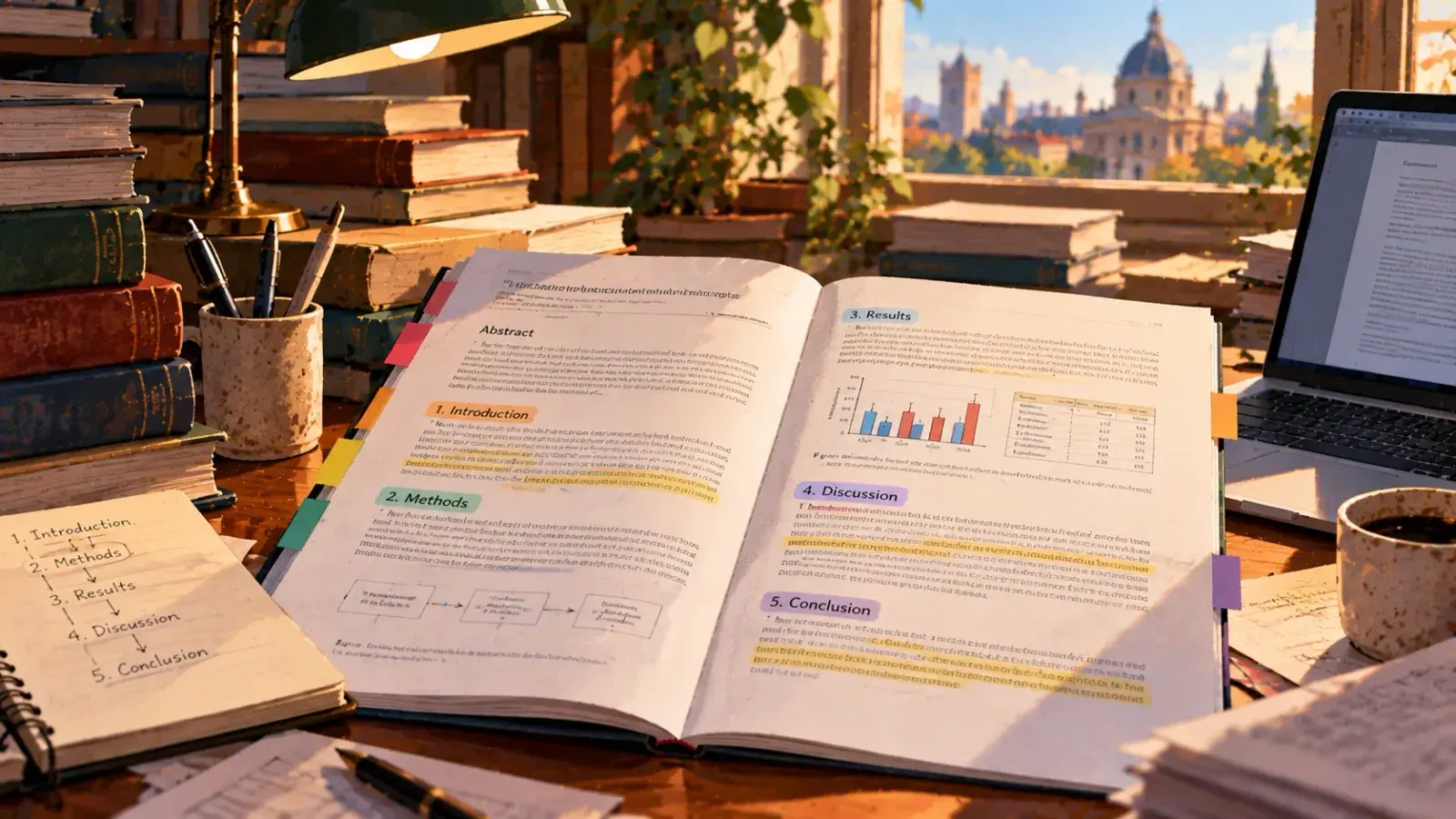
An abstract is a short, self-contained summary of a paper: usually one paragraph, capped at 250 or 300 words depending on the venue, that says what problem you studied, how you studied it, what you found and why it matters. Readers use it to decide whether to open the paper, and many databases index the abstract rather than the full text, so for many readers it is the only part of your work they see.
The six example abstracts below are original, each with a note on what it does well. A weak draft taken apart, a step-by-step method and a fill-in pattern follow.
What goes in an abstract
An abstract is a specialized kind of summary, and nearly every one makes the same five moves in the same order, whatever the field. The APA guide to abstracts suggests one or two sentences for each. The tense shifts with the move, which is one of the quickest ways to tell a practiced abstract from a first attempt.
| Move | It answers | Usual tense |
|---|---|---|
| MoveContext | It answersWhy does this matter, and what is missing? | Usual tensePresent |
| MovePurpose | It answersWhat did this paper set out to do? | Usual tensePast (a study) or present (an argument) |
| MoveMethod | It answersHow, with what sample, data or sources? | Usual tensePast |
| MoveResults | It answersWhat did you find? Numbers where possible. | Usual tensePast |
| MoveImplication | It answersSo what, and for whom? | Usual tensePresent |
The purpose sentence is usually your research question turned into a statement. If the question is still vague, the abstract will be too. The research question examples show what a focused one looks like.
Types of abstracts
The type you write depends on the work and on what the venue asks for. Most research papers need an informative abstract, and medicine and health journals usually want it structured.
| Type | Reports findings? | Typical length | Common in |
|---|---|---|---|
| TypeInformative | Reports findings?Yes | Typical lengthUp to 250–300 words | Common inResearch papers, theses |
| TypeDescriptive | Reports findings?No | Typical length100 words or fewer | Common inReviews, reports, some humanities |
| TypeStructured | Reports findings?Yes, under labeled headings | Typical lengthSet by the journal | Common inMedicine, health, many sciences |
| TypeCritical | Reports findings?Yes, plus an evaluation | Typical lengthVaries | Common inRare, close to a short review |
Informative abstracts are the default: they report results and conclusions so a reader could skip the paper and still know what it found. The UNC Writing Center notes they rarely run past 10 percent of the length of the work. Descriptive abstracts say what the work covers (purpose, method, scope) and stop there, like a table of contents in prose. That suits work without a single finding to report, such as a review essay or a long report.
Structured abstracts are informative abstracts split under labeled headings, often a version of the IMRaD sequence (introduction, methods, results, discussion). The International Committee of Medical Journal Editors (ICMJE) recommendations say original research, systematic reviews and meta-analyses require them, and that the exact format differs from journal to journal. Randomized trials have their own checklist for abstracts, CONSORT for Abstracts.
Some journals also ask for a graphical abstract, a single image that summarizes the paper and appears alongside the text abstract.
Abstract length by style and venue
There is no universal word count. The limit comes from the journal, the conference call, your graduate school or your instructor's style guide, and the first thing to do is find it.
| Style or venue | Limit | Notes |
|---|---|---|
| Style or venueAPA Style (7th ed.) | Limit250 words | NotesOne unindented paragraph on page 2; keywords line below |
| Style or venueIEEE journals | LimitUp to 250 words | NotesOne paragraph; no abbreviations, references or equations; 3–5 keywords |
| Style or venuePLOS ONE | Limit300 words | NotesNo citations; avoid abbreviations |
| Style or venueMedical journals | LimitSet by each journal | NotesStructured; trial registration number at the end |
| Style or venueThesis or dissertation | LimitSet by your school | NotesCheck the thesis manual for your degree |
| Style or venueConference | LimitSet by the call | NotesSome count characters, not words |
APA also notes that student papers do not usually need an abstract unless the instructor asks for one. If nobody gives you a limit, 150 to 250 words suits a journal-length paper. Conference abstracts follow their own rules and often stand in for a paper that does not exist yet. The conference abstract examples cover that case.
Example abstracts from six fields
Psychology: an informative abstract in APA style
Many undergraduates read assigned texts on the same phone that delivers their notifications, yet few studies have measured what those interruptions cost in comprehension of long readings. This study tested whether silencing notifications, or removing the phone altogether, during a 40-minute reading session improves comprehension and recall. Undergraduates (N = 212) at a public university were randomly assigned to read a 4,000-word history chapter with notifications on, with notifications silenced, or with the phone in another room. Comprehension was measured immediately with a 20-item multiple-choice test, and recall one week later with a free-response test. Students whose phones were in another room scored higher on immediate comprehension than students with notifications on (M = 14.1 vs. 12.3 of 20, d = 0.52). Silencing notifications without removing the phone produced a smaller gain (M = 13.0, d = 0.20). One-week recall followed the same pattern with smaller differences. The phone's presence, not only its alerts, appears to compete for attention. Instructors who assign long readings may gain more by asking students to leave phones elsewhere than by asking them to switch notifications off.
Keywords: reading comprehension, smartphones, notifications, attention, undergraduates
Why it works. The first sentence names a gap, not a trend. Design, sample size and measures fit in three sentences, and the results give means and effect sizes rather than "improved significantly." The last sentence tells a specific reader, instructors, what to do differently.
Public health: a structured abstract
Background: Flu vaccination rates among university students are low, and text reminders are cheap to send, but evidence on their effect in campus clinics is mixed.
Objective: To test whether text-message reminders increase flu vaccination among students at a university health clinic.
Methods: In a randomized controlled trial during one fall term, 3,000 undergraduates not yet vaccinated by October 1 were assigned to no message, one reminder, or three weekly reminders with a booking link. The primary outcome was vaccination at the campus clinic by December 15, taken from clinic records.
Results: Vaccination rates were 18.2% with no message, 22.9% with one reminder and 26.4% with three reminders (difference between three reminders and none, 8.2 percentage points; 95% CI, 4.6 to 11.8). The booking link was used for 61% of appointments made after a message.
Conclusions: Repeated reminders with a direct booking link raised vaccination by about 8 percentage points at almost no cost. Campus clinics could send them before each flu season.
Trial registration: [Registry name and number]
Why it works. The headings make it impossible to skip a move. The primary outcome is defined before the results, the key comparison comes with a confidence interval, and the registration line sits at the end, where the ICMJE recommends it.
Literature: a humanities abstract
Critics have debated the two endings of Charles Dickens's Great Expectations since John Forster printed the original in his biography of Dickens, usually asking which is truer to the novel. This essay sets that question aside and reads both endings against the weekly installments of All the Year Round, where the novel first appeared between December 1860 and August 1861. Weekly publication taught readers to expect each part to close on a turn, and Pip's narration repeatedly withholds what the older Pip already knows. Read in that rhythm, the revised ending, written after Edward Bulwer-Lytton objected to the first, is less a concession to sentiment than one last withheld outcome. The essay argues that serial form, not only Bulwer-Lytton's advice, explains why the published ending sounds uncertain, and that judging the endings by realism misses how the novel trained its first readers to read.
Why it works. No numbers, but the same moves: an existing debate, a new angle on it, the material, the claim, and what it changes for other critics. The argument is stated outright. An abstract that says only "this essay explores the endings" is descriptive by accident.
Computer science: an IEEE-style abstract
Large documentation sets drift: the same feature is called by different names on different pages, which confuses readers and weakens search. Existing style checkers flag only terms listed in advance. This paper presents a method that finds inconsistent terminology without a predefined list, by clustering noun phrases on their meaning and surrounding context and ranking clusters by how often the variants appear together in one documentation set. We evaluated the method on three open-source projects totaling 4,800 pages, against labels from two technical writers. It found 71% of the inconsistencies the writers identified, with a precision of 0.64. A checker using each project's own glossary found 38%. Most false positives were legitimate distinctions, such as a software component and the concept it implements. The method needs no training data and runs in under ten minutes per project on a laptop, so documentation teams can run it before each release.
Why it works. It follows IEEE's rules: one paragraph, no abbreviations, no references. The comparison with the existing approach is what makes 71% meaningful, and the line about false positives tells a skeptical reader what to expect.
History: a descriptive abstract
This review surveys research since 1990 on how ordinary households in nineteenth-century Britain used letter-writing manuals. It groups the literature into three approaches: studies of how the manuals were printed and sold, social histories that compare their model letters with surviving family correspondence, and literacy research that treats them as evidence of who was learning to write. It then sets out questions the field has left open and proposes archival sources for answering them.
Why it works. A reader learns the scope, period and organization, enough to decide whether the review is relevant, but not what it concludes. An informative version would add a sentence such as "Most studies find that…" and name the open questions.
Environmental science: a thesis abstract
Urban trees cool streets in summer, but most city planting programs place trees where residents request them or where space allows, not where heat is worst. This thesis asks whether tree canopy explains differences in summer surface temperature between neighborhoods in a mid-sized U.S. city, and whether canopy is distributed in a way that leaves lower-income neighborhoods hotter. Chapter 2 combines canopy maps from aerial imagery with summer satellite surface temperatures for 118 census tracts. Chapter 3 models temperature as a function of canopy while controlling for paved surface, building density and distance to water. Each 10-percentage-point increase in canopy cover was associated with surface temperatures 1.1 °C lower on clear afternoons. Tracts in the lowest income quartile had a median canopy cover of 14%, against 31% in the highest, and were on average 2.4 °C hotter. Chapter 4 draws on interviews with nine forestry and planning staff, who described request-based planting as a main reason canopy follows income. The thesis concludes that the current policy is likely to widen the temperature gap, and Chapter 5 proposes a heat-weighted priority list that would send 60% of new trees to the hottest third of tracts. The findings are limited to surface rather than air temperature and to a single city, but the method relies on public data and can be repeated elsewhere.
Why it works. Thesis abstracts can run longer and often walk through the chapters, which helps examiners and later readers find the part they need. This one still leads with the problem, gives the numbers and names its limits in the last sentence. For the larger project, see the stage-by-stage guide to writing a dissertation.
A weak abstract, revised
Here is the kind of draft that the psychology example above started as. Every sentence in it is grammatical, and almost none of it is useful.
In today's digital age, smartphones have become an important part of students' lives. Many researchers have studied the effects of technology on learning (Author, 2018; Author & Author, 2020). This study will examine the relationship between phones and reading. Participants completed a reading task under different conditions. The results are discussed, and implications for educators are considered.
- The opening could start any paper on the topic. Replace it with the specific gap your study fills.
- Citations belong in the introduction. Many journals, IEEE and PLOS ONE among them, do not allow references in the abstract at all.
- "Will examine" describes a study not yet done. Use the past tense for what you did.
- The method has no design, sample or measure. A reader cannot judge the result without them.
- "The results are discussed" withholds the one thing readers came for. Give the finding and its size.
Fix all five and you arrive at the psychology abstract above.
How to write an abstract, step by step
- Finish the paper first
You cannot summarize what is not settled. A rough abstract early on can keep you focused, but write the real one from the final draft, after the results and discussion stop changing. If you are still structuring the paper, start from a research paper outline.
- Write one sentence per move
Reverse-outline the paper: one sentence each for context, purpose, method, main result and implication. Good sources are the last paragraph of your introduction, the first of your methods, your key table and the opening of your discussion. Lifting sentences is fine for a first draft. Then paraphrase them so they read as one paragraph rather than five fragments.
- Put the numbers in
Name the design and the sample size. Report the main result as a figure, a comparison or a clear claim. In the humanities, state the argument as plainly as you would in a thesis sentence.
- Cut to the limit
Delete general background, citations, definitions and abbreviations you use only once. Keep the method details a reader needs to trust the result. If you are still over, merge the context and purpose sentences.
- Check it against the paper
The ICMJE notes that information in abstracts often differs from the body of the paper. Check that every number and claim in the abstract appears in the text, with the same values, and that nothing in the abstract is new.
- Choose keywords a searcher would type
APA's guide suggests keywords for the topic, the population and the method. Prefer terms that are not already in your title, including common synonyms, since the title is indexed anyway.
A pattern to start from, then rewrite in your own words:
Abstract pattern
[Topic] matters because [problem]. [What is known], but [gap]. This [study / paper / thesis] [tested / examined / argues] [purpose]. [Design, sample or sources]. [Main result, with its number]. [Second result or limitation]. These findings suggest [implication] for [who].Drafting and checking in Strokes
If you write the paper in Strokes, the abstract can be checked against everything else you wrote. Add the paper to an AI Assistant chat as context and ask it to list every claim or number in the abstract that it cannot find in the body. It says when it cannot verify something, and you decide what to change. Select a sentence and press ⌘K to tighten it, keep earlier drafts in version history, and export to Word or PDF when your journal or graduate school wants a file.
Frequently asked questions
How long should an abstract be?
Follow your venue. APA Style and IEEE journals cap abstracts at 250 words and PLOS ONE at 300, while theses and conference calls set their own limits. With no instructions, 150 to 250 words suits a journal-length paper.
Do student papers need an abstract?
Usually not. APA's guide says abstracts are not typically required for student papers unless the instructor asks for one. If your assignment requires an abstract, follow APA's 250-word limit unless you are told otherwise.
What tense should an abstract be written in?
Use the past tense for what you did and found (participants read, scores rose) and the present tense for established knowledge and for your conclusions (these results suggest). Humanities abstracts usually stay in the present tense throughout.
What is the difference between an abstract and an introduction?
The abstract summarizes the whole paper, including the results, and has to stand alone. The introduction sets up the problem and the gap, cites earlier work and leads into the method. In most fields it leaves the detailed results for later sections.
Can I cite sources in an abstract?
Generally no. Many journals, including IEEE journals and PLOS ONE, do not allow references in the abstract. If your paper responds to one specific work, name the author in the sentence instead of adding a citation.