When to use it
- Empirical papers for psychology, biology, nursing or social science courses
- Lab reports and capstone projects that report one study
- Journal manuscripts, before you format them to the author guidelines
- Conference papers and posters that present a study in a fixed order
- A thesis or dissertation chapter built around a single study
How to use this template
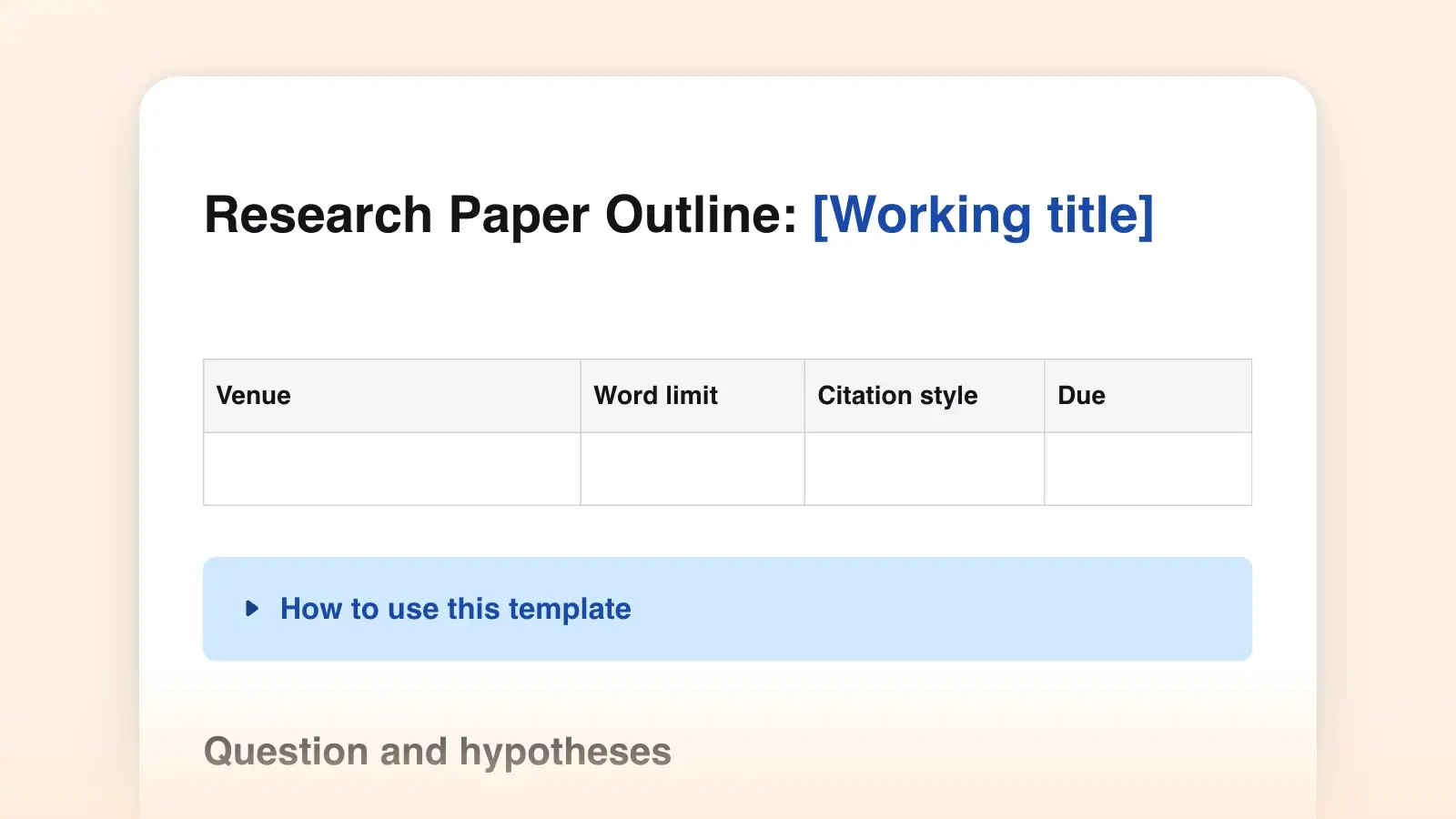
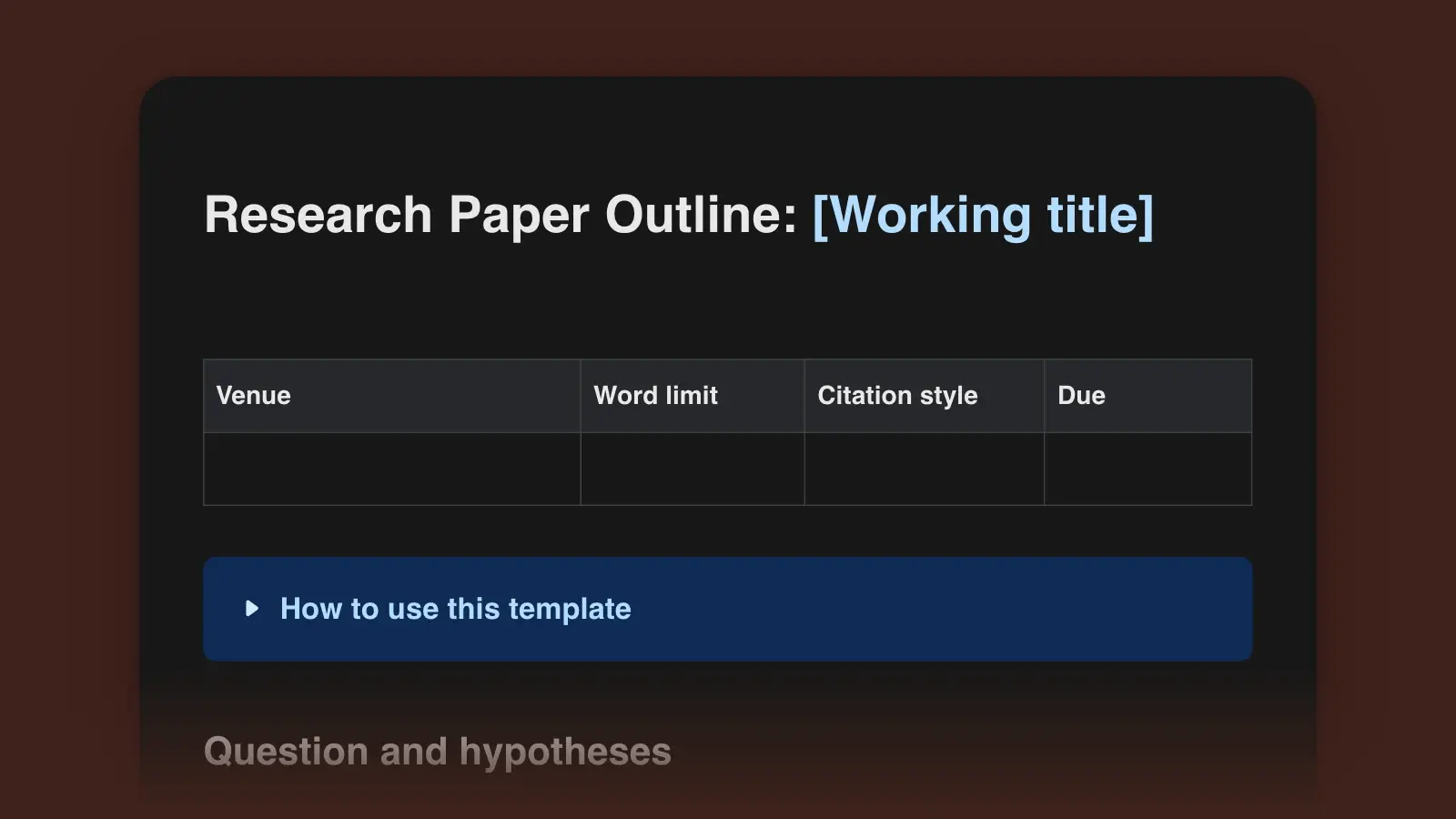
The outline follows IMRaD: Introduction, Methods, Results and Discussion, with a plan and an abstract in front and references at the end. Fill it in a different order from the one it reads in.
- Write the question before anything else
A topic cannot be answered. A question can. "Freewriting in composition classes" is a topic. "Does a ten-minute freewrite before drafting change how much students write, and how well?" is a question with a method built into it. Put it under Plan with the word limit and citation style, since both limit everything below. If you are stuck, these research question examples show what narrows a topic into one.
- Outline Methods and Results next
They record what you did and what you found, so they are the easiest sections to outline and the hardest to fudge. Fill one results row per hypothesis before you write a word of the introduction. A row you cannot fill is a hypothesis you did not test, and it should come out now rather than in revision.
- Build the introduction backward from the gap
The first three numbered lines move from what is known to what is missing to what this study does. The linguist John Swales described that pattern in Genre Analysis (1990) as the CARS model, for Create a Research Space. Cite two or three sources per line and paraphrase them. Long quotations in an introduction read as padding.
- Write the abstract and title last
Once the results table is full, the abstract is a summary of the outline: one sentence per bullet. APA abstracts are typically no longer than 250 words, and journals set their own limits. How to write an abstract covers the form in detail.
Research paper outline example
Here is the template filled in for a small classroom study. The study, its numbers and its findings are invented to show the form; the one reference is real. Notice how each section answers the one before it.
Working title: Freewriting Before Drafting: Effects on Draft Length and Quality in First-Year Composition
Research question: Does a ten-minute freewrite before an in-class drafting session change how much students write and how well?
Hypotheses: H1, students who freewrite first write longer drafts. H2, their drafts score higher on the course rubric.
I. Introduction
- Known: freewriting, which Peter Elbow championed in Writing Without Teachers (1973), is standard advice in composition courses.
- Missing: no data from this course on whether the warm-up its instructors already use changes the draft that follows.
- This study: compare two sections of the course, with and without the warm-up.
II. Methods
- Design: two intact sections, same instructor, same prompt, same 40-minute drafting session.
- Participants: 41 consenting students (21 warm-up, 20 comparison).
- Procedure: the warm-up section freewrote on the prompt for ten minutes; the comparison section reread the assigned essay for ten minutes.
- Measures: words per draft; rubric score from 1 to 6, given by two raters who did not know which section a draft came from.
- Analysis: independent-samples t tests; agreement between the two raters.
- Ethics: approved by the university's review board; written consent.
III. Results
- H1 supported: warm-up drafts were longer (Table 1).
- H2 not supported: rubric scores did not differ reliably (Table 2).
- Unplanned: raters marked more off-topic paragraphs in warm-up drafts.
IV. Discussion
- Answer: the warm-up raised quantity but not quality in one class period.
- Explanation: freewriting may lower the cost of starting, while quality needs revision time the session did not include.
- Limitations: two sections, no random assignment, one prompt, one session.
- Next study: random assignment and a second session for revision.
V. Conclusion — one paragraph: question, answer, and what instructors might try next.
References — Elbow, P. (1973). Writing without teachers. Oxford University Press.
The unsupported hypothesis stays in. A result that goes against you is still a result, and the discussion is where you explain it. To see the same shape written out as prose, read this annotated research paper example.
IMRaD or another structure
IMRaD fits any paper that reports new evidence. Papers that argue from existing sources need a different spine.
| Paper | Outline it as | Notes |
|---|---|---|
| PaperExperiment, survey, lab report | Outline it asIMRaD | NotesUse this template as it is |
| PaperInterview or qualitative study | Outline it asIMRaD, with results grouped by theme | NotesQuotes are the evidence. Some fields call the section Findings |
| PaperLiterature review | Outline it asIntroduction, themed sections, gaps, conclusion | NotesA systematic review adds a Methods section for the search |
| PaperHumanities research paper | Outline it asThesis, then one section per claim | NotesUse an essay outline instead |
For the last row, the essay outline template has the claim, evidence and counterargument slots a history or literature paper needs. Whatever the structure, check your style guide before you set the headings: APA, for example, titles the second section Method and puts the paper's title, not the word Introduction, above the introduction.
What a strong outline looks like
Specific
- Question: does a ten-minute freewrite change draft length and quality?
- Results: H2 not supported, rubric scores did not differ (Table 2)
- Limitation: two intact sections, no random assignment
Vague
- Topic: freewriting
- Results: talk about the data
- Limitations: small sample
- Write lines as claims, not labels. "Rubric scores did not differ" can become a sentence in the draft. "Scores" cannot.
- Give every table and figure a line. Number them in the order the text will mention them, so the results section has an order before you draft it.
- Keep interpretation out of Results. If a line says why, it belongs in the Discussion. Methods and Results are written in the past tense; they describe what already happened.
Frequently asked questions
How is a research paper outline different from an essay outline?
An essay outline is built around a thesis and the arguments for it. A research paper outline is built around a question and the evidence you collected, so it has Methods and Results sections that an essay does not. Humanities research papers sit in between and usually follow the essay shape.
How long should a research paper outline be?
Long enough that every planned paragraph, table and figure has a line. For a course paper that is often one or two pages; a journal article or thesis chapter needs more. If a section of the outline has one line, the section in the paper will be thin too.
Does a research paper need an abstract?
Journal articles almost always do. APA student papers usually include one only when the instructor asks. Keep the abstract lines in the outline anyway: if you cannot fill them in one sentence each, the study is not yet clear to you.
Should the outline use Roman numerals?
Only if your instructor asks for a formal outline. The traditional sequence is Roman numerals, capital letters, Arabic numerals, then lowercase letters. A decimal outline uses 1, 1.1 and 1.1.1 instead. The template uses headings and lists, which become the paper's headings when you start drafting.