When to use it
- A standalone annotated bibliography assignment in APA or MLA style
- The source list a supervisor approves before you draft a research paper or thesis
- Reading notes for a literature review, written one source at a time
- Research for a nonfiction book or long article, where you need to remember why each source matters
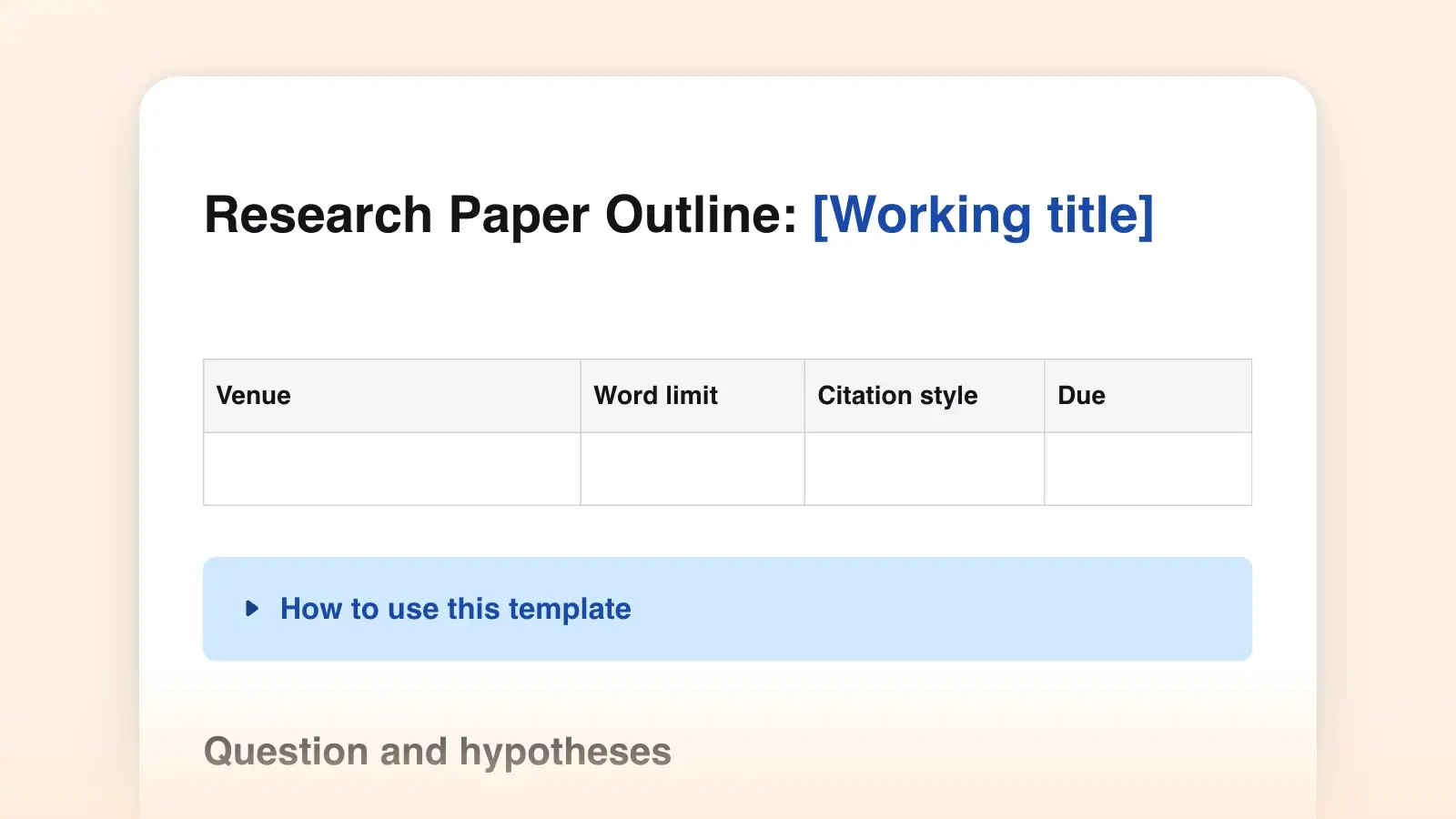
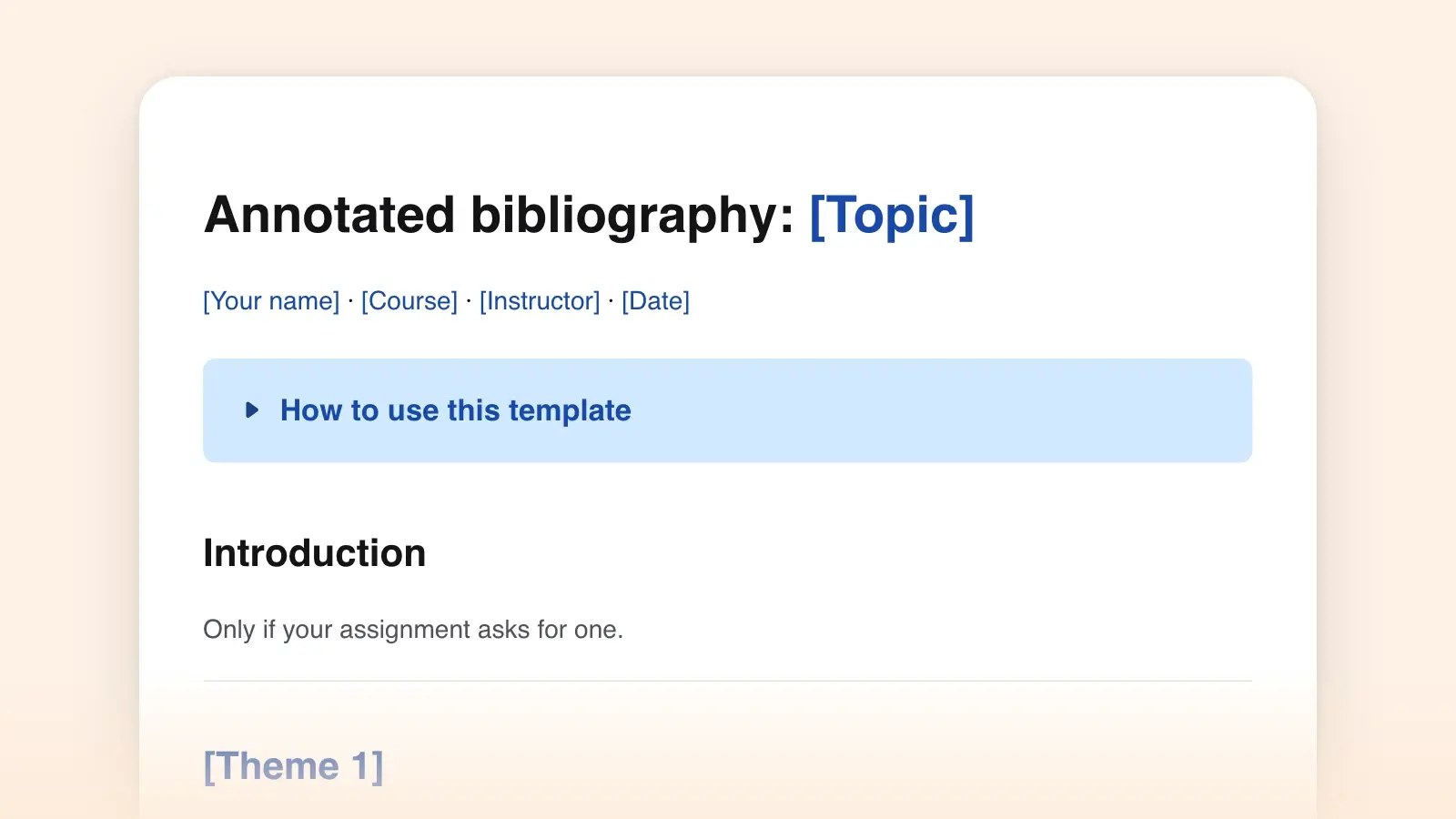
How to use this template
- Read the assignment, then set the scope
Find four things before you open a database: the citation style, the number of sources, the annotation length, and whether annotations must evaluate or only describe. Then put your research question in the title. The question decides what makes the list. A good source that does not help answer it belongs in someone else's bibliography.
- Cite each source while it is open
The moment you decide to keep a source, copy every detail the citation needs: all the authors, the year, the full title, the volume, issue and page range, and the DOI. Going back for a missing issue number the night before the deadline is slow and entirely avoidable. Fill in a row of the reading notes table at the same time, while the argument is fresh.
- Write the annotation in three moves
Replace the three bracketed placeholders, summary, evaluation and use, with your own sentences. When all three are filled, they read as one paragraph and no labels are left to delete. Write the summary with the source closed: it tests whether you understood it, and it keeps you from paraphrasing so closely that the author's sentences end up in yours.
- Order, format and check
Alphabetize by the first author's surname, which both APA and MLA use by default. If your instructor allows grouping, keep the theme headings and alphabetize within each. Set the indents described below, work through the checklist at the end of the template, then delete the reading notes and the checklist.
What goes in an annotation
An annotation is a short paragraph that follows the citation and tells a reader what the source says and how much it is worth. Cornell University Library's guide puts the typical length at about 150 words. Purdue's Online Writing Lab allows anything from two sentences to two pages, depending on the purpose, so check your assignment first. Assignments also use different names for the kind of annotation they want:
| Type | What it does | Usually asked for when |
|---|---|---|
| TypeDescriptive (indicative) | What it doesSays what the source covers, without its findings | Usually asked for whenYou survey a field quickly |
| TypeSummary (informative) | What it doesStates the argument and the findings | Usually asked for whenThe prompt says "summarize" |
| TypeEvaluative (critical) | What it doesSummarizes, then judges authority, evidence and bias | Usually asked for whenThe prompt says "analyze" or "assess" |
| TypeCombination | What it doesSummary, evaluation and how you will use it | Usually asked for whenMost course assignments |
The template defaults to the combination, because it covers the other three: delete the evaluation and use sentences if all you need is a summary. For each move, ask:
- Summary. What does the source claim? On what evidence or method? Over what period, place or group of people?
- Evaluation. Who wrote it, from what position, and for whom? Does the evidence carry the claim? What is missing or slanted, and how does it compare with another source on your list?
- Use. Which part of your argument does it support, complicate or give background to? Name the section if you can.
An annotation is not an abstract. An abstract describes a work on its author's terms; an annotation adds your judgment of it. If you need to write an abstract instead, see our guide to abstracts.
Annotated bibliography examples
Two original sample entries for a paper on how reporters and novelists pushed American housing and food reform around 1900. Both books are in the public domain, so you can read them and check the annotations against the text.
Riis, J. A. (1890). How the other half lives: Studies among the tenements of New York. Charles Scribner's Sons.
Riis, a New York police reporter, describes life in the tenements of Manhattan's Lower East Side, combining street-level reporting with official figures and pictures made from photographs. Chapters move through neighborhoods, immigrant groups and problems, from back-alley tenements to homeless children, and the book ends with what had been done and what remained. As firsthand evidence of conditions in 1890 it is vivid and specific, but it is not neutral: Riis describes several immigrant groups in stereotypes a paper should examine rather than repeat, and his numbers are worth checking against the records he drew on. I use it in my second section as the model of reform journalism that paired numbers with images, and as a contrast with Sinclair, who chose fiction to make a similar case.
Sinclair, Upton. The Jungle. Doubleday, Page, 1906.
Sinclair's novel follows Jurgis Rudkus, a Lithuanian immigrant, and his family through the stockyards and packing plants of Chicago, where injury, debt and corruption wear them down until Jurgis finds hope in socialism. Sinclair researched the plants in person, but this is a novel written to persuade, so it cannot serve as evidence of what happened inside any one plant; for that, I rely on the federal inspection reports from 1906. What it does show is how a story reached a mass audience. Readers fixed on the scenes of contaminated meat more than on the workers, and Congress passed the Meat Inspection Act within months. I use it in my third section, on persuasion, beside Riis.
Notice what each annotation does that a summary would not. The first names a weakness in the evidence. The second says what the source cannot be used for, which is the most useful sentence in it.
APA and MLA format at a glance
Both styles format the list like a reference list or works-cited page and add the annotation below each citation. The differences are small but graders notice them. Purdue's Online Writing Lab gives the annotation indents; the MLA Style Center gives the MLA titles. Your instructor's instructions override all of it.
| Rule | APA 7 | MLA 9 |
|---|---|---|
| RulePage title | APA 7Annotated Bibliography, or what your instructor asks for | MLA 9Annotated Bibliography or Annotated List of Works Cited |
| RuleOrder | APA 7Alphabetical by first author's surname | MLA 9Alphabetical by the first element, usually the surname |
| RuleCitation indent | APA 7Hanging, 0.5 in. | MLA 9Hanging, 0.5 in. |
| RuleAnnotation indent | APA 70.5 in. from the left margin | MLA 91 in. from the left margin |
| RuleSpacing | APA 7Double, throughout | MLA 9Double, throughout |
| RuleAuthor names | APA 7Surname and initials: Riis, J. A. | MLA 9Full name: Sinclair, Upton |
| RuleTitles of books | APA 7Italic, sentence case | MLA 9Italic, title case |
| RuleAnnotation form | APA 7Full sentences in paragraphs | MLA 9Phrases or full sentences |
Setting the indents in Word and Google Docs
The downloads keep the structure, not the indents, so set them once the entries are in. In the .docx file in Word, select a citation, open the Paragraph dialog from the Home tab, and under Indentation choose Special: Hanging, By: 0.5". Select an annotation and set Left to 0.5" for APA or 1" for MLA, with Special set to none. Set line spacing to Double in the same dialog. In Google Docs, the same settings are under Format, Align & indent, Indentation options. With a long list in Word, save the two settings as paragraph styles and apply each with one click.
Weak and strong annotations
A strong annotation sentence could only describe one source. A weak one fits every source on the list and tells the reader nothing.
Specific
- Documents tenement life on the Lower East Side through reporting, official figures and photographs.
- Written by a police reporter who knew the district, though his portraits of immigrant groups lean on stereotype.
- Supports section 2: pairing numbers with images as a reform strategy.
Vague
- This book is about poverty in New York.
- The author knows a lot about the topic.
- This source was very helpful for my research.
If the bibliography is the first step toward a longer paper, carry the use sentences straight into a research paper outline: each one already says where its source belongs.
Frequently asked questions
How long should an annotation be?
Follow the assignment first. Without one, about 150 words in a single paragraph is a common default; Cornell University Library's guide uses that figure. Descriptive annotations can be two sentences, and evaluative ones for a thesis can run to several paragraphs.
What is the difference between an annotated bibliography and a literature review?
An annotated bibliography treats each source on its own: a citation, then an annotation, usually in alphabetical order. A literature review is an essay that groups sources by theme or debate and argues what they add up to. The bibliography often comes first and becomes the notes the review is written from.
Can I organize an annotated bibliography by theme?
Yes, if your instructor allows it. Give each theme a heading and keep the entries alphabetical within it. The default in both APA and MLA is a single alphabetical list, so delete the theme headings in the template if you are not told otherwise.
Should an annotation quote the source?
Rarely. The value of an annotation is your summary and your judgment, in your words. If a phrase is essential, keep it short, put it in quotation marks and add the page number.