When to use it
- Planning a doctoral dissertation before the proposal or prospectus meeting
- Master's and undergraduate dissertations built on the introduction-to-conclusion chapter model
- Agreeing on a chapter plan and draft deadlines with a supervisor or committee
- Reverse-outlining a draft that grew without a plan, to see what is missing
- Article-based dissertations, with each paper outlined as its own chapter
How to use this template
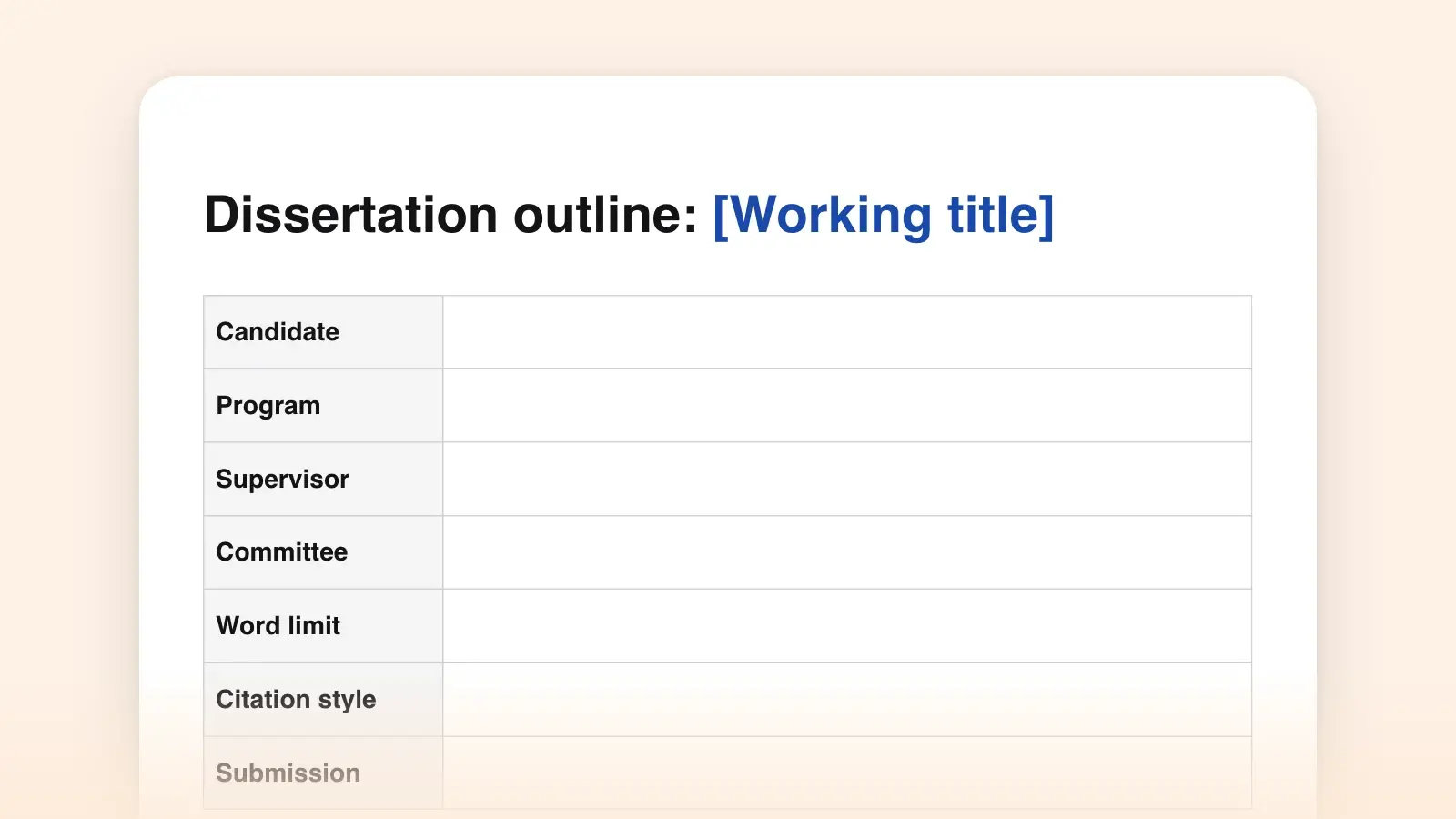
- Fill in the top block before any chapter
"At a glance" is the whole dissertation in eight lines. If you cannot yet write the main question or the contribution as a single sentence, outlining chapters is premature. Work on the question first (these research question examples show the difference between a topic and a question), then take the block to your supervisor.
- Outline each chapter as claims, not topics
Turn every bullet into a sentence that says something, and attach two or three sources in author-year form as you go. Keep your reading notes in an annotated bibliography and the literature review outline almost writes itself.
- Set targets and dates in the chapter plan
Take the length limit from your handbook and split it across the chapters with your supervisor. Fields weight the chapters differently. Then date each draft backward from the submission deadline, leaving weeks for your supervisor to read and for you to revise.
- Update the outline before you rewrite a chapter
Results change plans. When they do, fix the outline first, then the chapters, so the questions in Chapter 1 still match the answers in Chapter 5. Write the introduction's final version and the abstract last, and look up its word limit early. UNC Chapel Hill and the University of British Columbia, for example, both cap doctoral abstracts at 350 words.
Adapting the chapters to your field
The six chapters above follow the empirical model used across the social sciences, education, psychology and health research, an expanded version of the IMRaD structure of a journal article. Other fields keep the front matter, the introduction and the conclusion, and reorganize the middle.
| Type | Usual chapters | How to adapt the template |
|---|---|---|
| TypeEmpirical (social sciences, education, health) | Usual chaptersIntroduction, literature review, methodology, results, discussion, conclusion | How to adapt the templateUse it as written |
| TypeLab and natural sciences | Usual chaptersIntroduction, methods, then results by study or experiment | How to adapt the templateRepeat Chapter 4 for each study, often with its own discussion |
| TypeHumanities | Usual chaptersIntroduction, chapters by argument, period, author or theme, conclusion | How to adapt the templateFold the literature review and method into Chapter 1. Outline each body chapter as claim, evidence and link to the main question |
| TypeArticle-based (thesis by publication) | Usual chaptersIntroduction, one chapter per paper, closing synthesis | How to adapt the templateOutline each paper with its own question, method and findings. Use Chapter 6 for what the papers add up to |
If your school allows an article-based dissertation, read its rules on co-authored papers early. The University of British Columbia, for example, requires the preface to list each publication with its co-authors and the chapter it became.
A filled-in example
Here is the top of the template completed for an invented project, with the chapter map, so you can see how specific each line should be before you start drafting.
Working title: Short Runs, New Voices? Print on Demand and Independent Poetry Presses in the US, 2005–2020
Main question: Did print on demand change which poets independent presses chose to publish?
Sub-questions: RQ1: Did presses that adopted it publish more debut collections? RQ2: How do editors describe their selection criteria before and after? RQ3: What happened to their backlists?
- 1. Introduction. The puzzle: cheaper short runs should have opened lists to new poets. Did they?
- 2. Literature review. Small-press history, publishing economics and studies of literary gatekeeping, and the case for reading them together.
- 3. Methodology. Catalog data from 40 presses and interviews with 15 editors, coded against themes from Chapter 2.
- 4. Results. One section per sub-question: debuts, selection criteria, backlists.
- 5. Discussion. What the findings mean for theories of gatekeeping. Limits: US presses only, and only editors who agreed to talk.
- 6. Conclusion. The answer, the contribution, and the same question asked of fiction or of UK presses.
What a strong outline looks like
Section labels tell your supervisor what a chapter covers. Claims tell them what it argues, which is what they need to comment on. Here are three lines from the invented project, both ways.
Claims
- 2.3 Gatekeeping studies explain choices by taste and ignore production costs
- 3.2 Fifteen editors, chosen from small, mid-sized and large presses
- 4.1 RQ1: debut collections rose after adoption (Table 4.1)
Labels
- 2.3 Gatekeeping
- 3.2 Interviews
- 4.1 Results
- The question runs through every chapter. It appears in Chapter 1, returns as the gap at the end of Chapter 2, and is answered in Chapters 5 and 6 in the same words.
- Every sub-question has a matching result. The table in Chapter 4 makes a missing answer obvious before you have written a page of it.
- Each literature section earns its place. It ends in something your study uses: a concept, a method or the gap.
- Limitations come from the design. What you admit in Chapter 5 should be visible in the choices made in Chapter 3, not a surprise.
For a master's project with fewer chapters, the thesis outline template is shorter. For the stages around the outline, from proposal to defense, read how to write a dissertation.
Frequently asked questions
How many chapters does a dissertation have?
Five or six in the standard empirical model: introduction, literature review, methodology, results, discussion and conclusion, with the last two merged in some programs. Humanities dissertations usually have an introduction, several argument chapters and a conclusion. Your handbook and your supervisor decide.
What is the difference between a dissertation outline and a proposal?
The outline is your working plan for the whole dissertation, chapter by chapter. The proposal, called a prospectus in many US programs, is a formal document that argues for the project and asks a committee to approve it, usually with a short literature review, the method and a timeline. A good outline makes the proposal faster to write.
Is a thesis outline the same thing?
Nearly. In the US a dissertation is the doctoral project and a thesis usually belongs to a master's degree. In the UK and much of the Commonwealth the words swap: a PhD produces a thesis, and a dissertation is an undergraduate or taught master's project. The chapter structure is the same either way.
How detailed should a dissertation outline be?
Detailed enough that each chapter lists its sections, the claim each section makes and its key sources, yet short enough to read in one sitting. If a section still reads as a topic rather than a claim, it is not outlined yet.