When to use it
- A master's thesis or dissertation proposal that a supervisor or committee must approve
- The short research proposal that some PhD applications ask for
- A methods course assignment that asks you to design a study before you run it
- The project description for an ethics review or a small internal research grant
- Agreeing the scope of a study with a supervisor before you collect any data
A research proposal is a plan for a study, written before you start, that persuades a supervisor, committee or funder of three things: the question matters, your method can answer it, and you can finish in the time you have. Most proposals follow the same order: title, abstract, introduction and problem, aims and research questions, literature review, methods, ethics, timeline, budget if there is one, and references. This template uses that order, and the example below fills it in for an invented master's thesis about small-town newspapers. If your program names other headings or a word limit, use theirs.
How to use this template
- Start from your program's rules
Find the required headings, the word limit, the citation style and who approves the proposal: a supervisor, a committee, an ethics board, or all three. Rename the template's headings to match.
- Write the questions and aims first
Put the research questions at the top of the draft before you write anything else. Every later section either helps answer them or goes. If the questions are still loose, these research question examples show how to narrow them, and the research paper topics list has starting points in a dozen fields.
- Draft the methods and the timeline together
Plan each step of data collection against a month, including the slow parts: ethics approval, recruitment, transcription, a second coder. A supervisor will check whether the plan fits the time you have, not only whether the question is interesting.
- Make the literature review argue for the gap
Group what you have read by theme or debate, show where the evidence stops, and end on the gap your questions fill. The literature review template has a synthesis matrix for sorting sources by theme.
- Write the abstract last, then check the chain
Then read the whole proposal for one chain: problem, purpose, questions, methods, timeline. Each link should name the same people, places and dates.
Research proposal format, section by section
These are the sections most programs expect, with rough lengths for a thesis proposal of about 3,000 words.
| Section | What it answers | Rough length |
|---|---|---|
| SectionTitle | What it answersWhat you will study, with whom and where, in a phrase | Rough lengthOne line |
| SectionAbstract | What it answersThe whole proposal in one paragraph | Rough length150–250 words |
| SectionIntroduction and background | What it answersWhat the topic is and why it matters now | Rough length300–400 words |
| SectionProblem statement | What it answersWhat is not known, or not working | Rough lengthOne paragraph |
| SectionPurpose and research questions | What it answersWhat the study will do: one to three questions, plus hypotheses if it tests predictions | Rough length100–200 words |
| SectionLiterature review | What it answersWhat is known, where the evidence stops, and the gap | Rough length600–900 words |
| SectionMethods | What it answersDesign, participants or sources, data collection and analysis, and why each fits | Rough length800–1,000 words |
| SectionEthics | What it answersApproval, consent, privacy and risks | Rough length150–250 words |
| SectionTimeline | What it answersWhat happens when, month by month | Rough lengthA table |
| SectionBudget and resources | What it answersWhat the study costs or needs, and where it comes from | Rough lengthA table, if needed |
| SectionSignificance and limitations | What it answersWho will use the answer, and what the design can't tell you | Rough length150–250 words |
| SectionReferences and appendices | What it answersSources in the required style; instruments, consent forms, letters of access | Rough lengthAs needed |
In most proposals, two sections carry the most weight. The research questions decide what everything else has to do, and the methods prove you can do it. The purpose statement that introduces the questions follows the same formulas as the purpose statement examples. Write the methods in the future tense (“I will interview”), because the study hasn't happened yet; the methodology section example shows the finished, past-tense version of the same section.
Research proposal example: a master's thesis
Here is the proposal for an invented master's thesis in journalism studies, condensed to roughly a third of the 3,050 words in its details line. Each label says whether the section is shown in full or shortened. The newspapers, people and figures are invented. Citations in brackets mark where a real proposal would cite its sources; the one full reference is real.
After the Presses Stop: How Three Small-Town Weeklies Decide What to Cover When Print Ends
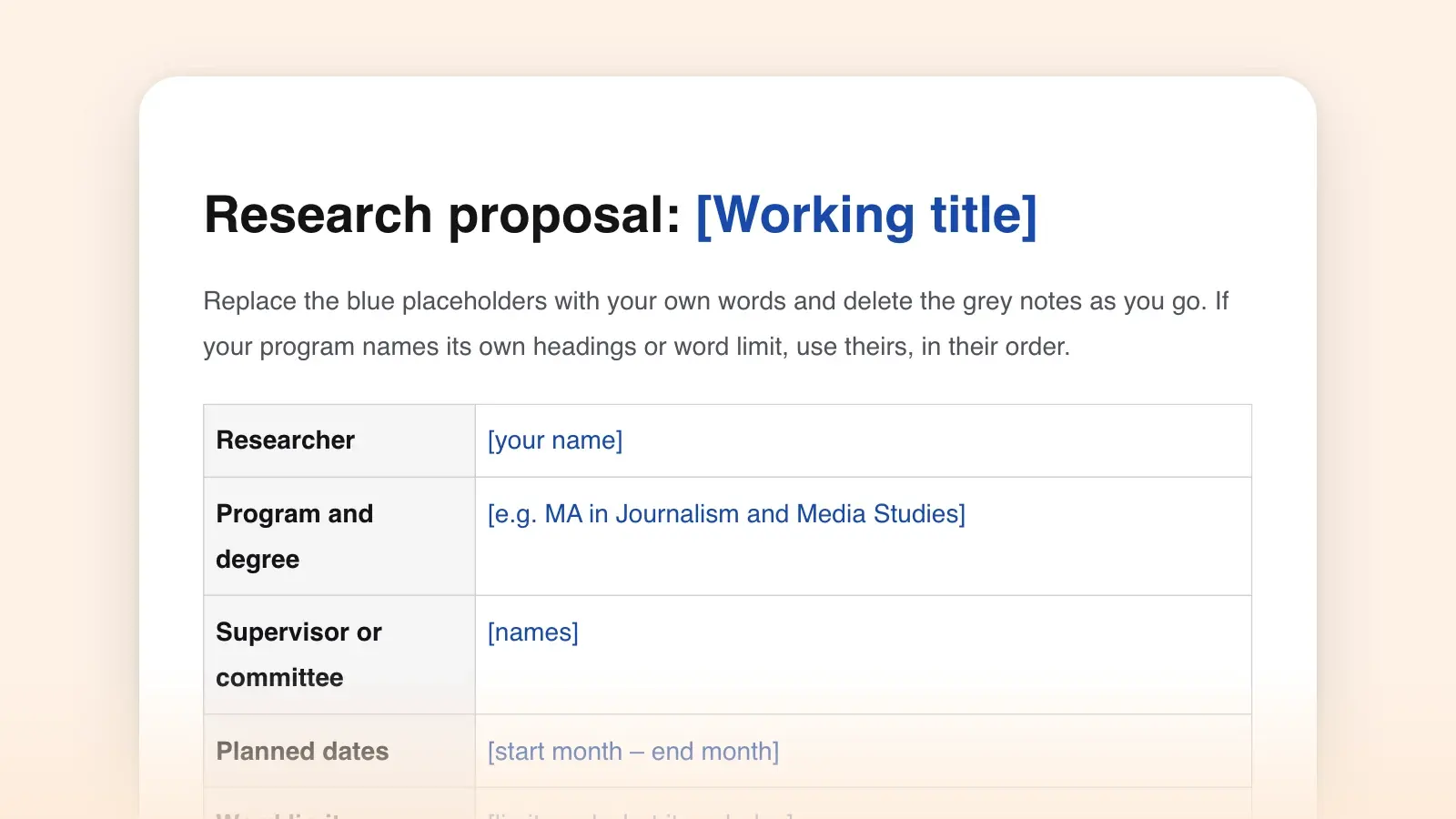
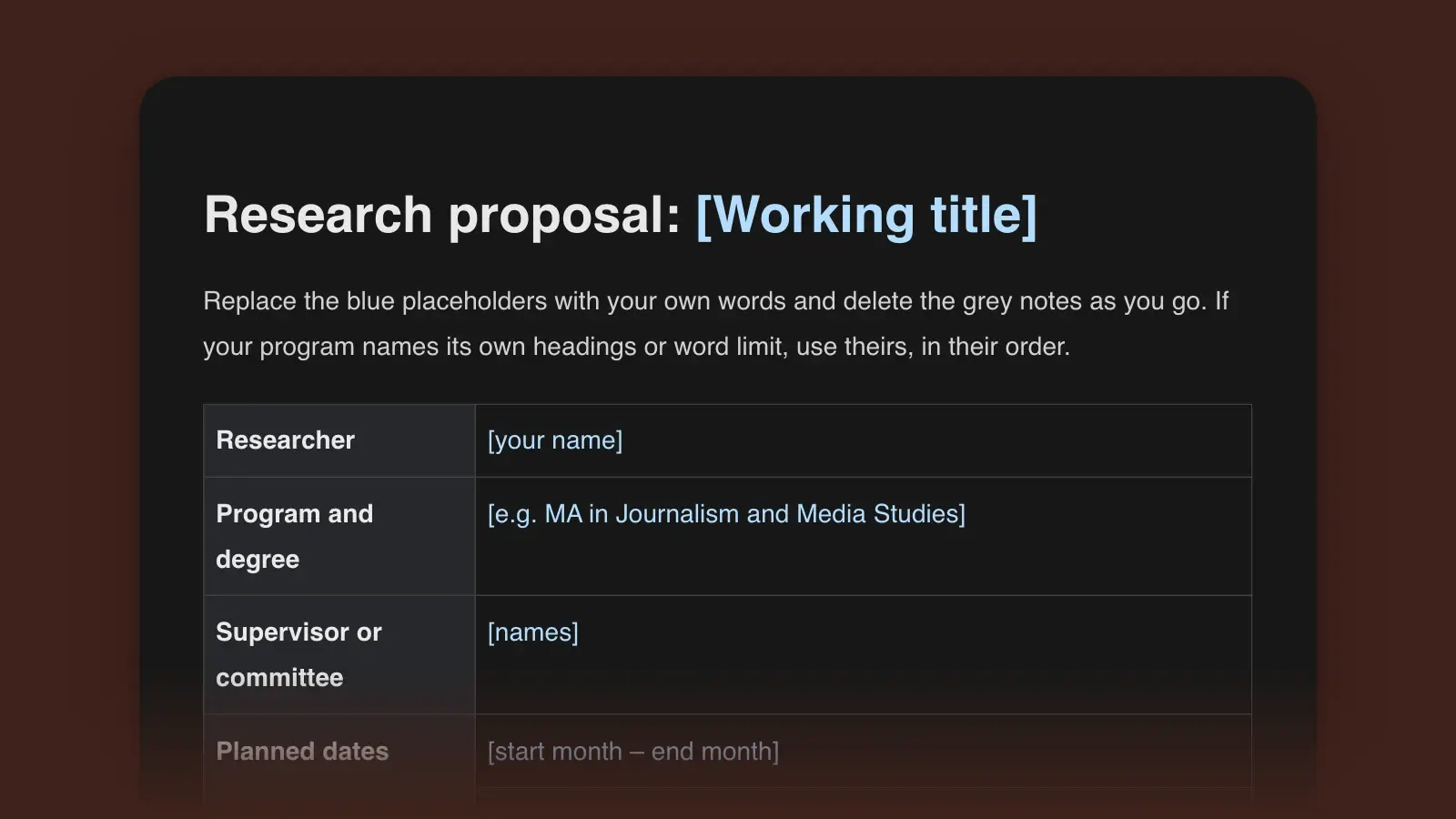
Maya Lindqvist, MA in Journalism and Media Studies, [University]. Supervisor: [Name]. Planned dates: January to December 2027. Length: 3,050 words, excluding references.
Abstract. Small-town weeklies that stop printing keep their names, but their newsrooms change: no pages to fill, no press deadline, readers who arrive one story at a time. This study asks how editors and reporters at three weeklies in one Midwestern state decided what to cover in the year after their last print edition, and how their coverage changed. It combines interviews with all nine current newsroom staff and a content analysis of every local story published in the twelve months before and after each paper's last print issue, about 3,000 stories. The findings will give newsrooms planning the same change a record of what three papers kept, dropped and added, and why.
Between 2024 and 2026, three century-old county weeklies printed their last editions and moved to a website and a weekly email newsletter, keeping their names, editors and most of their staff. Research on local news has documented closures and the loss of reporters [citations], and audience studies have asked what readers lose when a paper disappears [citations]. Fewer studies follow the papers that survive the end of print [citations]. Without a press deadline or a fixed number of pages, editors face choices print used to make for them: how often to publish, how long a story should be, whether a school board meeting still gets a reporter. Those choices decide what a town knows about itself, and nobody has recorded how they are made in newsrooms this small.
The purpose of this multiple-case study is to understand how editors and reporters at three small-town weeklies decided what to cover in the first year after their last print edition, and to describe how their local coverage changed.
- RQ1. How do newsroom staff describe their decisions about what to publish, how often and at what length after print ended?
- RQ2. How did the topics, sources and length of local stories change between the year before and the year after the last print edition?
- RQ3. Which kinds of coverage did each newsroom keep, add or drop, and how do staff explain those choices?
The review is organized around three bodies of work. The first documents the decline of local newspapers and its effects on local civic life [citations]. The second follows newspapers that cut print days or moved online, mostly metropolitan dailies rather than weeklies [citations]. The third studies news values and newsroom routines, how journalists decide what counts as news, a body of work built largely in newsrooms far bigger than three or four people [citations]. Together they leave the gap this study addresses: what happens to a small newsroom's news judgment when the print product that organized it disappears.
Design. A multiple-case study of three weeklies of different sizes, chosen because each ended print between 2024 and 2026 and kept its editor through the change, so staff can describe both sides of it.
Participants. All nine current newsroom staff at the three papers, three or four per paper, recruited through the editors, each of whom has agreed in writing to give access. Former staff who left in the year after print ended will be invited through the state press association.
Data collection. One semi-structured interview per participant, 60 to 90 minutes, recorded with consent and transcribed, using the guide in Appendix A. I will also collect every local story published in the 12 months before and after each paper's last print issue, from print archives and the papers' websites: about 3,000 stories.
Analysis. Transcripts will be coded using thematic analysis (Braun & Clarke, 2006), first within each case and then across cases. Stories will be coded for topic, main source and length with a codebook adapted from [citation]. A second coder will code a random 10 percent, and disagreements will be settled before the full set is coded. The story comparison answers RQ2, the interviews answer RQ1, and RQ3 reads the two together.
Researcher position. I worked as a reporter at a weekly in another state for two years. That will help me ask informed questions and may also make me sympathetic to editors, so I will write a reflective memo after each interview and review coding decisions with my supervisor.
The study will go to [University]'s institutional review board before any data are collected. Participants will sign a consent form and may withdraw until their transcripts are anonymized. Because each paper is the only one in its county, staff could be identified from context even without names, so participants will choose whether to be named; those who are not will be described by role only, with identifying details removed. Recordings and transcripts will be stored on an encrypted university drive and deleted on the schedule set by [University] policy. Published stories are public and need no consent.
| When | Task | Output |
|---|---|---|
| WhenJan–Feb 2027 | TaskEthics application; final interview guide and codebook; pilot interview with a former reporter | OutputApproval; final instruments |
| WhenMar–Apr 2027 | TaskCollect stories from archives and websites; begin interviews | OutputStory database; first interviews |
| WhenMay–Jun 2027 | TaskFinish and transcribe interviews; second coder checks 10% of stories | OutputTranscripts; agreement check |
| WhenJul–Aug 2027 | TaskCode all stories; first round of interview coding | OutputCoded data |
| WhenSep–Oct 2027 | TaskCross-case analysis; draft findings chapters | OutputChapters 4 and 5 |
| WhenNov–Dec 2027 | TaskRevise the full thesis and submit | OutputThesis |
| Budget item | Calculation | Amount |
|---|---|---|
| Budget itemTravel to the three newsrooms | Calculation3 round trips × 380 miles × $0.65 a mile (university rate) | Amount$741 |
| Budget itemTranscription | CalculationUp to 12 interviews (9 current staff, up to 3 former) × 75 minutes × $1.40 a minute | Amount$1,260 |
| Budget itemArchive access | CalculationOne year of digitized back issues for one paper | Amount$240 |
| Budget itemThank-you gift cards for participants | Calculation12 × $25 | Amount$300 |
| Budget itemTotal | CalculationRequested from the department's graduate research fund | Amount$2,541 |
Significance. Small newsrooms and the state press association get a record of what three papers kept, added and dropped when print ended, and why. For research, the study tests ideas about news values in newsrooms much smaller than the ones where those ideas were developed.
Limitations. Three papers in one state cannot stand for all weeklies, and staff who stayed may describe the change more favorably than those who left. Recruiting former staff and comparing interviews with the published record are meant to reduce that bias. The study describes decisions; it cannot say whether readers were better or worse served.
References (excerpt). Braun, V., & Clarke, V. (2006). Using thematic analysis in psychology. Qualitative Research in Psychology, 3(2), 77–101. https://doi.org/10.1191/1478088706qp063oa
What makes it work. Every section names the same three papers and the same two years, so the chain from problem to timeline is easy to check. The coding has a second reader, and the ethics section handles the risk specific to this study: in a newsroom of three, removing a name doesn't hide a person. Above all, each research question can be traced to its evidence, its method and the months it needs.
| Question | Evidence | Method | When |
|---|---|---|---|
| QuestionRQ1: how staff describe their decisions | EvidenceInterviews with the 9 current staff and up to 3 former staff, 60–90 minutes each | MethodThematic analysis within each paper, then across the three | WhenInterviews Mar–Jun 2027; coding Jul–Aug |
| QuestionRQ2: how coverage changed | EvidenceAbout 3,000 local stories from the 12 months before and after each last print issue | MethodContent analysis with a codebook; a second coder checks 10% | WhenCollected Mar–Apr; agreement check May–Jun; full coding Jul–Aug |
| QuestionRQ3: what each newsroom kept, added or dropped, and why | EvidenceBoth data sets, read together | MethodCross-case comparison | WhenSep–Oct 2027 |
The tightest stretch is July and August. If each story takes three to five minutes to code for topic, source and length, 3,000 stories come to roughly 150 to 250 hours, on top of the first round of interview coding. A full-time student can manage that; a part-time student would need to code a sample of the stories or give the coding more months. That is the arithmetic a supervisor will do.
Research proposal samples for other fields
The sections stay recognizable across fields, but what goes in them changes. Three short samples show the main differences.
This experiment will randomly assign ninth graders at two high schools to read the same two informational passages either on paper or on a tablet, then answer the same comprehension questions. H1: Students who read on paper will score higher on inferential questions. H2: The paper advantage will be larger for inferential questions than for literal recall questions. A power analysis for H1 (two-tailed, d = 0.5, α = .05, power = .80) gives 64 students per condition, 128 in all.
A quantitative proposal usually commits to its hypotheses and sample size before any data exist. If you are still choosing a design, the qualitative vs quantitative research guide sets out what each can and can't answer.
This dissertation asks how American advice manuals for young women changed their account of paid work between 1870 and 1920. It reads 40 manuals held at [Library], chosen because each went through at least three editions, so that changes between editions show what publishers thought readers wanted. Chapter 1 sets out the market for the manuals; Chapters 2 to 4 follow three kinds of work across editions (shop work, typing, teaching); Chapter 5 sets the manuals beside readers' letters in two women's magazines.
Humanities proposals (a prospectus in many US doctoral programs) often have no methods section by that name. They describe the sources and a chapter plan, and a working argument takes the place of hypotheses.
The idea. How do public library services in former mill towns in northern England decide which services to keep when budgets are cut, and who loses access when a branch reduces its hours? I propose a comparative study of three library services since 2015, using council decision records and interviews with library staff and users, building on [Supervisor]'s work on austerity and public space.
Some PhD applications ask for a short proposal instead of a full plan. As of November 2026, the University of Sheffield's guidance for applicants in arts, humanities and social sciences suggests about 500 to 1,000 words, organized around five questions: your idea, your aim, what makes it relevant, your plan and timetable, and the resources you need. It also says the proposal should fit the existing research interests and expertise of the school you apply to; naming the supervisor whose work yours builds on is one way to show that fit.
What a supervisor will check
Approval is your supervisor's or committee's call, but these checks can be made line by line before you send the draft.
Checks a supervisor can make
- Each research question has a data source in the methods and a slot in the timeline
- The sample is reachable: named sites, a number, a route to recruit them and, where needed, letters of access
- Ethics approval comes before any data collection in the timeline
- The months for transcription and coding match the amount of data, and the arithmetic adds up
- The literature review ends on a gap that the questions address
- Each limitation comes with what the design does about it
Signs it needs another draft
- A topic where the research question should be
- “Participants will be recruited” with no place, number or route
- Twenty sources summarized one at a time
- Data collection that starts before ethics approval
- Claims the design can't support: “prove,” “all,” “the first study ever”
Show your supervisor the research questions and a one-paragraph method before you write the rest; it can save a round of revisions. In an IMRaD field, the proposal's introduction, review and methods often become the first chapters of the thesis. When the proposal is approved, the thesis outline template turns it into a chapter plan. If the proposal also asks a funder for money, the grant proposal example covers budgets, budget narratives and funder formats.
Frequently asked questions
How long is a research proposal?
It depends on what it is for. A proposal for a PhD application is often short: the University of Sheffield suggests about 500 to 1,000 words for arts, humanities and social sciences. A thesis or dissertation proposal is longer, because it includes a literature review and full methods. A course assignment may be one or two pages. Your program's guidelines set the real limit.
What tense is a research proposal written in?
The future tense for what you will do: I will interview, the study will compare. The present tense for what is already true, such as what the literature shows, and the past tense for work already done, such as a pilot. When the study is finished, the methods move into the past tense for the thesis or paper.
What is the difference between a research proposal and a research paper?
A proposal describes a study you plan to do and argues that it is worth doing and feasible. A research paper reports a study you have done, with results and a discussion. The proposal's introduction, literature review and methods often become the first chapters of the thesis, rewritten in the past tense once the work is done.
Do I need a hypothesis in a research proposal?
Only if the study tests a prediction, which is usual in quantitative research. Qualitative and exploratory proposals state research questions instead, and humanities proposals often state a working argument. If you include hypotheses, each should follow from the literature review and match an analysis in your methods section.