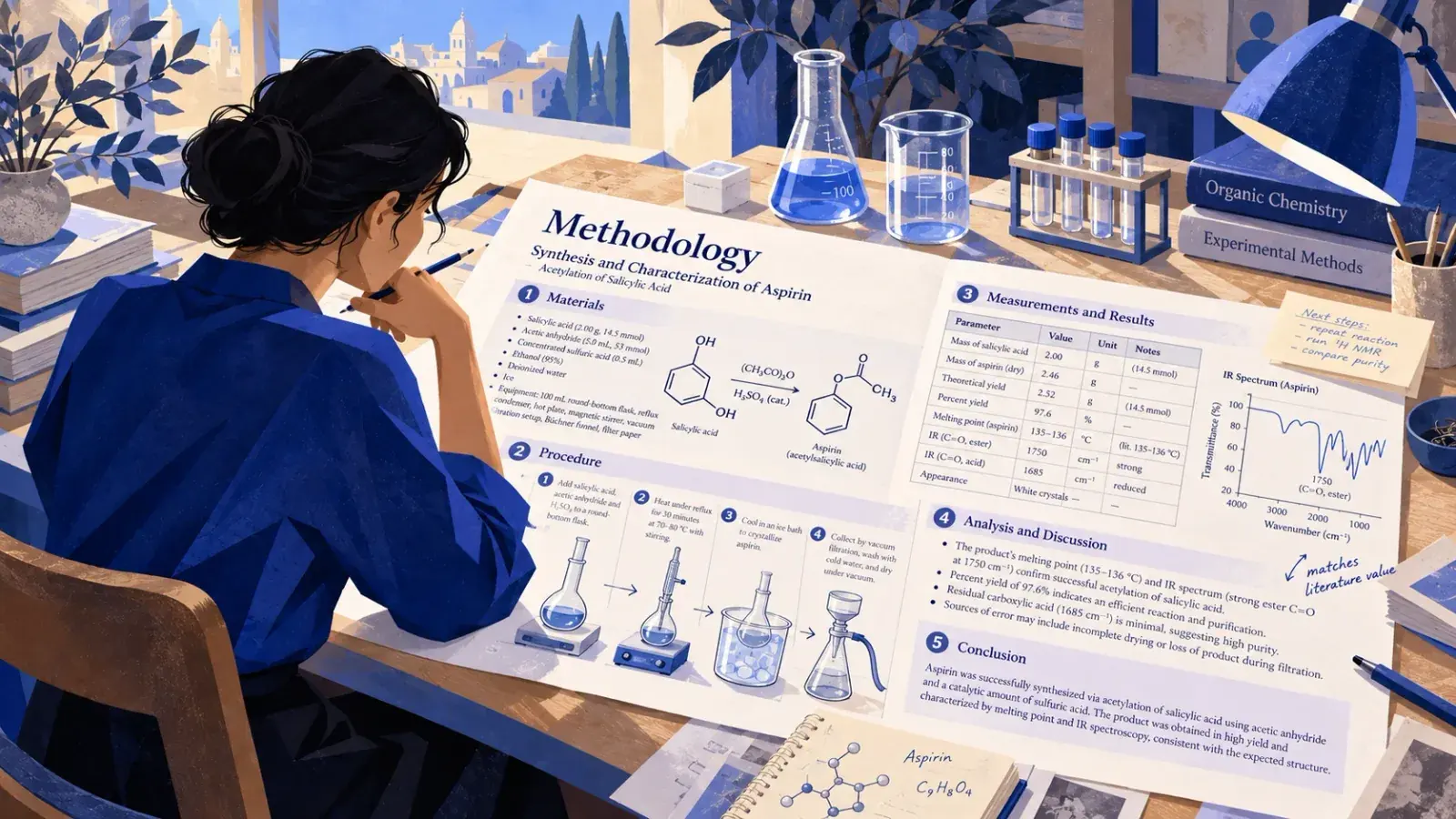
A methodology section (headed “Method” or “Methods” in most papers) explains how you answered your research question: who or what you studied, how you collected the data and how you analyzed it, with a reason for each choice. Write it in enough detail that another researcher could repeat the study, or at least judge whether your results deserve trust.
Below are two complete, annotated examples, a quantitative experiment and a qualitative interview study, followed by shorter samples of a survey, a mixed-methods design and an archival project. Every study on this page is invented, so the numbers illustrate form, not findings. After the examples comes a step-by-step method for writing your own.
What goes in a methodology section
The two words get used loosely, but they mean different things. A method is a technical step: a survey, a t test, a round of coding. Methodology is the reasoning behind choosing those steps. A journal article usually has a short Method section, the M in IMRaD, that reports the steps and justifies each in a clause. A dissertation’s methodology chapter is longer and also defends the overall research design, sometimes the philosophy behind it.
Either way, the content answers the same questions. The table follows the American Psychological Association’s Journal Article Reporting Standards (JARS), which have separate versions for quantitative and qualitative research. Education, health and business journals ask for the same elements, sometimes under other names.
| Part | Quantitative study | Qualitative study |
|---|---|---|
| PartDesign | Quantitative studyExperiment, survey or correlational; conditions and variables | Qualitative studyApproach (interviews, case study, ethnography) and why it fits |
| PartParticipants or sources | Quantitative studyEligibility, recruitment, final number and how it was set | Qualitative studySelection strategy, number, and why data collection stopped |
| PartMaterials | Quantitative studyMeasures and apparatus, with reliability | Qualitative studyInterview guide, observation protocol, documents |
| PartProcedure | Quantitative studyWhat happened, in order, with timing | Qualitative studyHow data were gathered, recorded and transcribed |
| PartAnalysis | Quantitative studyNamed tests, software, missing data and exclusions | Qualitative studyCoding approach, software, how themes were built and checked |
| PartEthics | Quantitative studyApproval, consent, compensation | Qualitative studyApproval, consent, researcher–participant relationship |
| PartResearcher | Quantitative studyUsually omitted | Qualitative studyYour background and how you managed its influence |
One difference is worth knowing before you start. The qualitative standards note that a qualitative Method section usually runs longer than a quantitative one, because the methods are adapted to each study and need explaining, and that data collection and analysis can be described together when they happened together.
Quantitative example: a writing experiment
The study asks whether writing a quick outline before an in-class essay improves how well the essay is organized. First-year students were randomly assigned to outline first or to start drafting at once, and two raters scored the essays. The section uses the subsection headings common in APA-style papers.
Participants
Participants were 128 first-year undergraduates from six sections of a required composition course at a public university in the midwestern United States. Students were eligible if they were 18 or older and had not taken a college writing course before. Of the 151 students invited, 136 (90%) consented. We excluded eight before analysis: five missed the essay session and three wrote fewer than 150 words. The final sample (outline n = 63, direct drafting n = 65) had a mean age of 18.7 years (SD = 1.1) and included 71 women, 54 men and three nonbinary students; 19 reported a first language other than English.
An a priori power analysis in G*Power 3.1 (Faul et al., 2009) showed that 64 participants per group would give 80% power to detect a medium effect (d = 0.5) with a two-tailed independent-samples t test at α = .05. Students received course credit; those who declined to take part completed an alternative assignment for the same credit. The university’s institutional review board approved the study.
Why it works. A reader can trace the sample from invitation to analysis: who was eligible, how many agreed, who was dropped and why, and how many ended up in each group. The power analysis explains why the study aimed for about 128 people rather than whatever number turned up.
Materials
Writing prompt. All participants answered the same argumentative prompt: “Should colleges require first-year students to live on campus?” We chose it from four candidates in a pilot with a separate class of 22 students, because it was the one most of them said they could argue without doing research.
Organization rubric. Essays were scored on a rubric adapted from the department’s first-year writing rubric, with four criteria: a clear thesis, unified paragraphs, logical order and transitions. Each criterion was scored from 1 to 6, and the four scores were averaged into one organization score. The full rubric appears in Appendix A.
Background questionnaire. Five items asked about age, gender, first language, previous writing courses and whether students had been taught to outline in high school.
Why it works. Each instrument gets a name, a source and a scoring rule, and anything too long for the page goes to an appendix. If you use a published scale, cite it and report its reliability in your own sample. A rubric written for the study needs enough description that someone else could rebuild it.
Procedure
Sessions took place during regular 75-minute class meetings in the fifth week of the fall semester. Within each section, a random number generator assigned students to one of the two conditions. In the outline condition, students spent 10 minutes writing an outline on a blank template, then 40 minutes writing the essay. In the direct-drafting condition, students spent the first 10 minutes reading two short articles unrelated to the prompt, then 40 minutes writing. Everyone wrote on a laptop with internet access and grammar checking turned off. Instructors left the room, and a research assistant who did not know the hypothesis read standardized instructions (Appendix B). Students completed the background questionnaire after submitting their essays.
Why it works. It runs in the order things happened, with times. The detail that matters most is the control condition: the drafting group did a filler task so both groups spent 50 minutes, which means a difference in scores cannot come from extra time.
Data analysis
Two composition instructors who did not teach the participating sections scored every essay independently, with names and condition labels removed. Interrater reliability for the averaged score was .84 (intraclass correlation, two-way random effects, absolute agreement). Where the raters differed by more than one point on any criterion, they discussed the essay and agreed on a score; otherwise we averaged their scores.
We compared organization scores between conditions with an independent-samples t test and report Cohen’s d with a 95% confidence interval. In a preregistered secondary analysis, we added prior outlining instruction as a covariate (ANCOVA). Analyses were run in R, version 4.4.1. The preregistration, data and analysis script are posted on the Open Science Framework.
Why it works. This subsection decides whether the results can be believed, so reviewers read it closely. It names the scoring safeguards (blind raters, a reliability figure, a rule for disagreements), the exact test, the effect size and which analysis was planned as secondary. It reports no results. The scores themselves belong in the Results section.
Qualitative example: an interview study
The study asks how first-generation doctoral students experience writing a dissertation. Fourteen students were interviewed and the transcripts analyzed for themes. Qualitative papers vary more in their headings, so this one follows its own logic: design and participants, data collection, then analysis and the researchers’ position.
Design and participants
We used a qualitative design with semistructured interviews, because the research question asked how students make sense of an experience, not how often it occurs. Our approach was interpretive: we aimed to understand participants’ accounts in their own terms rather than to test a hypothesis.
Participants were 14 doctoral students at two research universities in the United States who were the first in their families to complete a four-year degree and were writing their dissertations at the time of the interview. We recruited through graduate school newsletters and asked participants to pass the invitation to peers. To hear a range of experiences, we sampled purposively by discipline (five humanities, five social sciences, four STEM) and by stage, from proposal to final draft. We stopped recruiting after 14 interviews, when the last three added nothing new that bore on the research question; we treat this as a judgment that the data were sufficient, not as proof of saturation. Participants received a $30 gift card. The institutional review board at the first author’s university approved the study, and every participant gave written consent.
Why it works. The design is justified in one sentence tied to the research question, and the sampling strategy comes with its reason. The paragraph also says why recruitment stopped at 14. JARS-Qual asks for exactly that, because there is no agreed minimum number of participants for a qualitative study, only a rationale for the number you chose.
Data collection
The first author conducted all interviews by video call between February and April 2026. Interviews lasted 48 to 85 minutes (M = 63). The guide (Appendix C) opened with a broad request, “Tell me about a week when the writing went badly,” and moved to prompts about advisors, family, money and time. After the fourth interview we added a question about writing groups, which three participants had raised without being asked. Interviews were audio-recorded and transcribed verbatim; the first author checked each transcript against the recording and removed identifying details.
Why it works. Duration appears as a range with a mean, the format the APA standards themselves use as an example. The change to the interview guide is reported, not hidden. Adapting a guide is normal in qualitative work, and saying when and why shows the process was deliberate.
Analysis and researcher position
We analyzed the transcripts using reflexive thematic analysis (Braun & Clarke, 2006, 2019), coding inductively from the data rather than from a predefined framework. Both authors read every transcript before coding began. The first author coded all 14 transcripts in NVivo; the second author coded four independently, and we met after each to discuss where our readings differed, using those conversations to sharpen code definitions rather than to calculate agreement. We grouped codes into candidate themes, checked each theme against the full data set, and defined and named four final themes. Analytic memos and a log of coding decisions form an audit trail.
The first author is a first-generation college graduate who completed a doctorate in sociology; the second author is a continuing-generation professor who has supervised dissertations for 15 years. The first author’s background helped build rapport and shaped the interview guide. To keep it from narrowing the analysis, the second author questioned interpretations that echoed the first author’s own story, and we looked for accounts that contradicted early themes.
Why it works. “Data were analyzed thematically” tells a reader almost nothing. This version names the approach and its source, says the coding was inductive, and explains who coded what, how disagreements were used and how codes became themes. The positionality paragraph is standard in qualitative research: the interviewer is part of the instrument, so readers need to know who asked the questions.
Three shorter methodology examples
Not every study is an experiment or a set of interviews. These three show the same principles in other designs.
A survey
We surveyed graduate students at one public university about their writing habits. In March 2026 the graduate school emailed an invitation to all 3,212 enrolled master’s and doctoral students, followed by two reminders a week apart; 611 completed the questionnaire (19% response rate). The 24 items covered weekly writing hours, use of writing groups and deadlines missed in the past year, plus an eight-item procrastination scale written for this study (Cronbach’s α = .87 in this sample). Because respondents chose themselves, we compared them with the enrolled population on degree level, discipline and year of study using registrar data (Table 1), and weighted the analyses by discipline.
The sampling frame, the contact schedule, the response rate and what was done about nonresponse are all here. Leave any of them out and a reviewer will ask.
A mixed-methods design
The study used an explanatory sequential design (Creswell & Plano Clark, 2018): a survey of how often college writing instructors used peer review, followed by interviews to explain the patterns the survey found. From 214 survey respondents, we invited 12 for interviews, six who used peer review weekly and six who had stopped using it, so the interviews could account for the split. Survey responses were analyzed with logistic regression and the interviews with thematic analysis. We integrated the two strands in a joint display that sets each survey finding beside the interview themes that help explain it.
Name the design, the order of the phases, how the second sample was drawn from the first, and how the two kinds of data meet. Integration is the step readers look for and the easiest one to forget.
An archival or textual study
This chapter reads 186 editorials on women’s suffrage published in Ohio newspapers between 1910 and 1920, collected from the Library of Congress’s Chronicling America database. I searched for “suffrage,” “suffragist” and “votes for women,” kept pieces that took a position on the question, and set aside news reports and letters to the editor. Because the database’s machine-read text garbles many words on older pages, I read every editorial from the page image rather than the extracted text, and I note where damage made a passage unreadable. I coded each editorial for the arguments it made, starting from categories used in earlier studies of suffrage rhetoric and adding new ones when an argument did not fit.
Humanities projects have methods too. The reader needs the boundaries of the corpus, the search terms, the rule for what counted and the limits of the archive.
How to write your methodology
- Start from the research question
Put the question at the top of your draft. Every subsection should serve it; if a detail does not help a reader judge your answer, cut it. If the question is still vague, fix that first with these research question examples.
- Pick your headings and checklist
Use the headings your journal, department or instructor expects. For a journal, read its author guidelines and the reporting checklist for your design: CONSORT for randomized trials, STROBE for observational studies, COREQ (32 items) for interviews and focus groups, SRQR for qualitative research in general, PRISMA for systematic reviews. Some journals ask you to submit the completed checklist with the manuscript.
- Draft from your protocol, early
Write the method while you collect data, or right after, from your protocol, lab notebook or field notes. Dates, durations, response rates and exclusions are hard to reconstruct months later, and because this is the most factual section of the paper, it is a good one to draft first.
- Write what you did, in the past tense
Use the past tense for completed steps: “we recruited,” “participants completed.” A proposal describes planned work, so it uses the future tense. APA style encourages the active voice and the first person for your own research steps; some fields still prefer the passive, so follow your style guide.
- Justify each choice in a clause
Say why, briefly: “We sampled purposively to include each discipline.” Cite the source of a method instead of explaining how it works. Readers know what a t test is; they want to know why you ran this one.
- Test it on someone else
Give the draft to a classmate or colleague and ask whether they could run the study tomorrow. Every question they ask marks a missing detail. Move long material, such as full questionnaires, interview guides and rubrics, to appendices.
This skeleton covers most empirical papers. Drop the parts your design does not need, and rename them to match your field.
Method section outline
Method
  Research design: type of study and why it fits the question
  Participants or sources: eligibility, recruitment, sampling,
    final number and how it was set
  Materials or measures: each instrument, its source, scoring,
    reliability in your sample
  Procedure: what happened, in order, with timing and setting
  Data analysis: named tests or coding approach, software,
    missing data, exclusions, disagreements
  Ethics: approval, consent, compensation
  Researcher position (qualitative): background and how its
    influence was managed
To see the method in place among the other sections, read the research paper example; for a thesis, the dissertation outline template shows where the methodology chapter sits. Once the method is settled, it compresses into a sentence or two of your abstract.
Mistakes that weaken a method section
Strong method
- How you applied a method, with a citation for the method itself
- Procedures only; findings wait for the Results
- Every number a reader needs: invited, consented, excluded, analyzed
- Steps from transcript to theme, with who coded what
- A reason for each choice and a plain note on its limits
- The central interview questions, with the full guide in an appendix
Weak method
- Textbook definitions: “A t test compares two means”
- Results or interpretation slipped in early
- No response rate, no exclusions, no dates
- “Data were analyzed thematically” and nothing more
- Labels without reasons: “Convenience sampling was used”
- Thirty interview questions pasted into the body
Limitations sit in an awkward spot. In a journal article they usually go in the Discussion, after the results that give them meaning. A dissertation’s methodology chapter often has its own subsection on limitations and delimitations, the boundaries you chose on purpose, such as one university or one decade. Either way, the method should state its constraints plainly, as the archival example does with damaged pages.
Drafting the methods in Strokes
In Strokes, a desktop editor that keeps documents as files on your computer, you can keep the protocol, interview guide, field notes and draft as documents in one project, then add the protocol and the draft to an AI Assistant chat and ask pointed questions: “Which details in the protocol are missing from my Participants section?” or “List every number a reviewer would expect here that I haven’t reported.” The assistant only knows what is in your documents. It cannot know what you actually did, so never let it supply a date, a count or a step; an invented detail in a method section is a hallucination with consequences.
Version history saves drafts automatically, which helps when an advisor asks you to restructure and you later want the earlier wording back: preview any version with the changes marked and restore it in one click. Check your institution’s rules before using AI on assessed work.
Frequently asked questions
What is the difference between methods and methodology?
Methods are the steps you took: a survey, a set of interviews, a statistical test. Methodology is the reasoning for choosing them. A journal article’s Method section reports the steps with a brief justification; a dissertation’s methodology chapter also argues for the overall design.
How long should a methodology section be?
There is no fixed length. It should be as long as a reader needs to repeat or evaluate the study, within the limits your journal or department sets. Qualitative sections usually run longer than quantitative ones because the process needs more explanation. Put full instruments and interview guides in appendices.
What tense is a methodology written in?
The past tense for a completed study: we recruited, participants completed. A research proposal or preregistration describes planned work, so it uses the future tense: we will recruit. The present tense is fine for things that remain true, such as where the rubric appears.
Can I use “I” or “we” in a methodology section?
In APA style, yes: it encourages the first person and the active voice for your own research steps. Some fields and journals still prefer the passive voice, so check the style guide you are writing to.
Do limitations go in the methodology section?
In most journal articles, limitations go in the Discussion. Dissertations often include a limitations and delimitations subsection in the methodology chapter. Follow your journal’s or department’s guidelines.