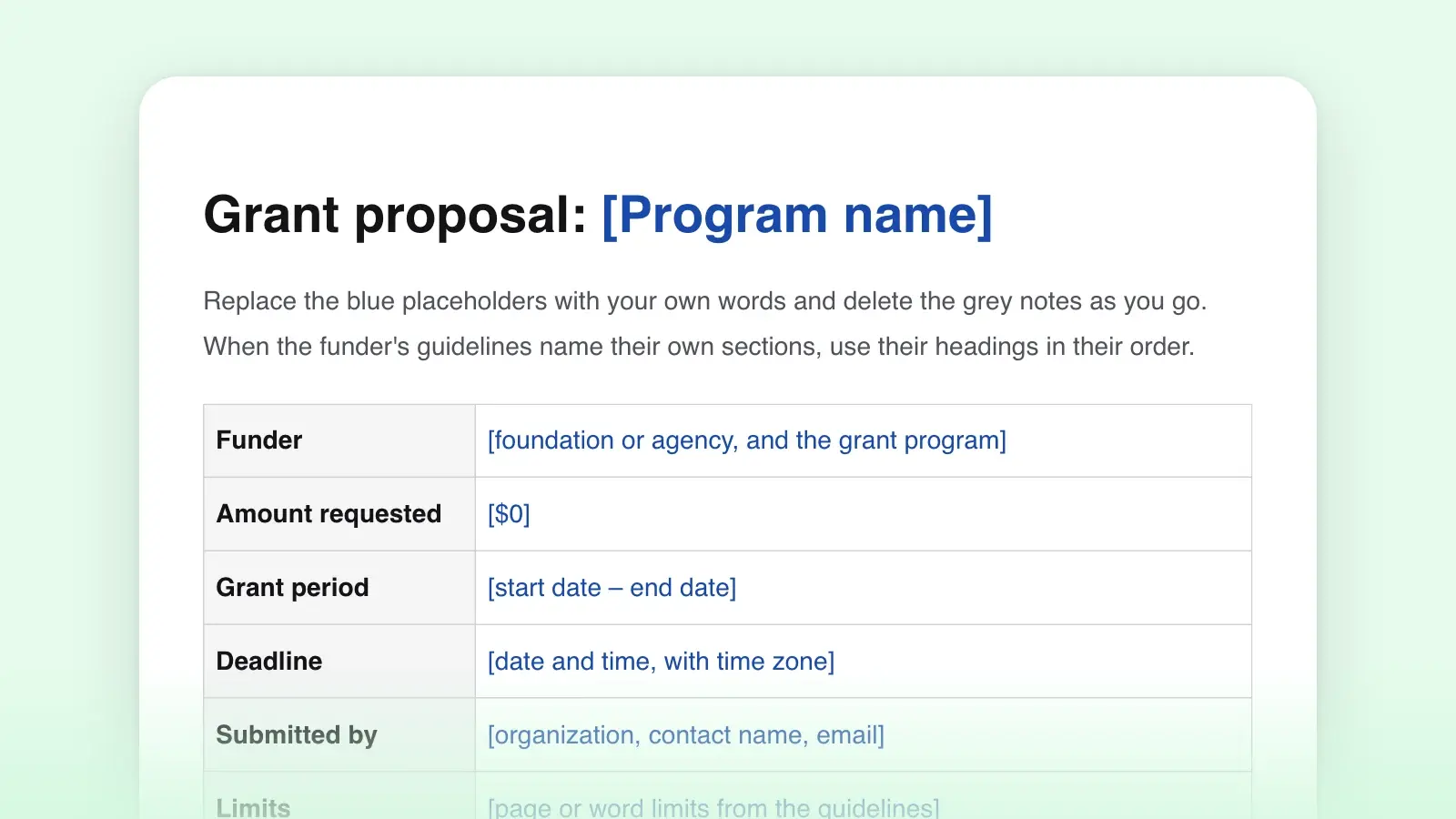
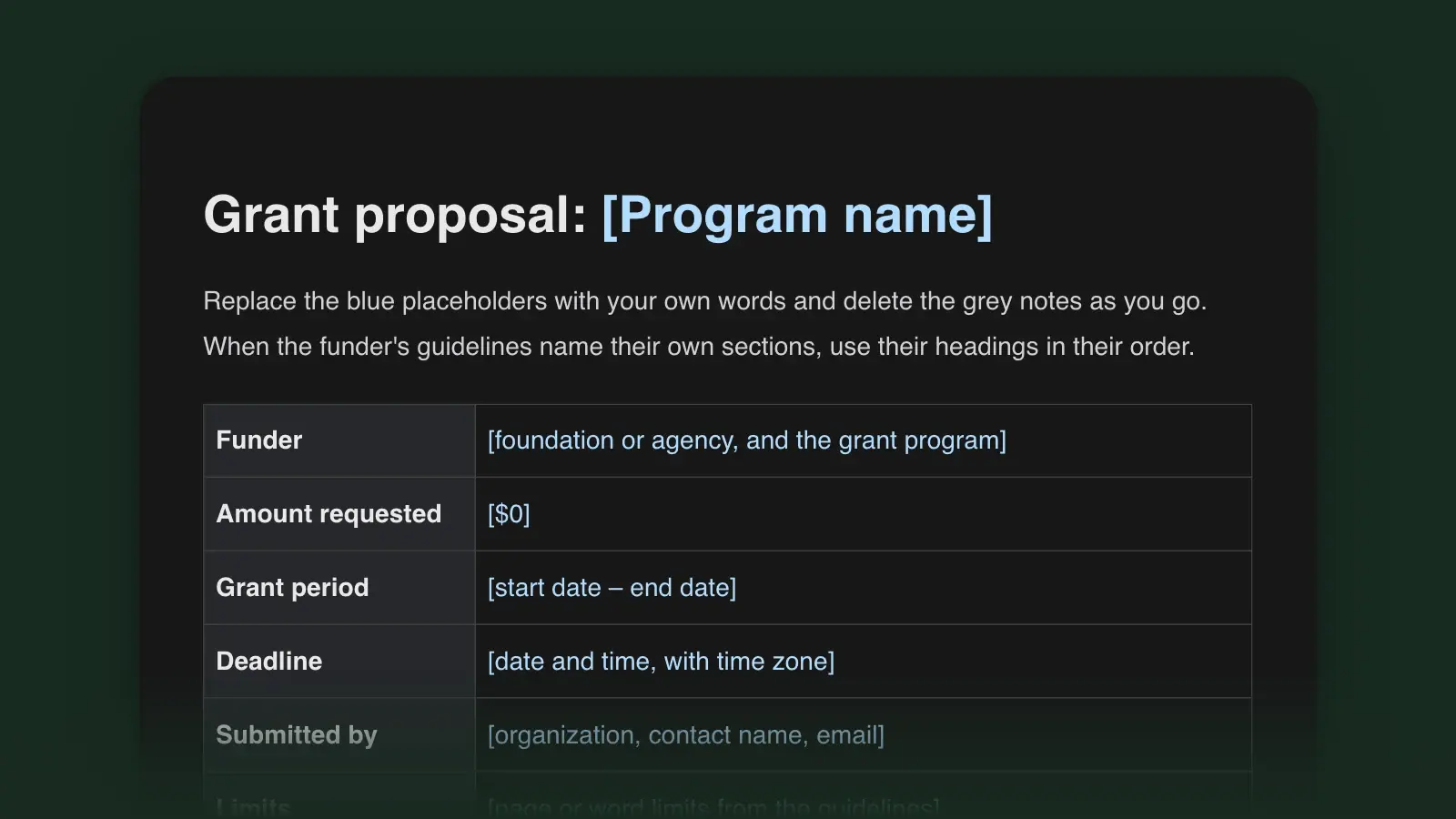
When to use it
- A foundation or community grant for a nonprofit program
- A small research or seed grant from a university, a society or a foundation
- Government grants where the funder's forms leave the narrative sections to you
- Turning a letter of inquiry into a full proposal after the funder invites one
- Keeping one master proposal that you adapt to each funder's guidelines
A grant proposal asks a funder for money to do a specific piece of work, and it has to show three things: the need is real, your plan will change it, and you can account for every dollar. This template follows the order most foundations expect, from the cover letter to the attachments, and the example below fills it in for an invented library literacy program, with a line-item budget. When a funder's guidelines name their own sections, use theirs, in their order. The funder's format always wins.
How to use this template
- Read the funder's guidelines before you write
Check eligibility, the funder's priorities, the deadline, page and word limits, and the attachments they require. Then rename and reorder the template's headings to match theirs. Reviewers score against their own criteria, often section by section, and an answer filed under the wrong heading can score as missing.
- Write the need, the objectives and the evaluation together
These three sections describe one chain: the problem, the change you promise, and how you will prove the change happened. Draft them side by side. If an objective has no measure in the evaluation plan, or the need names a problem no objective touches, a reviewer is likely to notice the gap.
- Build the budget from the methods
Every line in the budget should trace back to an activity in the methods: a person times their share of a salary, a learner times a workbook, a session times the cost of childcare. Then write the budget narrative, one short paragraph per line, saying what it is, how you calculated it and why the program needs it.
- Write the summary and the cover letter last
Once the rest is finished, the summary is a matter of picking sentences: the need, the program, who benefits, the amount and the results you expect. Check that the amount matches in the cover letter, the summary and the budget total. A mismatch is the easiest error to catch and an embarrassing one to send.
Grant proposal format, section by section
Most foundation proposals use some version of these sections. The lengths are rough guides for a proposal with no limits of its own; the funder's limits replace them.
| Section | What it answers | Rough length |
|---|---|---|
| SectionCover letter | What it answersWho is asking, for how much, and why this funder | Rough lengthOne page |
| SectionExecutive summary | What it answersThe whole proposal in one paragraph | Rough length150–250 words |
| SectionStatement of need | What it answersWhat problem, for whom, how you know, why now | Rough lengthOne to two pages |
| SectionGoals and objectives | What it answersWhat will change, by how much and by when | Rough lengthHalf a page |
| SectionMethods and timeline | What it answersWhat you will do, who does it, in what order | Rough lengthOne to three pages |
| SectionEvaluation plan | What it answersHow you will know the objectives were met | Rough lengthHalf a page to a page |
| SectionOrganizational background | What it answersWhy you can deliver it | Rough lengthHalf a page |
| SectionBudget and budget narrative | What it answersWhat it costs, line by line, and why | Rough lengthA table and a page |
| SectionSustainability | What it answersWhat happens when the grant ends | Rough lengthA paragraph or two |
| SectionAttachments | What it answersProof of status, finances, board, letters of support | Rough lengthAs the funder lists |
In most foundation proposals, three sections carry the argument. The statement of need is about the people the program serves, not about your organization. "We need a coordinator" is your need; "two in five adults who visit our branch can't read a medication label" is theirs. The objectives should pass the usual SMART test (specific, measurable, achievable, relevant and time-bound, though the letters get expanded a few different ways), and they should describe results, not activities. "Hold 56 classes" is an activity; "45 adults finish the course" is a result. The project proposal template covers the difference between deliverables and objectives in more detail. And the evaluation plan names a data source for every objective, so the final report can be built from records you were already keeping.
Grant proposal example: an adult literacy program
Here is the core of a finished proposal to a community foundation. The library, the foundation, the program, the local figures and every budget line are invented; only the national literacy figure is real. The headings follow the common foundation layout above, not any particular funder's required format: a real funder's guidelines or application form replace them. Read it for the chain from need to objectives to evaluation to budget.
Larkin Valley Public Library requests $60,830 from the Corrigan Family Foundation for Second Chapter, a 12-month program of evening reading classes and one-to-one tutoring for adults who read below a sixth-grade level. Between January and December 2027, two cohorts of 30 adults will meet twice a week for 14 weeks at our Fenwick Street branch, with free childcare and bus passes so that work and family don't decide who can attend. We expect 45 adults to complete the course and 70 percent of them to gain at least one grade level in reading. The library contributes the classroom and the branch manager's supervision, and 20 volunteer tutors will give about 1,200 hours.
In the 2023 Survey of Adult Skills, 28 percent of U.S. adults scored at Level 1 or below in literacy, up from 19 percent in 2017 (National Center for Education Statistics, 2024). Our own numbers suggest the share is higher in Larkin Valley. In 2025, library staff helped visitors fill in 1,140 job applications and benefit forms on the public computers; in a survey of 212 adults who asked for that help, 81 said they had trouble reading the forms themselves. There is no evening adult reading class within 20 miles of the branch, and the nearest daytime program has a waiting list of 46.
Goal. Adults in Larkin Valley can read the forms, letters and books their work and families depend on.
- Objective 1. By December 31, 2027, enroll 60 adults who test below a sixth-grade reading level. Measured by intake records.
- Objective 2. 45 of the 60 attend at least 24 of the 28 sessions in their cohort. Measured by attendance logs.
- Objective 3. 70 percent of those who complete the course gain at least one grade level between the intake and exit assessments. Measured by a standardized adult reading test given in weeks 1 and 14.
- Objective 4. 30 completers reach the goal they set at intake, such as reading to a child each week, enrolling in a high school equivalency class or applying for a job without help. Measured by goal check-ins in weeks 7 and 14.
Methods. Partners at the food bank, the community college and two large employers refer learners. The coordinator assesses each one at intake and leads two evening classes a week; trained volunteers give each learner a weekly one-to-one session. Each cohort ends with a reading circle where learners choose and discuss a book.
Evaluation. An external evaluator reviews the intake and exit scores, attendance and goal check-ins after each cohort and writes the final report, due to the foundation by January 31, 2028.
| Budget line | Calculation | Amount | What it pays for |
|---|---|---|---|
| Budget lineProgram coordinator | Calculation0.5 FTE × $52,000 annual salary | Amount$26,000 | What it pays forIntake and both evening classes: all four objectives |
| Budget lineFringe benefits | Calculation25% of the coordinator's salary | Amount$6,500 | What it pays forThe coordinator's benefits |
| Budget lineVolunteer tutor training | Calculation2 workshops × $1,500 trainer fee | Amount$3,000 | What it pays forWeekly one-to-one sessions: Objectives 3 and 4 |
| Budget lineLearning materials | Calculation60 learners × $90 workbook set | Amount$5,400 | What it pays forClasses and tutoring: Objective 3 |
| Budget lineChildcare during classes | Calculation56 sessions × 2 sitters × 2 hours × $15 | Amount$3,360 | What it pays forAttendance: Objective 2 |
| Budget lineBus passes | Calculation40 learners × 4 months × $30 | Amount$4,800 | What it pays forAttendance: Objective 2 |
| Budget lineReading assessments | Calculation60 learners × 2 tests × $12 | Amount$1,440 | What it pays forIntake and exit tests: Objectives 1 and 3 |
| Budget lineExternal evaluator | Calculation8 days × $450 | Amount$3,600 | What it pays forEvaluation of all four objectives |
| Budget lineOutreach and translation | CalculationFlyers in English and Spanish, partner visits | Amount$1,200 | What it pays forEnrolling 60 adults: Objective 1 |
| Budget lineIndirect costs | Calculation10% of direct costs ($55,300) | Amount$5,530 | What it pays forThe library's overhead |
| Budget lineTotal request | Calculation | Amount$60,830 | What it pays for |
What makes it work: the summary gives the amount, the dates and the expected results in its first lines. The need pairs a national figure with local evidence and names the gap (no evening class within 20 miles). Every objective has a number, a date and a data source, and every budget line shows its arithmetic, so a reviewer can check it without calling you. The last column ties each cost to an objective: the childcare and bus passes are there because attendance is Objective 2.
A shorter research grant variation
A small research or seed grant from a university, a professional society or a foundation usually wants a different set of headings: title and abstract, specific aims, background and significance, approach, timeline, budget and justification, the investigators and references. The aims carry the weight. Each one names what you will find out, how, and what it will let someone do next. The guides on research questions, methodology sections and abstracts cover the parts a research proposal shares with a paper.
Parents with low literacy read aloud to their children less often, but it is not known whether adult reading classes change that habit. Aim 1: measure how often parents in a library literacy program read aloud at home before and after the course, using a weekly two-question log. Aim 2: interview 12 parents to find out what made reading aloud easier or harder. Together the aims will tell libraries whether to add family reading to adult classes, and give us the effect size we need to design a larger study.
How NIH and NSF formats differ
Federal agencies publish their own structure, and it replaces this template's headings entirely. Two of the most common, as of November 2026:
- NIH. Research applications include a Specific Aims attachment limited to one page, and a Research Strategy with its own limit: 12 pages for an R01, 6 for an R21, according to NIH's table of page limits. A common layout for the aims page is the gap, the long-term goal, the central hypothesis, then two or three aims. The funding opportunity you apply to overrides the standard limits.
- NSF. Proposals open with a one-page Project Summary in three parts: an overview, a statement on intellectual merit and a statement on broader impacts. The Project Description is typically up to 15 pages. The rules sit in Chapter II of NSF's Proposal and Award Policies and Procedures Guide (PAPPG 24-1, with supplements), and a program solicitation can change them. NSF has published a draft Guidance on Financial Assistance that will replace the PAPPG, so check which version your solicitation names.
- Federal budgets. Many agencies use the SF-424A form, whose cost categories are fixed: personnel, fringe benefits, travel, equipment, supplies, contractual, construction, other and indirect charges. Building your budget table in the same categories from the start saves a translation step.
Letter of inquiry or full proposal?
Many foundations ask for a letter of inquiry first and invite a full proposal only if the idea fits. Some use the letter as their main application, and a few accept full proposals with no screening at all. The funder's guidelines say which; if they don't, ask the program officer before sending anything unsolicited. Planning a letter is a lot like planning a one-pager: one problem, one program, one amount.
Letter of inquiry
- Two to four pages is common, in letter form
- The need, the program idea, why you, the amount, why this funder
- Screens for fit: no invitation, no full proposal
- Reads as the start of a conversation
Full proposal
- Set sections, often with page or word limits per section
- Adds data on the need, a detailed plan and an evaluation plan
- A line-item budget with a budget narrative
- Attachments: proof of status, financial statements, board list
Why grant proposals get turned down
A good idea can still be turned down. Before you submit, check the draft against these common problems:
- A poor fit. The program doesn't match the funder's stated priorities, geography or eligibility rules. Read their recent grants list as well as their guidelines.
- Ignored instructions. Wrong order, over the page limit, missing attachments, submitted at 5:01 p.m.
- A need with no evidence. Adjectives instead of numbers, or numbers with no source and no year.
- Objectives that are activities. Classes held and flyers printed instead of people helped.
- A budget that doesn't match the plan. Costs with no activity behind them, activities with no cost, or totals that differ between pages.
- No plan for after the grant. Funders want to know the work won't stop when their money does.
Frequently asked questions
How long should a grant proposal be?
As long as the funder allows and no longer. Many foundations set a page or word limit for each section, and federal programs set limits in the funding announcement: NIH limits the Specific Aims to one page and an R01 Research Strategy to 12 pages, and an NSF Project Description is typically up to 15 pages. If a funder sets no limit, a short proposal that answers every question is easier to review than a long one.
What should a grant budget include?
Every cost of the work, grouped in clear categories such as personnel, fringe benefits, travel, equipment, supplies, contracts, other costs and indirect costs, with the calculation behind each line. Add a budget narrative that explains each line, and list other funding and in-kind contributions. Check which costs the funder allows and whether it caps indirect costs.
Can I send the same grant proposal to different funders?
You can reuse the content but not the document. Keep a master proposal, then make a copy for each funder that follows their headings, order and limits and speaks to their priorities. Check names and amounts twice: a proposal addressed to the wrong funder is an easy error for a reviewer to spot.