When to use it
- A literature review section inside a research paper, lab report or proposal
- Chapter 2 of a master's thesis or doctoral dissertation
- A standalone literature review assigned as a course paper
- Turning an annotated bibliography into themed sections before you draft
- Checking a draft for sections that summarize one source at a time
A literature review template lays out the sections every review needs, in order: an introduction that sets the question and scope, body sections organized by theme, period, method or theory, a section on gaps, and a conclusion that leads to your research question. This one starts with a synthesis matrix, a table of sources against themes, so the structure is visible before you write a paragraph. It works for a review inside a paper, a thesis chapter or a standalone review.
The filled-in example comes first: a matrix of five sources, then a section written from one of its columns. The steps, the blank outline and the APA headings follow. To compare finished reviews built on different structures, see the literature review examples.
Filled-in synthesis matrix and section
Here is the template filled in for a short review on whether dropping overdue fines changes how public libraries are used. Each row is a source and each column a theme, so reading down a column gives you what the literature says about one theme: the shape of a section, where an annotated bibliography gives you one source at a time. The last column records each study's design and sample. The sources are invented to show the format.
| Source | Returns | Who uses the library | Costs | Design and sample |
|---|---|---|---|---|
| SourceAlvarez (2019) | ReturnsOn-time returns fell 3 points; total returns unchanged | Who uses the library7% of lapsed cardholders came back | CostsFine revenue had been 0.6% of the budget | Design and sampleBefore-and-after, one city system |
| SourceBrooks & Tan (2020) | ReturnsLate returns rose, lost items fell | Who uses the library— | CostsLess staff time on fine disputes | Design and sampleSurvey of 64 libraries |
| SourceChikwanha (2021) | ReturnsAverage loan length unchanged | Who uses the libraryNew cards rose most at low-income branches | Costs— | Design and sampleBranch panel, three systems |
| SourceDelgado et al. (2023) | Returns— | Who uses the libraryChildren's borrowing up 12% | Costs— | Design and sampleComparison with neighboring systems |
| SourceEvans (2024) | ReturnsWaits for popular holds up two days | Who uses the library— | CostsReplacement spending up slightly | Design and sampleCase study, 18 staff interviews |
Ending fines appears to change when items come back more than whether they do. Late returns rose modestly after systems dropped fines (Alvarez, 2019; Brooks & Tan, 2020), but the share of items never returned did not rise (Alvarez, 2019), and in a survey of 64 libraries it fell (Brooks & Tan, 2020). Average loan length stayed flat across a three-system panel (Chikwanha, 2021). The cost may fall on other borrowers instead: in the one system Evans (2024) studied, waits for popular holds grew by about two days, a pattern no larger study has yet tested. No study has compared fine-free systems that kept automatic renewals with those that did not.
Follow one cell into the paragraph. Brooks & Tan's Returns entry, “Late returns rose, lost items fell,” is on its own a note about one survey. Set beside Alvarez's entry in the same column, it becomes evidence for the section's claim: two studies with different designs, one city system before and after the change and a survey of 64 libraries, both find items coming back later but not less often. That agreement across designs is the relationship the paragraph establishes, and the design column is what lets the writer say so. The claim in the first sentence, the caution about Evans's single case study and the gap at the end are the writer's own, which is what turns notes into a review.
Research question: Do fine-free policies change how public libraries are used, and who bears the cost?
Introduction: Systems that drop fines expect more borrowers and fear fewer returns. This review covers evaluations published from 2015 to 2025 and is organized by the three outcomes they measure.
Section 1, Returns: later, but not fewer. Late returns rose; lost items did not (Alvarez; Brooks & Tan; Chikwanha).
Section 2, Access: lapsed and young borrowers come back. Reactivated cards, new cards at low-income branches, more borrowing by children (Alvarez; Chikwanha; Delgado et al.).
Section 3, Costs: from fines to waiting lists. Lost fine revenue was small (Alvarez); the cost reported is longer waits for holds, from one case study (Evans).
Gaps: No study separates ending fines from automatic renewal, and none follows a system for more than three years.
Conclusion: The evidence, much of it from one or a few library systems, links ending fines to wider access and to later, but not fewer, returns. Whether automatic renewal explains the return pattern is the question this study takes up.
How to use this template
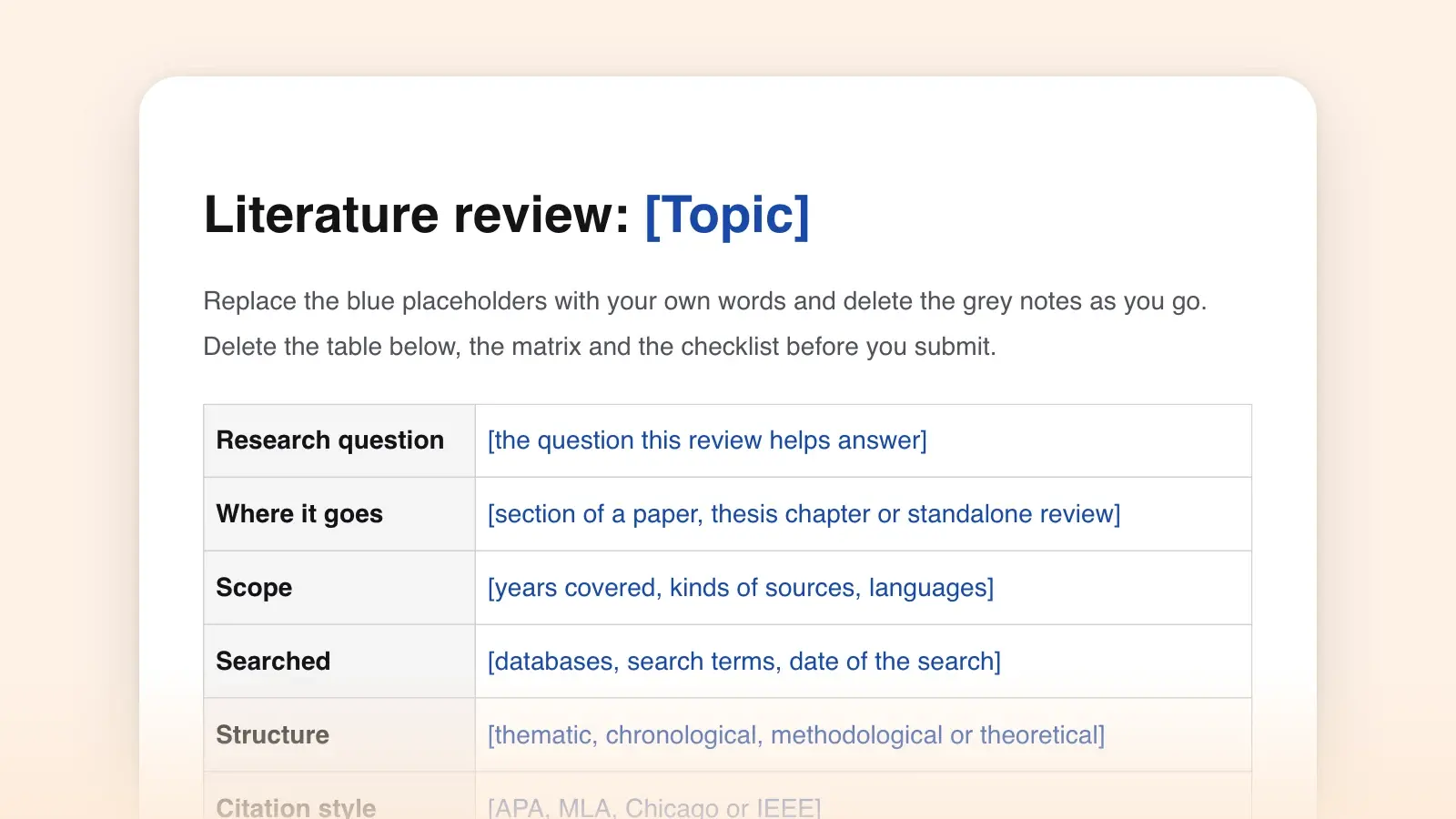
- Fill in the top table
Press “Use this template” to open it in Strokes as a document you can edit and export. Write the research question, where the review will go and its scope: the years, the kinds of sources and where you searched. The question decides what belongs in the review, and the scope tells readers what to expect. A thesis examiner will look for both.
- Build the matrix while you read
Give each source a row as soon as you decide to keep it, and each recurring theme or debate a column. Write a few words per cell in your own words, with a dash where a source says nothing. If you keep an annotated bibliography, its notes fill the matrix quickly.
- Let the columns choose the sections
A column with entries from most of your sources is a section. If the notes sort more naturally by period, method or theory, change the structure in the top table and rename the columns. Three to five sections suit most reviews.
- Write each section down its column
Read one column top to bottom and write the claim its entries support. Bring in the sources as evidence, explain where they disagree and why, and end on what the section means for your question. When a section is drafted, you can ask the Strokes Assistant to review it and point out paragraphs that rest on a single source or claims with no source behind them.
- Write the introduction and conclusion last
Once the sections are settled, the introduction can describe them in a sentence each and the conclusion can name the gap they leave. Then delete the grey notes, the top table, the matrix and the checklist.
Literature review outline
The template follows the three-part shape Purdue OWL describes, an introduction, a body and a conclusion, with the body split into sections and a section on gaps before the end. This is the outline it gives you:
Literature review outline
Literature review: [topic]

Introduction
  - The topic and why it matters now
  - The question or focus of the review
  - Scope and search: years, kinds of sources, where you searched
  - How the review is organized

Section 1: [a claim about a theme, period, method or theory]
  - Claim: what the studies show together
  - Evidence: which studies, and what each adds
  - Disagreement: which studies differ, and why
  - Strength of the evidence: designs and sample sizes
  - So what: what it means for your question

Sections 2 and 3: [the same five parts]

Gaps and open questions
  - Not yet studied, conflicting findings, missing methods

Conclusion
  - What the literature shows, in two or three sentences
  - The gap your work addresses
  - Your research question or the next step

References
The length of each part depends on where the review sits. Purdue OWL notes that inside a paper the review usually comes after the introduction and before the method, with an introduction and conclusion of only a few sentences. A thesis chapter keeps every part and ends with a short bridge to the methodology; for how many words the chapter usually gets, see how long a dissertation is. A standalone review has longer opening and closing sections and more often describes how the sources were found and selected; a systematic review adds a full method section for the search.
Outline examples by structure
The same review can be organized four ways. Write the structure you choose in the top table, then rename the section headings to match; the five parts under each heading stay the same. To decide between them, compare the finished samples in the examples guide linked above.
| Structure in the top table | Section headings for the fine-free review |
|---|---|
| Structure in the top tableThematic | Section headings for the fine-free reviewReturns: later, but not fewer · Access: who comes back · Costs: from fines to waiting lists |
| Structure in the top tableChronological | Section headings for the fine-free reviewEarly studies of fines and returns · Pilot programs and their evaluations · System-wide policies |
| Structure in the top tableMethodological | Section headings for the fine-free reviewBefore-and-after studies of one system · Comparisons across systems · Staff and patron interviews |
| Structure in the top tableTheoretical | Section headings for the fine-free reviewFines as deterrence · Fines as a barrier to access · A framework for judging fine-free policy |
APA format for a literature review
In APA Style, the paper's title at the top of the first page acts as a Level 1 heading, so the review does not begin with an "Introduction" heading. Below that, APA uses five heading levels, and most reviews need only two or three:
| Level | Format | Text begins |
|---|---|---|
| Level1 | FormatCentered, bold, title case | Text beginsAs a new paragraph |
| Level2 | FormatFlush left, bold, title case | Text beginsAs a new paragraph |
| Level3 | FormatFlush left, bold italic, title case | Text beginsAs a new paragraph |
| Level4 | FormatIndented, bold, title case, ending with a period | Text beginsOn the same line |
| Level5 | FormatIndented, bold italic, title case, ending with a period | Text beginsOn the same line |
APA recommends the past tense or the present perfect for other researchers' work: "Alvarez (2019) found," "studies have shown." For the title page of a standalone review, see the research paper title page template, and for reference entries, the APA annotated bibliography example. If your course uses another style guide, its rules replace these.
Tips for writing from the template
- Make each heading a claim. "Returns: later, but not fewer" tells the reader what the section shows. "Return rates" only names a topic.
- Put two sources in most paragraphs. Purdue OWL points out that a paragraph citing a single source usually signals summary. Synthesis brings several into the same paragraph.
- Weigh, don't count. One large comparison across systems can outweigh three single-library case studies. The design column of the matrix lets you say so.
- Quote sparingly. The UNC Writing Center advises keeping direct quotations limited. Paraphrase findings in your own words and save quotation for a definition or a phrase that can't be improved.
- Keep the matrix after you draft. When a new source turns up, its row shows which section it belongs in and whether it changes a claim.
Frequently asked questions
What is the format of a literature review?
Three parts: an introduction that states the question and scope, body sections that each synthesize several sources, and a conclusion that names the gap. Inside a paper the review is usually a few paragraphs under one heading; in a thesis it is a chapter with subheadings. In a standalone APA paper the title acts as the first heading, so the text starts without an Introduction heading. Your style guide sets the headings and citations.
How many sections should a literature review have?
As many as the main themes in your matrix, usually three to five body sections plus the introduction, a section on gaps and the conclusion. A review inside a short paper may need only one or two. If a section has only one source, fold it into another or cut it.
Can I turn an annotated bibliography into a literature review?
Yes, but not by stringing the annotations together, which produces a summary one source at a time. Move the notes into a synthesis matrix first, so each source is broken into the themes it speaks to, then write each section down a column. The annotations become evidence for claims instead of paragraphs of their own.