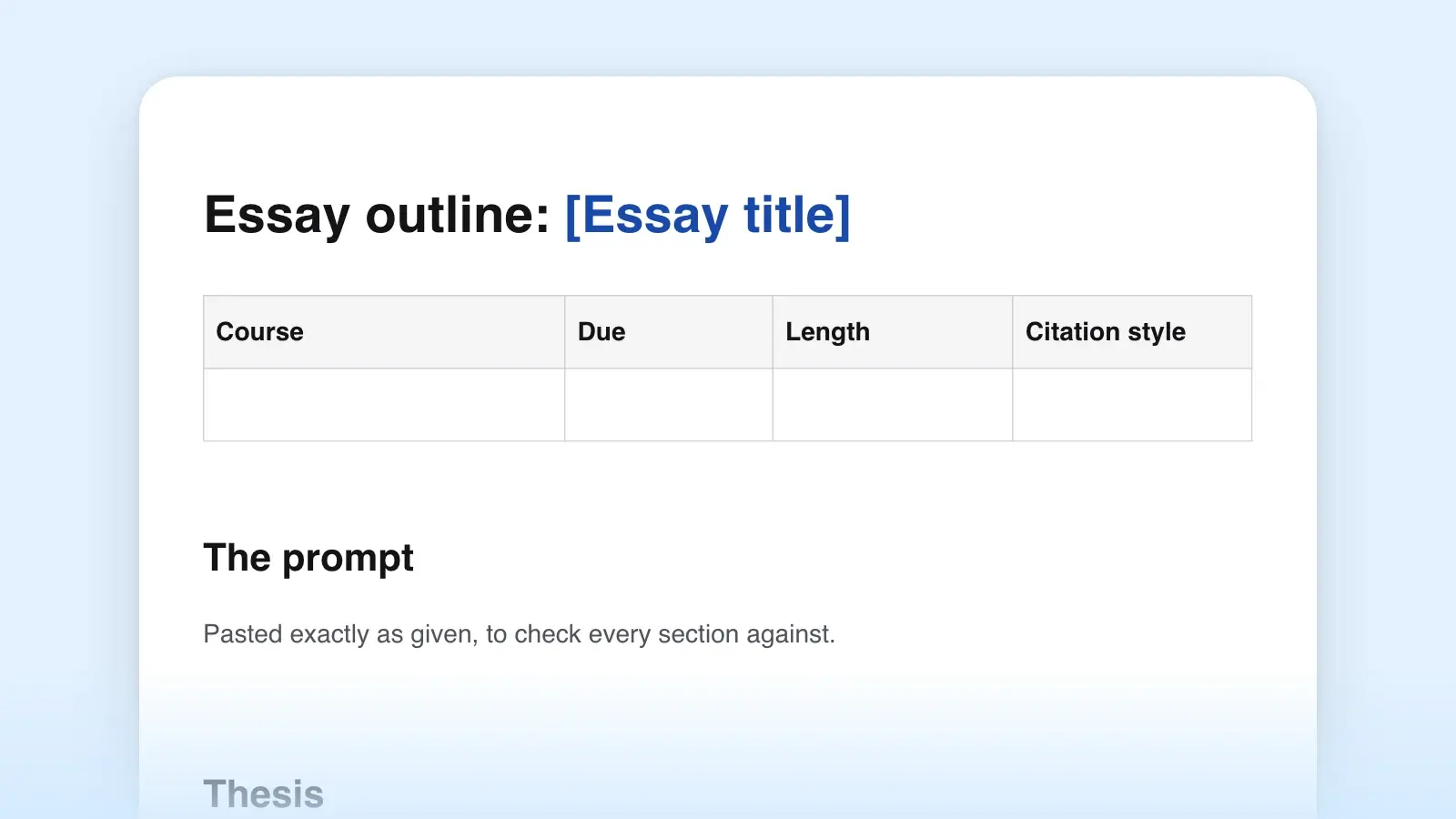
When to use it
- Argumentative and persuasive essays for school or university
- Op-eds and opinion pieces that need one clear line of argument
- Application and scholarship essays written to a word limit
- Five-paragraph essays: an introduction, three sections and a conclusion
- Long-form posts and newsletters that make a single case
How to use this template
- Write the thesis before anything else
A thesis is one sentence that someone could disagree with. "Remote work changed the office" is a topic; "Remote work made the open-plan office obsolete" is a thesis. Write it at the top of the outline and leave it there. Every other line in the document is judged by whether it supports that sentence.
- Fill each section as claim, evidence, link
Give each supporting section one claim, the evidence for it, and one line that says how the claim advances the thesis. The link line is the test: if you cannot write it in a sentence, the section belongs in a different essay. Three sections make a five-paragraph essay; use four or five when the argument needs them, never because the word count does.
- Argue against yourself
State the strongest objection to your thesis the way its best advocate would. Concede what it gets right, then show why the thesis still stands. An essay that skips this step reads as if the writer never looked up from the page.
- Draft from the outline, section by section
Each claim becomes the first sentence of its paragraph; the evidence and analysis become the sentences that follow. Draft under the outline headings, then delete the headings when the essay is complete. The structure stays even when the scaffolding is gone.
From outline to draft
- Order the sections on purpose. Put the strongest point last and the weakest in the middle, where it is least exposed. Chronological order works only when the chronology is the argument.
- Write the source next to the evidence. An author, a year and a page in the outline save an hour of searching when the draft is finished and the citations are due.
- Keep the introduction for last. The hook and the roadmap are easy to write once you know what the essay actually says, and nearly impossible before.
- Check readability after the argument is sound. Short sentences and concrete nouns make a good argument easy to follow; they cannot rescue a weak one. When the draft is done, proofread it in a separate pass so that fixing commas does not interrupt fixing logic.
Keeping the thesis in view
Drafts drift. A section that began as evidence for the thesis turns into a tour of everything you know about the subject, and the link line you wrote in the outline no longer describes what the paragraph does. The cure is mechanical: keep the thesis at the top of the document while you write, reread it before starting each section, and end each section by asking what the reader now believes that they did not believe before. If the answer is nothing, cut the section or rewrite it until the answer is the thesis.
Frequently asked questions
Is this an argumentative essay outline?
Yes. A thesis, claim-evidence-link sections and a counterargument are the structure of an argumentative or persuasive essay. For an expository essay, keep the sections and rename Counterargument to Limits, or remove it.
Can I use it as a five paragraph essay outline?
Yes. The introduction, three supporting sections and the conclusion are the five paragraphs. Fold the counterargument into the third section, or leave it out when the assignment does not ask for one.
How many supporting sections should an essay have?
Three is the default and five is the practical limit. Each section carries one claim. If a section needs two claims, split it; if two sections share a claim, merge them.
Which download should I use?
The .docx opens in Word or Google Docs with real headings, ready for a submission. The .md works in any plain-text editor and in Strokes, where the outline and the draft can live in one document.