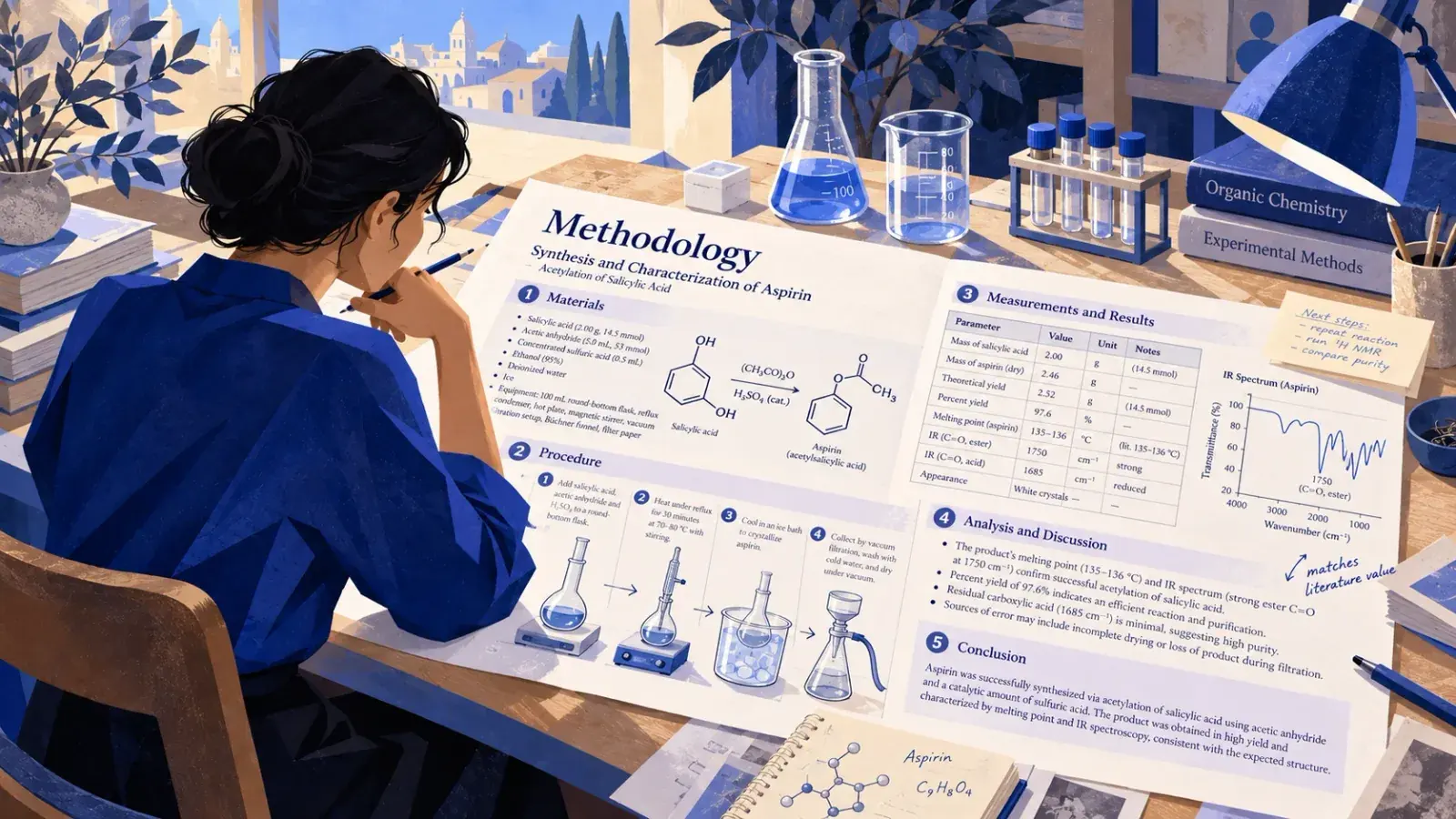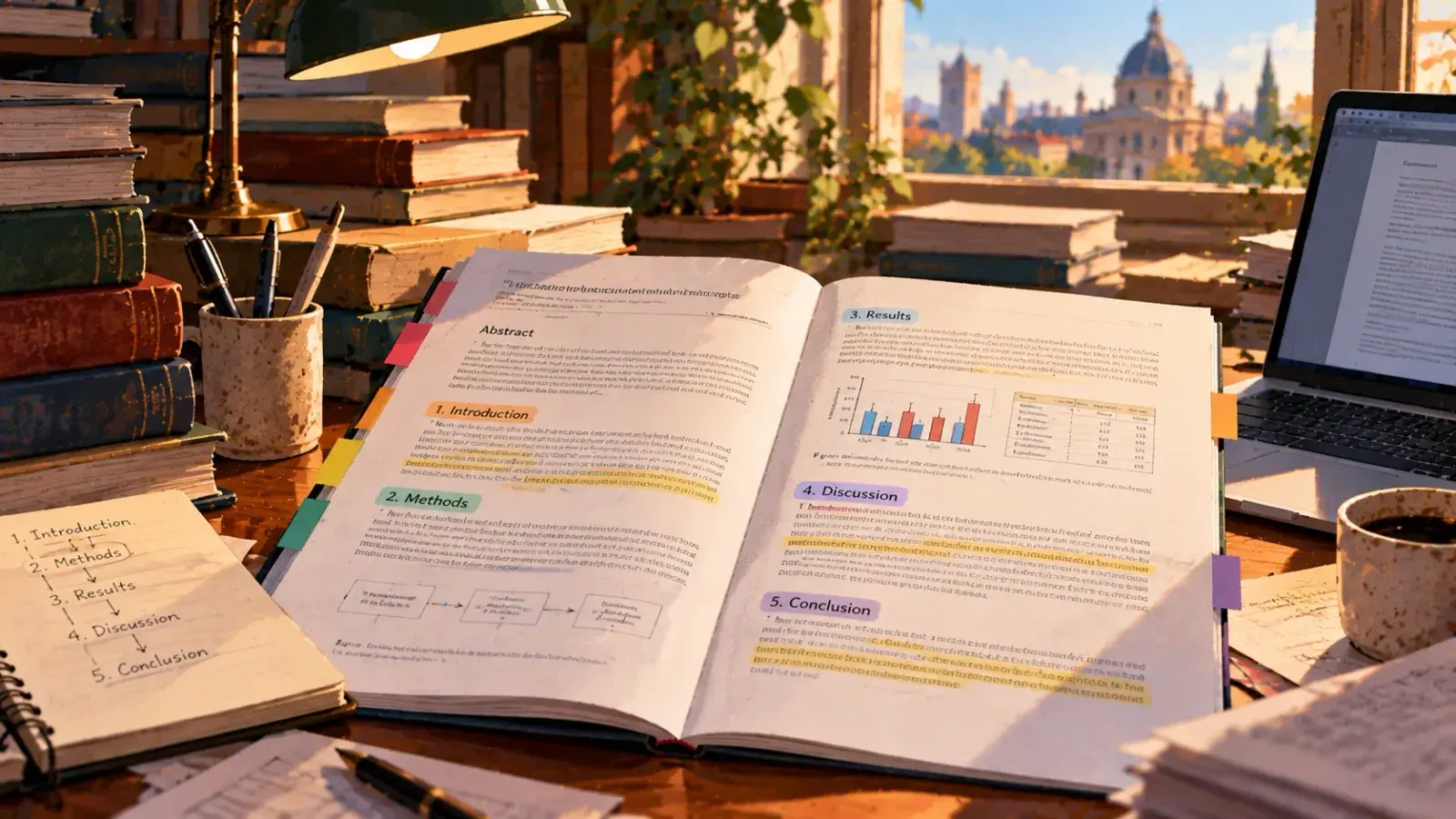
A research paper reports one question, how you answered it, what you found and what the finding means. In the sciences and social sciences that report almost always follows the IMRaD format: Introduction, Method, Results and Discussion, with a title and abstract in front and references at the end. Each section has one job, and a weak paper usually has a section doing another's.
Below is a complete short example paper, a fictional study of proofreading, with a note after each section on what it does and why. After it come weak and strong versions of the sentences students most often get wrong, how a humanities research paper differs, and an order for drafting your own.
The structure at a glance
IMRaD is younger than it looks. A 2004 survey of four leading medical journals in the Journal of the Medical Library Association found that it first appeared in the 1940s, was used by about 80% of articles by the 1970s and was the only structure for original research by the 1980s. Lab reports and social science courses now expect it too, because readers skim research papers in a predictable way: title, abstract, then whichever section they need.
| Section | Answers | Tense | Contains |
|---|---|---|---|
| SectionTitle | AnswersWhat is this about? | TenseNone | ContainsVariables, population, sometimes the finding |
| SectionAbstract | AnswersWhat happened, in one paragraph? | TensePast for the study, present for conclusions | ContainsOne or two sentences per section |
| SectionIntroduction | AnswersWhy ask this question? | TensePresent for what is known, past for specific studies | ContainsContext, gap, question or hypotheses |
| SectionMethod | AnswersWhat did you do? | TensePast | ContainsParticipants, materials, procedure, analysis |
| SectionResults | AnswersWhat did you find? | TensePast | ContainsNumbers, tables, tests; no interpretation |
| SectionDiscussion | AnswersWhat does it mean? | TensePresent for meaning, past for your results | ContainsAnswer, comparison, limitations, implications |
| SectionReferences | AnswersWhose work did you use? | TenseNone | ContainsEvery source cited in the text, nothing else |
The example paper, annotated
The paper follows APA, the style guide most psychology and social science courses use. APA student papers have a title page, the text and a reference list; an abstract is included only when the instructor asks for one, so treat it here as optional. At about 1,000 words the sample is far shorter than a real paper, but every section does its full job.
Title page
Reading Aloud Catches More Proofreading Errors but Costs Time
Maya Okafor
Department of Psychology, Example State University
PSYC 301: Research Methods
Dr. Daniel Reyes
March 4, 2026
What it does. The title names the variable, the outcome and the trade-off in nine words. A descriptive title ("Proofreading Aloud Versus Silently: Error Detection in Undergraduate Readers") is the safer choice when results are mixed. An APA student title page also carries the course, instructor and due date, with only a page number in the header: no running head and no author note.
Abstract
Reading a draft aloud is common proofreading advice. This study measured what it catches and what it costs. Forty-eight undergraduates proofread two 600-word passages, each seeded with 20 errors, once aloud and once silently, in counterbalanced order. Participants detected more errors when reading aloud (M = 13.1 of 20) than silently (M = 10.4), a large effect, but took about 35% longer. Two thirds of the advantage came from missing and repeated words; spelling detection barely changed. Errors found per minute did not differ between conditions. Reading aloud appears to help most with errors that silent readers skim past, and part of its benefit may come from reading more slowly. For short, high-stakes texts it is worth the time.
Keywords: proofreading, reading aloud, error detection, production effect
What it does. Five moves in one paragraph: the problem, what was done, the main result with its number, the result that complicates it, and what it means. It runs about 120 words; APA abstracts are typically no longer than 250. Write it last, and check every figure against the Results. There is more on the form in how to write an abstract.
Introduction
Writers are often told to read their drafts aloud before handing them in. The advice is plausible. Silent reading is fast partly because skilled readers do not give every word equal attention: when people search a passage for the letter t, they miss it more often in the word the than in other words, an effect Healy (1976) traced to how frequent the word is. Very common words seem to be read as whole units, which is efficient for comprehension and bad for catching a doubled the or a missing of.
Speaking may change that. In a series of recognition experiments, MacLeod et al. (2010) found that words read aloud during study were remembered better than words from the same list read silently, and attributed the gain to spoken words becoming more distinctive. If saying a word forces attention onto it, reading aloud should catch errors that silent reading glides over. Neither line of work, however, measured proofreading itself, and neither says what the extra attention costs in time.
The present study compared aloud and silent proofreading in the same readers. We predicted that (a) participants would detect more errors when reading aloud, (b) the advantage would be largest for word-level errors, and (c) reading aloud would take longer.
What it does. The funnel in three paragraphs: a familiar practice, two findings that explain why it might work, the gap neither covers, and hypotheses specific enough to fail. Each source is paraphrased and used as evidence for a claim, not summarized for its own sake. In APA the introduction has no heading; the paper's title repeats at the top of the first page of text instead.
Method
Method
Participants
Forty-eight undergraduates (34 women, 13 men, 1 nonbinary; age M = 20.3 years, SD = 1.9) took part for course credit. All were fluent readers of English. The university's institutional review board approved the study, and all participants gave written informed consent.
Materials
We wrote two expository passages of 600 words each, one on urban beekeeping and one on the history of the paperback. Each contained 20 seeded errors: eight spelling errors (e.g., recieve), six grammar errors (subject–verb agreement and tense), and six word-level errors (a missing or repeated word). Errors were spread evenly through each passage, with none in the first or last sentence.
Procedure
Each participant proofread both passages alone in a quiet room, one aloud and one silently. The order of the conditions and the pairing of passage with condition were counterbalanced across participants. Participants marked every error they found on a printed copy, took as long as they needed, and started and stopped a timer themselves.
Analysis
A hit was a mark on or beside a seeded error. We compared conditions with paired-samples t tests (α = .05) and report Cohen's d computed on the difference scores.
What it does. It gives enough detail for someone else to repeat the study: who took part, what they read, what happened in what order, and how answers were scored. The counterbalancing sentence answers the obvious objection (people get better at the second passage) before a reader raises it. Everything is in the past tense. In APA, Method is a level 1 heading (centered, bold) and its parts are level 2 (flush left, bold). For qualitative designs and other quantitative ones, see these methodology section examples.
Results
Results
Participants detected more errors when reading aloud (M = 13.1, SD = 2.9) than when reading silently (M = 10.4, SD = 3.2), t(47) = 6.03, p < .001, d = 0.87, a large effect by Cohen's (1988) conventions. Table 1 shows detection by error type. The difference was largest for word-level errors (4.2 vs. 2.4 of 6) and smallest for spelling errors (5.0 vs. 4.7 of 8).
Reading aloud took longer (M = 9.6 min, SD = 1.8) than reading silently (M = 7.1 min, SD = 1.5), t(47) = 10.19, p < .001. Errors detected per minute did not differ reliably between conditions (aloud M = 1.38, silent M = 1.47), t(47) = 1.12, p = .27. False alarms were rare in both conditions (M = 0.6 per passage).
| Error type (number seeded) | Aloud, M (SD) | Silent, M (SD) |
|---|---|---|
| Error type (number seeded)Spelling (8) | Aloud, M (SD)5.0 (1.4) | Silent, M (SD)4.7 (1.5) |
| Error type (number seeded)Grammar (6) | Aloud, M (SD)3.9 (1.2) | Silent, M (SD)3.3 (1.3) |
| Error type (number seeded)Missing or repeated word (6) | Aloud, M (SD)4.2 (1.1) | Silent, M (SD)2.4 (1.3) |
| Error type (number seeded)Total (20) | Aloud, M (SD)13.1 (2.9) | Silent, M (SD)10.4 (3.2) |
What it does. The numbers answer the three hypotheses in the order the introduction stated them, and not one sentence says why. Each test is reported in full (statistic, degrees of freedom, value, p and an effect size), and the text points to the table instead of repeating every cell. The per-minute result goes in even though it complicates the story.
Discussion
Discussion
Reading aloud helped. Participants caught about three more of 20 errors when they spoke the text, and as predicted the gain came mostly from missing and repeated words. This fits the view that silent readers take in common words as units (Healy, 1976): a doubled the passes unnoticed when the eye takes in the phrase, but not when the mouth has to say it twice.
The time cost limits how far that conclusion reaches. Reading aloud was about 35% slower, and per minute of effort the two methods found errors at a similar rate. Part of the benefit may come from slower reading rather than from speaking. A follow-up should hold time constant, for example by having silent readers point to each word, to separate pace from production.
Three limitations apply. The errors were seeded by the researchers and may be easier to find than the errors writers actually make. Participants checked someone else's text, while writers usually check their own, where they already know what each sentence is meant to say. And the passages were short; fatigue may change the picture over a 20-page paper.
For short, high-stakes texts, such as an application essay or an abstract, the extra minutes are a fair price. For long documents, a silent pass for spelling and grammar followed by an aloud pass over the sections that matter most may give most of the benefit for less time.
What it does. It opens by answering the question in plain words, ties the finding back to a source from the introduction, takes the inconvenient result seriously, and names limitations that belong to this study rather than "more research is needed." The closing advice is scaled to the evidence. Some fields add a separate Conclusion section; see how to write a conclusion for a research paper.
References
References
Cohen, J. (1988). Statistical power analysis for the behavioral sciences (2nd ed.). Lawrence Erlbaum Associates.
Healy, A. F. (1976). Detection errors on the word the: Evidence for reading units larger than letters. Journal of Experimental Psychology: Human Perception and Performance, 2(2), 235–242. https://doi.org/10.1037/0096-1523.2.2.235
MacLeod, C. M., Gopie, N., Hourihan, K. L., Neary, K. R., & Ozubko, J. D. (2010). The production effect: Delineation of a phenomenon. Journal of Experimental Psychology: Learning, Memory, and Cognition, 36(3), 671–685. https://doi.org/10.1037/a0018785
What it does. Every source cited in the text appears here, and nothing else does. Entries are alphabetical by first author, with the DOI written as a link; in the real paper each entry also gets a hanging indent. Check every DOI yourself: it should open the paper you cite.
Weak and strong versions
Most feedback on student research papers lands on a handful of sentences. Here are weak and strong versions of each, using the sample study.
Weak: A Study of Proofreading
Names a topic, not the variables, the readers or the result.
Strong, descriptive: Proofreading Aloud Versus Silently: Error Detection in Undergraduate Readers
Strong, declarative: Reading Aloud Catches More Proofreading Errors but Costs Time
Weak: Little research has been done on proofreading.
Unsupported, and it invites a reader to list the studies you missed.
Strong: Neither line of work, however, measured proofreading itself, and neither says what the extra attention costs in time.
Names the specific limit of the specific sources just cited.
Weak: Reading aloud was much better, because speaking forces attention onto every word.
"Much better" replaces a number, and the "because" belongs in the Discussion.
Strong: Participants detected more errors when reading aloud (M = 13.1) than silently (M = 10.4), t(47) = 6.03, p < .001.
Weak: This proves that everyone should proofread aloud. The sample was small and more research is needed.
One study of 48 students proves nothing about everyone, and the limitation could close any paper.
Strong: For short, high-stakes texts, the extra minutes are a fair price. The errors were seeded by the researchers and may be easier to find than the errors writers actually make.
The claim matches the conditions tested, and the limitation says which way it could bend the result.
When the paper isn't IMRaD
Many first-year writing and humanities courses use "research paper" for an argument built from sources rather than a report of your own study. The research is reading, and the parts change.
| Feature | Empirical paper (IMRaD) | Argumentative research paper |
|---|---|---|
| FeatureCore claim | Empirical paper (IMRaD)An answer to a question, from your data | Argumentative research paperA thesis, defended with sources |
| FeatureSections | Empirical paper (IMRaD)Labeled: Method, Results, Discussion | Argumentative research paperUsually unlabeled, ordered by the argument |
| FeatureEvidence | Empirical paper (IMRaD)Your own measurements | Argumentative research paperQuotations, data and scholarship |
| FeatureCommon styles | Empirical paper (IMRaD)APA in psychology and social sciences | Argumentative research paperMLA in literature, Chicago in history |
| FeatureSource list | Empirical paper (IMRaD)References | Argumentative research paperWorks Cited (MLA), Bibliography (Chicago) |
| FeatureTitle page | Empirical paper (IMRaD)Yes, in APA | Argumentative research paperNot in MLA unless requested |
Here is the same topic as an argumentative paper. The sources are identical; what changes is that they now support a thesis instead of framing an experiment.
"Read your draft aloud" is among the most familiar pieces of proofreading advice, offered by teachers and writing centers as a near-universal fix. Research on reading suggests the advice is right for a narrower reason than its fans assume. Alice Healy's letter-detection experiments showed that readers take in very common words as wholes, and Colin MacLeod and colleagues found that words spoken aloud are remembered better than words read silently. Together these findings explain why reading aloud should catch a doubled the or a dropped of, and why it should add little for a misspelling the eye already flags. Reading aloud is best treated not as a general cure but as a targeted check for the word-level errors that silent reading is built to miss.
The thesis is the last sentence, and each body section would defend one part of it.
How to write your own
Read a paper top to bottom; write it in a different order. Each section is easier once the one it depends on exists. If you want the skeleton as a document first, start from the research paper outline template.
- Fix the question in one sentence
Write the question, and your prediction if you have one, before anything else. "Does reading aloud catch more errors, and at what cost?" decides what you measure and what the paper leaves out. These research question examples show how narrow is narrow enough.
- Write the method as you work
Record details while they happen: how you recruited, what you changed, who dropped out and why. Turning notes into a past-tense Method later is quick. Reconstructing them from memory is slow, and something is always missing.
- Build tables, then results sentences
Decide which three or four numbers answer the question, put the full data in a table, and write sentences that report the key comparisons in order of the hypotheses. No explanations yet.
- Draft the discussion
Answer the question in the first sentence, compare the result with the sources you plan to cite, name the limitations that could change it, and say what follows. Keep claims the size of the evidence.
- Write the introduction to fit
Now you know what the paper delivers, so build the funnel toward it: context, the gap your results address, the question. Cut any background the discussion never returns to.
- Finish with the abstract, title and references
Summarize each section in a sentence or two, check every number against the Results, then choose the title. Finally, check the references both ways: every citation is in the list, and every entry in the list is cited.
Drafting a paper in Strokes
Strokes is a desktop editor that keeps documents as files on your own machine. For a research paper, a project folder can hold the draft beside your notes, sources and outline. Page view shows real pages with margins and page numbers, and the paper exports to Word or PDF for submission. Version history saves versions as you go, so the draft you sent your instructor is still there after you rebuild the discussion.
The AI Assistant is most useful here as a checker. Add the paper to a chat and ask whether every claim in the Discussion is backed by a number in the Results, or whether the abstract's figures match Table 1. In Agent mode it shows what it read and what it would change, and you accept each edit yourself. Check your course's policy on AI tools before you start.
Frequently asked questions
What are the main parts of a research paper?
An empirical research paper has a title, an abstract, an introduction, a method section, results, a discussion and references, often with tables, figures and appendices. Some fields add a separate conclusion. An argumentative research paper in the humanities has an introduction with a thesis, body sections organized by the argument, a conclusion and a list of works cited.
Does a student research paper need an abstract?
In APA style, abstracts are not typically required for student papers unless the instructor asks for one. When you include one, APA says it should typically be no more than 250 words. Journals set their own limits, so check the author guidelines.
How long should a research paper be?
The assignment or the journal decides. Course papers are usually set in pages and journal articles in words. If you have no guidance, make every section complete and no longer than its job requires; the method and results are rarely where you should cut.
Can I use this example paper for my assignment?
Use it to learn the structure, not as content. The study and its data are invented, and your school, instructor or journal sets the format and citation style. Your own paper needs your own question, data and sources.