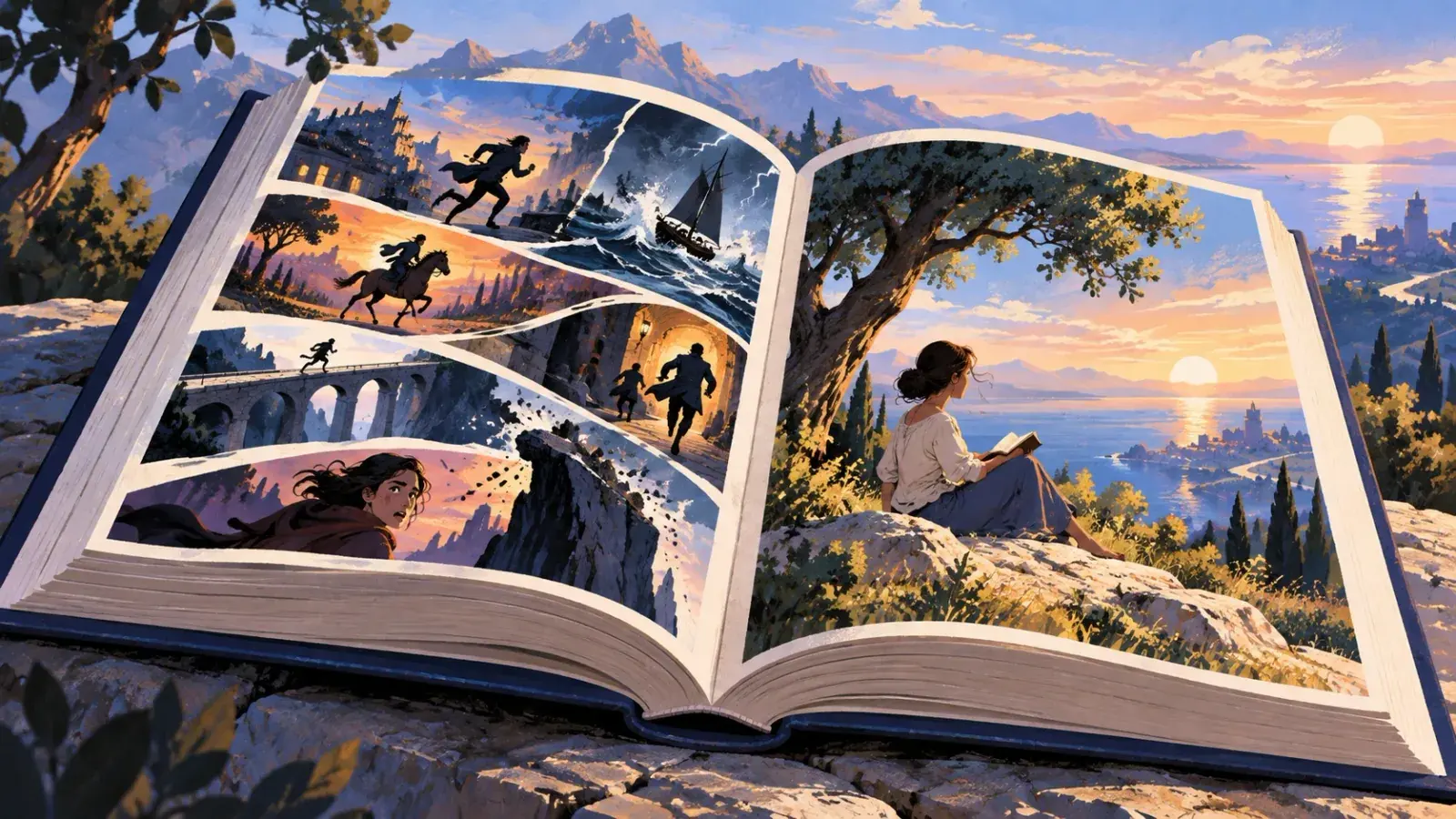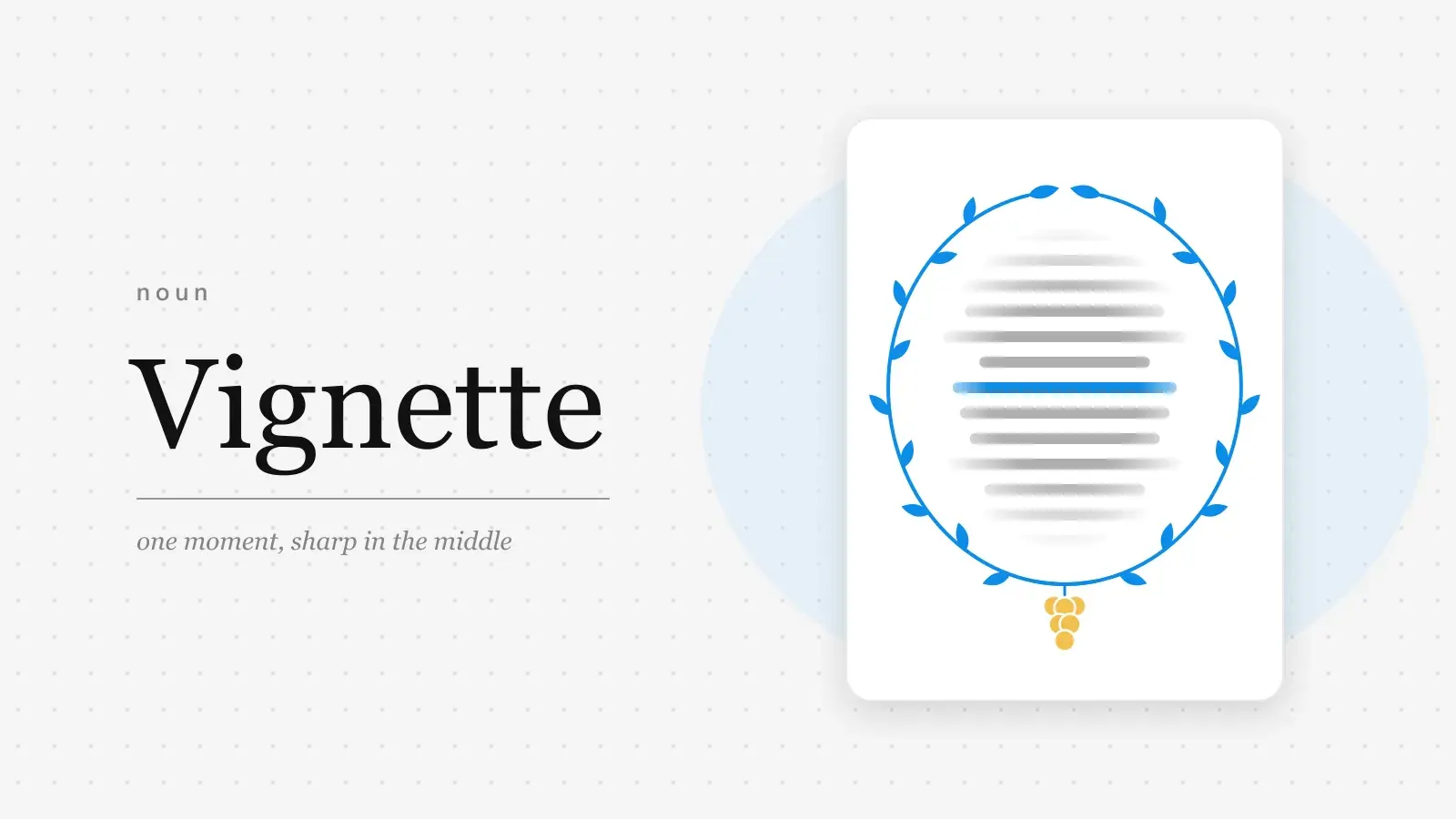
A vignette is a short piece of writing that captures a single moment, person, place or mood in close detail, with little or no plot. It shows a slice of experience instead of telling a complete story: nothing needs to be resolved, and often nothing much happens.
There is no set length. Most vignettes run from a single paragraph to a few pages, usually well under 1,000 words. A vignette can stand alone, gather with others into a book, or sit inside a longer work as a pause between chapters. It's pronounced vin-YET.
The word is French for "little vine." In early printed books a vignette was the vine-leaf ornament on a title page or at the head or foot of a chapter, and English took it over as a printers' term. By the mid-1800s it also named a picture, often a small photographic portrait, whose edges fade into the paper, and by about 1880 a short literary sketch. The photograph is the useful image to keep in mind: a vignette is sharp in the middle and lets the edges go soft.
Vignette examples in literature
A vignette is easier to recognize than to define, so the first one is quoted whole. Like the two after it, it is in the US public domain.
They shot the six cabinet ministers at half-past six in the morning against the wall of a hospital. There were pools of water in the courtyard. There were wet dead leaves on the paving of the courtyard. It rained hard. All the shutters of the hospital were nailed shut. One of the ministers was sick with typhoid. Two soldiers carried him downstairs and out into the rain. They tried to hold him up against the wall but he sat down in a puddle of water. The other five stood very quietly against the wall. Finally the officer told the soldiers it was no good trying to make him stand up. When they fired the first volley he was sitting down in the water with his head on his knees.
No names, no politics, no aftermath. Hemingway drew on news of the execution of six Greek officials in November 1922 and kept only what a witness would see: the rain, the nailed shutters, a sick man who cannot stand. It was the last of six pieces, 75 to 187 words each, that ran in The Little Review in 1923. In the 1925 American edition, In Our Time, most of the book's eighteen vignettes became short interchapters between the stories.
An occasional policeman may alone be seen at the street corners, listlessly gazing on the deserted prospect before him; and now and then a rakish-looking cat runs stealthily across the road and descends his own area with as much caution and slyness—bounding first on the water-butt, then on the dust-hole, and then alighting on the flag-stones—as if he were conscious that his character depended on his gallantry of the preceding night escaping public observation.
Dickens wrote these sketches for London papers and magazines between 1833 and 1836 and collected them in 1836. Most are portraits of places and types rather than stories. This one opens an hour before sunrise on a summer morning and stays until eleven, when the streets are full. Nobody in it wants anything except the cat, who wants to get home unseen. The subject is the hour itself.
The pointed fingers of glass hang downwards. The light slides down the glass, and drops a pool of green.
Two pieces of under 150 words each, one per color. In "Green," the light through a chandelier's glass drops turns into parakeets, palm blades, pools on the marble and an empty sea, until night comes and "The green's out." There is no character and no event. This is the vignette at the edge of the prose poem, held together by an image instead of a moment.
Forty-four short pieces, some a paragraph or two long and some a few pages, narrated by Esperanza Cordero, a young Chicana girl growing up in a Latino neighborhood of Chicago. The first sets the family's new house against the house they always said they would have one day. Each piece stands on its own. Read in order, they add up to a coming-of-age novel: Esperanza changes between the first page and the last, though no single vignette shows her changing.
India Bridge, a wife and mother of three in Kansas City between the world wars, appears in 117 brief episodes arranged in order from the 1920s to the early 1940s. Most turn on the kind of small moment a conventional novel would skip. None is a plot point. What the book has to say about her life shows only when the pieces pile up.
How to write a vignette
- Pick a moment that lasts minutes, not days. A kitchen at closing time, a station platform, a hand on a door. If your notes need the word "then" more than twice, the moment is too long.
- Choose one point of view and stay there. A vignette is what one observer notices, which is how it reveals that observer without saying anything about them.
- List every concrete detail, then keep three or four. Keep the ones that belong only to this moment: the minister with typhoid, not just the rain.
- Cut the backstory and the explanation. If the reader needs a fact, put it in an object. This is show, don't tell at its smallest scale.
- End on an image or a gesture, not a conclusion. The last line should be the most concrete one in the piece.
In your manuscript
Novelists use vignettes between chapters to widen the frame (another place, another year) or to give the reader a breath after a big scene. Because nothing advances in them, they slow a book down. The guide to pacing in writing covers when that helps. A single vignette can also introduce a character through one telling moment instead of a paragraph of history. In memoir the form comes almost naturally, because memory returns as moments rather than as plot. The guide on how to write a memoir covers structuring a book that way.
Four ways it goes wrong:
- The moral at the end. A last sentence that explains what the moment meant cancels the reason for writing it as a vignette.
- The adjective pile. Description with no observer behind it turns into purple prose. Every detail should be one this person, here, would notice.
- Too many in a row. Three vignettes between two scenes stall a novel. In a collection, give them a common thread: a place, a person or a recurring object, a motif.
- A scene in disguise. If someone makes a decision that the rest of the book depends on, write it as a scene with stakes. The scene outline template walks through goal, conflict and outcome.
Before. My grandmother lived in that house for forty years. When she finally sold it she was heartbroken, though she tried not to show it, and she spent the last day walking through the rooms remembering everything that had happened there.
After. The buyers' agent has left the front door open. Grandma stands in the empty kitchen in her coat and reads the note she taped inside the cupboard the year they moved in, the tape gone the color of tea: Pilot light sticks. Jiggle twice. She works the tape loose with a thumbnail so the paper won't tear, folds the note in half and puts it in her purse, next to the keys she has to hand over at four.
The second version never says heartbroken and never says forty years. The tape carries both. It covers about a minute, and it ends on a gesture.
Vignette vs. short story and flash fiction
The quickest test is what has changed by the last line. In a story, something has. In a vignette, usually only the reader's understanding has.
| Form | What it does | How it usually ends |
|---|---|---|
| FormVignette | What it doesCaptures one moment, place, person or mood | How it usually endsOn an image or a gesture |
| FormFlash fiction | What it doesTells a complete story in very few words | How it usually endsOn a turn or a twist |
| FormShort story | What it doesTakes a conflict through to a resolution | How it usually endsOn a change that lasts |
| FormScene | What it doesMoves a longer plot forward | How it usually endsOn a change that leads to the next scene |
| FormProse poem | What it doesWorks by sound and image, without line breaks | How it usually endsWhere the rhythm closes |
Flash fiction is the closest neighbor and the usual mix-up. A 300-word flash piece still has a character who wants something and a turn near the end. Take out the turn, keep the moment, and you have a vignette. A scene in a novel has to change something: a goal is blocked, a secret comes out. A vignette dropped into a novel may change nothing, which is why it slows the pace. Sketch is the older word for much the same thing, usually a portrait of a place or a social type, as in Dickens.
Other meanings of vignette
Outside fiction, the word keeps its older senses. In photography, vignetting is a fade or darkening toward the corners of a picture, caused by the lens or added on purpose. In book design a vignette is still a small ornament or illustration with no frame around it. In film and television it is a short self-contained scene, and anthology films are often described as strings of them. In psychology, medicine and survey research, a vignette is a brief hypothetical case that people are asked to judge or respond to.
Related terms: flash fiction, the nearest form that does need a plot, and juxtaposition, the reason a sequence of vignettes adds up to more than its parts. If you are building a memoir out of vignettes, the memoir outline template has room to group them by subject instead of by date.