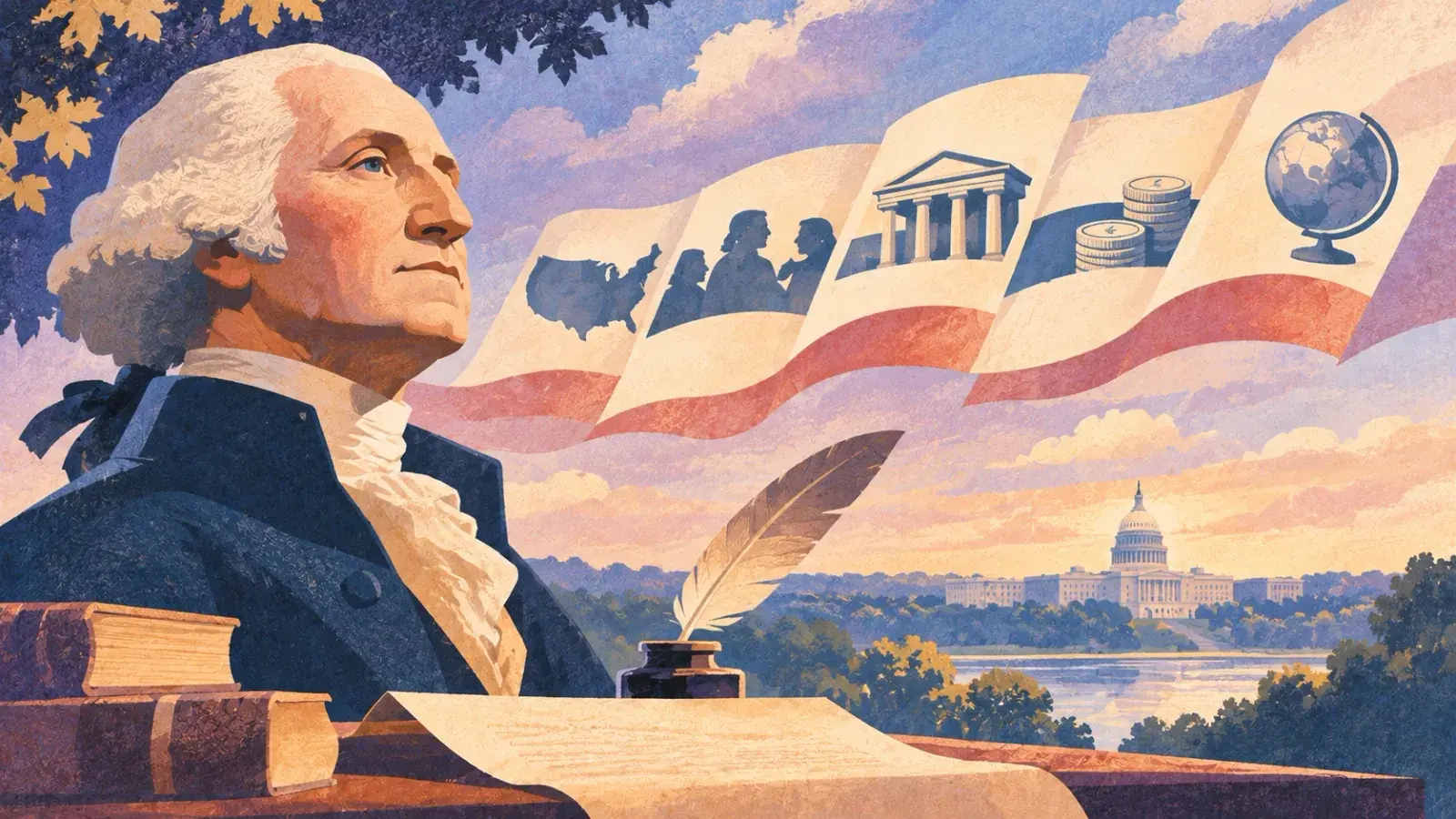
In 1796, George Washington published his Farewell Address as a letter to Americans rather than a speech. It appeared in a Philadelphia newspaper, Claypoole's American Daily Advertiser, on September 19, as the election to choose his successor approached, and other papers reprinted it. In 7,641 words, by the Senate's count, it announces that he will not seek a third term and then offers advice that this reading groups into five themes: keep the Union, distrust the spirit of party, keep religion, morality and knowledge strong, guard the public credit, and stay clear of permanent alliances abroad.
Below: how Washington, Madison and Hamilton drafted it, how it is built, the five themes in Washington's own words, how the prose persuades, three common misreadings, and the Senate's yearly reading. The address is in the public domain, so it is quoted at length from the Senate's edition, which prints Washington's final manuscript with spelling, capitalization and punctuation modernized. Other editions differ in small ways, so cite the one you quote.
The Farewell Address at a glance
| Fact | Detail |
|---|---|
| FactPublished | DetailSeptember 19, 1796, in Claypoole's American Daily Advertiser, Philadelphia; dated September 17 |
| FactOpens | Detail“Friends and Fellow-Citizens” |
| FactLength | Detail7,641 words, by the Senate's count |
| FactDrafting | DetailWashington's ideas, a 1792 draft by James Madison, a 1796 reorganization by Alexander Hamilton, read over by John Jay |
| FactManuscript | DetailWashington's final copy, kept by the printer David C. Claypoole, now in the New York Public Library |
| FactRead today | DetailIn the US Senate near Washington's birthday, February 22; every year since 1896 |
How Washington, Madison and Hamilton drafted it
Washington had meant to retire four years earlier, and he says so in the address: “The strength of my inclination to do this, previous to the last election, had even led to the preparation of an address to declare it to you; but mature reflection on the then perplexed and critical posture of our affairs with foreign nations, and the unanimous advice of persons entitled to my confidence, impelled me to abandon the idea.” The address he had prepared in 1792 was drafted by James Madison, who sent it with a letter dated June 20, 1792.
In 1796 Washington put together a new draft of his own: a short introduction, Madison's text quoted in full, and further thoughts prompted, as he put it, by “considerable changes having taken place both at home & abroad.” He had talked the plan over with Alexander Hamilton, his former Treasury secretary, in February, and in May sent him the draft with leave “to throw the whole into a different form.” Hamilton did, and the editorial note in the Papers of George Washington lays out what followed.
| Date | Step |
|---|---|
| DateJune 20, 1792 | StepMadison sends Washington a draft farewell. Washington stays for a second term. |
| DateFebruary 1796 | StepWashington discusses a farewell address with Hamilton in Philadelphia. |
| DateMay 15, 1796 | StepWashington sends Hamilton his new draft, which quotes Madison's in full, to revise or recast. |
| DateJuly 30, 1796 | StepHamilton sends Washington his reorganized version. Hamilton and John Jay had gone through it “paragraph by paragraph.” On August 10 Hamilton also sends a lighter revision of Washington's own draft. |
| DateAugust 25, 1796 | StepWashington picks the reorganized version and returns it for more work, ready to “expunge all that is marked in the paper as unimportant.” |
| DateSeptember 1–5, 1796 | StepWashington asks for a passage on education; Hamilton adds a short paragraph. |
| DateSeptember 15, 1796 | StepWashington, having written the final copy in his own hand, shows it to the cabinet and arranges publication with David C. Claypoole. |
| DateSeptember 19, 1796 | StepThe address appears in Claypoole's paper, dated September 17, then in papers across the country. |
Washington chose the medium as carefully as the words. He addressed the country, not Congress, and in a newspaper he could be read in every state in his own phrasing. Claypoole certified in 1826 that at the proof stage Washington made “but few alterations from the original, except in the punctuation, in which he was very minute.” When the printer asked to keep the manuscript, Washington agreed. That copy is the one the New York Public Library holds today.
Who wrote it, then? The editors' answer is a fair one: the ideas are Washington's, the structure Hamilton's, and the language “some indeterminable combination of the two,” with contributions from Jay and Madison and every word subject to Washington's approval. He cut what he judged unimportant and asked for what he found missing.
Madison drafted it, Hamilton rebuilt it, Jay read it, and Washington made every final call.
How the address is built
The address has no headings, but it moves in clear blocks. A personal opening and a personal close frame a long body of advice.
| Part | What Washington does | A line to know |
|---|---|---|
| Part1. The decision | What Washington doesDeclines a third term and explains why now | A line to know“the shade of retirement is as necessary to me as it will be welcome” |
| Part2. The turn to advice | What Washington doesPresents his counsel as disinterested | A line to know“the disinterested warnings of a parting friend” |
| Part3. The Union | What Washington doesShows each region needs the others | A line to know“The name of American … must always exalt the just pride of patriotism” |
| Part4. Government and party | What Washington doesThe Constitution binds until the people change it; parties, especially regional ones, endanger it | A line to know“A fire not to be quenched” |
| Part5. Character and knowledge | What Washington doesReligion and morality as supports of government; education | A line to know“indispensable supports” |
| Part6. Public credit | What Washington doesBorrow little, repay in peace, accept taxes | A line to know“the burden which we ourselves ought to bear” |
| Part7. Foreign relations | What Washington doesGood faith with all, attachment to none | A line to know“steer clear of permanent alliances” |
| Part8. His record | What Washington doesNeutrality since 1793 as the key to his policy | A line to know“the index to my plan” |
| Part9. Farewell | What Washington doesAdmits probable errors, looks forward to private life | A line to know“the ever favorite object of my heart” |
Read the advice in order and it moves outward. It starts with what binds citizens to each other, the Union, then turns to the government they share, then to the character of the people who run it, then to money, and only then to the rest of the world. In this reading each ring depends on the one inside it, and the argument for staying out of European wars arrives last, on top of everything before it.
Five themes, in his words
Keep the Union
Washington starts with the Union, and he argues for it from interest as much as feeling: “The unity of government which constitutes you one people is also now dear to you. It is justly so; for it is a main pillar in the edifice of your real independence, the support of your tranquility at home, your peace abroad, of your safety, of your prosperity, of that very liberty which you so highly prize.” Then the appeal to identity: “The name of American, which belongs to you in your national capacity, must always exalt the just pride of patriotism more than any appellation derived from local discriminations.”
He goes region by region, showing what the North gains from the South, the East from the West, and he names the danger plainly: parties defined by “geographical discriminations—northern and southern—Atlantic and western.”
Distrust the spirit of party
This warning is more careful than its reputation. Washington opens broadly: “Let me now take a more comprehensive view and warn you in the most solemn manner against the baneful effects of the spirit of party, generally.” Party spirit, he says, “serves always to distract the public councils and enfeeble the public administration,” and “opens the door to foreign influence and corruption.”
Then he concedes the other side: “There is an opinion that parties in free countries are useful checks upon the administration of the government and serve to keep alive the spirit of liberty. This within certain limits is probably true.” In a monarchy, he allows, patriotism may look on party “with indulgence, if not with favor.” But “in governments purely elective, it is a spirit not to be encouraged.” The image that closes the passage is about control, not abolition: “A fire not to be quenched, it demands a uniform vigilance to prevent its bursting into a flame, lest instead of warming it should consume.”
The address never names a party. By 1796 party lines had already formed in Congress and the press, and readers knew it, but the text speaks only of the spirit, which is one reason later readers have been able to apply it to their own times.
Keep religion, morality and knowledge strong
“Of all the dispositions and habits which lead to political prosperity, religion and morality are indispensable supports.” The argument is political, about what self-government needs, and it is pressed in a characteristic understatement: “And let us with caution indulge the supposition that morality can be maintained without religion.”
The passage on education was a late addition, written in September at Washington's request: “Promote then, as an object of primary importance, institutions for the general diffusion of knowledge.” The reason follows at once: “In proportion as the structure of a government gives force to public opinion, it is essential that public opinion should be enlightened.”
Guard the public credit
“As a very important source of strength and security, cherish public credit.” Washington asks for something no government finds easy: spend sparingly, pay down debt in peacetime, and do not hand the bill on, “not ungenerously throwing upon posterity the burden which we ourselves ought to bear.” Then he walks the reader to the unpopular conclusion one link at a time: “towards the payment of debts there must be revenue; that to have revenue there must be taxes; that no taxes can be devised which are not more or less inconvenient and unpleasant.” Each clause picks up the word the last one ended on, a linked chain close to what the catalog of rhetorical devices calls anadiplosis, so the reader agrees to each small step before seeing where the steps lead.
Steer clear of permanent alliances
The foreign-policy section opens with a rule and a rhetorical question: “Observe good faith and justice towards all nations; cultivate peace and harmony with all; religion and morality enjoin this conduct; and can it be that good policy does not equally enjoin it?” Its sharpest sentence is about feeling, not treaties: “The nation which indulges towards another an habitual hatred or an habitual fondness is in some degree a slave.”
The policy itself is commercial: “The great rule of conduct for us in regard to foreign nations is, in extending our commercial relations, to have with them as little political connection as possible.” Then the question whose verb later got attached to Washington's name: “Why, by interweaving our destiny with that of any part of Europe, entangle our peace and prosperity in the toils of European ambition, rivalship, interest, humor, or caprice?” And the conclusion, with its qualification: “It is our true policy to steer clear of permanent alliances with any portion of the foreign world—so far, I mean, as we are now at liberty to do it.” Existing treaties are to be kept, and “we may safely trust to temporary alliances for extraordinary emergencies.”
Behind all this was the war in Europe, which the address mentions directly: “In relation to the still subsisting war in Europe, my proclamation of the 22d of April 1793 is the index to my plan.” Yet the only foreign nations it names are Great Britain and Spain, in a single passage reminding Western settlers of the treaties made with both. France is never named. The address warns against favoritism toward any nation without accusing one.
How Washington persuades
He presents himself as a friend with nothing to gain. The counsel comes from “a parting friend, who can possibly have no personal motive to bias his counsel,” and later from “an old and affectionate friend.” That self-portrait does the work rhetoric calls ethos (see ethos, pathos and logos). It is a claim, not a proof: a departing president still has a record and a policy to defend, and the address defends both, down to his neutrality proclamation of 1793. Announcing the retirement first is what gives the claim its footing.
He writes for readers, not listeners. The first sentence runs to 95 words, and its main clause does not arrive until word 47: “it appears to me proper … that I should now apprise you of the resolution I have formed, to decline being considered among the number of those out of whom a choice is to be made.” The news comes last, after all the conditions. That is a periodic sentence, built for a reader who can go back over it, not a listener who can't.
He gives each danger an image. The Union is a “main pillar in the edifice” of independence. Party is a fire that warms or consumes. Habitual attachment to a foreign power makes a nation “in some degree a slave.” European ambition has “toils,” the old word for a hunter's nets. Each metaphor gets a full sentence to work in.
He concedes, and doubts himself. Parties are useful checks “within certain limits.” Alliances are to be avoided “so far … as we are now at liberty to do it.” And he doubts the whole effort: “I dare not hope they will make the strong and lasting impression I could wish—that they will control the usual current of the passions, or prevent our nation from running the course which has hitherto marked the destiny of nations.” Near the end he adds that, though “unconscious of intentional error,” he thinks it probable “that I may have committed many errors.” The admission makes the advice read as counsel rather than command.
Myths and misquotations
- “Entangling alliances.” The phrase is Thomas Jefferson's. His first inaugural, on March 4, 1801, promised “peace, commerce, and honest friendship with all nations, entangling alliances with none.” Washington used “entangle” once, as a verb in his question, and warned against permanent alliances.
- “Hamilton wrote it.” He wrote the structure and much of the wording, from Washington's draft and on his instructions. Washington chose the version, ordered the cuts and wrote out the final copy.
- “Washington condemned all parties.” He warned against the spirit of party in an elected government and granted that parties can check those in power. His fire is to be watched, not put out.
The Senate reading
The address became a ritual during the Civil War. In 1862 a thousand citizens of Philadelphia petitioned Congress to mark the 130th anniversary of Washington's birth, and on February 22, 1862, both houses met in the House chamber to hear the Secretary of the Senate, John W. Forney, read it aloud. The Senate repeated the ceremony in 1888, when its presiding officer read the address. Its list of readers then shows senators reading it in 1893 and 1894, none in 1895, and an unbroken run from 1896. That is why the Senate's edition of the address dates the custom from 1893, while its historical office says the reading has been held every year since 1896.
One senator reads it each year, the assignment alternating between the parties, and then signs a black, leather-bound book kept by the Secretary of the Senate, often adding a few lines. The first entry, dated February 22, 1900, is signed by Joseph Foraker of Ohio. So the address that warned against the spirit of party is read, year after year, by members of both parties in turn.
At least one later White House looked back to it. Among the papers on Dwight D. Eisenhower's 1961 farewell address, the Eisenhower Library keeps a memo on Washington's farewell, dated April 5, 1960.
What writers can take from it
Few writers will announce a retirement to a nation, but the address is a model for any long letter of advice: a departing editor's note to the newsroom, a founder's letter on stepping down, a teacher's last word to a graduating class.
- Give the news, then say what you no longer stand to gain. Advice from someone on the way out can be easier to hear, as long as the claim of having nothing to gain is believable.
- Order the advice from the inside out. Start with what holds your readers together and end with what lies outside their control.
- Concede, then warn. Grant the best argument on the other side in a sentence, then say why it fails here.
- Draft with people you trust, and decide alone. Washington took a draft from Madison, a structure from Hamilton and a reading from Jay. The final copy was in his hand.
After nineteen years I am leaving the desk at the end of June, and I want you to hear it from me before you read it anywhere else. I will not be consulting, writing a column or sitting on the board, so what follows is advice from someone with nothing left to ask of you. Look after each other first: this paper works because the night desk trusts the reporters it has never met. Keep the corrections column honest, even on the days it embarrasses us. And when someone offers to buy us, take the meeting, but remember who we are for.
The letter runs in Washington's order: the decision, the claim of having nothing left to ask, then advice moving outward from the newsroom to the owners.
If you write a letter like this in Strokes, attach the earlier draft in the Strokes Assistant panel and ask it to list the advice in each version, one line per paragraph, so you can see what the revision added, dropped or moved.
If you write a farewell to be spoken rather than read, the guide to farewell speeches has short examples for work and school. To compare Washington's method with the great spoken addresses, see famous speeches in history, and if you are writing about the address for a class, the rhetorical analysis example shows how to turn notes like these into an essay. The essay outline template gives you the skeleton.
Frequently asked questions
What are the main points of Washington's Farewell Address?
After announcing that he would not serve a third term, Washington urged Americans to keep the Union and put the name of American above regional loyalties, to distrust the spirit of party, to treat religion, morality and education as supports of self-government, to use public credit sparingly and pay debts in peacetime, and to trade with all nations while avoiding permanent alliances.
Who helped write Washington's Farewell Address?
James Madison drafted a farewell in 1792, when Washington first planned to retire. In 1796 Alexander Hamilton reorganized Washington's new draft and went over it with John Jay. Washington chose Hamilton's reorganized version, ordered cuts and an added passage on education, and wrote out the final copy in his own hand before showing it to his cabinet.
Did Washington warn against entangling alliances?
Not in those words. “Entangling alliances with none” comes from Thomas Jefferson's first inaugural address of 1801. Washington asked why the country should “entangle” its peace in European rivalries and said its policy was to steer clear of permanent alliances. He added that existing treaties should be honored and that temporary alliances were acceptable for extraordinary emergencies.
Why does the Senate read Washington's Farewell Address every year?
The custom began during the Civil War, when Philadelphia citizens petitioned Congress to mark Washington's birthday in 1862 and the address was read to both houses. The Senate revived the reading in 1888, held it again in 1893 and 1894, and has held it every year since 1896. Senators from the two parties take the duty in alternate years, and each reader signs a leather-bound book.