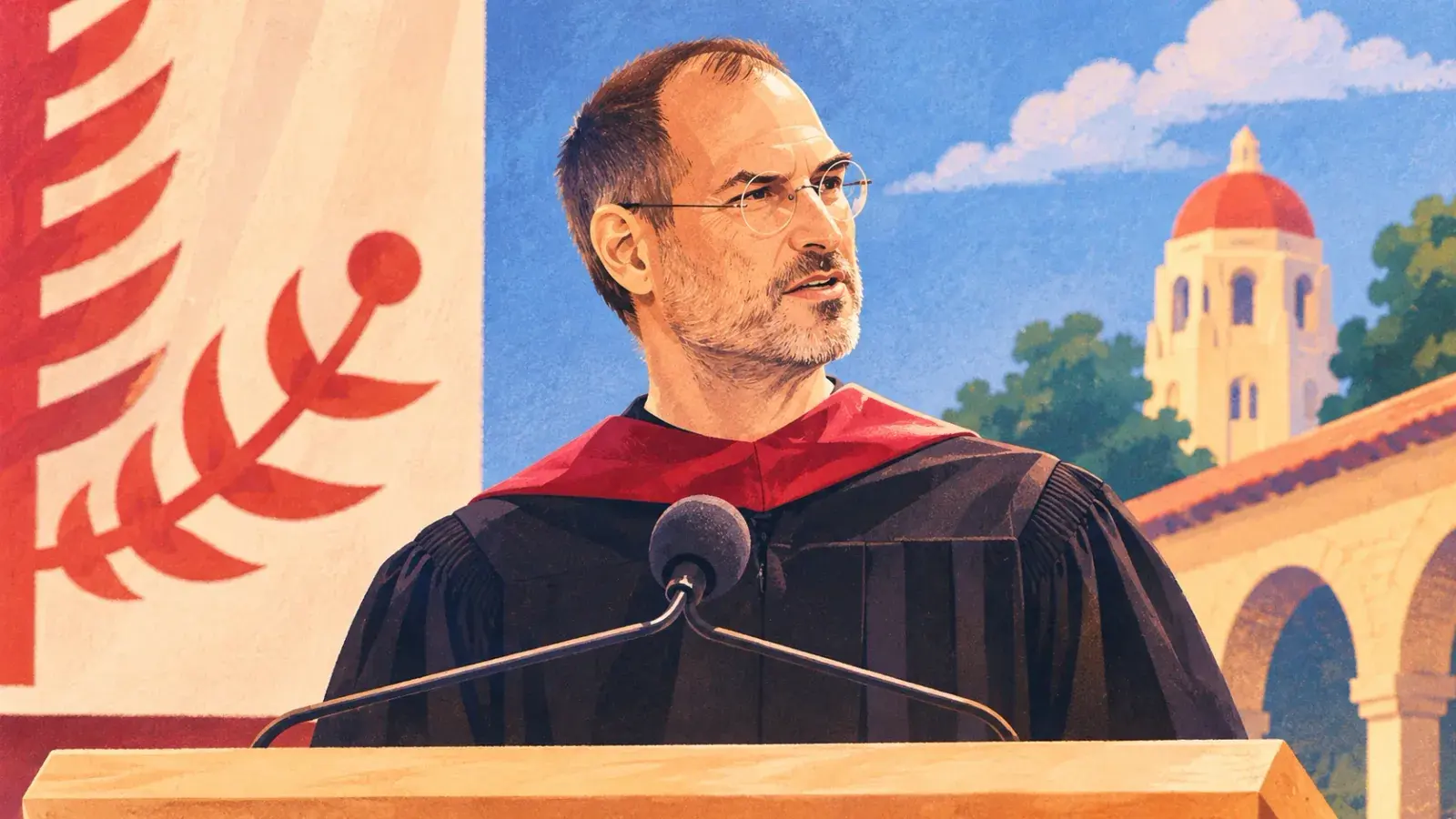
Steve Jobs's graduation speech was the main address at Stanford University's 114th Commencement, on Sunday, June 12, 2005, in Stanford Stadium, before a crowd reported at about 23,000. Stanford's video of it runs just over 15 minutes. Jobs organized his advice around three stories from his own life, about connecting the dots, about love and loss and about death, and closed on a line he borrowed, with credit, from a catalog he had loved when he was the graduates' age: “Stay hungry. Stay foolish.”
Below: the three-story map, what Jobs's drafting emails show about how he found those stories, how each one turns, and what a speechwriter can take from it. Stanford publishes the prepared text of the address, which this post paraphrases.
The speech at a glance
| Fact | Detail |
|---|---|
| FactDate | DetailSunday, June 12, 2005 |
| FactPlace | DetailStanford Stadium, Stanford University, California |
| FactOccasion | DetailStanford's 114th Commencement. President John Hennessy introduced him. |
| FactAudience | DetailAbout 23,000, as reported at the time |
| FactSpeaker | DetailSteve Jobs, 50, head of Apple Computer and of Pixar Animation Studios |
| FactLength | Detail15 minutes 4 seconds in the video Stanford posted on YouTube in March 2008 |
| FactShape | DetailA short opening, three numbered stories, a borrowed closing line |
| FactDelivery | DetailRead from the lectern, unusual for a man who memorized his Apple keynotes or spoke from a few notes |
The setting explains part of the tone. The ceremony opened with Stanford's Wacky Walk, in which graduates enter the stadium in costume; Stanford Magazine's report on the day noted four women dressed as iPods. Jobs wore jeans and sandals under his robe. About a year earlier, as he tells it in the speech, a scan had found a tumor on his pancreas, and a biopsy showed a rare form that surgery could treat. He had the surgery, and the third story is about that.
Three stories and a frame
In his first lines Jobs admits he never graduated from college, says this ceremony is the closest he has come to one, and promises three stories and nothing more. Then he keeps the promise in the plainest way possible: he numbers each story as he starts it and names its subject in a word or two. The table follows his map.
| Part | What he tells | The turn and the lesson |
|---|---|---|
| PartOpening | What he tellsHe never finished college, so this is the nearest he has come to a graduation. | The turn and the lessonHe promises three stories, and only three. |
| Part1. Connecting the dots | What he tellsHis adoption, Reed College, dropping out after six months, a calligraphy class he sat in on afterward. | The turn and the lessonTen years later the class shapes the Mac's typefaces. You can only connect the dots looking back, so trust that they will connect. |
| Part2. Love and loss | What he tellsApple in his parents' garage at 20, a $2 billion company ten years later, fired at 30. | The turn and the lessonThe firing frees him to start again: NeXT, Pixar, his marriage. Find work you love, and don't settle. |
| Part3. Death | What he tellsA question he has asked his mirror every morning for 33 years, a cancer diagnosis a year earlier, surgery. | The turn and the lessonDeath clears the way for the new. Your time is limited, so don't spend it living someone else's life. |
| PartClose | What he tellsThe Whole Earth Catalog and the farewell on the back of its final issue. | The turn and the lessonThe same four words, said three times, end as his wish for the graduates. |
Every story has the same skeleton: a setback, a payoff nobody could have planned, and a lesson stated in a sentence or two. The setbacks grow, from dropping out of college to losing a company to nearly losing his life, and the lessons grow with them, from trusting your gut to how to spend the time you have. That rising scale gives the speech its build, and the order puts each story before its lesson: he doesn't tell anyone to trust their gut until he has shown them a dropout's calligraphy class turning into the Macintosh.
What the drafts show
The speech sounds like one sitting of plain talk. It wasn't. The Steve Jobs Archive's book Make Something Wonderful, a collection of his speeches, interviews and emails that is free to read online, prints the notes he emailed to himself while he worked on it, and they show a writer finding his structure late.
| Date in 2005 | What the notes held |
|---|---|
| Date in 2005January 15 | What the notes heldEarly notes: a list of ideas and habits, among them meditation, walking to work, diet and fasting, curiosity and a scholarship idea tied to Reed, framed around a crazy world and a quotation from Gandhi |
| Date in 2005May 1 | What the notes heldThe main draft: numbered points of advice, not stories. Surround yourself with people smarter than you; a second point left blank; mortality. Also a teacher with a flashlight and a socialist engineer. |
| Date in 2005May 5 | What the notes heldThe calligraphy story appears, and so does the ending, the Whole Earth Catalog and its farewell, in a version that dates the final issue to 1974 |
| Date in 2005June 7 | What the notes heldThe founding of Apple and meeting his wife |
| Date in 2005June 9 | What the notes heldA draft of the death story, three days before the ceremony |
Three things in that record are worth copying. The ending came early: Jobs had his last line more than five weeks before the speech, and before he had most of his stories. The advice came first, and the drafts show him finding stories that give it a shape. Of the three points in the May 1 draft, only mortality survives, and it survives as a story. And a lot was cut: the advice about smarter people, the image of a teacher with a flashlight, the anecdote about a socialist engineer, the habits, the diet, the scholarship and the Gandhi quotation.
Jobs had his last line weeks before he had his three stories.
According to the archive's note, he worked on the speech on and off for about six months. He asked friends, Apple colleagues and the screenwriter Aaron Sorkin for their thoughts, then wrote it himself. Three days before the ceremony he still wasn't satisfied, and sent a friend the draft with a warning. He was still revising on the morning he gave it. For another famous text whose drafts survive, see our analysis of Washington's Farewell Address.
How each story turns
Story one: a class with no use
The first story starts before Jobs was born. His biological mother, an unmarried graduate student, wanted him adopted by college graduates, and signed the papers only after his adoptive parents, who weren't, promised he would go to college. Seventeen years later he went, to Reed College, on his working-class parents' savings. After six months he dropped out, then stayed on as a drop-in for about 18 months more.
The details are what make it work. He slept on friends' floors, returned Coke bottles for the five-cent deposits and walked seven miles across town on Sunday nights for a weekly meal at the Hare Krishna temple. He sat in on a calligraphy class and learned about serif and sans serif type and the spacing between letter combinations. None of it had a practical use. Ten years later, designing the first Macintosh, he used all of it.
In fiction this is a plant and a payoff, the principle behind Chekhov's gun. The class enters as a digression, so its return lands as a surprise. Jobs adds a joke to the payoff, that since Windows copied the Mac, personal computers might never have had good typography at all. Then he draws the first lesson: you can't connect the dots looking forward, so you have to trust something. He offers four candidates, from your gut to karma, and doesn't insist on any of them.
Story two: the firing told as a release
The second story moves fast through success: Apple in his parents' garage when he was 20, a $2 billion company with more than 4,000 employees ten years later. The Macintosh had been out for a year and he had just turned 30 when the executive he had hired to run the company with him fell out with him, the board took the other man's side, and Jobs was out. He calls it a very public failure, says he felt he had let down the entrepreneurs who came before him, and mentions that he apologized to David Packard and Bob Noyce.
The turn is a reversal of weight. Success, in his telling, had been heavy; starting over made him a beginner again, and light. In the next five years he started NeXT and Pixar and fell in love with Laurene, the woman he married. Pixar made Toy Story, which he calls the first computer-animated feature film, and Apple bought NeXT. He didn't see it then, he says, but being fired was the best thing that could have happened to him, bitter medicine that the patient needed.
Only then comes the advice: find work you love, keep looking if you haven't found it, and don't settle. Coming from a man who has just described being thrown out of his own company, it reads as testimony rather than a slogan. Rhetoric calls that credibility ethos, and the failure is where Jobs gets it.
Story three: death as the argument
At 17, Jobs read a line about living each day as if it were your last. For 33 years since, he says, he has asked the mirror each morning whether he would want to do what he is about to do if today were his last day, and changed something when the answer was no too many days in a row. Then he tells the diagnosis in clock time: a scan at 7:30 in the morning, a tumor on his pancreas, an organ he admits he couldn't have described, doctors who gave him three to six months. A biopsy that evening, he says, showed a very rare form that surgery could cure. He was sedated, so his wife, who was there, told him afterward that the doctors had cried when they saw the cells.
That secondhand detail is the strongest in the speech. Jobs can't describe his own reprieve, because he was asleep for it, so he hands the moment to the person who saw it. The lesson follows directly. Death is how life clears out the old to make way for the new, the graduates' time is limited, and they shouldn't waste it living someone else's life or let other people's opinions drown out their inner voice. He even finds the one joke the subject allows: people who want to go to heaven still don't want to die to get there.
The close: someone else's words, credited
For the ending, Jobs steps out of his own life. The Whole Earth Catalog, which Stewart Brand made in Menlo Park in the late 1960s with typewriters, scissors and Polaroid cameras, was in his description something like Google in paperback, 35 years before Google existed. That comparison does real work. It translates an object most of the graduates had never seen into one they used every day.
When the final issue came out in the mid-1970s, he says, he was their age. Its back cover showed a photograph of an early-morning country road, the kind you might hitchhike on, with the farewell words underneath. He reads them as a quotation, repeats them as what he has always wished for himself, and says them a third time as his wish for the graduates. Same four words, three owners: the catalog's, his, theirs.
Rhetorical devices at a glance
| Device | Where it appears | What it does |
|---|---|---|
| DeviceAnnounced structure | Where it appearsThree stories promised at the start, each numbered as it begins | What it doesLets listeners keep their place in a talk they can't reread |
| DevicePlant and payoff | Where it appearsThe calligraphy class returns as the Mac's typefaces | What it doesMakes the lesson feel discovered rather than preached |
| DeviceConfession first | Where it appearsNo degree, a firing at 30, a cancer diagnosis | What it doesAdmits failure before offering advice |
| DeviceAntithesis | Where it appearsLooking forward against looking back; the weight of success against the lightness of a beginner | What it doesPuts each lesson in a pair that is easy to remember |
| DeviceConcrete detail | Where it appearsCoke bottles, seven miles on Sunday nights, a scan at 7:30 a.m. | What it doesTurns a famous life into scenes the audience can picture |
| DeviceHumor | Where it appearsThe missing degree, Windows, heaven | What it doesReleases tension, most of all in the story about death |
| DeviceRepetition with a new frame | Where it appearsThe closing words, three times | What it doesTurns a quotation into a gift |
What speechwriters can take from it
- Promise a shape, then keep it. Three stories, numbered as they start. A listener who knows there are three can relax into the second one.
- Look for the story that gives a piece of advice its shape. Jobs's May draft was a list of advice; the speech is three stories that each end in a lesson. For a personal commencement address, test whether a story can make an abstract point easier to follow, and leave room for evidence, explanation or a direct invitation where no story fits.
- Plant the detail early. The calligraphy class works because it arrives as a digression. Introduce the thing that will matter before anyone can tell that it matters.
- Let someone else carry the last line, and credit them. A borrowed close works when you name the source and show why it mattered to you, and it's easier to write toward if you find it early, as Jobs did. The guide on how to end a speech has more closing moves.
Advice: Don't be afraid to fail. Every setback is a chance to learn. Keep going, and the path will become clear.
Story: In my first semester I failed anatomy. Not a C. An F, posted on the board outside room 114 next to my student number. That summer I worked nights at Larsen's bakery on Hickman Road, and at four in the morning, between batches, I drew the bones of the hand on the backs of order slips until I could do it with my eyes shut. Last spring a surgeon at Mercy asked who had taught me to walk patients through a hand X-ray so calmly. I told him it was a bakery.
The lesson is the same in both versions. Only the second gives the room a place, a time and a payoff it didn't see coming, which is the pattern Jobs repeats three times.
Jobs's dated emails are a habit worth copying: keep each round of a speech as its own dated draft, so you can see what a new story added and what it replaced.
With a draft open in Strokes, ask the Strokes Assistant which passages give advice with no story behind them, which story has no turn, and whether the ending points back to anything earlier.
For ten commencement addresses compared by structure, Jobs's among them, read commencement speech examples. To build your own from the outline up, start with the speech outline template. For a speech that persuades by refrain rather than by story, read our analysis of “I Have a Dream”.
Frequently asked questions
What are the three stories in Steve Jobs's Stanford speech?
The first is about connecting the dots: dropping out of Reed College and the calligraphy class that later shaped the Mac's typefaces. The second is about love and loss: being fired from Apple at 30, then starting NeXT and Pixar and meeting his wife. The third is about death: his cancer diagnosis a year earlier and what it taught him about time.
How long is Steve Jobs's Stanford speech?
Stanford's video of the address runs 15 minutes and 4 seconds. Jobs read it from a prepared text at the lectern, which the Steve Jobs Archive notes was unusual for him, and Stanford publishes that text on its news site. A short opening and a short close frame the three stories.
Where does “Stay hungry. Stay foolish.” come from?
From the Whole Earth Catalog, which Stewart Brand started in Menlo Park, California, in the late 1960s. Jobs said the final issue, which came out in the mid-1970s, carried the words on its back cover under a photograph of an early-morning country road, as the editors' farewell. He credited the catalog in the speech, then made the line his wish for the graduates.
Did Steve Jobs write his Stanford speech himself?
Yes. According to the Steve Jobs Archive, he worked on it on and off for about six months, emailing himself notes and drafts from January 2005. He asked friends, Apple colleagues and the screenwriter Aaron Sorkin for their thoughts but wrote it on his own, and he was still revising it on the morning he gave it.