The parts of a book fall into three sections: front matter that introduces it, a body containing the main text, and back matter that supports or follows it. Around all of it sit the physical parts: covers, spine, jacket, endpapers.
Few books use every part. A novel may have a dozen pages before chapter one; a scholarly history may have forty and an index of thirty more. Below is every part in a common order, what each part is for, how fiction differs from nonfiction, and the short list a self-published novel really needs.
The parts of a book in order
The table gives a common order: the one set out in the first chapter of The Chicago Manual of Style, which many English-language publishers follow. Publishers and formats vary it. Praise pages may come before everything else, acknowledgments often move to the back, and an introduction can belong to the main text instead of the front matter.
| Section | Part | What it is |
|---|---|---|
| SectionFront matter | PartPraise pages | What it isReview quotes and endorsements, mostly in paperbacks |
| SectionFront matter | PartHalf title | What it isA page carrying only the main title; any praise pages come before it |
| SectionFront matter | PartSeries title or “also by” page | What it isOther books in the series or by the author, on the back of the half title |
| SectionFront matter | PartFrontispiece | What it isAn illustration facing the title page |
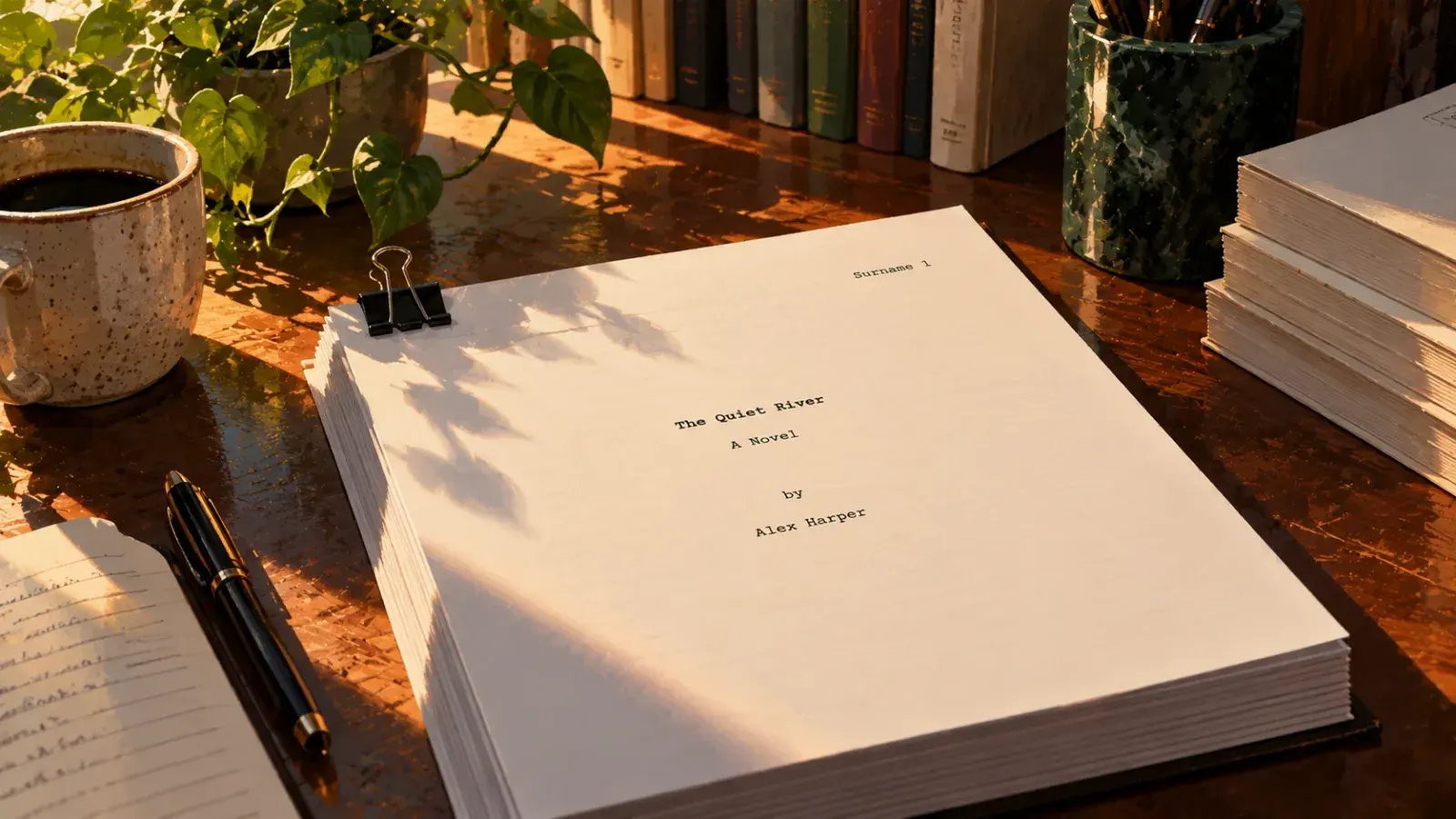
| SectionFront matter | PartTitle page | What it isTitle, subtitle, author, publisher |
| SectionFront matter | PartCopyright page | What it isCopyright notice, edition, ISBN, credits, printing line |
| SectionFront matter | PartDedication | What it isThe person or people the book is offered to |
| SectionFront matter | PartEpigraph | What it isA short quotation that frames the book |
| SectionFront matter | PartTable of contents | What it isParts and chapters with page numbers |
| SectionFront matter | PartList of illustrations or tables | What it isFor books with numbered figures |
| SectionFront matter | PartForeword | What it isAn introduction by someone other than the author |
| SectionFront matter | PartPreface | What it isThe author on how and why the book came to be |
| SectionFront matter | PartAcknowledgments | What it isThanks; often moved to the back in fiction |
| SectionFront matter | PartIntroduction | What it isPrepares the reader for the subject (if not part of the text) |
| SectionFront matter | PartAbbreviations, editor's or translator's notes | What it isReference material the reader needs first |
| SectionBody | PartSecond half title or first part title | What it isRepeats the title, or opens Part One |
| SectionBody | PartPrologue | What it isIn fiction, a scene set apart before chapter one |
| SectionBody | PartChapters, in parts if the book has them | What it isThe text itself |
| SectionBody | PartConclusion | What it isIn nonfiction, the argument drawn together |
| SectionBody | PartEpilogue or afterword | What it isWhat came after the story, or the author's closing word |
| SectionBack matter | PartAcknowledgments | What it isWhen they are not in the front |
| SectionBack matter | PartAppendixes | What it isSupporting material too long for the text |
| SectionBack matter | PartChronology or genealogy | What it isTimelines and family trees |
| SectionBack matter | PartGlossary | What it isDefinitions of terms used in the book |
| SectionBack matter | PartNotes | What it isEndnotes, grouped by chapter |
| SectionBack matter | PartBibliography or references | What it isSources cited or consulted |
| SectionBack matter | PartContributors and illustration credits | What it isFor edited and illustrated books |
| SectionBack matter | PartIndex | What it isSubjects and names with page numbers |
| SectionBack matter | PartReading group guide | What it isDiscussion questions, in book club fiction |
| SectionBack matter | PartAbout the author | What it isA short biographical note, often with a photo |
| SectionBack matter | PartColophon, errata | What it isNotes on the typeface and printing; corrections |
Front matter also has its own page numbers. It is traditionally numbered in lowercase roman numerals (i, ii, iii), and arabic page 1 usually falls on the first page of the main text: the first chapter, an introduction that belongs to the text, or a part title. That way, adding a foreword late in production doesn't renumber the whole book.
The physical parts of a book
The terms below come from bookbinding and printing, and you will meet them as soon as you talk to a cover designer or a printer.
| Part | Where | What it does |
|---|---|---|
| PartFront cover | WhereOutside, front | What it doesTitle, author, the image that sells the book |
| PartSpine | WhereThe bound edge | What it doesTitle, author and publisher's logo, read on the shelf |
| PartBack cover | WhereOutside, back | What it doesThe blurb, endorsements, ISBN barcode and price |
| PartBoards | WhereHardcover | What it doesThe stiff covers under the cloth or paper |
| PartDust jacket | WhereHardcover | What it doesThe removable paper wrap around the boards |
| PartFlaps | WhereInside the jacket | What it doesFront flap: the description. Back flap: author bio and photo |
| PartEndpapers | WhereInside each cover | What it doesThe pasted-down sheet and the free sheet (flyleaf) that join the book to its case |
| PartHeadband | WhereTop and bottom of the spine | What it doesA small band of thread, mostly decorative now |
| PartHead, tail and fore-edge | WhereThe page edges | What it doesTop, bottom and the outer edge opposite the spine |
| PartGutter | WhereInner margin | What it doesWhere the pages run into the binding; needs extra space in a thick book |
| PartRecto and verso | WhereEvery spread | What it doesThe right-hand (odd) page and the left-hand (even) page |
| PartRunning heads | WhereTop of the page | What it doesThe book or chapter title, repeated |
| PartFolio | WhereTop or bottom of the page | What it doesThe page number |
| PartSignatures | WhereInside the binding | What it doesSheets printed, folded and gathered into groups of pages |
The page dimensions themselves are the trim size, which sets how many words fit on a page and how thick the spine will be. Ebooks drop most of this list. What remains is the cover image and a table of contents the reader can tap.
Front matter, page by page
Front matter tells the reader what the book is, who made it and how to find their way around it. Traditionally the title page sits on a right-hand page, with the copyright page on its back. The dedication follows on a fresh page.
Half title and title page
The half title carries the main title alone. It goes back to the days when books were sold unbound, and a plain first leaf protected the title page. The title page gives the full title, subtitle, author and the publisher's name and city. A frontispiece, when there is one, faces it from the left.
Copyright page
The copyright page is the book's paperwork. Chicago's list of what can go on it is long; most trade books carry some version of this:
- The copyright notice: the symbol, the year and the holder's name.
- The publisher's name and address, and the edition or publishing history.
- An ISBN for each format, such as hardcover, paperback and ebook.
- Cataloging data from the national library, for publishers that qualify.
- A printing line, a row of numbers such as 10 9 8 7 6 5 4 3 2 1. The lowest number shows which printing you are holding.
- Credits and permissions for quoted material, the cover design and the photographs.
- Disclaimers. A novel's usual one says it is a work of fiction and that any resemblance to real people is coincidental.
Dedication and epigraph
A dedication offers the book to someone in a line or two, and an epigraph sets a quotation at the door. Both are optional, both get a page to themselves, and the dedication comes first. The glossary entries on the book dedication and the epigraph have examples, and the epigraph entry covers when a quotation needs permission.
Table of contents
The contents page lists parts and chapters, plus any front and back matter a reader might look for, with page numbers in print. Many print novels skip it, especially when the chapters are numbered rather than titled. Ebooks are different. Amazon's Kindle Publishing Guidelines require a logical table of contents, the navigation menu a Kindle reader opens, in every Kindle book, and strongly recommend a linked contents page in the text as well.
Foreword, preface, introduction and acknowledgments
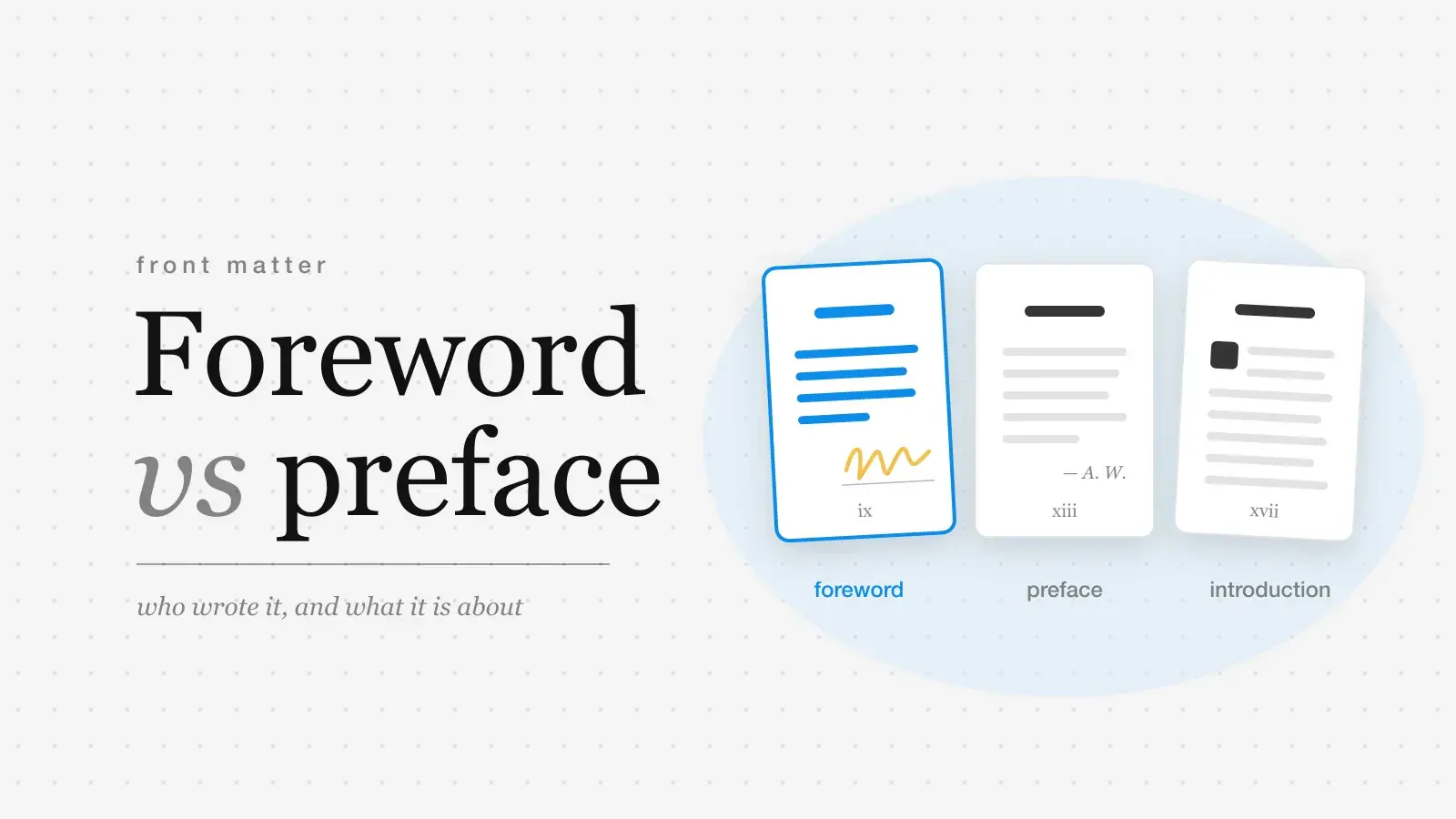
These four get mixed up more than any other parts of a book. A foreword is written by someone else, usually a name that lends the book weight. A preface is the author's own account of how the book came about. An introduction prepares the reader for the subject itself, and if it is essential reading it can belong to the main text, starting the arabic page numbers. Acknowledgments may sit in the preface, on their own page in the front, or at the back, where many novels now put them. The glossary entry on foreword vs. preface vs. introduction has the details and real examples.
The body of the book
The body is the text itself, and its divisions depend on the kind of book.
- Prologue. A scene set apart before chapter one, often in another time or viewpoint. Chicago's outline gives it no separate entry. In a novel it belongs to the story text, though some designers list it with the front matter. See prologue vs. epilogue for when a novel needs one.
- Parts. Large divisions, each with its own title page: Part One, Book Two. Useful when the story jumps in time or changes narrator.
- Chapters. The basic unit of almost every book. Many traditionally published books start each chapter on a right-hand page; many novels simply start a new page. Inside a chapter, a blank line or an ornament marks a scene break.
- Interludes. Short sections between chapters or parts, in another voice or time.
- Conclusion. In nonfiction, the chapter that draws the argument together.
- Epilogue and afterword. An epilogue shows what happened after the story, still inside it. An afterword is the author, or another writer, stepping out to comment, as in a new edition of an older book.
Back matter, page by page
Back matter supports the text without interrupting it. Reference books and histories lean on it heavily; a novel may have nothing but acknowledgments and a note about the author.
- Appendixes. Documents, data or detail that would stall the text: a treaty, a table of results, a map key.
- Chronology or genealogy. Timelines and family trees, a gift to readers of sagas and histories.
- Glossary. Definitions of terms or invented words. Fantasy novels sometimes carry one for their languages.
- Notes. Endnotes, grouped by chapter, with the chapter titles as headings so a reader can find their place.
- Bibliography or references. The sources behind the book.
- Index. Names and subjects with page numbers, compiled once the pages are final. Usually only nonfiction has one.
- Reading group guide. Discussion questions, common in book club fiction.
- About the author. A short biographical note, often with a photo, usually the last page. The author bio examples show how long it should run.
- Colophon and errata. A note on the typeface and printing, and a list of corrections. Both are rare in trade books today.
Self-published genre fiction adds its own back matter after the last chapter: an "also by" list, a link to the author's newsletter and sometimes the first chapter of the next book. In an ebook these pages work as the book's ending call to action, so they come straight after the story.
Fiction vs. nonfiction
The same parts exist for both, but they don't pull equal weight.
| Part | Novel | Nonfiction |
|---|---|---|
| PartTitle page and copyright page | NovelUsual | NonfictionUsual |
| PartDedication | NovelCommon | NonfictionCommon |
| PartEpigraph | NovelCommon | NonfictionSometimes |
| PartTable of contents | NovelOptional in print; a navigation contents in Kindle ebooks | NonfictionUsual |
| PartForeword, preface | NovelRare, except in classics and new editions | NonfictionCommon |
| PartIntroduction | NovelRare | NonfictionCommon |
| PartPrologue, epilogue | NovelSometimes | NonfictionRare |
| PartNotes, bibliography | NovelRare; an author's note may cite sources | NonfictionCommon |
| PartIndex | NovelRare | NonfictionUsual in history, science, reference |
| PartAcknowledgments | NovelUsually at the back | NonfictionFront or back |
| PartAbout the author | NovelUsual | NonfictionUsual |
| PartReading group guide | NovelBook club fiction | NonfictionSometimes, in narrative nonfiction |
Historical novels are the overlap. Many end with an author's note that separates fact from invention and names the main sources, which does in a page what a nonfiction bibliography does in twenty.
What a self-published novel needs
Traditional publishers handle most of the front and back matter for you. If you publish yourself, the essentials are short:
A few practical points. On Kindle Direct Publishing, ebooks don't need an ISBN, but paperbacks and hardcovers do. If you use the free ISBN KDP offers, your imprint appears as "Independently published". The Library of Congress's Cataloging in Publication program doesn't include self-published works, which may be eligible for its Preassigned Control Number program instead. And keep the front matter lean in the ebook. Online stores show readers the first pages as a free sample, so many indie authors move acknowledgments and "also by" pages to the back to let the sample reach the story sooner.
Front matter drifts. Chapter titles change and the contents page doesn't, and a new book never makes it onto the "also by" list in the old one. If you draft in Strokes, attach the contents page and the chapters to a chat with the Strokes Assistant before you export and ask it to list every chapter title that doesn't match the table of contents.
Frequently asked questions
Is the prologue part of the front matter?
In a novel, no. A prologue is part of the story, set before chapter one, and it normally falls inside the main text. Some designers list it at the end of the front matter, but readers experience it as the first scene. A preface or foreword, written about the book rather than inside it, is front matter.
Where do acknowledgments go in a book?
Either place is correct. Chicago allows acknowledgments in the front matter, inside or after the preface, or in the back matter. Many novels now put them at the back so the story starts sooner, while academic and nonfiction books often keep them in the front.
What is the difference between a foreword and a preface?
Who writes it. A foreword is written by someone other than the author, often a well-known name who explains why the book matters. A preface is written by the author and tells how or why the book came to be. An introduction, by either, prepares the reader for the subject itself.
Does a novel need a table of contents?
In print it is optional, and many novels with numbered chapters leave it out. In an ebook you need one: Amazon requires a logical table of contents in every Kindle book and strongly recommends a linked contents page as well, and readers expect to be able to jump between chapters.