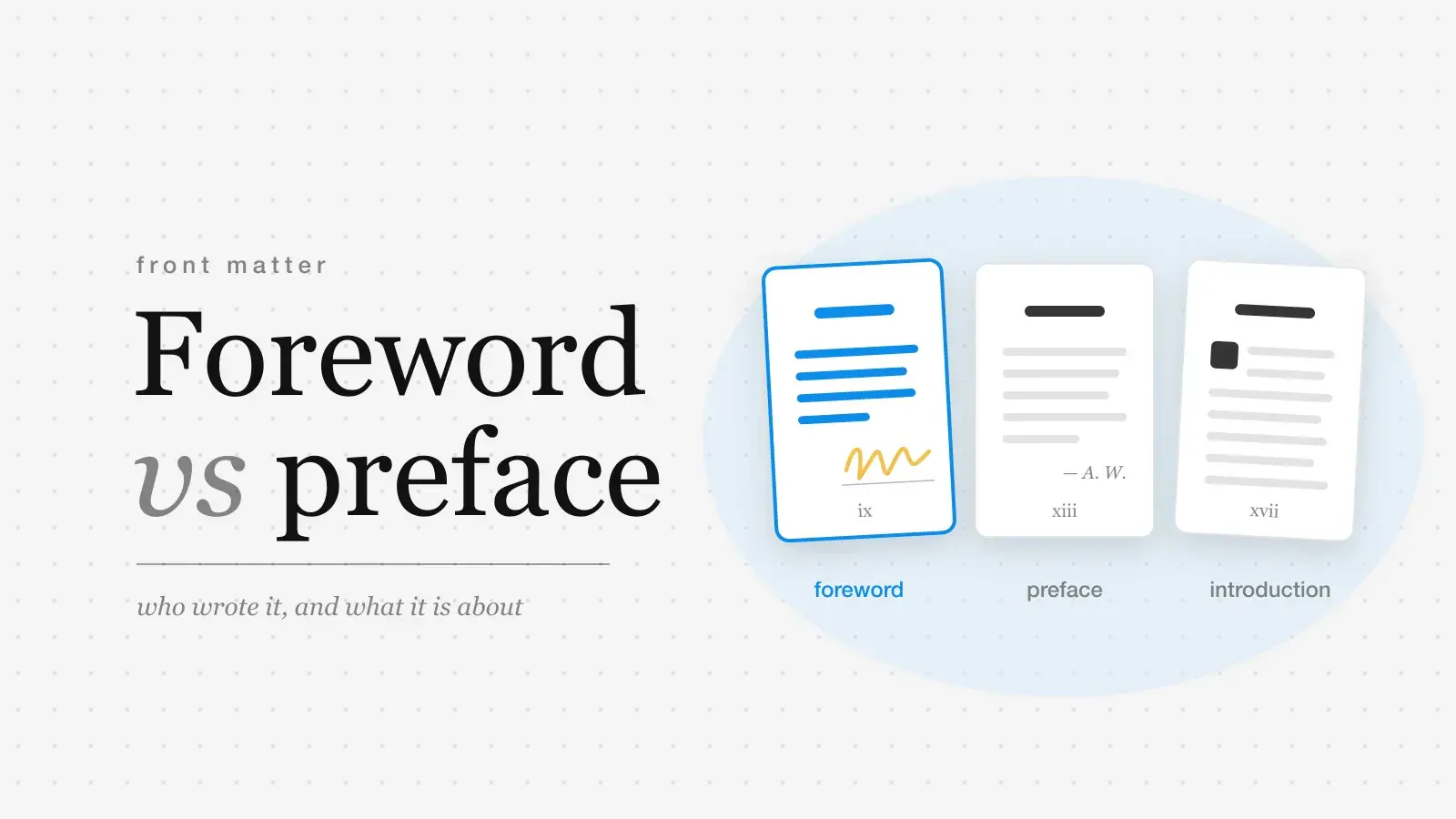
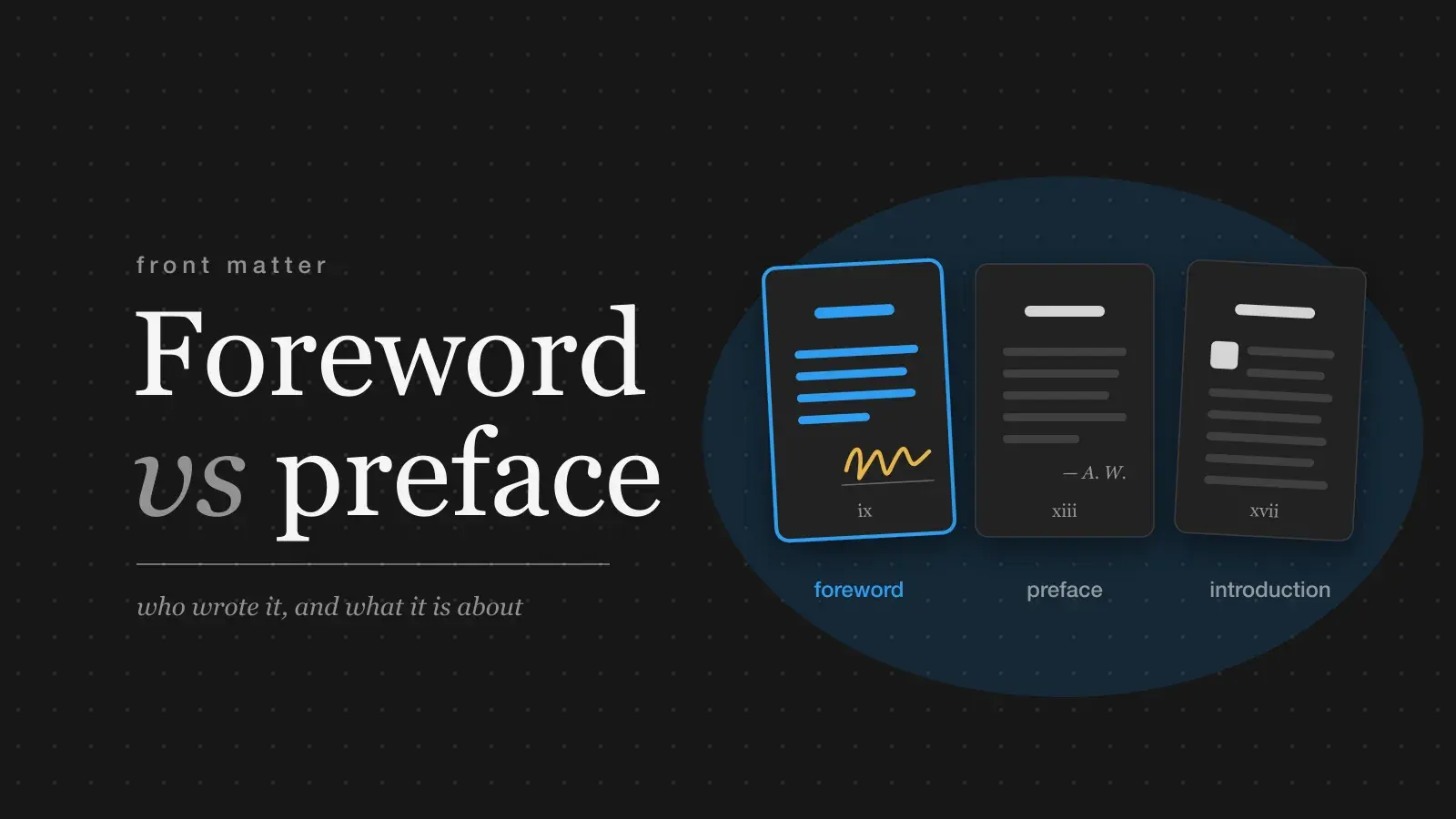
A foreword is written by someone other than the author, usually a name readers already trust. A preface is the author's account of how and why the book was written. An introduction sets up the subject: what the reader needs before chapter one.
When a book has all three, they run in that order, with acknowledgments, if any, between the preface and the introduction. All three usually sit in the front matter, the pages numbered in lowercase roman numerals, though an introduction that opens the book's argument can start the main text as page 1.
Both words mean "words before": preface from the Latin praefatio, "a saying beforehand", and foreword a loan translation of the German Vorwort, itself a translation of the same Latin word. That is also why it is spelled foreword, never "forward". The difference between the two is a publishing convention, and older books don't always follow it.
Foreword vs preface vs introduction compared
| Foreword | Preface | Introduction | |
|---|---|---|---|
| Written by | ForewordSomeone other than the author | PrefaceThe author | IntroductionUsually the author (a scholar, in classics editions) |
| About | ForewordThe author or the book, seen from outside | PrefaceHow and why the book was written | IntroductionThe subject, and how to read what follows |
| Signed | ForewordYes: a name, often a place and date | PrefaceSometimes, with initials or a date | IntroductionRarely |
| Position | ForewordFirst, after the contents | PrefaceAfter the foreword | IntroductionAfter the preface and acknowledgments, or page 1 of the main text |
| Safe to skip | ForewordYes | PrefaceYes | IntroductionUsually not |
Foreword and preface examples
It is, therefore, entirely his own production.
Garrison, editor of the antislavery paper The Liberator, recalls meeting Douglass at an 1841 convention in Nantucket and assures readers that Douglass wrote every word himself. The book calls it a preface. By today's rule it is a foreword: a known name telling doubtful readers that the book is real. Garrison signs and dates it, Boston, May 1, 1845.
Reader, be assured this narrative is no fiction.
The author's preface, signed Linda Brent, says why she wrote and why she gave people and places false names. Then the editor, L. Maria Child, adds an introduction saying she knows the author personally. Child's piece does a foreword's job, and a publisher today would print it before the preface.
As far as I can recollect, it was entirely written by him.
Mary Shelley wrote that line in 1831 about the preface to the anonymous first edition of 1818, which Percy Bysshe Shelley wrote for his wife in the author's voice. Her own introduction to the revised edition, signed M. W. S., answers the question readers kept asking: how she came to think of "so very hideous an idea." She tells of the ghost-story challenge at the Villa Diodati in 1816. Whatever the heading says, that introduction is a preface.
There is no such thing as a moral or an immoral book.
The novel first ran in a magazine in 1890, and reviewers attacked it as indecent. For the 1891 book, Wilde answered with a preface of aphorisms about art, ending with "All art is quite useless." It says nothing about how the novel was written.
The first American edition, published by Doubleday in 1952, opened with an introduction by Eleanor Roosevelt. The heading says introduction, but the job is a foreword's: a famous outsider vouching for a writer readers have never heard of.
In your manuscript
Most novels need none of the three. A debut almost never has a foreword or a preface, and agents who ask for sample pages want to see the story start, so leave front matter out of a submission. Nonfiction and memoir are where these pieces earn their pages.
- Get a foreword only if someone your readers already trust will write one and has something only they can say: how they know you, what the work changed for them. Publishers often put that name on the cover ("With a foreword by…"). You can't write your own. If you did, it would be a preface.
- Write a preface when the story of the book helps the reader trust it: why you wrote it, the research or access behind it, what you changed (names, dates, a compressed timeline).
- Write an introduction when the reader needs a map: the question the book answers, the terms it uses, how its parts fit together. Anything a reader can't do without belongs here or in chapter one, never in the preface, which plenty of readers skip.
The usual mistakes follow from mixing the jobs up. A preface that summarizes each chapter is doing the introduction's work. A foreword that only praises reads like a long blurb. And a heading that says "Forward" will be the first thing a reviewer notices.
Foreword, by a reporter the author once hired:
I was nineteen when Dana Whitlock handed me a police scanner and the keys to the paper's Buick and told me to come back with a story by six. I came back with two, and she cut one. She has written the history of the Ledger the way she ran it, with no adjective she couldn't defend.
Ray Okafor, Columbus, Ohio, March 2026
Preface, by the author:
This book began with forty bound volumes in a basement that floods every April. I spent two winters reading them. I have changed two names at the request of their families. The errors are mine, and there would be more of them without the people thanked at the back.
Introduction, about the subject:
Every Thursday for 112 years, the Tessmer County Ledger told four thousand households who had died, who had married and what the feed store wanted for oats. Then it stopped. This book follows its last year to ask what a town loses when nobody keeps its record.
The foreword is about the author, the preface is about the book, the introduction is about the town.
Prologue, afterword and other neighbors
Four neighbors get confused with these.
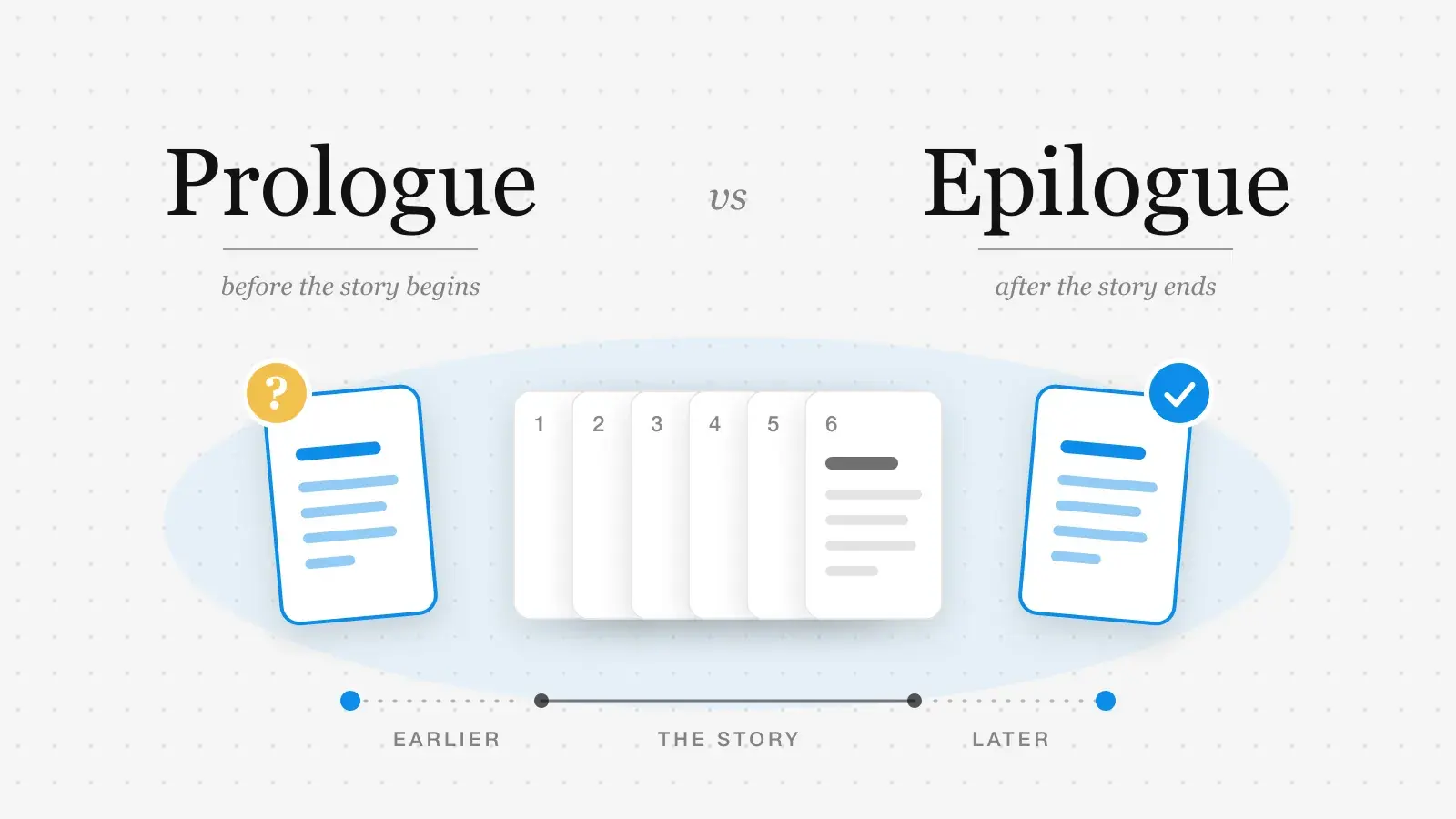
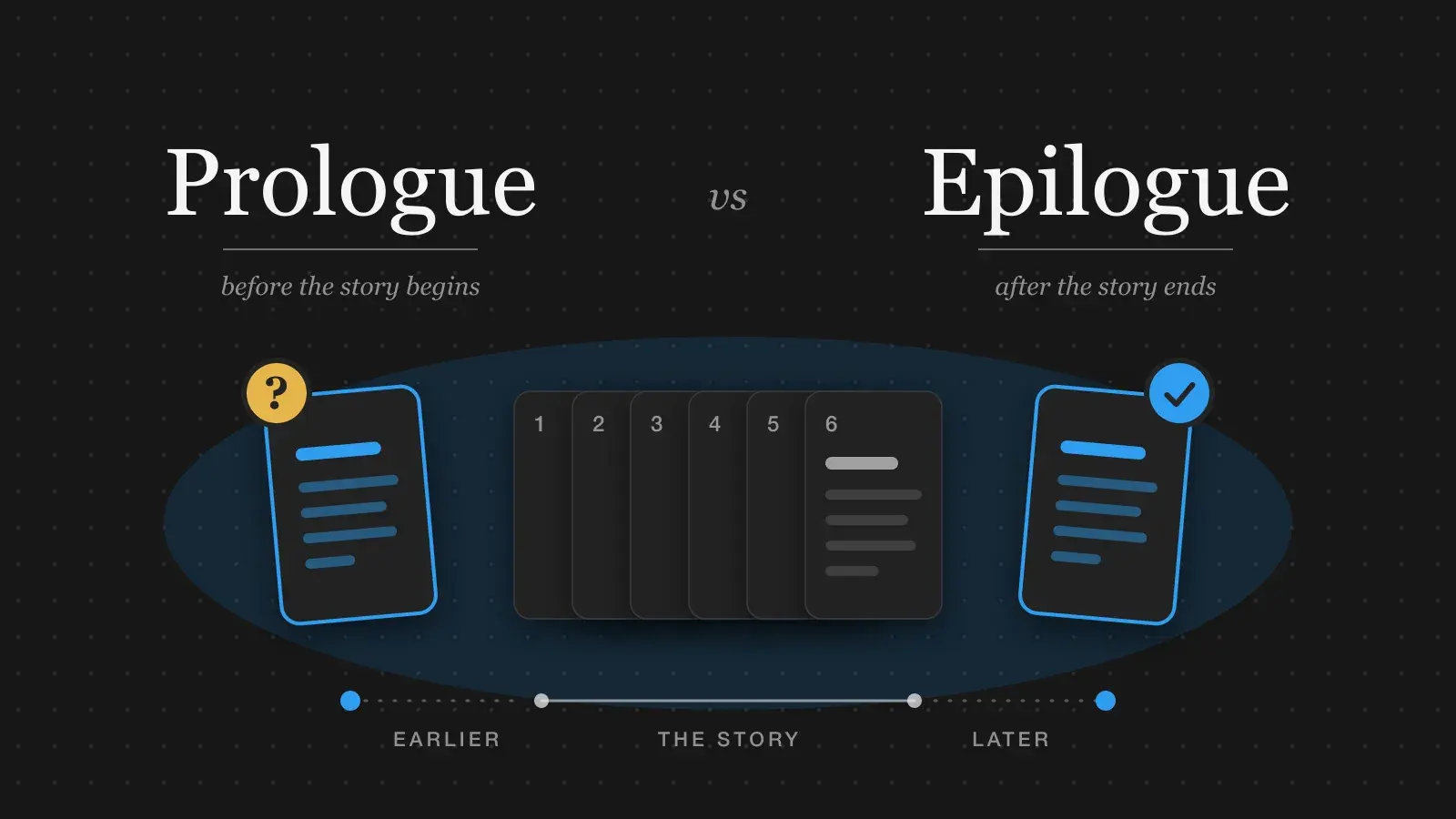
- A prologue belongs to the story, told in the book's own voice, mostly in fiction. The Chicago Manual of Style counts it as main text, not front matter. If skipping it would cost the reader part of the plot, it is a prologue.
- Acknowledgments thank the people who helped. They can close the preface, follow it on a page of their own, or move to the back matter.
- An author's note is a short preface by another name, common in memoir and historical fiction: what is true, what was changed and why. It can sit at the front or the back.
- An afterword is the back-matter version of a foreword or preface, by the author or someone else, and common in later editions. Its fiction counterpart is the epilogue, part of the story like a prologue.
The dedication and the epigraph come earlier still, before the table of contents. When the front matter is settled and the book needs to look like one, read How to format a manuscript (and a book) the standard way.