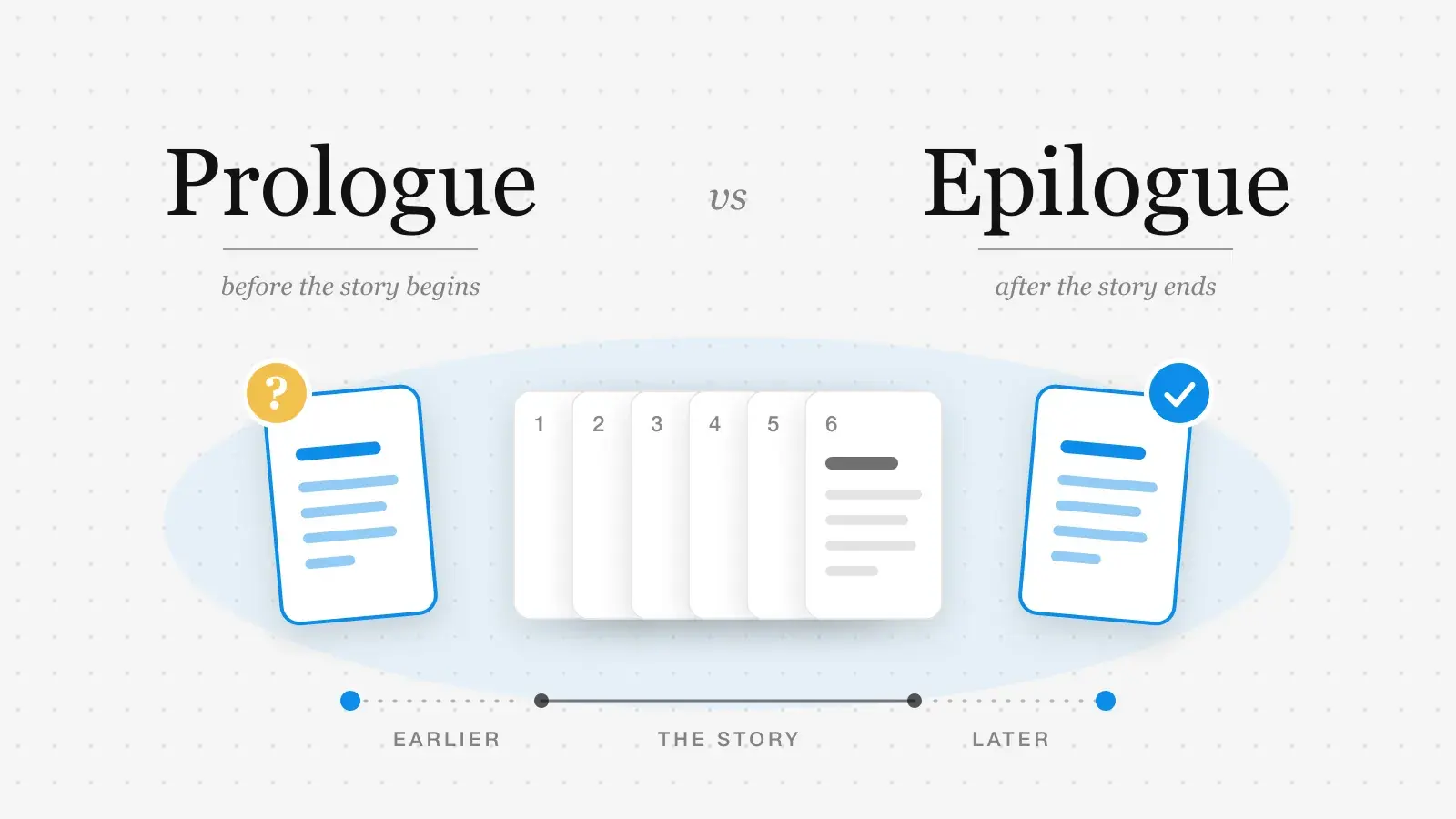
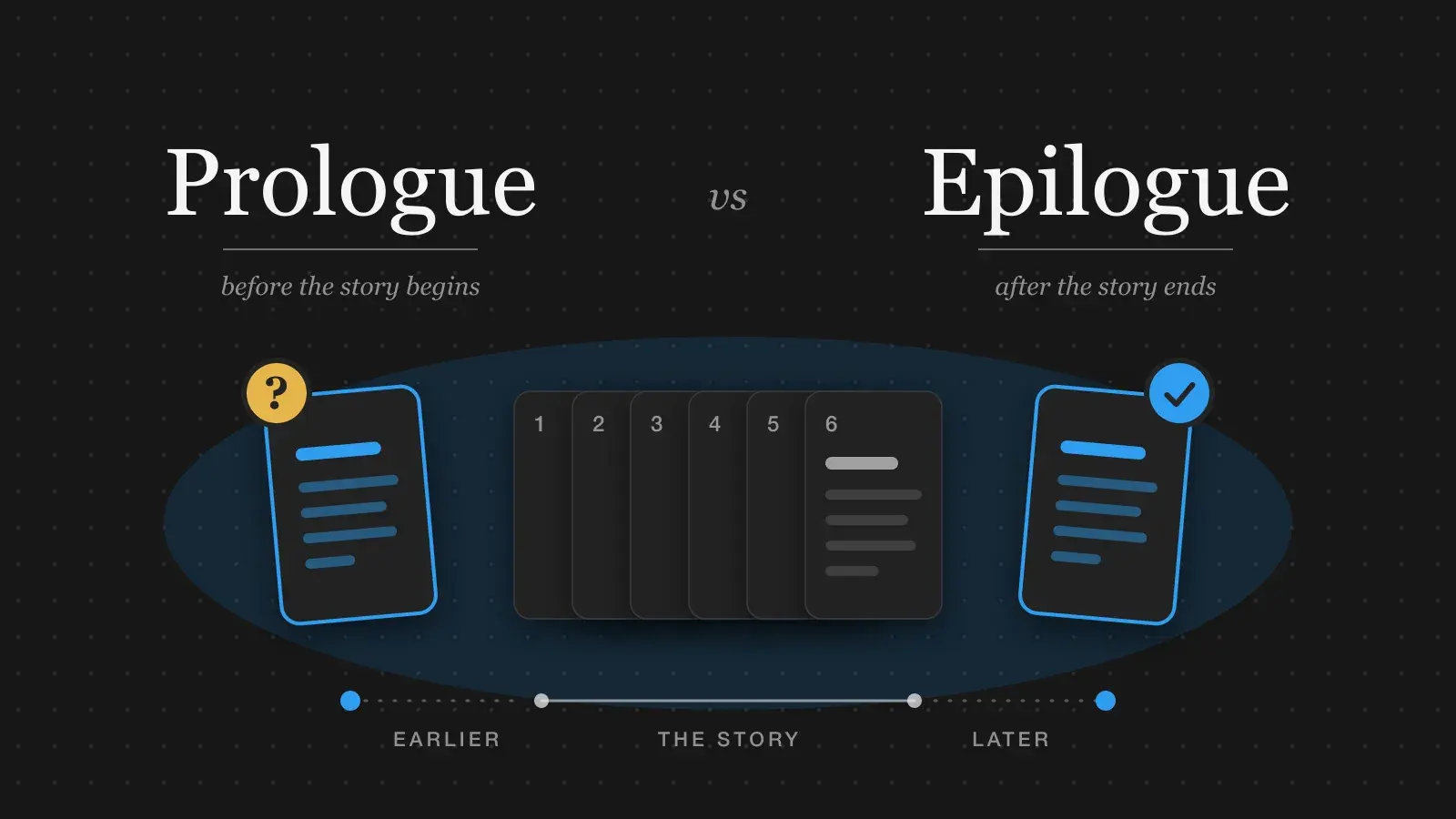
A prologue is a short section before chapter one that stands apart from the main story, usually because it is set earlier or told from another point of view. An epilogue is a short section after the last chapter that shows what happened afterward, usually some time later.
Both words are Greek: pro, before, and epi, in addition, each joined to logos, speech. On the Elizabethan stage an actor often stepped out to speak them: the prologue to say what the audience would see, the epilogue to ask for applause. Novels dropped the speeches and kept the jobs.
| Prologue | Epilogue | |
|---|---|---|
| Position | PrologueBefore chapter one | EpilogueAfter the last chapter |
| Time | PrologueUsually earlier, sometimes much earlier | EpilogueUsually later, often by years |
| Viewpoint | PrologueOften someone the book won't follow again | EpilogueUsually the main cast |
| Job | PrologueRaise a question or show a threat | EpilogueShow what the ending changed or cost |
| Typical failure | PrologueBackstory the reader doesn't need yet | EpilogueAnswers so many questions the ending goes slack |
| Test | PrologueWould chapter one lose anything without it? | EpilogueWould the last chapter lose anything without it? |
Prologue and epilogue examples
From forth the fatal loins of these two foes
A pair of star-cross'd lovers take their life
Before the first scene, the Chorus speaks a sonnet that tells the audience the lovers will die and that their deaths will end the feud. Once the outcome is settled, the question shifts from what happens to how, and every delay and missed message plays as dread rather than suspense.
The drama's done. Why then here does any one step forth?—Because one did survive the wreck.
The last chapter sinks the Pequod and drowns her crew. The one-page epilogue explains how Ishmael lived to tell the story: he floated on Queequeg's coffin until the Rachel, still searching for her own lost crew, picked him up. The first British edition, The Whale, left the epilogue out, and some reviewers complained that the book seemed to be narrated by a man who had drowned.
Every limit is a beginning as well as an ending.
Eliot opens with a Prelude about Saint Theresa and the later women born with the same hunger for an "epic life" and nowhere to spend it. The Finale follows the cast into their "after-years" and closes on the good done by people who "rest in unvisited tombs," which is where the Prelude was pointing. Neither is called a prologue or epilogue. The job matters more than the label.
The plot ends with Raskolnikov's confession. The epilogue jumps to a prison in Siberia about a year and a half after the murders, where Sonya has followed him, and the change the whole novel has been working toward happens in a few pages. Then the narrator shuts the door: it "might be the subject of a new story, but our present story is ended."
Martin's prologue follows a ranger named Will beyond the Wall, a viewpoint the book never returns to. The reader meets the Others there, long before the lords fighting over the throne take them seriously. Rowling's epilogue, headed "Nineteen Years Later," shows the survivors seeing their own children off to school, which settles whether these people ever got ordinary lives.
In your manuscript
Decide about both at the end of the draft. A prologue written on day one is usually notes to yourself about the world, and an epilogue written before the ending exists has nothing to stand on. Keep each in its own document so you can read the book with and without it.
When a prologue earns its place
A prologue is worth keeping when it shows something chapter one can't: an event decades before the main story, or a point of view the book won't return to (the victim in a thriller, the threat in a fantasy). Keep it to one short scene and end it on a question, not an explanation.
Agents and editors see a lot of prologues that are backstory in costume: a history of the kingdom, or a scene the reader will meet again in chapter twelve. Many are openly wary of them. Sample pages usually start on the book's first page, so in a submission your prologue is your opening whatever you call it. A few agents ask you to start at chapter one instead, so check each agent's guidelines. If chapter one reads fine without the prologue, cut it and move anything essential to where the reader needs it.
Memoirs use prologues too. A common one is a scene from the worst day, told before the book goes back to the beginning, a close cousin of opening in medias res.
When an epilogue helps
An epilogue is worth keeping when the ending leaves a question the last chapter can't answer without breaking its own moment: what the victory cost, or how the narrator lived to tell it. A good epilogue jumps forward, shows one scene and gets out. It goes wrong when it tries to answer everything. A last chapter that ends on a held breath, followed by three pages of who married whom, trades the ending for an inventory.
Romance readers often expect one: a scene months or years later that confirms the happily-ever-after. In a series, an epilogue that exists only to set up the next book can read like an ad to people who bought this one for its ending.
Prologue, flat: Three hundred years before Mara was born, the river kingdoms fought over the salt roads. The war ended with the Treaty of Ashford, which let the northern houses tax every barge that passed the falls.
Prologue, as a scene: The toll clerk at Ashford Falls counted thirty-one barges that morning and wrote down thirty. The last one rode low in the water, and when the boatman caught his eye he touched a finger to his lips.
Epilogue, flat: Five years later, Mara ran the toll house. Tomas had married her sister, the ledger was in a museum, and the falls were quiet.
Epilogue, as a scene: Five years later, Mara counted thirty-one barges past the falls and wrote down thirty-one. She checked the last one twice.
The flat versions report. The revised prologue gives the reader a clerk and a number that doesn't add up. The revised epilogue comes back to the same count and shows what the story changed without listing anything.
Before you cut either one for good, save a version. In Strokes, version history saves versions as you go and restores one in a click, so a deleted prologue can come back if your critique partner misses it.
Prologue vs preface, epilogue vs afterword
| Section | Where it goes | Who's speaking | What it's about |
|---|---|---|---|
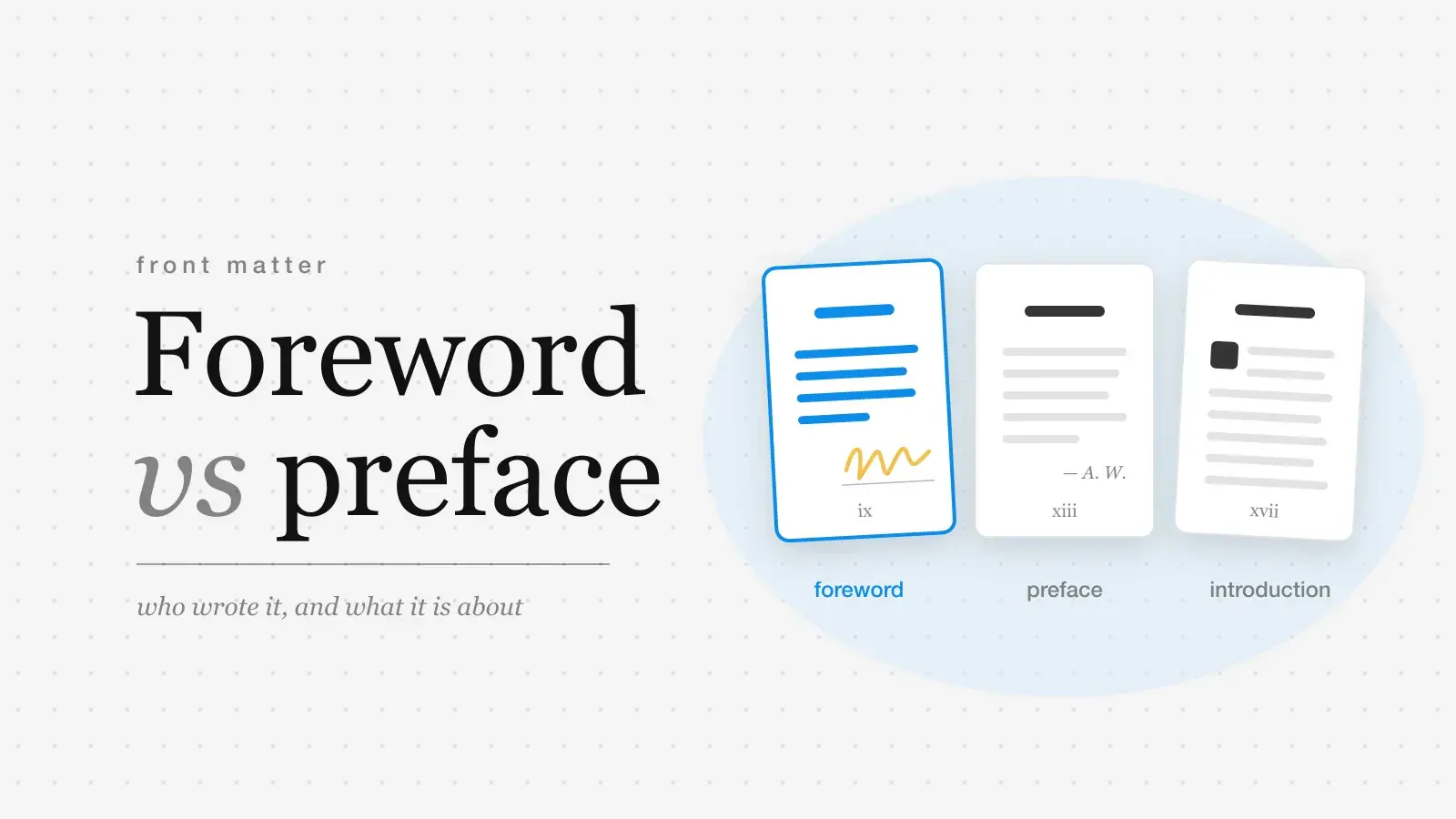
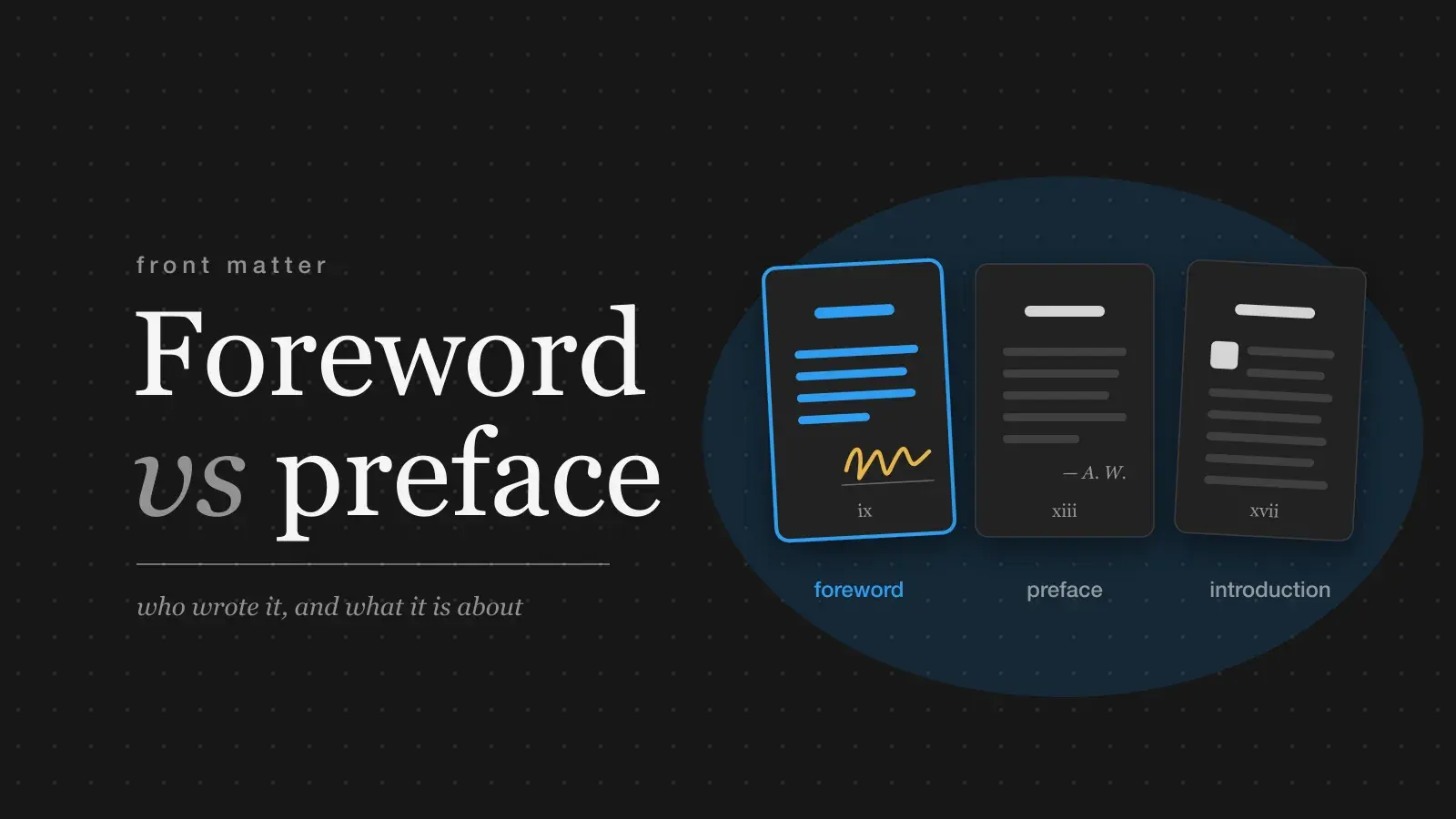
| SectionForeword | Where it goesFront matter | Who's speakingSomeone other than the author | What it's aboutThe author or the book |
| SectionPreface | Where it goesFront matter | Who's speakingThe author | What it's aboutHow and why the book was written |
| SectionPrologue | Where it goesStart of the story | Who's speakingThe story's narrator | What it's aboutEvents in the story's world |
| SectionEpilogue | Where it goesEnd of the story | Who's speakingThe story's narrator | What it's aboutWhat happened afterward |
| SectionAfterword | Where it goesBack matter | Who's speakingThe author or a guest | What it's aboutThe book, once you've read it |
Readers who skip the front and back matter miss nothing of the plot. Readers who skip an epilogue do. It is also not the denouement, the last stretch of the plot inside the final chapters, where the conflict settles. The epilogue steps past it, usually after a gap in time. Every finished plot has a denouement, but an epilogue is optional, and plenty of books have a prologue without one, or the reverse. When a book has both, the strongest echo each other, as Middlemarch's do.
A prologue becomes a frame story if the book comes back to it at the end. To plan where each one falls, give them their own rows in a chapter outline, and before you query, read how to get a literary agent for what agents ask to see.