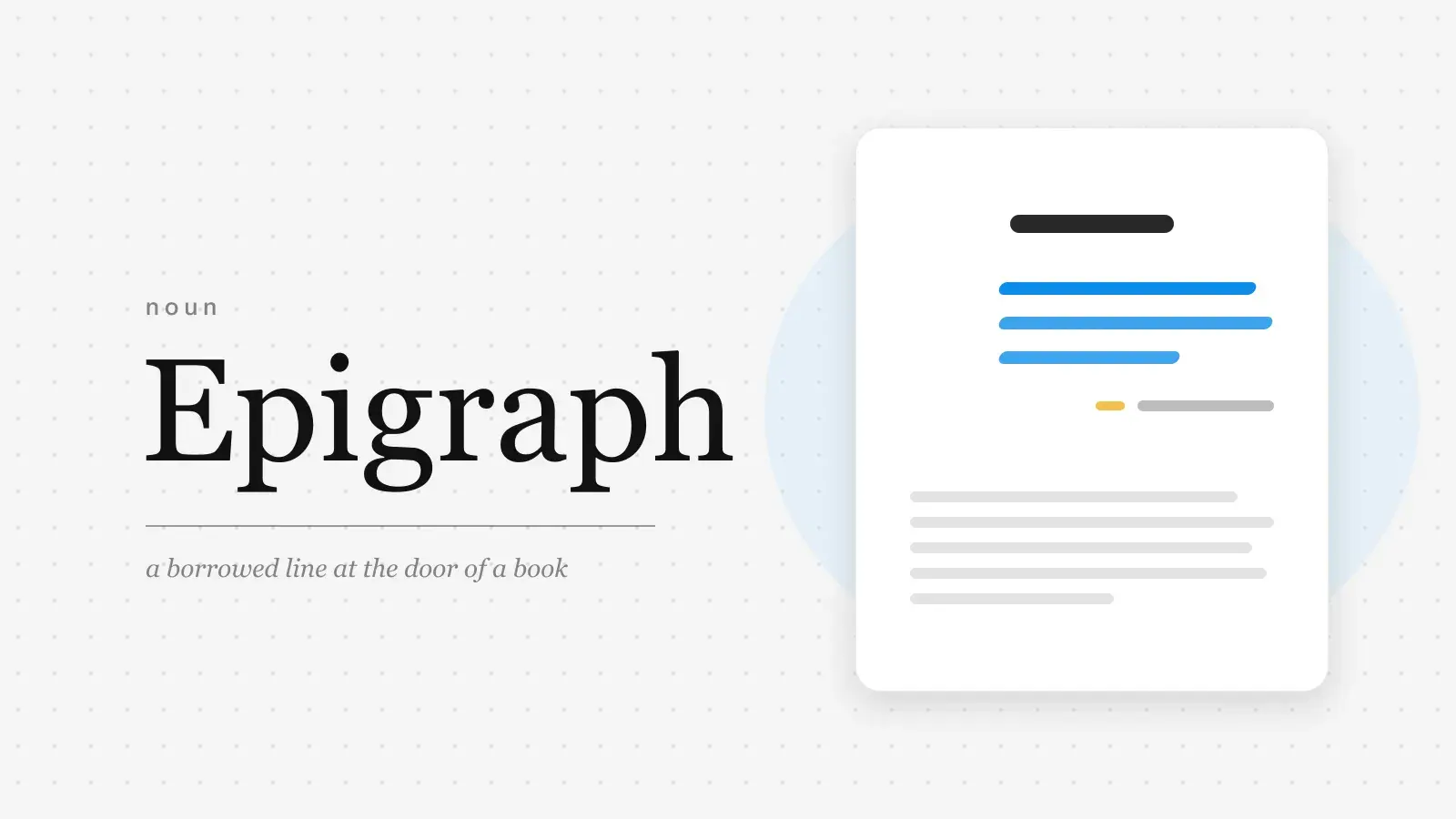
An epigraph is a short quotation, verse or phrase placed at the start of a book, chapter or poem. It hints at the theme, sets the mood or opens an argument the text will take up. Most epigraphs are borrowed from another writer. Some are invented.
The word comes from the Greek epigraphē, an inscription, from epigraphein, to write on. Archaeologists still use the older sense, words cut into a building or monument, and call the study of them epigraphy. In a book, the epigraph is part of the front matter: it comes after the dedication and before the table of contents, usually on a page of its own. A chapter epigraph sits under the chapter title, above the first line.
Epigraph examples
Did I request thee, Maker, from my clay
To mould me man?
In Paradise Lost these are Adam's words to God after the Fall. On Shelley's title page they already sound like the creature, who later reads Milton and compares his lot with Adam's. The epigraph puts the book's question before the story starts: what does a maker owe the thing he makes?
You are all a lost generation.
—Gertrude Stein in conversation
One generation passeth away, and another generation cometh; but the earth abideth forever…
—Ecclesiastes
Stein's line passes judgment on Hemingway's expatriates. The verse shrugs at them: generations come and go, the earth stays. Hemingway later told his editor, Maxwell Perkins, that the abiding earth was the book's hero, so the second epigraph answers the first. He quotes four verses in all, and the second supplies the title: "The sun also ariseth." Note the source line, too. A remark made in conversation counts.
Then wear the gold hat, if that will move her;
If you can bounce high, bounce for her too…
The poem is signed Thomas Parke D'Invilliers, a character from Fitzgerald's first novel, This Side of Paradise (1920). Its advice, put on a show for her, is Gatsby's entire plan for Daisy.
Since I can do no good because a woman,
Reach constantly at something that is near it.
The lines, from Beaumont and Fletcher's play The Maid's Tragedy, stand over the first chapter about Dorothea Brooke, a young woman with large ambitions and nowhere to put them. Chapter after chapter opens the same way, with lines from Cervantes, Milton, Burton and others.
Each chapter opens with an excerpt from the writings of Princess Irulan, a character the reader barely meets. She writes as a historian looking back on Muad'Dib, the name the boy on page one will earn. The excerpts carry the history and politics of the world without an info dump, and the first one already treats that boy as a figure historians study.
Few books go as far as Moby-Dick (1851), which opens with about eighty "Extracts" on whales, from Genesis on, credited to a sub-sub-librarian.
Using an epigraph in your manuscript
An epigraph is optional, and plenty of good books go without one. Use one when a line from elsewhere says something about your book that the book can't say about itself: a tone, a question, a lineage. Two tests help. Does it read differently after the last chapter than it did before the first? Would anything be lost if you cut it? If the answer to both is no, cut it.
- Keep it short. One to four lines. Readers give an epigraph a glance, not a study.
- Point, don't explain. A line that announces your theme leaves the book nothing to reveal. A line that comes at it sideways makes the reader watch for the connection.
- Skip the quote everyone has seen. Lines that circulate on quote sites and graduation cards arrive worn out, and many are misattributed. Find yours in the original text, not in a list.
- Consider a voice from inside the book. A letter, a hymn, a manual your character owns. Fitzgerald and Herbert both invented their sources.
- Use two only if one answers the other. Hemingway's pair works because the second answers the first. Two that say the same thing are one too many.
The novel: a woman moves home to look after her father, a retired ferry captain who is losing his memory.
Borrowed: I fear I am not in my perfect mind. —William Shakespeare, King Lear. Lear says it on waking to find Cordelia beside him. Readers who know the scene hear a father and a daughter. Readers who don't still hear the fear.
From inside the book: Out on the four o'clock tide. Back by six. —Note on the kitchen door, 1994. It gives the father his voice before he starts to lose it, and the note can come back in the last chapter.
How to format an epigraph
House styles vary, but most printed books follow the same pattern, the one Chicago style describes for US book publishing:
- No quotation marks around the epigraph.
- Set it apart from the text, often in italic or a smaller size, indented or centered.
- Put the source on its own line underneath, usually flush right and often after an em dash.
- Give the author and the title of the work. No page number, no publisher, no footnote.
- Keep the original wording and spelling. In For Whom the Bell Tolls (1940), Hemingway quotes John Donne's 1624 meditation, which also gave him the title, in Donne's own spelling.
Chapter 1
And, to deal plainly,
I fear I am not in my perfect mind.
—Shakespeare, King Lear
The ferry was already out when Nora reached the slip, and her father was standing at the wheel.
In a school essay, the epigraph goes under the title, set off like a block quotation, with the source on the line below. Style guides differ on whether it also needs a works-cited entry, so follow the one your class uses.
Quoting with permission
In the US, works enter the public domain a year at a time, each January 1. As of 2026, anything published in 1930 or earlier is in, so Shakespeare, Milton, the King James Bible and The Great Gatsby are free to quote. A modern translation is a separate work with its own copyright: Dante is free, last year's translation of Dante is not. For anything still in copyright, ask the rights holder, and expect your publisher to ask whether you have.
Epigraph vs. epigram, epitaph and epithet
| Word | What it is | Example |
|---|---|---|
| WordEpigraph | What it isA quotation at the start of a book, chapter or poem | ExampleMilton's lines on the title page of Frankenstein |
| WordEpigram | What it isA short, witty saying or poem | Example"I can resist everything except temptation." (Oscar Wilde) |
| WordEpitaph | What it isWords in memory of someone who has died, often on a gravestone | Example"Here lies One Whose Name was writ in Water" (Keats's grave) |
| WordEpithet | What it isA descriptive word or phrase attached to a name, or a slur | Example"rosy-fingered Dawn" in Homer |
The epigraph is also easy to confuse with the page before it. A dedication offers the book to someone (Gatsby's reads "Once again to Zelda"). An epigraph speaks to every reader. Neither is a foreword or a preface, which are prose about the book, and an epigraph isn't a prologue, which is already part of the story.
For the order of the other preliminary pages and how to lay them out for print and ebook, read How to format a manuscript (and a book) the standard way.