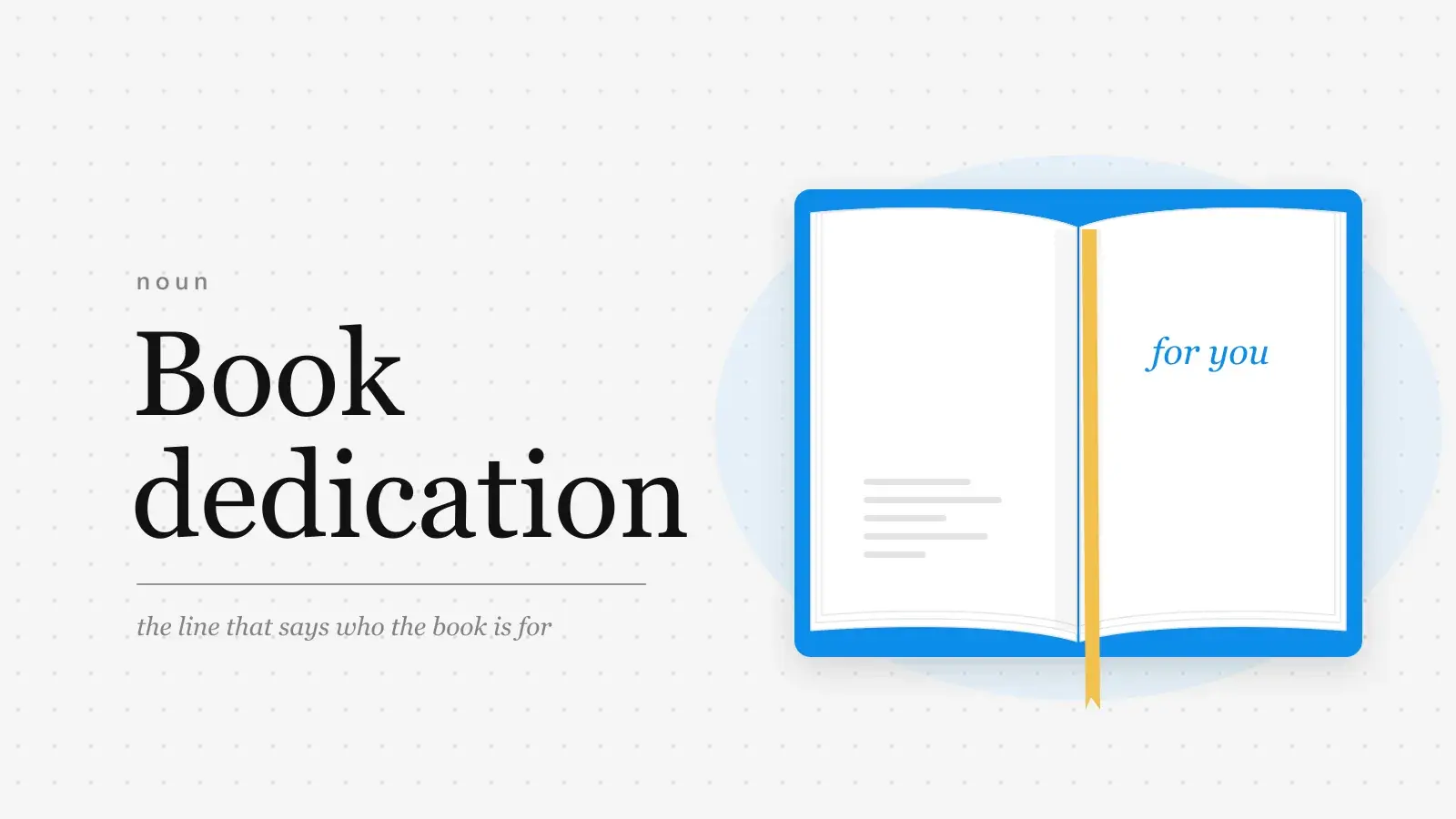
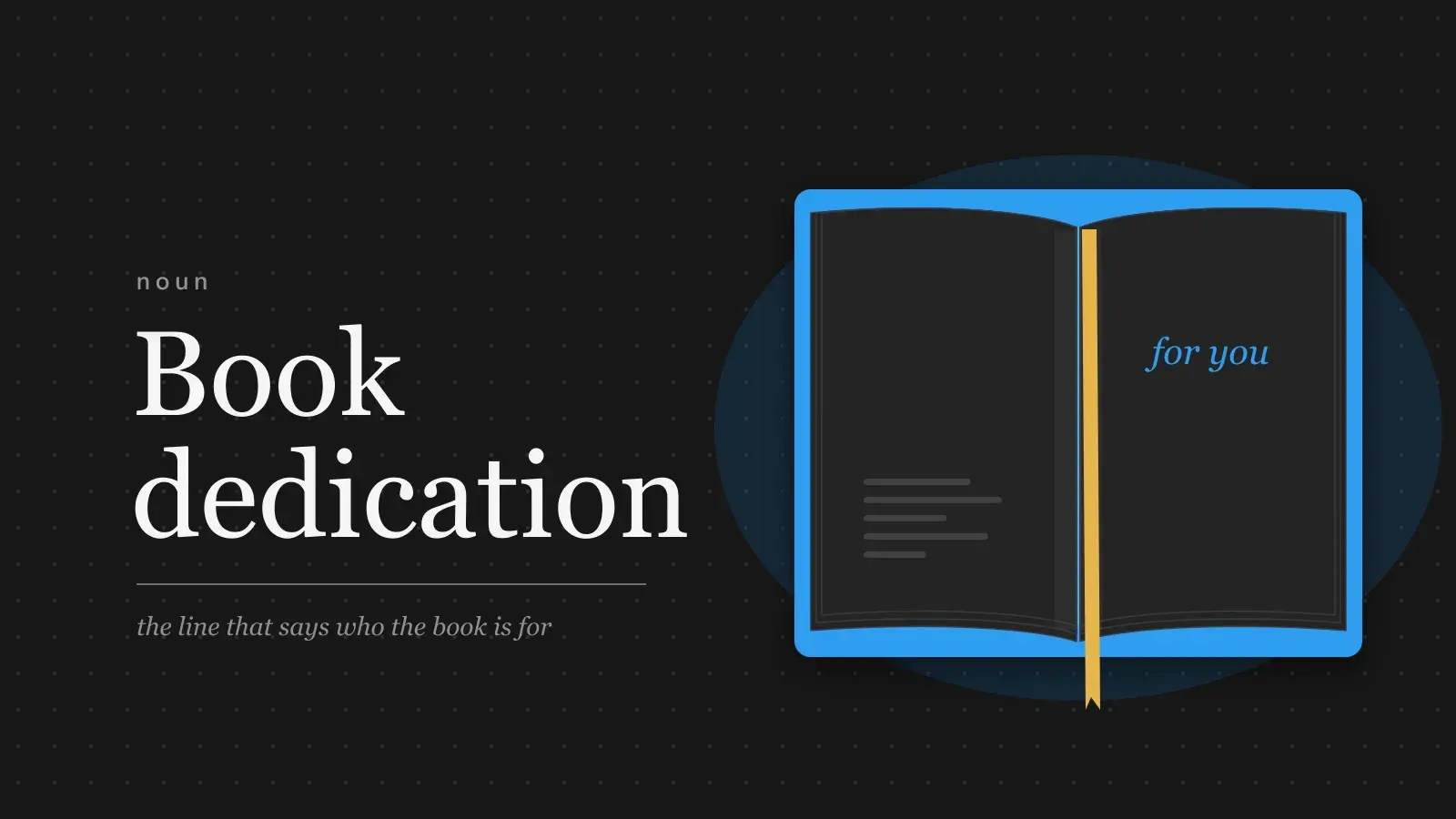
A book dedication is a short printed note at the front of a book that offers it to a person, a group or a cause. It usually sits alone on a right-hand page after the copyright page and runs one or two lines, though some stretch to a short letter.
The person named is the dedicatee. For centuries that was a patron. Until well into the eighteenth century, writers were often supported by wealthy backers rather than paid by publishers, and the dedication was the public thank-you, sometimes written with the next gift in mind. Now it is almost always personal: a partner, a parent, a child, the friend who read the drafts, someone who died before the book came out.
Book dedication examples
Once again to Zelda
Fitzgerald had dedicated his 1920 story collection, Flappers and Philosophers, "To Zelda." The two added words turn a name into a history. Morrison's dedication to Beloved is just as short and points the other way, from private life to a public loss. It reads "Sixty Million and more," her estimate of the Africans who died in capture and on the slave ships, and it frames the novel before the first page.
This book is for Hadley and for John Hadley Nicanor
Hadley Richardson was Hemingway's first wife, and John, born in 1923, was their son. The marriage was failing by the time the book came out in October 1926. They divorced in January 1927, and he gave her the book's royalties. The dedication stayed. A dedication is printed in every copy for as long as the book is in print, so write one you will still stand behind.
To my dear friend Hommy-Beg
Hommy-Beg was the novelist Hall Caine. His grandmother had nicknamed him that, Manx for "little Tommy." Few readers in 1897 could have decoded it, and they didn't need to, because "my dear friend" tells a stranger everything required.
To His Royal Highness the Prince Regent, this work is, by His Royal Highness's permission, most respectfully dedicated, by His Royal Highness's dutiful and obedient humble servant, the Author.
The prince's librarian, James Stanier Clarke, let Austen know in November 1815 that a dedication would be welcome. She disliked the prince and could hardly refuse. Shelley's Frankenstein, published anonymously in 1818, is "respectfully inscribed" to William Godwin, identified as the author of Political Justice and Caleb Williams. Godwin was her father. The page doesn't say so.
To Her
Hand in hand we come
Christopher Robin and I
To lay this book in your lap.
"Her" is Milne's wife, Christopher Robin's mother, who appears nowhere else in the book. The rest of the poem imagines her reaction to the gift. Verse lets Milne bring along the boy the stories are about.
To S.L.O., an American gentleman in accordance with whose classic taste the following narrative has been designed, it is now, in return for numerous delightful hours, and with the kindest wishes, dedicated by his affectionate friend, the author.
S.L.O. was Samuel Lloyd Osbourne, Stevenson's thirteen-year-old stepson, and Stevenson began the story in the summer of 1881 to entertain him. The joke is the grand manner: a schoolboy addressed as a gentleman of classic taste.
Lewis's dedication is a short letter to his goddaughter, Lucy Barfield, who grew up while the book was being written. He tells her that "girls grow quicker than books," so she is already too old for fairy tales, and that one day she will be old enough to read them again.
How to write a book dedication
Start with who. The obvious person is usually the right one: whoever lived with the book while you wrote it, or whoever made you someone who would write it. A parent, a child, a teacher, someone who died before it was finished, a place, the people the book is about and the readers who need it are all fair choices. You can name two people, as Hemingway did. Past two or three, it turns into a thank-you list. Co-authors can each write a line and sign it with initials.
Then pick the first word. "For" says you wrote it for them. "To" offers it to them and sounds a little more formal. "In memory of" is for the dead. Add their years if you want the line to mean something to strangers. After the name, one clause about why is usually enough, and the best ones contain a detail only that person would recognize.
- For Dana, who read every draft and told me when it wasn't working.
- To my mother, who signed for my library card before I could write my name.
- In memory of Walter Ruiz (1938–2021), who taught me to fish and to wait.
- For Ruth and Eli. You can read this one when you're older.
- For the night shift on Ward 4B, who never once asked how the book was going.
- To the 7:15 train, where most of this was written.
- For Ms. Adebayo, tenth-grade English, who wrote "more of this" in a margin.
- For anyone who has ever been picked last.
The most common first draft tries to thank everyone at once.
Before: This book is dedicated to my amazing husband, my wonderful children, my parents, my writing group, my agent and everyone who ever believed in me.
After: For Sam, who took the kids to the park every Saturday morning for three years.
The second version names one person and one specific thing. Everyone else moves to the acknowledgments, where there is room for all of them.
A few things go wrong often enough to check for:
- Settling a score. "To my ex, who said I'd never finish" is funny once. In print it reads as bitter, and strangers buy the book without the backstory.
- An unwelcome surprise. Ask first if naming someone ties them to something private: an illness, a death, a memoir about their family. A child named in a book about a divorce will read it one day.
- A misspelled name. Check every name on the proofs, accents and middle initials included. The dedicatee will read this page first.
Expect to try several versions before one sticks. If you keep the book as a Strokes project, give the dedication its own short document beside the chapters. Version history saves versions as you go and whenever you ask, so you can preview an earlier wording and restore it in one click.
Where the dedication page goes
In a printed book, the dedication belongs to the front matter. It follows the copyright page, usually on the next right-hand page, and comes before the epigraph and the table of contents. That is the order The Chicago Manual of Style sets out, and most trade books follow it.
It is a display page, so it has no heading that says "Dedication" and no printed page number, although the page still counts in the roman numbering of the front matter. Set it centered in the upper part of the page, in the body font or its italic, at text size or a little smaller. A short line on an empty page looks deliberate, and enlarging the type to fill it doesn't.
In an ebook, give the dedication its own section so it gets its own screen instead of running into the next page. A manuscript you send to agents can leave it out. The dedication can wait until the book goes into production.
Dedication vs. acknowledgments
| Page | What it does | Where it goes | Length |
|---|---|---|---|
| PageDedication | What it doesOffers the book to someone | Where it goesFront matter, after the copyright page | LengthA line or two |
| PageEpigraph | What it doesQuotes another writer to set the tone | Where it goesAfter the dedication, or at a chapter opening | LengthA few lines and a source |
| PageAcknowledgments | What it doesThanks the people who helped | Where it goesBack of most novels, front of much nonfiction | LengthA page or more |
| PageInscription | What it doesA handwritten note in one copy | Where it goesFlyleaf or title page of that copy | LengthA sentence and a signature |
A dedication is about who the book is for, and acknowledgments are about how it got made. The agent, the editor, the early readers and the friend who lent you a cabin for a month belong in the acknowledgments (a thesis has its own rules, covered in acknowledgments for a dissertation). An inscription is written by hand in a single copy, though older books also used the word for the printed dedication, as Frankenstein does. The copy an author gives the dedicatee is the dedication copy. For Emma, it went to the Prince Regent's residence in December 1815.
Related terms: foreword, preface and the other preliminary pages. For the full order of front matter and how to lay it out for print and ebook, see the guide to formatting a manuscript and a book. For the page about you at the back, see these author bio examples.