When to use it
- Interview episodes, where the guest supplies most of the words
- Co-hosted conversation shows that need a lead for every segment
- Solo episodes delivered from talking points instead of a full script
- Live recordings in front of an audience, run from a clock-time run sheet
- Planning a season of episodes before the first booking
A podcast outline is a one- or two-page plan for an episode you won't read word for word: the promise, the segments in order with a time box and a lead for each, and under every segment the talking points, the opening question and the line it should land on. It's what you take into the room when the conversation is the show.
The outline sets the episode's editorial shape: what each segment is for and where it lands. The run sheet in the same template is the production document for the session itself. The interview outline below shows the format filled in. When every word needs writing, use the podcast script template instead.
Interview episode outline example
Each line is one segment: when it starts, its length in brackets, then its goal, its points, the question that opens it and the line it lands on.
Promise. By the end, you'll know why obituaries became the Larkin County Ledger's most-read page, and how its editor writes one in an afternoon.
- 0:00 · Cold open (0:30). Tape: Ines reads the first line of her favorite obituary.
- 0:30 · Intro (1:00). Written out.
- 1:30 · The page nobody wanted (7:00). Goal: how a two-person weekly made obituaries its best-read section. Points: she inherited three-line paid notices; began interviewing families for free; readers started writing in. Opening question, word for word: “When you took over the Ledger, what did the obituary page look like?” Lands on: the letter that told her it worked. If long: skip the budget story.
- 8:30 · How she writes one (12:00). Essential: this segment keeps the promise. Goal: her method, so listeners can use it. Points: the call with the family; the one detail; what she leaves out. Story: the beekeeper. Lands on: her three questions, repeated slowly.
- 20:30 · Mid-roll (1:00). Written out.
- 21:30 · The one she got wrong (7:30). Goal: what a correction taught her. Agreed in the pre-interview; she can stop at any point. Lands on: what she checks now.
- 29:00 · What other papers can take (6:00). Drop first if the episode runs long; the three habits go in the show notes instead. Three habits, two minutes each. Bridge, word for word: “So what does a paper with two reporters do on Monday?”
- 35:00 · Outro (1:30). Written out: the three questions again, next week's guest, credits.
Every segment has a job and a place to stop, and the time boxes add up to 36:30, leaving three and a half minutes for the conversation to breathe. Two segments are marked on the page. “How she writes one” can't go: it delivers the promise, and the outro repeats its three questions. “What other papers can take” goes first if the interview runs long, because its habits work as well in the show notes and the episode still keeps its promise. The hard segment comes third, after the guest is warm, and its ground rules are written on the page so nobody improvises them. The cold open drops the listener in medias res, inside the best tape of the interview. Questions come from your research; the interview notes template keeps the sources, quotes and facts to check.
How to use this template
- Write the promise first
Finish the sentence “By the end of this episode, listeners will…” It works like a logline for the episode: every segment has to serve it, and the intro and outro both say it.
- Time-box the segments
Give each segment a start time, a length and a lead. Plan a few minutes under the target, because conversations tend to run long. Mark the segment that keeps the promise and the one you'll drop first.
- Fill one card per segment
A goal in one line, three talking points at most, the story or example that carries it, the question that opens it, where it should land, and what to drop if you're running long. Bullets, not sentences: you want to glance down, not read.
- Write out only the edges
The first line, the first question, each bridge between segments and the outro go in word for word. Those are the moments a conversation most often loses its footing, so give them exact words. Everything in between stays in bullets.
- Make the run sheet, then log the times
For the session, list clock times, who's on mic and every cue. After recording, replace the planned times with the real ones; they become the timestamps in your show notes.
What goes in a podcast outline
| Part | What it holds | Written as |
|---|---|---|
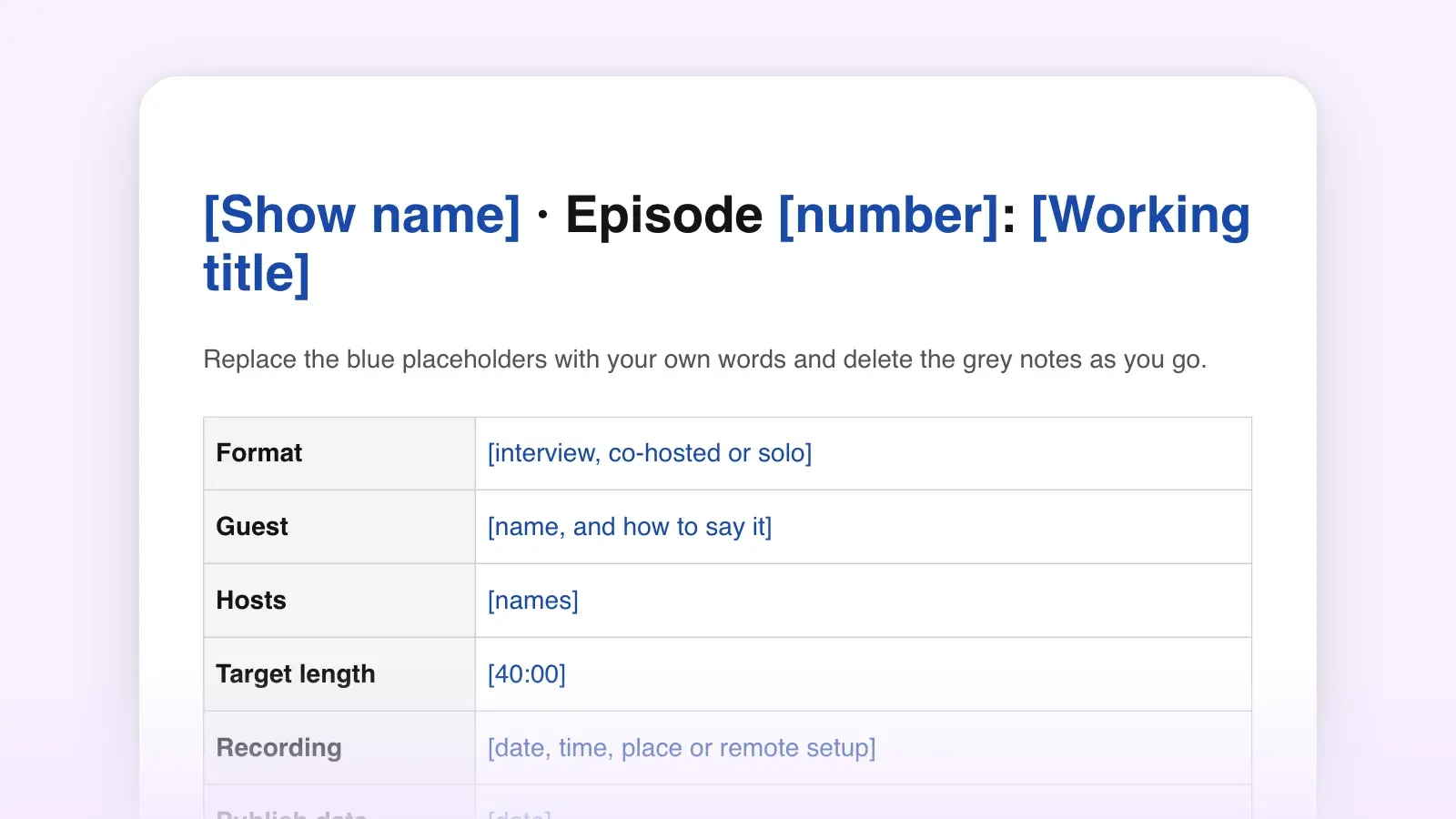
| PartEpisode header | What it holdsShow, number, title, format, guest, target length, record date | Written asFields |
| PartPromise | What it holdsWhat the listener will have by the end | Written asOne sentence, word for word |
| PartSegment cards | What it holdsGoal, points, story, opening question, landing line, time box, lead, cut | Written asBullets |
| PartWritten-out lines | What it holdsOpening, first question, bridges, ad read, outro | Written asWord for word |
| PartPrep | What it holdsResearch links, names and how to say them, facts to check, anything off limits | Written asA list |
| PartParking lot | What it holdsGood tangents to save for another episode | Written asA list |
| PartRun sheet | What it holdsClock time, item, who, cues | Written asA table |
| PartAfter the recording | What it holdsReal start times and chapter titles | Written asA table |
The landing line is easy to skip and worth writing. A segment with points but no destination tends to end when someone runs out of things to say. One with a landing line (“the three questions she asks every family”) ends when it gets there, and the bridge can pick up from it.
Co-hosted episode outline example
On a two-host show, the outline's main job is to say who carries each segment, so neither host waits for the other.
| Time | Segment | Lead | Points | Lands on |
|---|---|---|---|---|
| Time0:00 | SegmentCold open | LeadTheo | PointsReads the client email: “we went with someone cheaper” | Lands on“Best thing that happened to me that year.” |
| Time0:45 | SegmentIntro | LeadMaren | PointsWritten out | Lands onThe promise: what to say when you raise your rate |
| Time2:00 | SegmentHow we picked the number | LeadMaren | PointsOld rate, new rate, the spreadsheet, the gut check | Lands onTheo asks: did you round up? |
| Time9:00 | SegmentThe email we sent | LeadTheo | PointsBoth emails read word for word; what each would change | Lands onThe one sentence that did the work |
| Time16:00 | SegmentWho stayed, who left | LeadBoth | PointsTwo of seven clients left; income three months later | Lands on“Losing two was the point.” |
| Time22:00 | SegmentListener question | LeadMaren | PointsRaising a rate in the middle of a project | Lands onOne rule a listener can use |
| Time25:30 | SegmentOutro | LeadTheo | PointsWritten out | Lands onNext week, and where to send questions |
The leads alternate, so both voices carry weight, and the conversation's anchor (the two emails) is read word for word because the exact phrasing is the point. Everything else is a prompt to talk, not a line to read. The plan ends at 27:00, three minutes under the target, for the same reason as the interview: conversations run long.
Solo episode outline example
Promise. By the end, you'll have a two-minute test for whether your first paragraph is doing any work.
- 0:00 · Intro (0:45). Written out.
- 0:45 · The problem (2:30). Many drafts start before the story does. Read two sentences of my own warm-up paragraph. Lands on: “The first paragraph is often you clearing your throat.”
- 3:15 · The test (4:30). Cover paragraph one; read from paragraph two. What breaks? A name, a time, a stake. Lands on: the test in one sentence, said twice.
- 7:45 · Two listener drafts (2:30). Before and after, read with permission. If long: one draft, not two.
- 10:15 · Outro (0:45). Written out: the test again, this week's homework, next episode.
A solo host has nobody to rescue a stalled segment, so each point is a complete thought and the examples are chosen in advance. With no guest to run long, the plan can sit closer to the clock: it ends at 11:00, a minute under, with one listener draft ready to drop. If you find yourself writing full sentences under every bullet, the episode wants a script.
Run sheet for a live recording
The outline is the editorial plan: what the episode says, in what order, and where each segment lands. The run sheet is the production plan for the room. It runs on the clock on the wall rather than the episode's clock, and at a live taping the producer works from it.
| Clock | Item | Who | Notes |
|---|---|---|---|
| Clock6:15 p.m. | ItemDoors open, house music | WhoProducer | NotesBoth recorders tested; spare batteries |
| Clock6:55 | ItemWelcome: phones off, how the Q&A works | WhoProducer | NotesNot part of the episode |
| Clock7:00 | ItemRecording starts. Cold open | WhoHost | NotesOne clap on mic, so the two recordings line up later |
| Clock7:02 | ItemIntro, guest walks on | WhoHost | NotesHold three seconds for applause |
| Clock7:05 | ItemInterview, segments 1 to 3 | WhoHost and guest | NotesOut by 7:40, whatever happens |
| Clock7:40 | ItemAudience questions | WhoProducer with the roaming mic | NotesHost repeats each question on mic |
| Clock7:52 | ItemOutro and thanks | WhoHost | NotesWritten out |
| Clock7:55 | ItemRecording stops | WhoProducer | NotesThirty seconds of room tone for the editor |
Plan a season in one table
The season outline keeps the promises from repeating and shows the gaps before you book anyone.
| Episode | Working title | Guest | Promise | Status |
|---|---|---|---|---|
| Episode112 | Working titleThe obituary page | GuestInes Calderón | PromiseWhy obituaries became the most-read page | StatusRecorded |
| Episode113 | Working titleSelling the building | GuestGene Harlow, publisher | PromiseWhat a paper loses when it leaves Main Street | StatusBooked |
| Episode114 | Working titleThe intern who stayed | GuestTo be booked | PromiseHow small papers train reporters | StatusPitching |
| Episode115 | Working titlePaper Route Live | GuestInes Calderón and a reader | PromiseA live Q&A on local news | StatusVenue held |
If the episode also goes on YouTube, the real start times from your outline can become chapters. YouTube's rules, as of November 2026: the first timestamp must be 00:00, you need at least three in ascending order, and each chapter must run at least 10 seconds. The YouTube script template covers chapter titles in more detail.
Tips for outlining a conversation
- Keep it to one page per half hour. Much more than that and you may start reading it instead of talking.
- Three points per segment. A fourth usually belongs in the next segment or the parking lot.
- Decide the cuts now. An “if running long” line on every card, and one segment marked to drop first, turn a panicked choice into a planned one.
- Keep a parking lot. When a great tangent comes up, write it down and move on. That list is where next season starts.
- Watch the clock, not the outline. Put a clock where the host can see it, and check it against each segment's start time.
Frequently asked questions
What is the difference between a podcast outline and a script?
A script holds every word the host will say. An outline holds the structure and the talking points and leaves the wording to the conversation, with only the set pieces written out. Interview and co-hosted shows tend to run on outlines; narrative and news shows, where exact wording matters, tend to be scripted.
How long should a podcast outline be?
About a page for every half hour of episode. Much longer and the host may start reading instead of talking. If the outline keeps growing full sentences under every bullet, the episode probably needs a script, at least for the segments where the wording matters.
What is a podcast run sheet?
A run sheet is the production timetable for a recording session or live show. It lists clock times, each item in order, who is speaking or responsible, and the cues: music, clips, ads, audience questions. The outline is the editorial plan for what the episode says; the run sheet runs the room.