When to use it
- Announcing a policy, process or schedule change to a team or a whole company
- Asking a manager or another department for a decision, a budget or an approval
- Recommending one option when someone else makes the call
- Recording an incident, a finding or a project's status for people outside the thread
How to use this template
- Write the purpose paragraph first
Before the heading, before the background, write the one to three sentences that open the memo: what is happening, what you need and by when. Military writers call this BLUF, bottom line up front, and news writers build stories the same way with the inverted pyramid. If you cannot write that paragraph yet, you are not ready to send the memo.
- Turn it into the subject line, then fill the heading
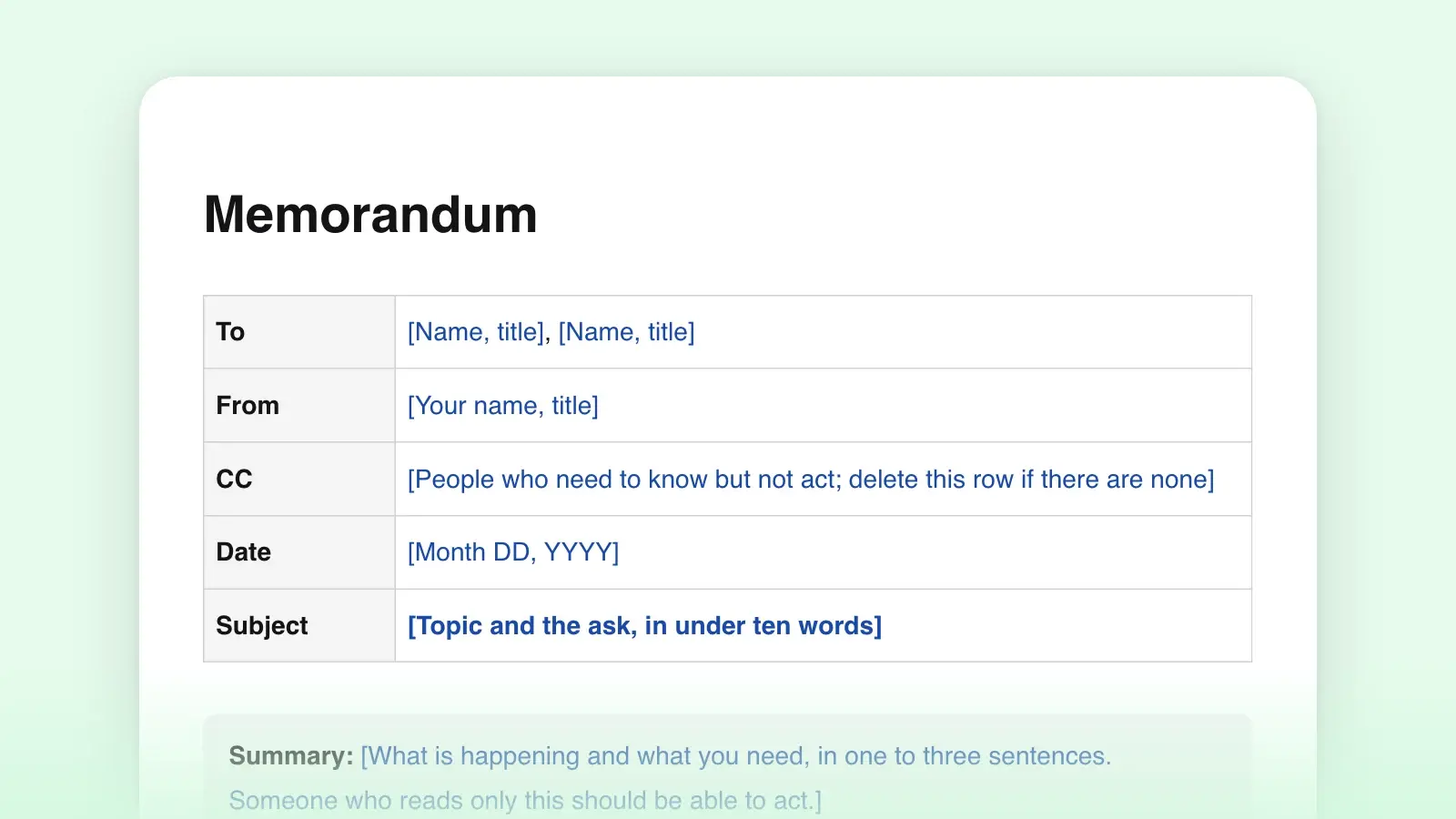
Squeeze the purpose into fewer than ten words, keeping the ask and the date. Put the people who must act or decide on the To line, with titles for a formal memo, and the people who only need to know on CC. Write the date out in full: "October 14, 2026" reads the same everywhere, while 10/14 and 14/10 do not.
- Add only the background the reader needs
Fill in Background and Details, then rename the headings so they say something. "Details" becomes "What changes on November 1." Put parallel facts in a list and prefer numbers, names and dates to adjectives. Anything the reader would look up rather than read, such as a full schedule or a spreadsheet, goes in an attachment.
- End with the action, then cut
Give every action one owner and one date. Then read the memo as the busiest person on the To line and cut whatever they would skip. Most memos run a page, two at most; if yours runs longer, it is turning into a report.
A filled-in memo example
Here is the template used for a schedule change at a small publisher. The first paragraph gives the new date and the request before it explains anything.
To: Editorial and design teams
From: Dana Whitfield, Managing Editor
CC: Marcus Lee, Sales Director
Date: October 14, 2026
Subject: Spring catalog copy now due October 27, not November 6
The spring catalog goes to press on November 3 instead of November 12, so final copy is due Tuesday, October 27, ten days earlier than planned. Each editor, please confirm by Friday, October 16, that your titles can make the new date, or tell me which ones cannot.
Why the date moved. Our printer has a press down for repairs in November and offered us an earlier slot or one in December. December would put the catalog in stores after most spring orders are placed, so I took the earlier slot.
What changes.
- Catalog copy, cover images and prices: due October 27
- Sales sees proofs on October 29 instead of November 10
- Titles not confirmed by October 16 move to the summer catalog
Action needed. Confirm your titles or flag the ones at risk (each editor, October 16). Send final cover files (design, October 23).
Questions to me or to Priya Shah in production.
Attachments: Revised production schedule, October 14, 2026
Subject lines that get read
The subject line is the one part of a memo that everyone reads, often in a list of forty others. Say what the memo is about and, if you need something, what and by when. Some teams start it with a keyword such as ACTION, INFO or REQUEST so readers can sort their inbox at a glance.
Specific
- Approval needed by May 2: new print vendor contract
- New expense tool from Nov 1; file October receipts in the old one
- Office closed Dec 24 to Jan 1; support schedule attached
- Q3 returns: paperbacks up, hardcovers flat (no action needed)
Vague
- Update
- Important: please read
- Vendor
- Process changes
Four kinds of memo, one template
Most memos do one of four jobs. The structure stays the same; what changes is what the first paragraph promises and which section carries the weight.
| Memo type | First paragraph says | Adjust the template |
|---|---|---|
| Memo typeAnnouncement | First paragraph saysWhat changes, for whom, from when | Adjust the templateRename Details to what changes; drop the action table if nothing is needed |
| Memo typeRequest | First paragraph saysWhat you need, from whom, by when | Adjust the templatePut the ask and the date in the subject line |
| Memo typeRecommendation | First paragraph saysThe option you recommend and when a decision is due | Adjust the templateAdd a table of options with cost and risk |
| Memo typeReport | First paragraph saysWhat happened or what you found, and what happens next | Adjust the templateTurn Details into a timeline or findings; add a summary past one page |
Policy briefing notes in many governments make the split explicit: each is marked either for information or for decision, and one that asks for a decision must carry a recommendation. A line under the subject that says "For decision" tells your reader which kind they are holding before they read a word of it.
Memo format rules worth keeping
- Single-spaced and left-aligned. No paragraph indents; leave a blank line between paragraphs instead.
- No greeting, no sign-off. The To line does the greeting and the From line says who wrote it. Close with who to contact. Some offices still ask writers to initial a printed memo beside their name; follow the house style.
- Short headings that say something. A reader who skims only the headings should come away with the outline of the argument.
- Attachments named at the end and mentioned in the body. Otherwise the one document that answers the question goes unopened.
- A level tone. Memos get forwarded, so keep the tone of voice you would use with the reader's manager copied. Plain words do more for readability than any formatting.
Memo or email?
Most memos now travel by email, so the real choice is the format. Use the memo shape when the message is a record (a policy, a decision, an incident) or goes to a group that includes people who were not in the conversation. Paste a short memo into the email body with its heading block intact, or attach it as a PDF when it must look the same for everyone or will be filed. A quick question to one person is just an email; these professional email examples cover that side.
Some companies stretch the form much further. In his 2017 letter to shareholders, Jeff Bezos described Amazon meetings that start with everyone silently reading a six-page narrative memo instead of watching slides, and wrote that a great one probably takes a week or more to write. That is a different genre from the one-page memo here, but the lesson carries: the time goes into rewriting. If your memo is really a proposal, the one-pager template is built for making a case, and the executive summary template fronts a longer report.
Frequently asked questions
What is the standard memo format?
A heading block with To, From, Date and Subject (plus CC if needed) above a rule, then a purpose paragraph, the background, the details and the action you need. Memos are single-spaced and left-aligned, with a blank line between paragraphs instead of indents, and usually run one or two pages.
Does a memo need a greeting or a signature?
No. The To line takes the place of a greeting and the From line identifies you, so there is no Dear line and no sign-off. Some offices ask writers to initial printed memos beside their name; follow your organization's house style.
Is RE the same as Subject on a memo?
Yes. Both label the topic line. Use whichever your organization uses and keep it the same across memos so they file and search consistently.
How long should a memo be?
One page for most memos, two at most. If it runs longer, add a two- or three-sentence summary under the heading, or turn it into a report with an executive summary and send a short memo that points to it.