When to use it
- The first page of a report, study or audit that decision-makers will not read in full
- The front of a business plan going to a lender, investor or partner
- A project or budget proposal that needs a yes from leadership
- Board and committee papers, where each item opens with one page
- Briefing someone new on a long project without sending them the whole file
How to use this template
- Finish the report first
An executive summary condenses a document that already exists. Sketching the bottom line early can help you aim the report, but fill in the template once the findings are final, so the summary and the report never disagree.
- Put the conclusion in the first three sentences
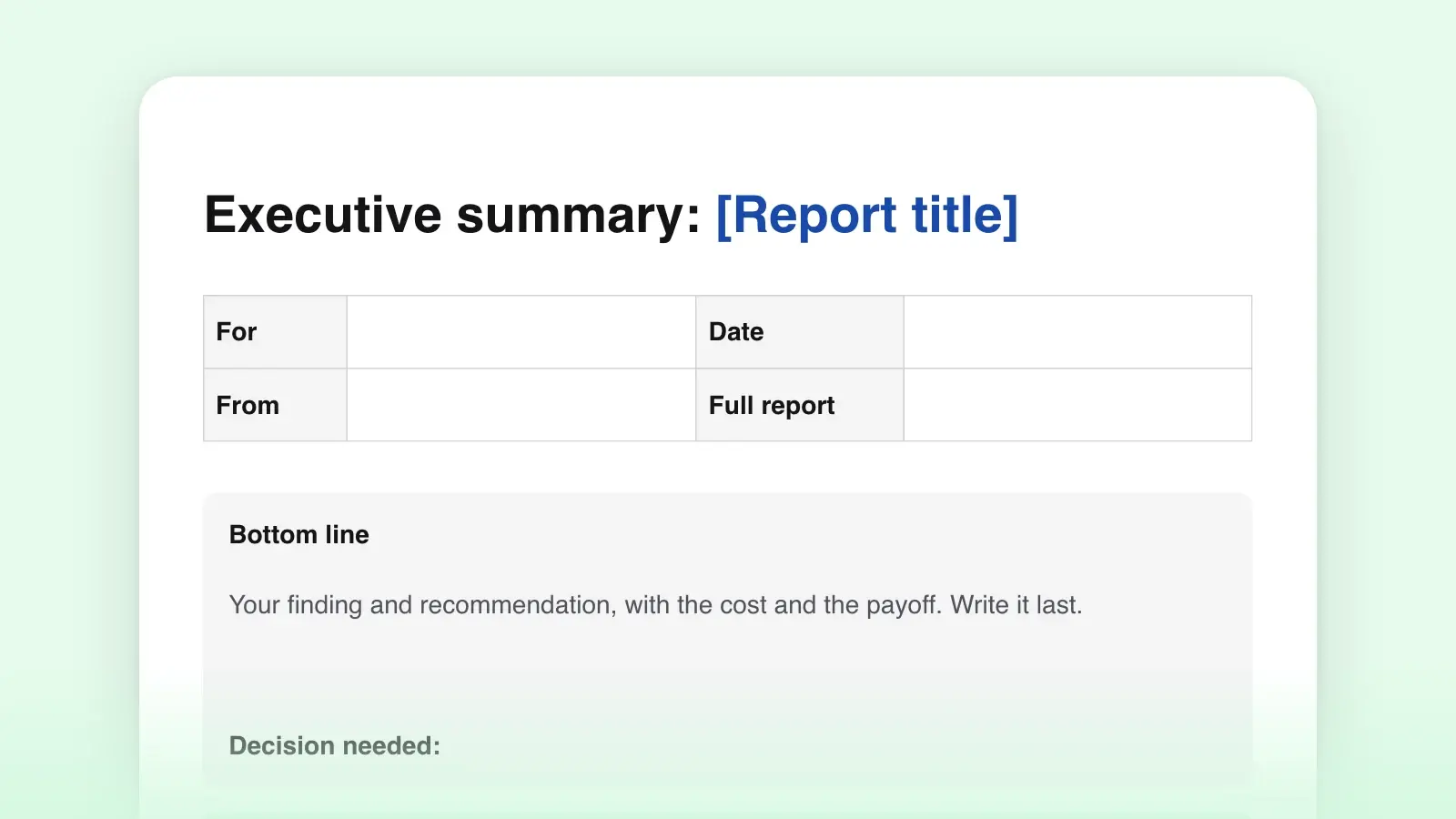
For many readers, Bottom line is the whole summary. Say what you found and what you want done, with the cost and the date. US Army correspondence rules call this BLUF, bottom line up front. Journalists know it as the inverted pyramid. "This report reviews our audiobook options" describes a document. "We recommend producing six audiobooks in-house for about $41,000" gives someone something to approve.
- Fill in the rest in the report's order
Situation, findings, recommendation, risks. Give each finding the number that supports it and the section where the evidence lives, so a skeptical reader can check one claim without reading forty pages. Use only what the report contains. A summary is the wrong place for a new fact.
- Cut to one page and check every number
Cut adjectives first, then background, then any finding that does not bear on the recommendation. In Strokes, page view shows real page breaks, so you can see the moment you run over. Then check each figure against the report. One number that disagrees with page 14 makes the reader doubt all the others.
A filled-in example
Here is the template completed for a 22-page internal report at a small publisher. It runs about 250 words and fits on one page with room to spare.
Executive summary — Audiobook production review
For the publisher · From Mara Ellison, managing editor · November 3 · Summarizes the 22-page review
Bottom line. We recommend producing audiobooks of six backlist titles in-house next year, with contract narrators and a rented studio, instead of licensing audio rights to another publisher. It costs about $41,000 and keeps the audio rights and revenue with us. We need approval by November 15 to record in January.
Situation. None of our 140 titles has an audiobook. This year two of our authors said they would take their next book to a publisher that offers one.
Key findings.
- Audio was the most requested format in reader email: 41 of 118 format requests in the past twelve months (section 2).
- Producing in-house costs $5,800 to $7,400 per title for books of 70,000 to 90,000 words, covering narrator, studio, editing and mastering (section 3).
- Both licensing offers paid about $2,000 per title up front but took the audio rights for seven years (section 4).
Recommendation. Produce six titles in-house, starting with the two whose authors raised it. Alternatives: license to an audio publisher (about $12,000 in advances, no production cost, rights gone for seven years), or wait a year (no cost now, but we risk losing both authors' next books).
Risks. Narrator availability in January: two backups are on hold. Sales below plan: titles were chosen by print sales, and we review results after six months.
Decision needed. Approve $41,000 from the 2027 production budget by November 15.
Notice what the example leaves out: how the reader survey was run, the history of the two licensing offers, the per-title spreadsheet. All of it is in the report, and each finding says where.
What to lead with, by document
The template fits most documents, but what goes first changes with the reader. The business plan row follows the US Small Business Administration's guide to writing a business plan.
| Document | Open with | Must include | Keep brief |
|---|---|---|---|
| DocumentBusiness plan | Open withWhat the company is and why it will succeed | Must includeMission, product or service, leadership team, employees, location; financials and growth plans if you are asking for money | Keep briefThe founding story |
| DocumentReport or study | Open withThe main conclusion | Must includeScope, a one-line method, findings, recommendation | Keep briefMethodology |
| DocumentProject or budget proposal | Open withThe ask and what it will achieve | Must includeProblem, approach, cost, timeline, decision needed | Keep briefAlternatives beyond the main one |
| DocumentPolicy recommendation | Open withThe recommended action | Must includeWho it applies to, who carries it out, how success is measured | Keep briefBackground and history |
| DocumentGrant application | Open withWhatever the funder's guidelines put first | Must includeThe funder's required sections, in the funder's order | Keep briefAnything past the funder's length limit |
Summary, abstract or introduction
An abstract describes a paper so a researcher can decide whether to read it, and it rarely ends with a recommendation; see how to write an abstract for that form. An introduction prepares someone who is about to read everything. An executive summary is written for the reader who will act without reading the rest, which is why it carries the recommendation and the decision.
If there is no longer document behind your page, use the one-pager template instead. The shape is similar, but a one-pager has to make the whole case on its own, while an executive summary can point to the report for proof.
Mistakes that get it skipped
- Describing the report instead of summarizing it. "This report examines vendor options" tells the reader the topic. Replace every "examines", "discusses" and "explores" with what you found.
- Saving the recommendation for the end. Suspense works in fiction. Here it means the reader who stops after one paragraph leaves without the point.
- Vague numbers. "Significant savings" invites a question. "$18,000 a year, from the vendor quotes in section 3" invites a decision.
- Facts that are not in the report. If it matters enough for the summary, it belongs in the report first.
- Your team's shorthand. The person approving the budget may not know your acronyms or project code names. Spell them out or cut them.
- Running long. University writing guides commonly put the ceiling at about 10 percent of the full document. Most readers will give you one page.
Frequently asked questions
How long should an executive summary be?
One page for most reports and proposals. Many university writing guides set the upper limit at about 10 percent of the full document, so a long report can justify two pages, but treat that as a ceiling rather than a target. If you cannot fit the bottom line, the findings and the decision on one page, the report may be making more than one case.
Should I write the executive summary first or last?
Last, though it goes first in the document. Writing a one-sentence bottom line at the start can keep the report focused, but rewrite the summary once the report is finished so every finding and number matches.
What goes in a business plan executive summary?
The US Small Business Administration suggests saying what your company is and why it will succeed, with your mission statement, product or service, and basic information about your leadership team, employees and location. If you are asking for financing, add financial information and high-level growth plans.
Can an executive summary use bullet points?
Yes, for findings, options and risks, where readers scan. Keep the bottom line in full sentences: a recommendation needs a verb, a cost and a date, and bullets tend to strip those out.