When to use it
- A help page for a product, an app or an online service
- A small business website: booking, prices, delivery and refunds
- An event: tickets, getting there, accessibility and what to bring
- An internal FAQ for a policy change, a move or a new tool
- A launch or an announcement, so support and sales give the same answers
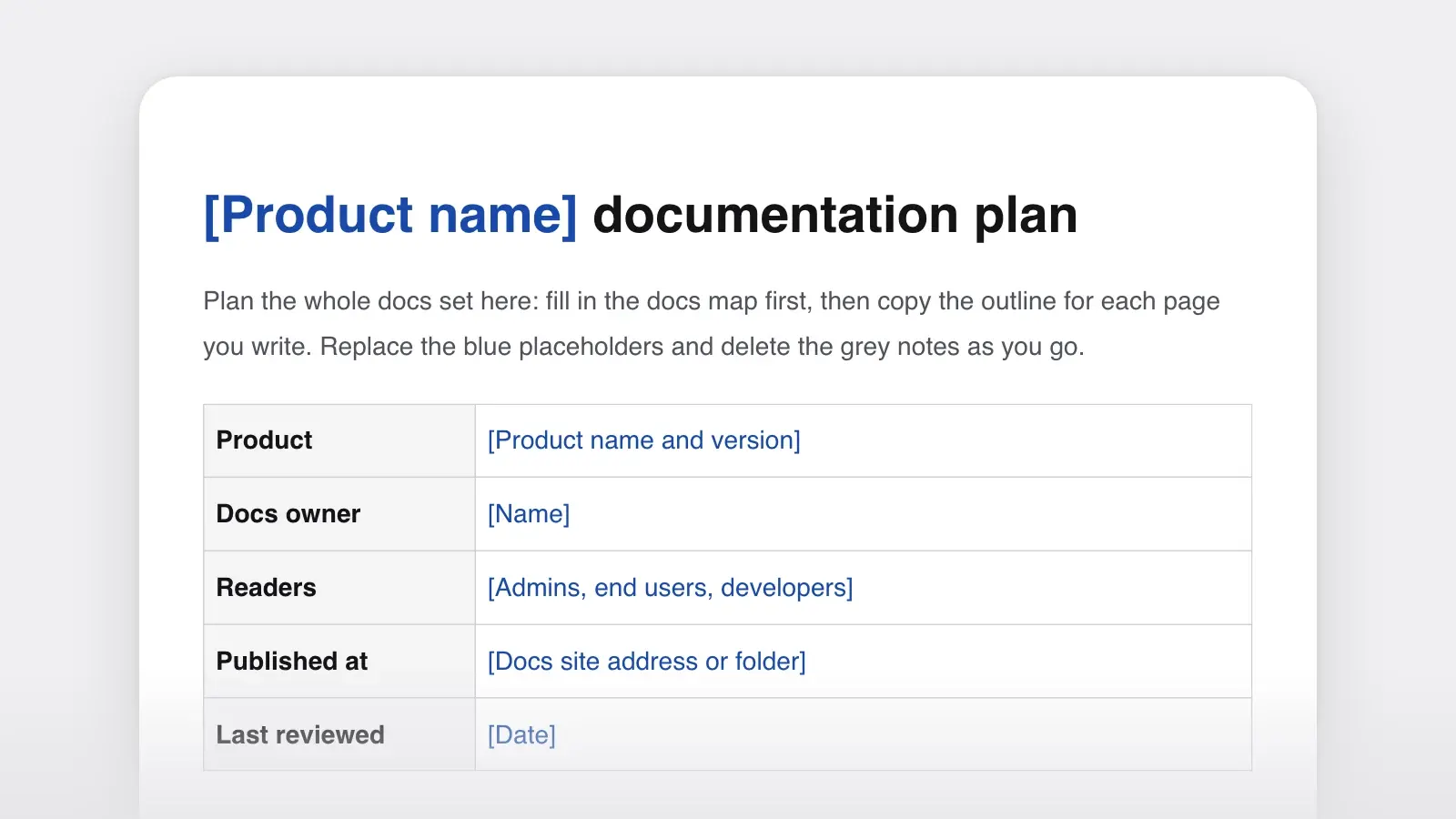
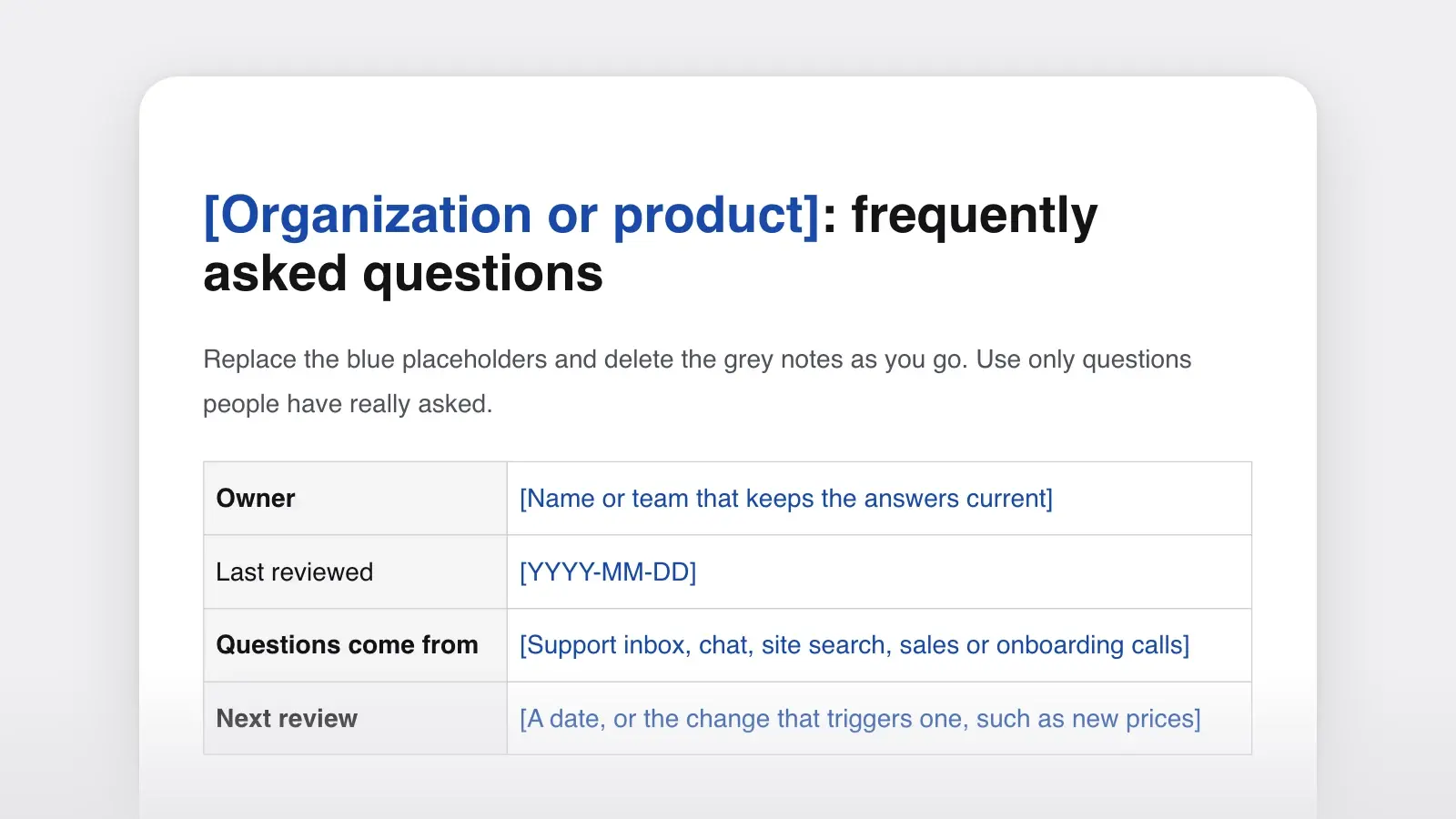
An FAQ page (frequently asked questions) answers the questions people really ask about a product, a service, an event or a policy, each written as a question with a short answer below it. This FAQ template groups the questions by topic, answers each one in its first sentence and ends with a way to ask something the page doesn't cover. Fill it in from real questions, not guesses.
The filled-in example comes first, so you can see a whole page before the steps.
FAQ page example: a pottery studio
Here is the template filled in for an invented pottery studio. Most answers start with yes or no, the condition that limits an answer comes right after it, and every policy has a number in it.
Answers about classes, open studio and firing. Can't find yours? Email hello@kilnstreet.example and we'll add it here.
Classes
Do I need any experience? No. The six-week wheel course starts with centering clay, and most students throw a small bowl by week two.
What should I wear? Clothes you don't mind getting clay on, and closed shoes. Short nails help. We have aprons.
Clay and firing
Can I bring my own clay? No. We fire one stoneware clay so that everything in a kiln load matures at the same temperature; other clays can melt onto the kiln shelves. Clay is included in the course price.
When do I get my pieces back? About three weeks after you finish them. Each piece dries, is fired once, is glazed and is fired again. We text you when it's on the pickup shelf.
Booking and refunds
Can I get a refund if I cancel? Yes, a full refund up to 7 days before the first class. After that, we can move you to a later course once.
I missed a class. Can I make it up? Yes, once per course, at any open studio session in the same month.
Visiting
Is the studio accessible? Yes, through the side entrance on Mill Lane: the classroom and restroom are step-free from there, and two wheels have adjustable seats. Tell us what you need when you book.
Still have a question? Email hello@kilnstreet.example or call during studio hours, 1 p.m. to 6 p.m., Tuesday to Saturday. We reply within one working day. Updated November 2, 2026.
Why it works. Each question is the kind a beginner emails about, and the most anxious one (experience) comes first. The conditions sit right after the answers they limit: “Yes, a full refund up to 7 days before the first class,” not a yes with the deadline two sentences later. Answers explain the rule that might annoy people, such as the clay, so the reader gets a reason rather than a refusal. Numbers make policies checkable: 7 days, once per course, one working day. And the page says how to ask the next question, which is where next season's entries will come from.
How to use this template
- Collect the questions people really ask
Go through the support inbox, chat logs, the search box on your site and notes from sales or onboarding calls. Write each question in the asker's words and keep a tally. Keep their words even when they aren't yours: if customers write “pick up my pots,” the question says that, not “collect fired work.” Ten real questions beat thirty invented ones.
Press “Use this template” to open it in Strokes as a document you can edit and export. To find the wording, attach your support notes to a chat with the Strokes Assistant and ask which questions come up most, and in what words.
- Keep the frequent ones
The F in FAQ is the filter. A question asked once deserves an email reply; one asked every week belongs on the page. A question only the marketing team wants asked doesn't belong at all.
- Answer in the first sentence
Start with yes, no, a number or the action, then add the detail and a link. It is the same principle as the news writer's inverted pyramid: a reader who stops after one sentence still has the answer.
- Group and order the questions
Use three to six topics named the way readers think (booking, payment, on the day), not the way the company is organized. Put the most common question first in each topic.
- Name an owner and a review date
Prices, dates and policies change, and an FAQ that contradicts the checkout page can do more harm than no FAQ. Record who owns the page and when it was last checked, and update it the day a fact changes.
What goes on an FAQ page
| Part | What to write | Example |
|---|---|---|
| PartTitle | What to writeWho the page is about, then “frequently asked questions” | ExampleKiln Street Pottery: frequently asked questions |
| PartOpening line | What to writeWhat the page covers and where to ask anything else | ExampleAnswers about classes, open studio and firing. |
| PartTopic headings | What to writeThree to six groups, in the reader's words | ExampleClasses · Clay and firing · Booking and refunds · Visiting |
| PartQuestions | What to writeOne question per entry, as the reader would type it | ExampleCan I bring my own clay? |
| PartAnswers | What to writeThe answer first, then detail, then a link | ExampleNo. We fire one stoneware clay so that… |
| PartStill have a question? | What to writeEmail, phone or form, with hours and a reply time | ExampleEmail us; we reply within one working day. |
| PartLast updated | What to writeThe date the facts were last checked | ExampleUpdated November 2, 2026 |
Writing FAQ questions and answers
Questions and answers that work
- Can I bring my own clay?
- No. We fire one stoneware clay, because other clays can melt onto the kiln shelves.
- Can I get a refund if I cancel? Yes, a full refund up to 7 days before the first class.
- Is the studio step-free? Yes, from the side entrance on Mill Lane.
Questions and answers that don't
- Clay policy (a topic, not a question)
- Great question! At Kiln Street, we're passionate about clay… (the answer is buried)
- Why is Kiln Street the best studio in town? (nobody asks this)
- Please contact us for details. (not an answer)
- Write the question as the reader asks it. First person (“Can I…”, “How do I…”) and the reader's own words, which are also the words they are likely to search with.
- One question per entry. “Can I cancel, and will I get a refund?” is two entries with two answers.
- Keep answers to a few sentences. When an answer turns into steps, write the steps on their own page and link it.
- Leave edge cases to a help article or a reply. If an answer depends on three conditions at once (a course started, then paused for illness, and paid with a gift card), the FAQ answers the common case and links to the article or invites an email.
- Use the same words as the rest of the site. If the booking page says “course,” the FAQ doesn't say “workshop.” A glossary settles which word wins.
Product FAQ examples
A product FAQ answers the questions people ask before they read the manual. These come from the help center of an invented newsletter platform.
Why did my edition reach fewer people than my subscriber count? Because Lanternfish skips addresses that have hard-bounced or unsubscribed, and members-only editions skip free subscribers. The delivery report for each edition lists every skipped address and the reason.
Can I send at the same local time in every time zone? Yes. Choose Send window instead of Send now and pick an hour. Each subscriber gets the edition at that hour in their own time zone.
How do I move my list from another platform? Export it as a CSV file, then go to Subscribers > Import. Paid status comes across if your old platform includes it in the export.
The questions describe symptoms (“fewer people than my subscriber count”), because that is how people arrive at a help page. Each answer names the exact menu path. Past a few dozen questions, a product needs a docs set with search, and the product documentation template maps one out.
Event FAQ example
Do I need a ticket for every event? No. Talks in the tents are free, first come, first served. Only the three evening events need a ticket.
Is the festival accessible? Every venue is step-free. The evening events have sign language interpretation; ask for it by Friday, April 30, and we will reserve seats with a clear view.
Can I bring my own books to be signed? Yes, up to three per author at each signing.
What if it rains? The tents stay up. Readings on the lawn move to the library hall, and the program app shows the change.
Event FAQs answer logistics, so every answer carries a date, a place or a number. The accessibility answer gives a deadline and says what happens next. A festival handing out press passes can add the questions reporters ask; the press kit examples include a press FAQ.
Internal FAQ example for employees
When do I have to switch? Submit paper claims by Friday, January 29, 2027. From Monday, February 1, every claim goes through the app.
Do I still need receipts? Yes, as photos taken in the app. Keep paper receipts over $75 until the claim is paid.
Who approves my claims now? Your manager, as before. Claims over $500 also go to Finance.
What if I'm traveling when it changes? Paper claims for trips that start before February 1 are accepted until Friday, February 26. Questions go to Dana Ruiz in Finance.
At a change, people ask the same three things: when, what's different for me, and what if I'm the exception. This FAQ answers all three with dates and amounts and names a person, which an internal announcement often forgets.
When not to use an FAQ
The GOV.UK style guide is blunt: “Do not use FAQs on GOV.UK.” Its reasoning is that content written from what users need makes them unnecessary. The warning applies anywhere an FAQ collects answers that belong somewhere else:
- The answer is a procedure. Steps belong in a guide or a user manual; the FAQ links to them.
- The FAQ repeats the main page. If everyone asks what the price includes, the pricing page should say so.
- The questions are invented. “Why choose us?” is sales copy dressed as a question.
- The list keeps growing. Once it passes a few dozen questions, readers usually need search and articles more than a longer page.
Frequently asked questions
How many questions should an FAQ page have?
As many as people really ask often, which for a small website is usually a short list. Start with the ten you hear most. Group them under topic headings once you pass about a dozen, and if the page keeps growing past a few dozen, move the answers into a searchable help center and link to it.
Should FAQ questions be written in first person?
Usually, yes. Write each question the way a reader would ask it, such as “Can I change my plan?”, and answer in second person: “Yes. You can change it at any time.” First-person questions read the way people ask and use the reader's words rather than the company's. Whatever pattern you choose, keep it for every question on the page.
Is FAQ schema markup still worth adding?
Not for Google Search features, as of November 2026. Google limited FAQ rich results to well-known government and health websites in August 2023, and they stopped appearing in Google Search on May 7, 2026. Write the FAQ for people, and check the current documentation of any other service before you add markup for it.
What is the difference between an FAQ and a knowledge base?
An FAQ is one page of short answers to common questions. A knowledge base is a searchable collection of articles, each covering one task or problem in full. A small site needs only the FAQ. A product with many features needs a knowledge base, and its FAQ page becomes a short list of links into it.