A research paper conclusion answers the question your introduction asked, says what that answer adds to what was known, names the limits that matter and points to a specific next step. It usually takes one to three paragraphs. It moves from your findings back out to the wider field, the reverse of the introduction, and it adds no new data, no new sources and no section-by-section recap.
Below are the four moves with the sentence each one needs, how a conclusion differs from the discussion and the abstract, three original example conclusions from different fields, a weak draft taken apart, and a pattern you can fill in.
What a conclusion is for
Your reader has just finished the paper. They do not need it again in miniature. What they need is the payoff: what the evidence adds up to, and why it was worth their time. A conclusion that only restates the results is a summary, and most published papers already have one at the top: the abstract.
The USC Libraries research writing guide describes a paper as an hourglass. The introduction starts wide, with the field and the problem, and narrows to one question. The body works at that narrow point. The conclusion starts from the answer and widens again, to what it means for the field, for practice or for the next study. If your conclusion stays as narrow as your results section, it has not done its job.
It also gets read out of order. People who skim a paper often read the abstract, the introduction and then the last section, so the conclusion has to make sense without the middle: state the answer in plain words, with at most one number.
Conclusion, discussion and abstract
These three sections overlap, which is why conclusions so often turn into a second discussion or a second abstract. Each has its own job.
| Section | Its job | Usual length | Leave out |
|---|---|---|---|
| SectionAbstract | Its jobSummarize the whole paper for someone deciding whether to read it | Usual length250–300 words at most, set by the venue | Leave outCitations, detail |
| SectionDiscussion | Its jobInterpret each finding, compare it with earlier studies, weigh other explanations and limitations | Usual lengthAs long as the interpretation needs | Leave outA recap of the results |
| SectionConclusion | Its jobState the answer, what it adds, its limits and what should happen next | Usual lengthOne to three paragraphs | Leave outNew data, new sources, a section-by-section recap |
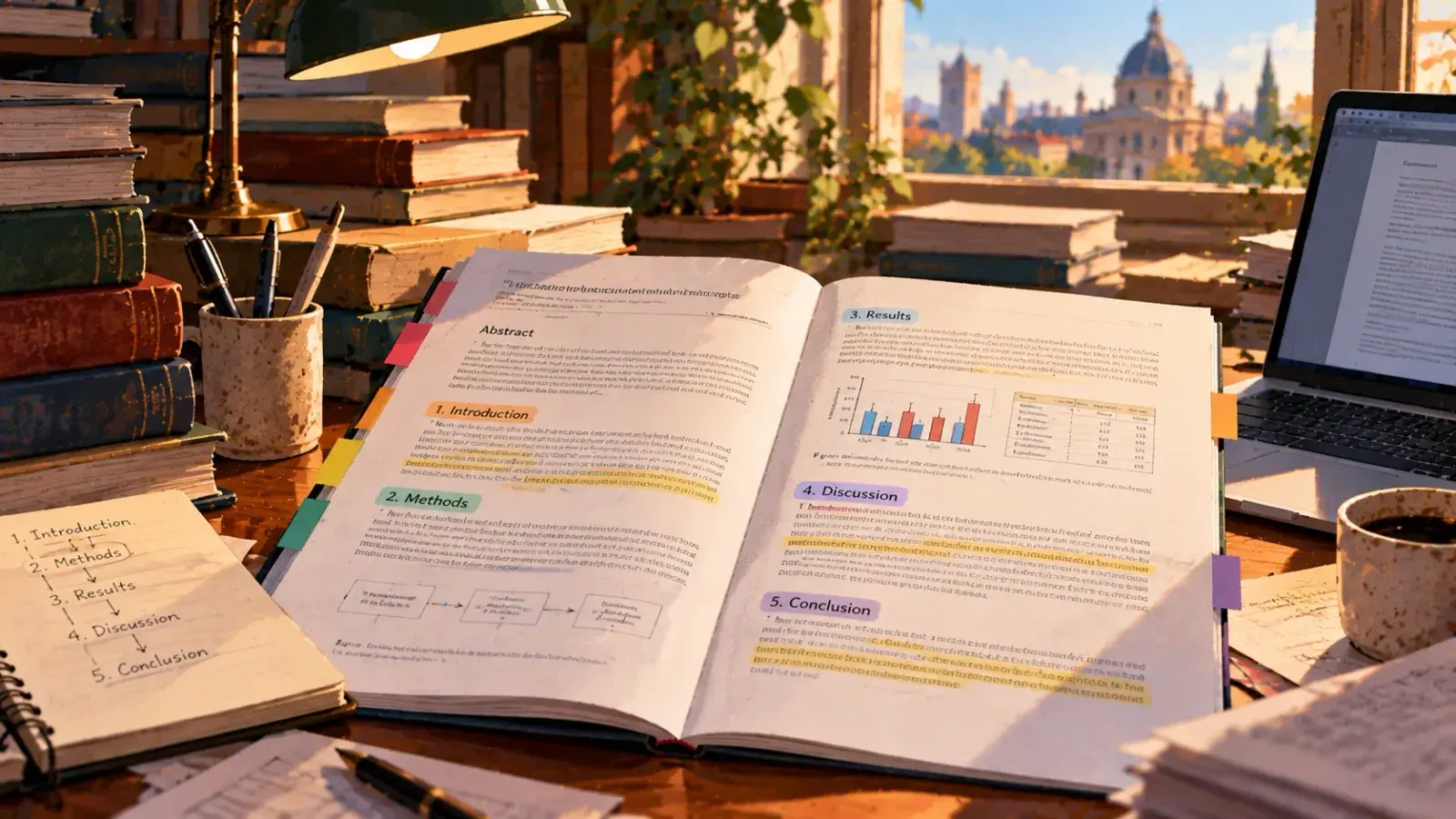
Whether you need a separate section depends on the kind of paper. In journal articles that follow IMRaD, the conclusion is often the closing paragraph of the discussion. PLOS ONE, for example, lists Conclusions as an optional section and lets authors merge it into the Discussion. The University of Manchester's Academic Phrasebank makes the same point the other way round: research articles often skip a separate conclusion, while dissertations and essays are generally expected to have one. Student research papers almost always need one.
One rule from the USC guide saves a lot of repetition: recommendations for future research go in the discussion or the conclusion, not both. Pick the one where they fit the flow of your paper.
The four moves, sentence by sentence
Nearly every good research conclusion makes the same moves in the same order. The proportions change by field: a lab report spends more on limits, a literature paper more on meaning.
| Move | What it says | Length | Tense |
|---|---|---|---|
| Move1. Answer | What it saysThe answer to your research question, or your thesis as the evidence left it | Length1–2 sentences | TensePast for what you found |
| Move2. Meaning | What it saysWhat the findings show together, and why that matters to the field | Length2–3 sentences | TensePresent |
| Move3. Limits | What it saysThe one or two limitations that bound the answer | Length1–2 sentences | TensePresent or past |
| Move4. Next step | What it saysA specific study, method or action that follows, and a closing implication | Length1–2 sentences | TensePresent; could or should for advice |
1. Answer the question you asked
Turn your research question into a statement. If the introduction asked whether street trees cool city blocks, the conclusion opens by saying whether they did, by how much and under what conditions. If your hypothesis was not supported, say so in the first sentence. A null result stated plainly reads as confidence. Buried, it reads as the opposite. If you asked three questions, answer three.
Read your introduction before you write this sentence. Questions drift during research, and a conclusion that answers a slightly different question from the one the paper set up is on the USC guide's list of problems to avoid. If the question changed, fix the introduction. If the question itself is still vague, the research question examples show what a focused one looks like.
2. Say what it means
This is the move that separates a conclusion from a recap. Show how your findings fit together: two results that looked separate may point to one explanation, or a small effect may matter because of where it occurs. Then place the answer against the gap your introduction named. Does it fill that gap, narrow it or show that it was framed wrongly?
The UNC Writing Center suggests a test it calls the "So what?" game: after each sentence, ask "So what?" and answer, until you reach a claim someone in your field would care about. Two rounds is usually enough to get past restating the result.
3. Name the limits that matter
Choose the one or two limitations that change how far your answer reaches: a single site, a volunteer sample, a design that shows association but not cause, an edition or archive you did not consult. The full list belongs in the discussion. State them without apology. "This study has many limitations" undermines the paper without telling the reader anything. "Because the data cover one summer, they cannot show whether the effect holds in drought years" tells them exactly where the answer stops.
4. End on a next step
Every limit you named suggests the study that would remove it. Say what that study is: who, what method, what it would establish. For applied work, add what a practitioner or policymaker could do now, at the scope your evidence supports. Then stop. The last sentence should be the widest claim your evidence can carry, not a slogan about the future of the field. "More research is needed" is not a next step, since every paper could end with it.
Three example conclusions
Environmental science: a field study
Blocks with more street-tree canopy were measurably cooler on the hottest afternoons of the summer. Across 48 residential blocks, each additional 10 percentage points of canopy cover was associated with a surface temperature 1.1 °C lower at midafternoon, and the difference was largest on blocks with dark asphalt and narrow setbacks. The size of the effect matters less than where it falls: the blocks with the least canopy were also the hottest to begin with, so the streets that most need shade have the least of it. Because the study was observational and covered one summer in one city, it cannot show that new plantings will produce the same cooling, or how many years young trees need before they do. A planting trial that measures matched blocks before and after new trees go in would answer both questions. Until then, the evidence favors spending the city's planting budget first on the hot, bare blocks this study identified.
What it does. The first sentence answers the question and the second gives the one number that matters, with "associated with" rather than "caused." The third is the synthesis: two results (canopy and baseline heat) read together produce a point neither makes alone. The limits are stated as what the data cannot show, the next step is a specific design, and the recommendation stays inside the evidence.
Education: an interview study
The first-generation students in this study did not skip office hours for lack of time. They skipped them because they were unsure what office hours were for. In 18 interviews, students described them as a place to bring a specific, well-formed problem, and several said they waited until they had a question that seemed good enough, which in practice meant they rarely went. Read alongside their accounts of a first visit, which most described as easier than they expected, this suggests the barrier lies in the invitation rather than the meeting. The participants attended one public university and volunteered to be interviewed, so their experience may differ from that of students who avoid campus services altogether. Future studies could test whether renaming office hours, or scheduling one required visit early in the term, changes who attends. For instructors, the step is small: explain on the first day what office hours are for, and give an example of a question that is welcome.
What it does. Qualitative conclusions answer with a pattern rather than a number. The limit here is about who the findings transfer to, which is the right limit for an interview study, and the next step turns the finding into two testable changes.
Literature: an argumentative paper
Frankenstein is usually read as Victor's confession, but its frame hands the last decision to someone else. Robert Walton, whose letters to his sister open and close the novel, hears Victor's whole story and then must act on it: when his crew asks to turn back from the Arctic ice, he agrees. Read through the frame, the novel's warning about ambition is delivered less by Victor's dying advice, which he half takes back, than by Walton's choice to sail home. This reading rests on the 1818 text and on treating Walton as more than a narrative device; a comparison with the 1831 edition, which Shelley revised, would show whether it holds there too. Either way, the frame suggests the novel is less about what one man made than about whether the next man listens.
What it does. In a humanities paper the answer is the thesis, restated as something the paper has now shown. The limit becomes a statement of scope (which text, which assumption) and the next step is the comparison that would test it. The last line returns to the usual reading from the first sentence and turns it: the UNC handout's advice to return to the opening theme, with a change rather than a repeat.
A weak conclusion, rewritten
Here is the kind of draft that the field-study conclusion above replaced. Almost every sentence shows a habit worth unlearning.
In conclusion, this paper has examined the relationship between street trees and urban heat. First, the literature review showed that urban heat is a growing problem. Then, the methods section described how temperatures were measured on 48 blocks. The results showed that trees have a significant effect on temperature. Although this study has many limitations, it shows that trees are very important. A city survey also found that most residents want more trees. More research is needed on this important topic. Trees are the key to a cooler future for all.
| Sentence | Problem | Fix |
|---|---|---|
| Sentence"In conclusion, this paper has examined…" | ProblemStock opener; describes the paper instead of answering | FixOpen with the finding |
| Sentence"First… Then… The results showed…" | ProblemRecaps the paper section by section | FixKeep only the answer and one number |
| Sentence"…a significant effect…" | ProblemVague, and "significant" hides the size and direction | FixSay how much cooler, and where |
| Sentence"…has many limitations…" | ProblemApologizes without naming anything | FixName the limit and what it rules out |
| Sentence"A city survey also found…" | ProblemNew evidence the paper never discussed | FixCut it, or move it into the body |
| Sentence"More research is needed…" | ProblemTrue of every paper | FixDescribe the specific study |
| Sentence"Trees are the key…" | ProblemA slogan the data cannot support | FixEnd on a scoped recommendation |
How to write your conclusion
- Write it after the discussion
The conclusion depends on what the discussion decided, so it comes last, or second to last if you write the abstract after it. Reread your introduction first and copy your research question or thesis into a note above the blank conclusion.
- Write the answer in one sentence
Answer the question you copied, as directly as the evidence allows. If it takes more than two sentences, the answer is not yet clear to you, and the discussion may need work first.
- Ask "So what?" twice
Under the answer, write why it matters, then why that matters. The second answer is usually your meaning sentence. Check it against the gap your introduction named.
- Pick one or two limits and their next steps
Choose the limitations that bound the answer, not the full list. For each, write the study or action that would address it.
- Write the last sentence, then cut
End on the widest implication your evidence supports. Then delete anything that recaps a section, cites a source the paper has not used, or begins with "in conclusion."
If you are still planning the paper, put the four moves in your outline now. The research paper outline template has a slot for them, and the annotated research paper example shows how a conclusion sits against the rest of the paper.
A pattern to fill in
Use this as scaffolding for a first draft, then rewrite it in your own sentences. A conclusion that still reads like a form will sound like one.
Conclusion pattern
[Answer] This study found that [main finding, with the one number that matters], which [supports / does not support / complicates] [the hypothesis or thesis].

[Meaning] Read alongside [a second finding], this suggests [what the findings mean together], which [fills / narrows / challenges] [the gap named in the introduction].

[Limits] Because [design, sample or scope], these results cannot show [the specific boundary].

[Next step] [A specific study, method or source] would establish [what it would settle].

[Close] For [the reader who can use this], [the implication, at the scope your evidence supports].
Mistakes that weaken a conclusion
The weak draft above shows the recap, the vague result, the apology, the new evidence and the slogan. Four more problems are harder to spot in your own work:
- Overclaiming. Correlation stated as cause, one sample stated as everyone, "proves" where the data suggest. A careful reader checks the conclusion for exactly this.
- Hiding a null or awkward result. If the main hypothesis failed, the conclusion is where you say what that failure teaches. Leaving it out invites the reader to assume the worst.
- The late thesis. The UNC handout calls it the "Sherlock Holmes" conclusion: the main claim appears for the first time at the end. Academic readers expect it in the introduction, and the conclusion should confirm it, not reveal it.
- A grab bag of leftovers. Interesting facts that did not fit the argument get tacked on at the end, another pattern UNC warns about. Leave them out or work them into the body.
"In conclusion" and "in summary" are on the avoid lists of both the UNC and USC guides. The reader can already see the paper is ending.
Checking a conclusion with AI
An AI model is more useful for checking a conclusion than for writing one. A conclusion has to report what your paper found, and only your paper knows that. A model asked to write one produces something fluent and generic, and it can add claims or citations that exist nowhere in your work, a form of hallucination. Check your instructor's or institution's policy on AI use before you start.
In Strokes, you can add the whole paper to an AI Assistant chat as context and ask it to test the conclusion against the rest of the document:
Prompt
Read the attached paper. Then check its conclusion only:
1. Does it answer the research question exactly as the introduction states it?
2. Quote any sentence that claims more than the results section supports.
3. List any fact, number or source in the conclusion that does not appear earlier in the paper.
Do not rewrite anything.
To tighten one sentence, select it, press ⌘K and ask for the change in place, then compare the result with your own wording. Version history saves drafts automatically, so you can return to an earlier conclusion in one click if a revision goes too far.
The conclusion and the abstract should report the same main finding in compatible words. Write the abstract last, from the finished paper, as the guide to writing an abstract explains. For a thesis, where the conclusion is a full chapter, see how to write a dissertation.
Frequently asked questions
How long should a research paper conclusion be?
Usually one to three paragraphs. Writing guides such as the USC Libraries research guide describe it as often the shortest section of the paper. A dissertation's concluding chapter is longer because it draws together several chapters. If your instructor or journal sets a length, follow it.
Can I cite sources in a conclusion?
You can refer back to sources you already discussed, for example to show how your answer changes a debate from your literature review. Avoid introducing sources the reader has not seen yet. New evidence belongs in the body of the paper.
Should a conclusion include limitations?
In most research papers, yes, briefly: one or two sentences on the limits that bound your answer, ideally paired with the study that would address them. The full discussion of limitations belongs in the discussion section.
What tense should a conclusion be written in?
Use the past tense for what your study did and found, and the present tense for what the findings mean and for established knowledge. Literature papers usually discuss the text itself in the present tense throughout.
Do journal articles need a separate conclusion section?
It depends on the journal. Many articles end the discussion with a concluding paragraph instead. PLOS ONE, for example, lists Conclusions as optional and allows it to be merged with the Discussion. Check the author guidelines of the journal you are submitting to.