The best poem ideas are small and specific: not “love” but the first morning your coats hung in the same closet, not “time” but a phone number you can't bring yourself to delete. A poem works through things a reader can see and hear, so the idea that starts one is usually an object, a place, a habit or a single afternoon. The 150 ideas below are grouped by theme, and each comes with an angle: the specific detail to start from.
These are topics, not prompts. A prompt tells you how to write (“every line is a question”); a topic tells you what to write about and leaves the how to you. If you want instructions instead, the poetry prompts page has 100 of them, and the ideas here were chosen not to repeat them.
| If you want to write about… | Start with | Ideas |
|---|---|---|
| If you want to write about…Who you are | Start withYourself | Ideas1–12 |
| If you want to write about…Someone you love, or loved | Start withLove | Ideas13–26 |
| If you want to write about…The people you live with | Start withFamily and home | Ideas27–40 |
| If you want to write about…Everyone else | Start withFriends, neighbors and strangers | Ideas41–52 |
| If you want to write about…The past | Start withChildhood and memory | Ideas53–66 |
| If you want to write about…The outdoors | Start withNature, weather and animals | Ideas67–82 |
| If you want to write about…Somewhere else | Start withPlaces and travel | Ideas83–94 |
| If you want to write about…The working week | Start withWork and everyday life | Ideas95–108 |
| If you want to write about…What changes and what's gone | Start withTime, change and loss | Ideas109–122 |
| If you want to write about…The news, science and history | Start withThe wider world | Ideas123–136 |
| If you want to write about…Something that makes you laugh | Start withFunny poem ideas | Ideas137–150 |
| If you want to write about…Which form to write it in | Start withMatch the idea to a form | Ideas14 forms |
Poem ideas about yourself
Poems about yourself go flat when they describe a personality. Come at yourself sideways, through something you own, do or can't stop doing.
- Your name — who chose it, who shortens it, and the one person who still says all of it.
- The language you count in — or dream in, or swear in, when it isn't the one you use at work.
- Your handwriting — how it changed after school, and whose it's starting to look like.
- Your voice on a recording — why it sounds wrong to you, and who it sounds like now.
- A gesture you caught from someone — a hand on the hip, a jingle of keys, and the day you saw yourself doing it.
- The thing you're known for — the joke, the dish or the skill people expect, and what it costs to keep delivering it.
- Something you're still bad at — parallel parking, small talk, swimming, saying no.
- The life you nearly chose — the other city, the other degree, and the person living it in your place.
- The hour you wake at night — what the house sounds like, and what you think about until it's light.
- Your oldest pair of shoes — where they've been, and when you'll admit they're finished.
- Your reflection in a shop window — the half second before you recognize yourself.
- Your age — the number you are, the number you feel and the number strangers guess.
Love poem ideas
The word love has been worn smooth by use. Give it something to hold: a place, an object or a habit two people share.
- The first time you held hands — where you were walking, and which of you let go first.
- Sharing a closet — the first morning your coats hung side by side.
- Meeting their family — the dinner, the word you mispronounced, the relative who decided to like you.
- A text you typed and deleted — the words that stayed in the box, and why they stayed there.
- Love across time zones — one of you waking as the other goes to sleep, a phone held up to show the sky.
- A crush at work — the meeting where you sat one chair closer than you needed to.
- A long marriage in the kitchen — two people who no longer need to say “pass the salt.”
- The moment it ended — not the fight, but the ordinary habit that suddenly grated.
- Love after seventy — a second wedding, grandchildren as bridesmaids, a slow dance with a cane.
- Unrequited love — in the present tense, with the other person as ordinary as they really are.
- Jealousy — as a list of everything you checked, and what time you checked it.
- An ex you'd know from behind — the walk, the coat, the neighborhood you still avoid.
- A wedding ring — the pale band of skin under it, the nights it comes off to knead bread, the drawer it might end up in.
- A love you don't call love — for a team, a bakery, a brother or a dog.
Poems about family and home
Family poems live in rooms and objects. Choose one, and the people will walk into it.
- A parent's work clothes — the uniform, the toolbelt, the smell of the job when they came through the door. (Worked through below.)
- The kitchen table — homework, bills, birthday cakes and the night the phone rang.
- A sibling's room after they moved out — what they left behind and what moved in.
- The family photo albums — who took the pictures, and who is never in them because they were holding the camera.
- Sunday dinner — who cooks, who carves, who always leaves before dessert.
- The argument that returns every holiday — same people, same chairs, a new reason.
- The first night home with a baby — the car seat on the floor, the silence when she finally sleeps.
- A child's question you couldn't answer — word for word, and what you said instead.
- Joining a family late — the first dinner with a stepparent, and deciding what to call them.
- A parent growing older — the first time you carried their bag or read the small print for them.
- Teaching a parent something — a phone, a recipe from your travels, a word of your slang.
- A child leaving home — the car packed to the roof, the room you don't go into for a week.
- A family secret — not the secret itself, but the place in the house where it was kept.
- Being mistaken for a relative — your mother's voice on the phone, your brother's laugh coming out of you.
Poems about friends, neighbors and strangers
A stranger leaves room for imagination, and an old friend supplies the details. Both make good subjects.
- The friend you call first — with good news, and the different friend you call with bad.
- A friendship that faded without a fight — the last message, and how long it took you to notice.
- Your neighbor's garden — what they grow, and what you've learned about them from it.
- The regulars — at a diner, a pool or a laundromat: the nods you trade and the names you never learned.
- A coach or boss who was hard on you — and the one thing they turned out to be right about.
- A friend's wedding — watching someone you've known since school promise the rest of their life.
- Your first roommate — the labeled milk, the 2 a.m. talks, the friend you made by accident.
- People on your commute — the woman who reads, the man who sleeps, the stop where everyone gets off.
- A friend you've never met in person — the voice you imagine from the way they write.
- Someone whose job is to be there — a crossing guard, a mail carrier, the night porter.
- A friend who moved away — their new city, pieced together from the photos they post.
- Being the new person — the first day on a team or at a school, and the first person who spoke to you.
Childhood and memory poem ideas
Memory poems need one afternoon, not a whole childhood. Choose the moment and stay in it.
- The first book you read on your own — where you read it, and who you told.
- The school bus — your seat, the driver, the kid who got on at the last stop.
- A childhood fear — the basement, the drain, the dog behind the fence, and what it looks like now.
- Learning to ride a bike — the hand on the seat, and the moment it wasn't there.
- A lie you told as a child — how long you kept it up, and the day it came out.
- Home sick from school — daytime television, soup on a tray, the strange quiet of a weekday.
- The fair, the parade or the fireworks — the one night a year the whole town came out.
- A hiding place — under the stairs, up a tree, at the back of a closet, and what you kept there.
- Learning to swim — the cold, the instructor's voice, the moment your feet left the bottom.
- The record your parents played until it skipped — the song, the skip, and who got up to nudge the needle.
- A friend's house that ran by different rules — the food, the noise, the way they talked at dinner.
- A photograph from before you can remember — what the adults around you were doing.
- The first time you saw the sea, snow or a big city — and what you had expected instead.
- A word you misheard for years — a song lyric, a prayer, a phrase your grandfather used.
Nature, weather and animal poem ideas
Name the species, the street and the month. “A tree” is scenery. “The sycamore by the bus depot in March” is the start of a poem.
- Fog over a field at dawn — what disappears first, and what stays.
- Ice on a puddle — the sound of a boot breaking it, a child's face looking up out of it.
- A city heat wave — open hydrants, fans in the windows, the parks full at midnight.
- Rain on a tin roof, a tent and a car — the same rain, three different sounds.
- A beach in winter — shuttered kiosks, one dog running, one swimmer.
- A river in flood — the bench under water, the mark on the bridge where it peaked.
- A garden's first year — what the seed packets promised and what actually came up.
- Stars you can't see from the city — what you know is there anyway.
- A dead bird on the sidewalk — a color you'd never seen up close.
- A spider's web at eye level — found by walking into it.
- Deer, foxes or bears at the edge of town — what they're doing there, and what the town says about it.
- A cat that chooses you — the first night it stays, and the terms it sets.
- An old dog on the stairs — the climb that used to take one bound.
- Bees in a lavender bush — the hum you hear before you see them.
- A tide pool — a whole town in a puddle of seawater.
- The first warm day of the year — everyone outside at once, coats over their arms.
Poems about places and travel
A place poem needs a reason to be there: arriving, leaving, or finding the place changed.
- An airport at night — the shuttered shops, the floor polisher, the gate for a flight that isn't yours.
- A hotel room — a stranger's view, voices through the wall, the drawer of things other guests left.
- A train window — what rushes past, and the one house with a light on.
- Your hometown after years away — what's gone, what's the same, what got smaller.
- A border crossing — the passport, the questions, the line where one language stops.
- A city you lived in once — the apartment, the corner shop, the route you walked every day.
- An abandoned building — a mill, a mall, a cinema, and what it was built to hold.
- A gas station at 2 a.m. — the hum of the lights, the cashier, a car with its engine running.
- A market where you don't speak the language — buying by pointing, and being understood anyway.
- A waiting room — the magazines, the clock, the names called out of order.
- A public library on a weekday — the radiators, the line for the computers, the man asleep over the newspapers.
- Getting lost — the wrong turn, the stranger you asked, the place you'd never have found otherwise.
Poems about work and everyday life
Work fills most of the waking week, and it rarely gets into poems. Name the tools, the hours and the pay.
- Your first paycheck — the amount, and the first thing you bought with it.
- A night shift — the hour the building changes, and who's awake with you.
- Being laid off — the box, the badge, the drive home at eleven in the morning.
- Watching an expert work — a butcher, a tailor, a mechanic, and what their hands know that they couldn't tell you.
- The office kitchen — notes on the fridge, the birthday cake, the mug nobody claims.
- Money when there wasn't enough — arithmetic in the grocery aisle, coins in the car's cup holder.
- A uniform — the name badge, the apron, and what you're allowed to say while you wear them.
- The last day at a job — handing in the keys, the goodbye email, the desk someone else will clear.
- A machine that breaks — the washer, the boiler, the car, and the person who comes to fix it.
- The first Monday of retirement — the alarm you forgot to switch off.
- Your to-do list — the item that's been on it longest, and why it's still there.
- Selling something you loved — a guitar, a car, a house, and the stranger who bought it.
- The sound of a workplace — a kitchen during service, a newsroom, a classroom before the bell.
- Payday, rent day, tax day — a date on the calendar that changes the shape of the week.
Poems about time, change and loss
The heaviest subjects need the lightest touch: one object, one gesture, one day. For a poem of mourning, the elegy is the traditional form, and the table further down says why.
- A phone number you can't delete — and what would happen if you called it.
- An empty chair at a holiday table — who sits there now, and who still can't.
- Clothes that still smell like someone — and the day you notice they don't.
- A recipe card in someone's handwriting — the stains, the abbreviations, the step they left out.
- A pet's collar on a hook — the habit of listening for it.
- A last time you didn't know was the last — carrying a child up to bed, a phone call with a friend, a visit to a house.
- A friend's long illness — the parking garage, visiting hours, the jokes you both still made.
- Growing older — the first reading glasses, the knees on the stairs, reaching the age your parent was in your favorite photograph.
- A town that changed — the factory closing, the new bypass, the shop that became a phone store.
- A season ending — the last swim, the last tomato, the first morning you need a coat.
- Dividing a household — the books, the photographs, the friends.
- A clock that stopped — in a kitchen, a station, a church tower, and nobody wound it.
- An anniversary nobody else marks — the date that comes round whether or not you're ready.
- Things that outlast people — a tree someone planted, a wall someone built, initials carved in a school desk.
Poems about the wider world
Poems can take on science, history and justice if they come at them from somewhere specific: one street, one headline, one face in the crowd.
- The news at breakfast — a war, the weather and a football score in the same scroll.
- A line at a polling place — neighbors waiting together, whatever they've come to vote for.
- A march or a vigil — one sign, one chant, one face lit by a candle.
- A changing climate in one place — the creek that floods more often now, the snow that comes later each year.
- The deep sea — animals that make their own light where sunlight never reaches.
- Earth seen from space — the photograph, and the billions of people in it you'll never meet.
- A scientific fact that floors you — the age of the light from a star, the life in one spoonful of soil.
- An invention you use every day — the zipper, the light switch, the postage stamp, and the person who made it.
- History from the edge of the picture — the cook, the clerk or the child in the crowd at a famous event.
- Your ancestors' journey — the ship or the train, the papers, the first winter.
- Belief and doubt — a prayer, a ritual, a building you go into or walk past.
- Justice in a small room — a courtroom, a principal's office, a referee's decision.
- A language with few speakers left — the last fluent speakers, the words with no translation.
- Your street in fifty years — what will stand there, and who will be living in your rooms.
Funny poem ideas
Light verse is still verse, and it needs a straight face. A strict form helps: a limerick or a mock ode gives the joke a frame to push against.
- The sock that never comes back from the wash — where it goes, and what it's doing there.
- A cat's daily schedule — the 5 a.m. alarm, the cardboard box, the one sunbeam it will fight for.
- The group photo — the one where everyone blinked except you.
- Flat-pack furniture — the instructions, the argument, the leftover screw.
- Autocorrect — the message you sent your boss, and what you meant to say.
- The office printer — a mock ode to the most hated machine in the building.
- A pigeon who thinks he runs the station — his rounds, his rivals, his favorite bench.
- A battle over something tiny — the last slice of pizza or the armrest on a plane, told as an epic.
- Every excuse you've given for being late — in chronological order.
- A day in your dog's diary — with the mail carrier as the villain.
- The worst present you ever received — and the face you made when you opened it.
- Small talk in an elevator — the whole conversation, in rhyme.
- Self-help advice taken literally — “think outside the box,” “sleep on it,” “let it go.”
- Your job as a limerick — what you do all day, in five lines.
Match the idea to a form
Once you have the idea, a form can do some of the work. Some pairings come up again and again, because the shape of the form acts out something in the subject:
| If your idea is… | Try | Why it fits |
|---|---|---|
| If your idea is…One moment you noticed | TryHaiku | Why it fitsThree short lines hold one image and the pause after it |
| If your idea is…A name, or a single word | TryAcrostic | Why it fitsThe word runs down the left edge, so the subject is built into the shape |
| If your idea is…A joke or a comic story | TryLimerick | Why it fitsFive lines rhymed AABBA, with the punch line saved for the last |
| If your idea is…An argument with yourself | TrySonnet | Why it fitsFourteen lines with a turn, where the poem changes its mind |
| If your idea is…Something that keeps coming back | TryVillanelle or pantoum | Why it fitsRepeating lines act out the return |
| If your idea is…Praise for something ordinary | TryOde | Why it fitsA form built to celebrate, so a mock ode makes small things grand |
| If your idea is…Someone or something lost | TryElegy | Why it fitsA poem of mourning that moves from grief toward what remains |
| If your idea is…A story with a twist | TryBallad | Why it fitsShort rhymed stanzas made for telling, and for singing |
| If your idea is…A list of things | TryCatalog poem or abecedarian | Why it fitsThe list is the structure, and the order is the art |
| If your idea is…Someone else's point of view | TryPersona poem or dramatic monologue | Why it fitsThe speaker gives away more than they mean to |
| If your idea is…A parting at dawn | TryAubade | Why it fitsThe dawn poem: two people and the light that separates them |
| If your idea is…Words from a page you didn't write | TryBlackout poem | Why it fitsThe source text supplies the words, and you choose which stay |
| If your idea is…A small thing in five lines | TryCinquain | Why it fitsThe lines grow and shrink by a count, like a breath |
| If your idea is…Anything that resists a rule | TryFree verse | Why it fitsNo meter or rhyme scheme, so the line breaks carry the shape |
Some formal decisions are smaller than choosing a form, and they can change a poem as much. Five to try, each on an idea from the list:
- Address someone. Write idea 109, the phone number you can't delete, to the person whose number it is. Saying "you" changes what the poem can admit.
- Add a refrain. Let one line come back in every stanza of idea 32, the argument that returns every holiday, the way the argument does.
- Make it a list. Write idea 119, dividing a household, as an inventory of who takes what, and let the last item be the one nobody can split.
- Write one long sentence. Run idea 56, learning to ride a bike, as a single sentence that doesn't stop until the hand lets go of the seat.
- Change who speaks. Give idea 79, the old dog on the stairs, to the dog.
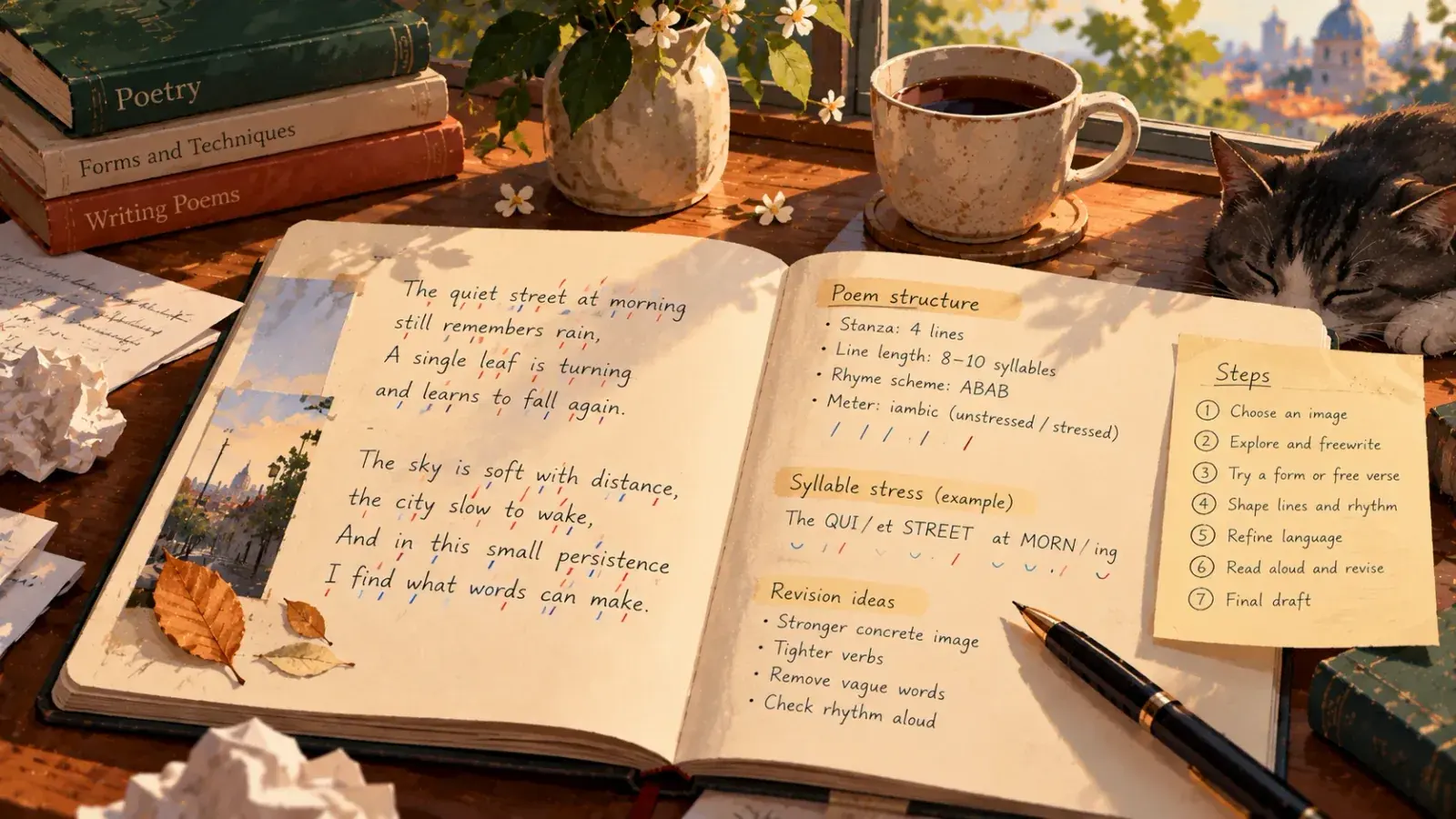
If a form needs a steady beat, the guide to meter in poetry explains iambs, anapests and how to scan a line. Try writing the same idea twice, once in free verse and once in a form. The form will force a word you wouldn't have chosen, and sometimes that word is better.
Famous poems that started small
It's easy to think a poem needs a grand subject. Many of the poems people still read began with something a passerby might not have noticed:
| Poem | The small idea | What it became |
|---|---|---|
| PoemRobert Burns, “To a Mouse” (1786) | The small ideaA plow turning up a field mouse's nest in November 1785 | What it becamePlans that go wrong for mice and men alike, and a mouse that at least lives only in the present |
| PoemWilliam Wordsworth, “I Wandered Lonely as a Cloud” (1807) | The small ideaDaffodils by a lake, seen on a walk with his sister Dorothy | What it becameWhat the memory does later, when the poet is alone on his couch |
| PoemPercy Bysshe Shelley, “Ozymandias” (1818) | The small ideaA traveler's report of a broken statue in the desert | What it becameThe boasts of power, outlasted by sand |
| PoemRobert Frost, “Mending Wall” (1914) | The small ideaTwo neighbors rebuilding the stone wall between their farms each spring | What it becameWhether good fences really make good neighbors |
| PoemWilliam Carlos Williams, “This Is Just to Say” (1934) | The small ideaA note owning up to eating the plums in the icebox | What it becameAn apology that can't quite stop enjoying what it apologizes for |
| PoemElizabeth Bishop, “One Art” (1976) | The small ideaMisplaced keys and a wasted hour | What it becameA villanelle that works up from small losses to one that can't be shrugged off |
Each of these has a topic you could put on a list and an angle that only the poet found: the mouse's luck in having no past to regret, the neighbor who repeats his father's saying. That is the gap the ideas on this page leave open for you.
From idea to finished poem
Here is one idea from the list taken all the way to a short poem. The steps work for any of the 150.
- Pick the idea that gives you a picture
Read down the list until one idea brings a specific image to mind within a few seconds. That's the one. Idea 27 reads: “A parent's work clothes — the uniform, the toolbelt, the smell of the job when they came through the door.” It brought back a pair of white hospital clogs on the mat by the front door.
- Write the angle sentence
“It's about my mother's clogs by the door, but really it's about the hours she gave to strangers and how little of the day was left for us.” The sentence stays out of the poem.
- List ten concrete details
Nouns and verbs, no adjectives yet: clogs, heels together, 7:40 a.m., the third floor, iodine, floor wax, the dog sniffing the soles, the parking permit on the dashboard, curtains pinned shut with clothespins, a jar of hand cream by the sink.
- Draft fast, then break the lines
Write for ten minutes in plain sentences. Then break them into lines, ending each one on a word that can carry weight. The guide to writing a poem covers line breaks and sound in detail.
- Cut what the details already say
Any line that explains (“she worked so hard for us”) goes. The poem should show, not tell: the clogs and the curtains have to carry the feeling on their own.
Third Floor
Her white clogs by the door at seven-forty,
heels together on the mat
the way she taught us to leave ours.
All night they walked the third floor
for other people's mothers.
Now the dog reads the soles like a newspaper:
iodine, floor wax, rain.
She sleeps till two, the curtains
pinned shut with clothespins.
We keep the radio low.
When she wakes she will ask
what she missed,
and we will tell her slowly,
to make it last.
The angle sentence never appears. The clogs carry it: they walked all night “for other people's mothers,” and the last two lines show what the family does with the little time left. The detail that gave the poem its shape was the time, 7:40 a.m. Clogs by the door at that hour mean a night shift, so the poem follows her upside-down day: home at dawn, asleep till two, waking to ask what she missed. Eight of the ten details made it in, and three new ones (the rain, the radio, her question) turned up while drafting. The parking permit and the hand cream were part of finding the poem, which is what a detail list is for.
Mistakes that waste a good idea
- Starting from the abstraction. A poem titled “Love” or “Time” starts with nothing to look at. Pick the object first and let the big word stay out of the poem, or at least out of the title.
- Choosing an idea too big for the poem. A war, a whole childhood, “my life.” Shrink it until it fits in one room and one afternoon, then write that.
- Putting three ideas in one poem. If a draft about your grandmother's kitchen keeps drifting to her garden and her funeral, you may have three poems. Split them and give each its own page.
- Ending on the angle sentence. The line that explains what the poem meant tells readers what the images already showed them. Stop on the image.
- Waiting for a subject that sounds like poetry. Sunsets and roses arrive loaded with other poets' versions. A printer, a gas station or a labeled carton of milk comes with far fewer, which is why they're on the list.
- Dropping an idea after one bad draft. Mark it, leave it and come back in a month. An image that keeps returning across drafts may be the poem's motif, not a failure.
Some angles need a fact you don't have yet: the species of the tree by the depot, the year your street was paved. Ask the Strokes Assistant to look it up, and it answers beside your draft.
Frequently asked questions
What are good poem ideas for beginners?
Start with ideas that hand you something concrete: an object in your home, a place you know well, a person doing one ordinary thing. Childhood memories and nature ideas often work well, because the details come easily. If you want a frame, a haiku or an acrostic keeps the poem short enough to finish in one sitting, and you can try a longer form later.
How do I come up with my own poem ideas?
Keep a running list and add to it whenever something catches your attention: an overheard sentence, an object out of place, a word you misheard. Read poems and note what they are about, not only how they sound. When you're stuck, take any idea from this page and change one detail to make it yours: your street, your job, your family's version of it.