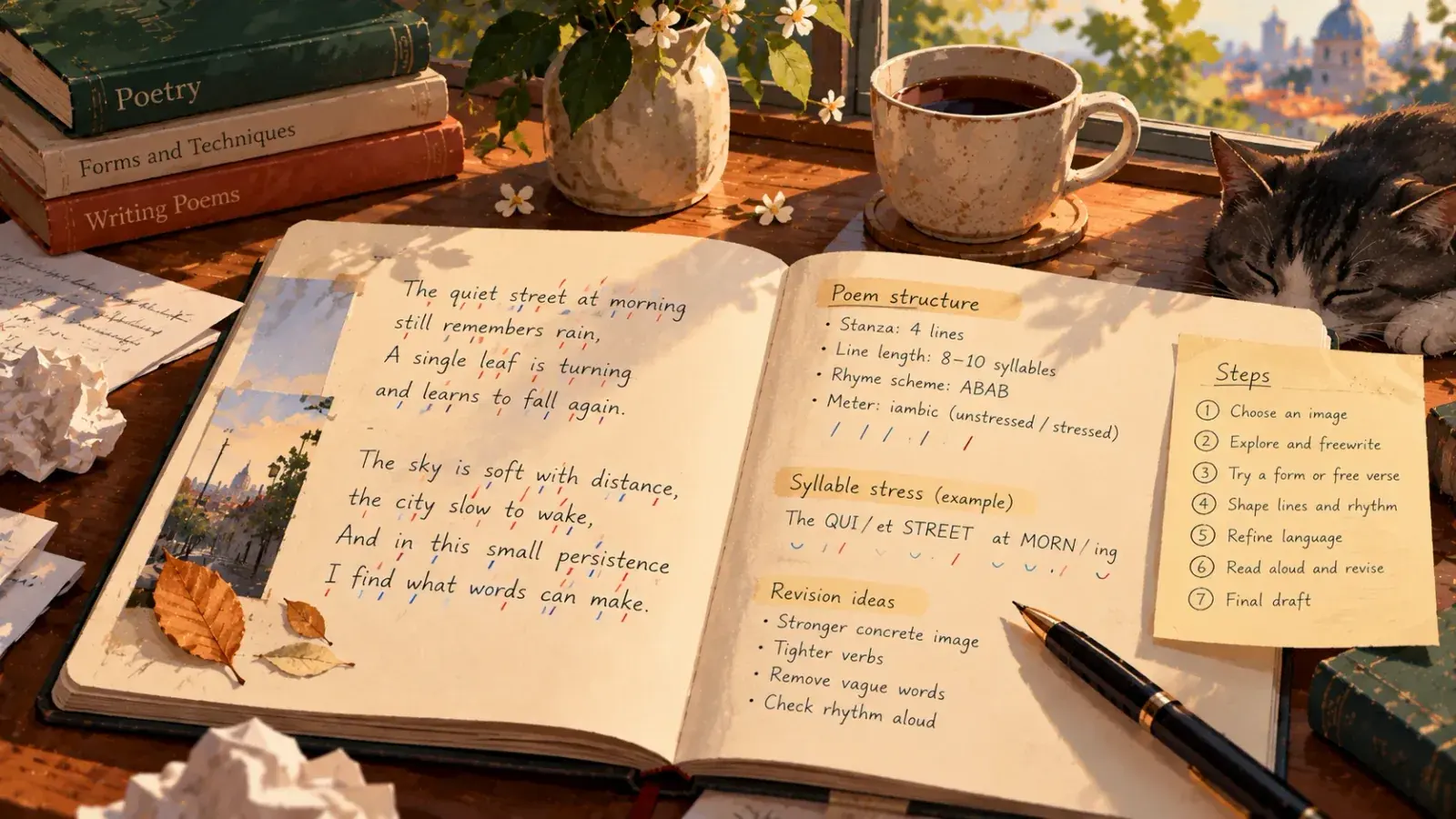
To write a sonnet, write fourteen lines of iambic pentameter (ten syllables a line, with the stress on every second one), rhyme them in a fixed pattern, and let the poem change direction once, at the turn. A Shakespearean sonnet rhymes ABAB CDCD EFEF GG and turns at line 9 or in the closing couplet. A Petrarchan sonnet rhymes ABBAABBA, then CDECDE or CDCDCD, and turns at line 9. Start with a subject that looks different the second time you look at it. That difference is your turn.
What makes a poem a sonnet
A sonnet has four parts: length, meter, rhyme and a turn. Fourteen lines is the fixed part. Iambic pentameter is the standard rhythm in English. The rhyme scheme depends on which form you choose. The turn, or volta (Italian for “turn”), is the moment the poem shifts: a question gets its answer, a complaint becomes a consolation, a description becomes a judgment. A poem with the first three and no turn looks like a sonnet and reads like a list.
The form began in 13th-century Sicily, where Giacomo da Lentini, a poet at the court of Frederick II, is credited with inventing it. Petrarch made it famous in the next century; his Canzoniere contains 317 sonnets, most of them about Laura. Thomas Wyatt and Henry Howard, Earl of Surrey, brought the sonnet into English in the 1500s, and Surrey’s division into quatrains became the shape Shakespeare used for the 154 sonnets published in 1609.
| Feature | Shakespearean | Petrarchan | Spenserian |
|---|---|---|---|
| FeatureRhyme scheme | ShakespeareanABAB CDCD EFEF GG | PetrarchanABBAABBA CDECDE or CDCDCD | SpenserianABAB BCBC CDCD EE |
| FeatureParts | ShakespeareanThree quatrains and a couplet | PetrarchanOctave (8) and sestet (6) | SpenserianThree linked quatrains and a couplet |
| FeatureUsual turn | ShakespeareanLine 9, or the couplet | PetrarchanLine 9 | SpenserianLine 9, or the couplet |
| FeatureMost lines on one rhyme | Shakespearean2 | Petrarchan4 | Spenserian4 |
| FeatureGood for | ShakespeareanAn argument that ends on a twist | PetrarchanA problem and its answer | SpenserianIdeas that grow out of each other |
The Spenserian sonnet, which Edmund Spenser used in Amoretti (1595), hooks each quatrain to the next by carrying a rhyme over. It is the rarest of the three and the hardest to sustain, so most writers start with one of the other two.
Iambic pentameter in practice
An iamb is a pair of syllables, unstressed then stressed: away, the door, to see. Pentameter means five of them per line, so a line has ten syllables and five beats: da-DUM da-DUM da-DUM da-DUM da-DUM. It is the most common meter in English poetry, and ordinary English sentences slip into it without effort. In the lines below, stressed syllables are in bold.
That time of year thou mayst in me behold
When I do count the clock that tells the time
To scan a line, say it the way you would in conversation, tap the stresses on the table, and mark them. Then check the alternation. Don’t expect every strong position to hold a heavy word. In “Shall I compare thee to a summer’s day?” the word “to” sits on a beat but carries only a light one. Meter is a pattern the natural stresses lean against, not a rule that each beat lands on an important word.
Variations poets use
Strict alternation for fourteen lines sounds mechanical, and Shakespeare varies it constantly. Two variations are so common that you can use them freely:
- An inverted first foot. The line opens on a stress, then settles into iambs: “Sometime too hot the eye of heaven shines” (Sonnet 18). It gives a line a push at the start.
- A feminine ending. An extra unstressed syllable at the end makes eleven: “Farewell! thou art too dear for my possessing” (Sonnet 87). It softens the close of a line and widens your choice of rhymes.
A line can carry one variation and still be heard as pentameter. Put two inversions next to each other and the beat disappears.
Shakespearean and Petrarchan sonnets
The Shakespearean sonnet
Three quatrains and a couplet. Each quatrain usually takes one step of the argument, and the couplet closes it, often with a twist. Sonnet 73 is the clearest model. Its three quatrains give three images of the speaker’s age, each covering less time than the one before, and the couplet turns to the listener.
That time of year thou mayst in me behold
When yellow leaves, or none, or few, do hang
Upon those boughs which shake against the cold,
Bare ruined choirs, where late the sweet birds sang.
In me thou seest the twilight of such day
As after sunset fadeth in the west,
Which by and by black night doth take away,
Death’s second self, that seals up all in rest.
In me thou seest the glowing of such fire
That on the ashes of his youth doth lie,
As the death-bed whereon it must expire,
Consumed with that which it was nourished by.
This thou perceiv’st, which makes thy love more strong,
To love that well which thou must leave ere long.
Autumn lasts months, twilight an hour, a dying fire a few minutes. The time left shrinks with every quatrain, so when the couplet says “leave ere long,” the reader has already felt it. That is what quatrains are for: three moves that build, not three ways of saying the same thing.
The couplet can also carry the turn itself. Sonnet 130 spends twelve lines listing what the speaker’s mistress is not (her eyes are “nothing like the sun,” coral is redder than her lips) and then reverses in two lines: “And yet, by heaven, I think my love as rare / As any she belied with false compare.”
The Petrarchan sonnet
The first eight lines, the octave, set out a situation, a problem or a question. The last six, the sestet, respond. The octave rhymes ABBAABBA, which means finding four words on each of two sounds. That comes easily in Italian, where most words end in a vowel, and is the hardest part of the form in English. The sestet is looser: CDECDE and CDCDCD are the usual patterns, and variants such as CDCCDC and CDEDCE turn up too.
The world is too much with us; late and soon,
Getting and spending, we lay waste our powers;—
Little we see in Nature that is ours;
We have given our hearts away, a sordid boon!
This Sea that bares her bosom to the moon;
The winds that will be howling at all hours,
And are up-gathered now like sleeping flowers;
For this, for everything, we are out of tune;
It moves us not. Great God! I’d rather be
A Pagan suckled in a creed outworn;
So might I, standing on this pleasant lea,
Have glimpses that would make me less forlorn;
Have sight of Proteus rising from the sea;
Or hear old Triton blow his wreathèd horn.
The octave is a complaint: we are too busy getting and spending to be moved by the sea or the wind. The sestet is a wish, and the turn comes in the middle of line 9, at “Great God!” Look at the rhymes Wordsworth needed: soon, boon, moon, tune; powers, ours, hours, flowers. Try finding four good rhymes for “month” and you will see the appeal of the Shakespearean form, which never asks for more than two.
The volta: where the sonnet turns
The turn is what separates a sonnet from fourteen rhymed lines. It is often flagged by a small word (but, yet, then, so, now), and it works by juxtaposition: the second part of the poem sits against the first and changes how you read it. These are the turns you will meet most often.
| Turn | Before the turn | After the turn | Example |
|---|---|---|---|
| TurnProblem to answer | Before the turnA complaint or a question | After the turnA reply | ExampleMilton, “When I consider how my light is spent” |
| TurnDespair to comfort | Before the turnWhat is wrong | After the turnWhat makes it bearable | ExampleShakespeare, Sonnet 29 |
| TurnObservation to judgment | Before the turnWhat the speaker sees | After the turnWhat it means | ExampleWordsworth, “The World Is Too Much with Us” |
| TurnExpectation to reversal | Before the turnA familiar claim | After the turnIts undoing | ExampleShakespeare, Sonnet 130 |
| TurnThen to now | Before the turnA memory | After the turnWhat it means today | ExampleCommon in elegies |
Sonnet 29 is the textbook case. Eight lines of self-pity (out of luck, out of favor, envying “this man’s art and that man’s scope”) and then, at line 9:
Yet in these thoughts myself almost despising,
Haply I think on thee, and then my state,
(Like to the lark at break of day arising
From sullen earth) sings hymns at heaven’s gate;
The turn doesn’t have to wait for line 9. Milton’s sonnet on his blindness, published in 1673, asks its question in line 7 and starts the answer halfway through line 8: “I fondly ask. But Patience, to prevent / That murmur, soon replies.” The early turn feels like an interruption, which is exactly what it is. Place the turn where the thought changes, and let the rhyme scheme hold the structure around it.
Write a sonnet in seven steps
This order puts the hard decisions first, so you never spend an hour perfecting a quatrain the poem doesn’t need. If you are new to writing poems at all, our guide on how to write a poem covers images, line breaks and revision in general.
- Find a subject with two sides
Write one plain sentence with a “but” in it: “I keep her voicemail, but I have never played it.” The part before the “but” is your first eight lines; the part after is your turn. If nothing comes, borrow a starting point from a list of poetry prompts and look for the “but.”
- Choose the form
Choose Shakespearean if the poem builds to a final twist or if this is your first sonnet, since it needs only rhyme pairs. Choose Petrarchan if the poem is a problem and its answer, and you can find four rhymes for your opening sounds.
- Draft the turn and the ending first
Write line 9 and the last two lines in prose, then in meter. Once you know where the poem lands, the opening lines only have to get there.
- Build a rhyme bank
Before each quatrain, list ten or more words on the sounds you plan to use. One-syllable nouns and verbs are the most useful. Slant rhymes (room and home, love and move, stone and gone) are fine in a modern sonnet if they sound deliberate.
- Give each quatrain one job
Set the scene, complicate it, turn. Use concrete images rather than stated feelings, the poet’s version of show, don’t tell: a phone asking for storage says more than “I miss her.”
- Scan every line aloud
Mark the stresses, count the syllables and listen for lines where the beat falls on a word nobody would stress. Fix those by reordering words or swapping one, not by adding “do” or “so.”
- Revise the couplet last
A closing couplet should add something: a reversal, an image, a decision. If it only summarizes the twelve lines above it, cut it and write the line the poem has been heading toward.
One sonnet, built from scratch
Here is the voicemail sentence from step 1 turned into a Shakespearean sonnet. The letters in parentheses mark the rhyme scheme.
My phone has asked me twice this week to choose (A)
what I can live without. I start with games, (B)
the songs I skip, the apps I never use, (A)
a thread of numbers I can’t put to names. (B)
It still wants room. Down at the bottom, deep (C)
in last year’s list: a voicemail, March, from Mom, (D)
the thing it flags as old and wants to sweep (C)
away. I tap on Keep. The screen goes calm. (D)
Yet I have never played it: not that spring, (E)
not on her birthday, not the night I tried (F)
and held my thumb above it. Everything (E)
she said, I’ve heard. This one I set aside. (F)
As long as it stays sealed, she isn’t done: (G)
there’s one more thing she hasn’t said. Just one. (G)
How it was put together:
- Quatrain 1 sets up an ordinary chore. Nothing in it hints at grief, which makes the turn land harder.
- Quatrain 2 narrows to one file. “Mom” and “calm” are a full rhyme in most American accents, a regional choice worth checking against how your readers speak.
- Line 9 turns on “Yet”: the speaker keeps the message and has never listened to it. Line 10 opens with an inverted foot (“not on her birthday”) to push the list forward.
- Lines 11–12 run over the line break (enjambment), so “Everything / she said” hangs for a moment, the way the thumb does.
- The couplet adds an idea the quatrains haven’t said: an unplayed message is the only way she can still have something left to say.
The first draft of line 6 was “I have a voicemail from my mom from March.” It has ten syllables, but the beat lands on “from” and the line reads like a statement to a clerk. Moving the facts into a list (“a voicemail, March, from Mom”) fixed the meter and put the rhyme word last. The rhyme bank for lines 10 and 12 read: tried, side, aside, wide, inside, denied, replied, hide, ride, pride. Two made the cut.
Mistakes that sink sonnets
| Mistake | Draft line | Better |
|---|---|---|
| MistakeWord order bent to reach a rhyme | Draft lineAnd all the stars above so bright did shine | BetterThe stars came out above the parking lot |
| MistakeFiller words to pad the meter | Draft lineI do recall the evening of the storm | BetterI can’t forget the evening of the storm |
| MistakeTen syllables, no iambs | Draft lineHappiness is a window in the rain | BetterThe rain is on the window, and I’m glad |
| MistakeBorrowed old-fashioned diction | Draft lineO’er yonder hill thy gentle voice doth ring | BetterYour voice comes up the hill before you do |
| MistakeA couplet that sums up | Draft lineAnd so I know that love will always stay | BetterEnd on a new image, reversal or decision |
Two more show up in nearly every workshop. The first is a poem with no turn: fourteen lines that circle one feeling and end where they began. The second is a run of end-stopped lines, each a full sentence closed with a period, which makes the meter thud. Let some sentences run across line breaks, as Shakespeare does in lines 10 to 12 of Sonnet 29.
Drafting sonnets in Strokes
A sonnet goes through more versions per line than almost anything else you will write, so the useful tools are the ones that keep old drafts. In Strokes, each poem is a document in a project folder, and version history saves versions as you work: preview the draft from before you rewrote the couplet, with the changes marked, and restore it in one click if the old one was better. The AI Assistant opens beside the poem for a second pair of eyes. Ask it to mark the stresses in a line you can’t hear clearly, list rhymes for a sound, or say whether the turn reads as a turn. Treat its scansion as a suggestion and trust your own ear when they disagree. When the poem is done, export it to PDF or Word for a workshop or a submission.
Frequently asked questions
Does a sonnet have to rhyme?
Traditional sonnets do, and a rhymed, metered sonnet is the right place to start. Many modern poets write unrhymed sonnets that keep the length, the compression and the turn; Terrance Hayes’s American Sonnets for My Past and Future Assassin (2018), inspired by Wanda Coleman’s American Sonnets, is a well-known example.
Does a sonnet have to be exactly 14 lines?
Almost always. Even Shakespeare broke the rule: Sonnet 99 has fifteen lines and Sonnet 126 has twelve, in couplets. Gerard Manley Hopkins invented a shortened ‘curtal’ sonnet, and George Meredith used sixteen-line sonnets in Modern Love (1862). If a class or contest asks for a sonnet, write fourteen.
How many syllables are in each line of a sonnet?
Ten in iambic pentameter, or eleven when the line has a feminine ending (an extra unstressed syllable at the end). The pattern of stresses matters more than the count: a ten-syllable line with the beats in the wrong places still won’t sound like pentameter.
What is a crown of sonnets?
A sequence in which each sonnet begins with the last line of the one before, and the final sonnet ends with the first line of the first, closing the circle. John Donne’s La Corona is a crown of seven.
Which kind of sonnet should a beginner write first?
The Shakespearean. It needs only seven rhyme pairs, and its three quatrains and couplet give you a clear plan: one step per quatrain, then the turn or the twist at the end.