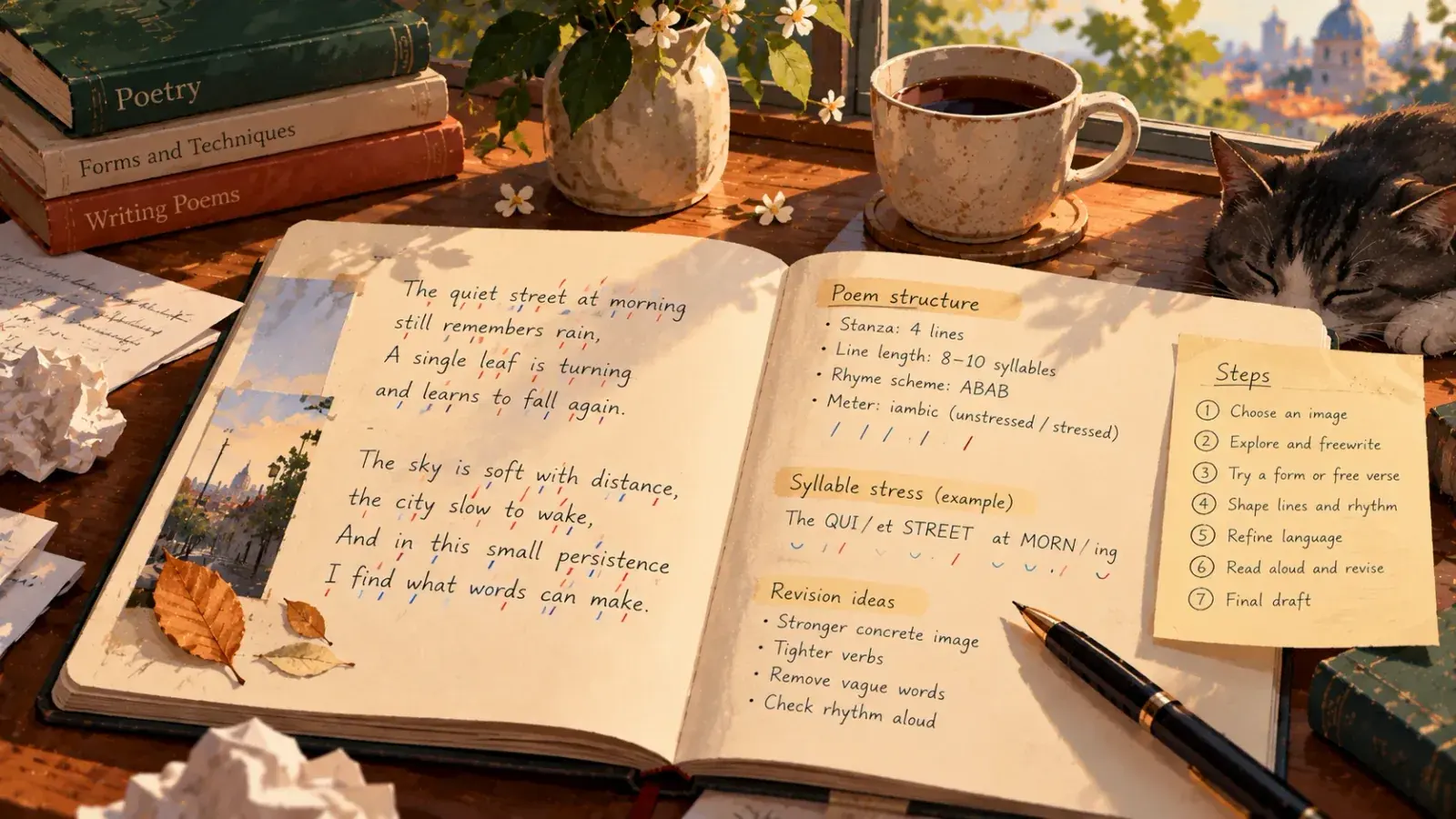
To write a poem, start with one specific thing you saw, heard or held, not a big subject like love or time. Write about it in plain sentences, then break them into lines, ending each line where you want the reader to pause or lean forward. Read the draft aloud and tune the sounds. Cut every word that explains what the images already show, and revise a few days later. Free verse is the easiest place to begin. Forms like the haiku and sonnet are there when you want rules to push against.
Start with an image, not a subject
Most first poems begin with a feeling and reach for the words that name it: love, loss, lonely, beautiful, forever. Those words tell the reader what to feel without giving them anything to feel it about. A reader can’t see grief. They can see a coat still hanging by the back door. Poets call that concrete detail an image, and it is the poet’s version of the advice to show, don’t tell.
Emily Dickinson’s bird poem opens with nothing but observation:
A bird came down the walk:
He did not know I saw;
He bit an angle-worm in halves
And ate the fellow, raw.
There is no statement about nature and almost no adjectives. The effect comes from exact detail (“in halves”) and from “fellow,” which makes the worm almost a person and the bird’s breakfast a little comic, a little brutal. You get there yourself, which is why it sticks.
Image (shows)
- Butterscotch in her coat pocket, kept for whoever needed one
- One mug on the drying rack where there used to be two
- Snow on the front steps with no footprints in it
- The 2 a.m. bus lit up like an aquarium
Abstraction (tells)
- She was the kindest person I knew
- I feel so lonely since you left
- Nobody visits anymore
- The city is beautiful at night
Two images set side by side, with nothing between them, make the reader build the connection. That is juxtaposition. Ezra Pound’s two-line “In a Station of the Metro” (1913) does nothing else: faces in a crowded station, then petals on a wet, dark branch.
Decide where each line breaks
The line is what makes a poem a poem rather than a paragraph. A line break is a small pause, and the last word of a line gets extra weight because white space follows it. A line that ends with punctuation is end-stopped and feels settled. When the sentence runs on, the line is enjambed: the reader is pulled forward, sometimes reading a line one way before the next one changes it.
Here is one sentence broken three ways:
As prose:
My father kept the porch light on for years after I stopped coming home late.
Two lines:
My father kept the porch light on
for years after I stopped coming home late.
Four lines:
My father kept
the porch light on for years
after I stopped
coming home late.
As prose, the sentence is information. In two lines, the porch light gets a beat of its own. In four, “after I stopped” sits alone and could mean almost anything (stopped visiting, stopped calling) until the last line narrows it. That brief double reading is what enjambment is for.
Line length sets the pace. Walt Whitman, the poet most responsible for making free verse an American form, wrote long lines that unspool like the thing they describe:
A noiseless patient spider,
I mark’d where on a little promontory it stood isolated,
Mark’d how to explore the vacant vast surrounding,
It launch’d forth filament, filament, filament, out of itself,
Ever unreeling them, ever tirelessly speeding them.
The first line is short: the spider, alone. Then the lines lengthen, and the fourth repeats “filament” until the line itself seems to pay out thread. Dickinson goes the other way, with short lines that shut like a lid. Neither is correct. The length should suit the poem.
Rules of thumb for line breaks
- End lines on words that can bear weight, usually nouns and verbs. Ending on “the” or “of” leaves the reader hanging, so do it only on purpose.
- Vary the length. A short line after several long ones lands hard.
- Start a new stanza when the time, place or thought shifts, as you would a paragraph. The blank line is a longer pause.
- Capitalize as in prose. A capital on every line is an older convention that many contemporary poets skip.
- Test every break aloud. If the pause sounds wrong, move it.
Listen to the sound
Poetry was spoken long before it was printed, and readers still hear it in their heads. Sound slows a line down, speeds it up, or ties two distant words together. Keats opens “To Autumn” with lines that are almost all sound:
Season of mists and mellow fruitfulness,
Close bosom-friend of the maturing sun;
Listen for the m in mists, mellow, bosom and maturing, and the s sounds running through both lines. Nothing has happened yet. The sound alone makes the season feel heavy and slow.
| Device | What it is | Example |
|---|---|---|
| DeviceAlliteration | What it isSame first consonant in nearby words | Example“mists and mellow” (Keats) |
| DeviceAssonance | What it isRepeated vowel sounds | Example“the cold road home” |
| DeviceConsonance | What it isRepeated consonants inside or at the ends of words | Example“a thick black clock” |
| DeviceFull rhyme | What it isMatching end sounds | Example“keep” and “sleep” (Frost) |
| DeviceSlant rhyme | What it isClose but not exact end sounds | Example“soul” and “all” (Dickinson) |
| DeviceRefrain | What it isA line or phrase repeated | Example“And miles to go before I sleep” (Frost) |
| DeviceMeter | What it isA regular beat of stressed syllables | Examplethe WOODS are LOVE-ly, DARK and DEEP |
Repetition can do more than make music. Frost ends his best-known poem with the same line twice:
And miles to go before I sleep,
And miles to go before I sleep.
The first time, the line means a long ride home. Repeated as the poem’s last line, it invites a second meaning, and many readers hear a longer sleep in it. The meter helps: every line has four beats, da-DUM four times (iambic tetrameter), so the repeat lands as steadily as a clock.
Hope is the thing with feathers
That perches in the soul,
And sings the tune without the words,
And never stops at all,
“Soul” and “all” nearly rhyme, and the near miss keeps a short, regular stanza from sounding like a nursery rhyme. Dickinson used slant rhyme throughout her work, often in stanzas shaped like hymns, alternating longer and shorter lines.
Rhyme is optional. The usual trouble in first poems is forcing it: twisting word order (“the wind so cold did blow”) or settling for a weaker word because it rhymes. If a rhyme makes you say something you don’t mean, drop it or use a slant rhyme.
Free verse or a fixed form
Free verse has no set meter, rhyme or length. It follows the rhythms of speech and gets its shape from line breaks. A fixed form hands you rules: a line count, a meter, a rhyme scheme, sometimes lines that must repeat. Rules force choices you wouldn’t otherwise make, and hunting for a rhyme often turns up a better word than the one you started with.
| Form | Shape | Suits |
|---|---|---|
| FormFree verse | ShapeNo set meter, rhyme or length | SuitsMost first poems |
| FormHaiku | Shape3 lines; traditionally 5-7-5 syllables, often fewer in English | SuitsOne moment, often seasonal |
| FormLimerick | Shape5 lines rhymed AABBA, with a bouncing rhythm | SuitsComic verse |
| FormBallad stanza | Shape4 lines of 4 and 3 beats, rhymed ABCB | SuitsStories and songs |
| FormSonnet | Shape14 lines of iambic pentameter | SuitsAn argument with a turn |
| FormVillanelle | Shape19 lines, two rhymes, two repeating refrains | SuitsA thought that won’t let go |
Sonnets come in two main patterns: the Shakespearean (ABAB CDCD EFEF GG, ending on a couplet) and the Petrarchan (ABBAABBA, then CDECDE or CDCDCD, with a turn in thought between the two parts). Our guide to writing a sonnet takes both apart, and the guide to writing a haiku explains why many English-language poets no longer count strict 5-7-5.
If you can’t decide, write in free verse first, then try recasting a finished draft in a form. Even if you keep the free verse version, the exercise shows you which words were padding.
Write your first poem in seven steps
- Collect raw material
Set a timer for ten minutes and list specific things you noticed this week: objects, sounds, smells, gestures, a sentence you overheard. Nouns and verbs, no adjectives yet. If you keep a notebook or a daily journal, mine it. Throwaway notes are often the best material.
- Pick the one with a charge
Choose the item you keep coming back to. Usually it stands in for something you haven’t said out loud. Write that something in one private sentence, then keep it out of the poem.
- Draft in sentences
Write about the image for ten minutes in plain sentences, with no line breaks and no rhyme. Stay with the senses: how it looks, sounds, weighs, smells. Let one image lead to the next.
- Break it into lines
Break the draft where you would pause, or where a word deserves to stand at the end of a line. Try one version with long lines and one with short, and keep whichever sounds more like the poem.
- Read it aloud
Read it aloud twice, slowly. Mark every stumble, flat patch and accidental rhyme. Swap in a better-sounding word only where the meaning survives.
- Cut
Delete abstract words (love, pain, soul, beauty), adjectives that repeat the noun, and any line that explains the poem. First drafts often run a line or two past their real ending, so cover the last line with your thumb and see if the poem is stronger without it.
- Title it and let it rest
A title can carry what the poem leaves out: a place, a date, a name, the object itself. Then put the poem away for a few days and reread it cold, or show it to a critique partner who will tell you which line they stopped believing.
A first draft, revised
A beginner’s draft that does most of what the steps warn against, then the same poem after a few rounds of revision:
Grandmother
I miss my grandmother every day,
she was the kindest person I knew.
Her kitchen was always warm and full of love,
and now that she is gone
my heart is broken in two.
Butterscotch
Her winter coat still hangs by the back door,
the left pocket heavy
with butterscotch, each one twisted
shut in its cellophane
for whoever came in from the cold
needing something.
All January I reach past it
for my own.
What changed:
- The abstract words are gone: miss, kindest, love, heart, broken. Her kindness is now candy kept for other people.
- “Broken in two” was a cliché picked to rhyme with “knew.” The revision ends on an action instead: the speaker avoiding the coat.
- “Grandmother” is gone too. The reader learns who she was from what she kept in her pocket.
- The breaks put weight on “heavy” and “twisted,” and leave “shut” to open the next line, the way the wrapper closes.
- A thread of long o sounds (coat, cold, own) holds the poem together without a single rhyme.
Common mistakes in first poems
- Abstract words doing the work. If love, pain, hope or soul carries a line, replace it with the thing that made you feel it.
- Forced rhyme. Inverted word order and filler syllables give it away. Drop the rhyme before you twist a sentence to reach it.
- Clichés. Heart of gold, tears like rain, cold as ice. If you have heard it before, so has the reader.
- Piling on adjectives. “The dark, cold, lonely, silent night” is purple prose broken into lines. One exact noun beats three adjectives.
- Explaining the ending. A last line that sums up (“and that is why I’ll always love her”) tells readers what they already felt. Stop on the image.
- Centering every line. Centered verse looks like a greeting card. Set the poem flush left and let the line breaks make the shape.
Drafting poems in Strokes
The line you cut on Tuesday is sometimes the one you want back on Friday. In Strokes, the desktop editor we make, each poem is a file on your own machine, and a project folder can hold a whole collection. Version history saves drafts automatically and on demand, so you can preview any earlier version with the changes marked and restore it in one click.
The AI Assistant is most useful as a reader, not a writer. Add the poem to a chat and ask narrow questions: which words are abstract, which breaks fall on weak words, which phrases sound secondhand. Its rewrites tend to smooth a line toward the familiar, so keep the writing yours.
Frequently asked questions
Does a poem have to rhyme?
No. Much contemporary poetry is free verse, with no regular rhyme or meter. Use rhyme when it helps the sound and drop it when it forces you to say something you don't mean. Slant rhyme, where the end sounds are close but not exact, is a softer option.
How long should a poem be?
There is no required length. A haiku is three lines, a sonnet fourteen, and free verse can run for pages. For a first poem, aim for something you can read aloud in under a minute: short poems are easier to revise because you can hold the whole thing in your head.
How do I start a poem when I have nothing to write about?
Start with an object instead of a topic. Describe something within reach for five minutes using every sense, then ask who it reminds you of or where it came from. A list of poetry prompts helps on days when nothing comes.
How do I know when a poem is finished?
Put it away for a few days and reread it cold. When every change you try makes it worse, or only different, it is close to done. Reading it aloud to someone is a good last test: you hear the weak line as you say it.