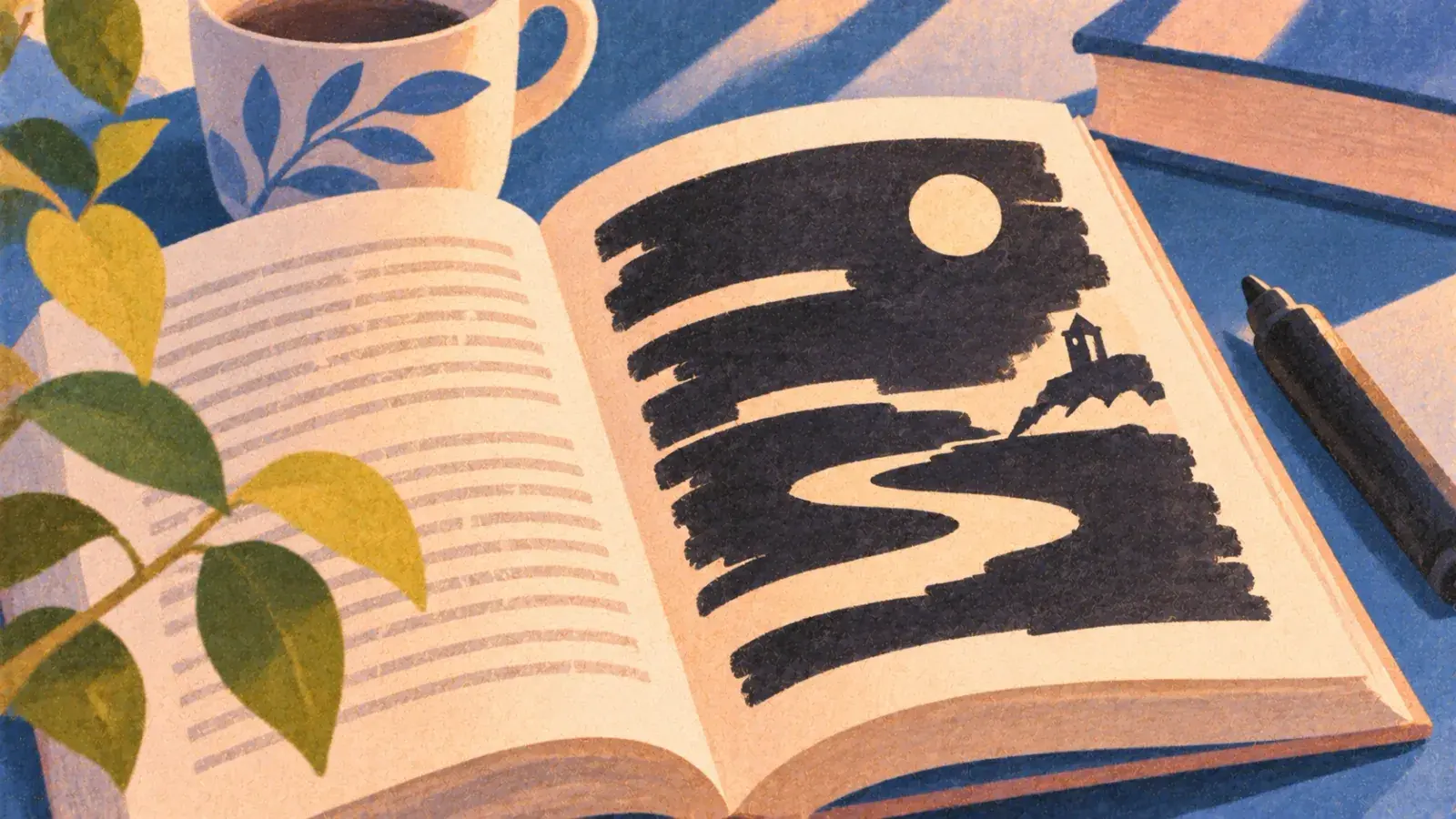
Blackout poetry is a poem made by covering most of a printed page with black marker, so that the words left showing, read from top to bottom, say something new. It is a kind of erasure poetry and a close cousin of found poetry: every word comes from someone else, and the poem lives in what you choose to keep. All you need is a page, a pencil and a marker.
Below: how blackout poetry differs from its relatives, a short history of the form, a six-step method, five original blackout poems made from public-domain books (with the source passage shown, so you can see exactly what was kept), and ideas for your next page.
What blackout poetry is
A blackout poem has two rules. You can't add words, and you can't change their order: the poem reads the way the page reads, top to bottom and left to right. Everything else is your choice. You can keep a whole sentence or a single word from a paragraph, keep punctuation or cover it, and turn the black bars into part of the picture.
That constraint is the point. Because you can't write anything, you have to read differently, looking for the second poem hidden inside someone else's prose. Some writers use blackout pages as a warm-up for the same reason: it is a way to make something when the blank page won't give you anything.
| Form | How it works | What you get |
|---|---|---|
| FormBlackout poetry | How it worksCover everything except the words you keep, usually with black marker | What you getA page with a few words showing through the bars |
| FormErasure poetry | How it worksRemove words by any means: marker, white-out, paint, cutting, deleting on screen | What you getThe general term; blackout is one kind of erasure |
| FormFound poetry | How it worksTake existing language (a sign, a letter, an article) and frame it as a poem | What you getMay reorder, re-lineate or combine sources |
| FormCut-up | How it worksCut a text into pieces and rearrange them | What you getA new order, chosen or random |
| FormCento | How it worksBuild a poem entirely from lines of other poems | What you getWhole lines kept and credited |
| FormBook spine poetry | How it worksStack books so the titles on their spines read as a poem | What you getA photo of a stack |
The distinction that matters in practice is reordering. In blackout and erasure poems the words stay where the original writer put them. In found poems and cut-ups they can move. The poetry prompts include a cento exercise if you want to try the line-by-line version.
A short history of blackout poetry
The milestones usually cited:
- 1965: Doris Cross. The American artist began her "Dictionary Columns," erasing most of the text on dictionary pages so that a few words stood alone. She is often named as one of the earliest artists to work this way.
- 1966: Tom Phillips. The English artist set himself a task: find a secondhand book that cost threepence and alter every page of it. The book was A Human Document, an 1892 novel by W. H. Mallock. He painted and drew over its pages, leaving islands of text, and called the result A Humument. He kept reworking it for fifty years, and the sixth edition, in 2016, was billed as the final version.
- 1977: Ronald Johnson. Radi os is a book-length erasure of Milton's Paradise Lost. Even the title is an erasure: RADI OS is what's left of PARADISE LOST.
- The 2000s: Austin Kleon. While working at a public library in Cleveland, Kleon took a black marker to newspaper pages and posted the poems on his blog. His book Newspaper Blackout (2010) brought the form to a large audience.
- 2010: Jonathan Safran Foer. Tree of Codes is a die-cut erasure of Bruno Schulz's The Street of Crocodiles: the removed words are physically cut out of each page.
- 2023: Nicole Sealey. The Ferguson Report: An Erasure (Knopf) works through a government report on policing, and shows how erasure can argue with its source as well as play with it.
How to make a blackout poem
- Choose a page
Dense prose works best: a page of an old novel, a newspaper column, a manual, a recipe, a letter, a page of your own abandoned draft. Concrete nouns and strong verbs give you more to work with than dialogue or lists. For anything you plan to share, pick a public-domain book. In the US, as of 2026, works published in 1930 or earlier are in the public domain; other countries count differently. Photocopy or print the page first, so you can try the same text more than once and leave the book itself unmarked.
- Read it once without a pen
Read the whole page for its sense first. Then read it again quickly, letting your eye skip, and notice which words jump out of the gray. Those are your candidates.
- Box your anchor words
In pencil, lightly circle ten to twenty words that carry weight: a noun, a verb, an odd adjective, a number. Don't build the poem yet. You are only finding the words with charge.
- Connect them in order
Read only the circled words, top to bottom. Look for a sentence, a voice or a turn. Add the small words you need ("I," "the," "and") from wherever they sit between your anchors, and drop anchors that won't fit. If the poem only works with two words swapped, find another path.
- Black out the rest
Cover everything you're not keeping. Test the marker on a corner first, because cheap paper bleeds. Neat rectangles look like a redacted file. Loose scribbles, paint or drawings make it look like art. Either is fine, but the kept words must stay readable. This is the only step that changes in other kinds of erasure: white-out, paint or a craft knife does the marker's job, and the words still stay in their original order (see the variations below). Found poems and cut-ups are different, because they let you move the words.
- Title it and credit the source
The title is the one place you can add words of your own, and it can change how the whole page reads. Underneath or on the back, note the source: title, author, year and page.
Blackout poetry examples
Five blackout poems written for this guide, each made from a passage of a public-domain book. The source passage comes first, with the kept words in bold, then the poem as it reads once everything else is gone. The titles are new. Each passage follows the edition named under it, so you can check it against the full text.
Call me Ishmael. Some years ago—never mind how long precisely—having little or no money in my purse, and nothing particular to interest me on shore, I thought I would sail about a little and see the watery part of the world. It is a way I have of driving off the spleen and regulating the circulation. Whenever I find myself growing grim about the mouth; whenever it is a damp, drizzly November in my soul; whenever I find myself involuntarily pausing before coffin warehouses, and bringing up the rear of every funeral I meet; and especially whenever my hypos get such an upper hand of me, that it requires a strong moral principle to prevent me from deliberately stepping into the street, and methodically knocking people’s hats off—then, I account it high time to get to sea as soon as I can.
Call me
little
and nothing particular
I would sail
the watery part of the world.
a damp, drizzly November in my soul;
and
get to sea as soon as I can.
The poem turns on one rejected word. A first pencil pass on this paragraph would circle "Ishmael," the name everyone knows. Keep it, and the poem opens the way Melville's does, with a man introducing himself. Black it out, and "Call me" has to take its next word from further along the line: "little," out of "little or no money." That one cut is the poem's idea. Melville's confident narrator becomes someone who doesn't think much of himself.
The final selection keeps 31 of the paragraph's 145 words. After "little," the kept phrases barely change Melville's sense, which is a legitimate move: sometimes erasure sharpens the source instead of overturning it.
It was on a dreary night of November that I beheld the accomplishment of my toils. With an anxiety that almost amounted to agony, I collected the instruments of life around me, that I might infuse a spark of being into the lifeless thing that lay at my feet. It was already one in the morning; the rain pattered dismally against the panes, and my candle was nearly burnt out, when, by the glimmer of the half-extinguished light, I saw the dull yellow eye of the creature open; it breathed hard, and a convulsive motion agitated its limbs.
a dreary night of November
I collected
a spark
into the lifeless thing
at my feet.
one in the morning;
my candle
nearly burnt out,
I saw the
eye
open;
Here the title does the work. Without "First Draft" this is a short version of Shelley's scene. With it, the lifeless thing at the writer's feet is a manuscript, and the eye opening at one in the morning is the moment a draft comes alive. Notice that the creature and its convulsions are gone: the poem stops at the hopeful part.
It is a truth universally acknowledged, that a single man in possession of a good fortune must be in want of a wife. However little known the feelings or views of such a man may be on his first entering a neighbourhood, this truth is so well fixed in the minds of the surrounding families, that he is considered as the rightful property of some one or other of their daughters.
It is a truth universally acknowledged,
that a single man
must be in want
However little known
the feelings
of
some one or other
Removing "of a wife" leaves the want open, and cutting "a good fortune" takes away the money that makes Austen's line a joke. What's left is quieter: a man who wants, and the unknown feelings of someone or other. A dating-app title pulls it into the present.
Oh! But he was a tight-fisted hand at the grind-stone, Scrooge! a squeezing, wrenching, grasping, scraping, clutching, covetous, old sinner! Hard and sharp as flint, from which no steel had ever struck out generous fire; secret, and self-contained, and solitary as an oyster. The cold within him froze his old features, nipped his pointed nose, shrivelled his cheek, stiffened his gait; made his eyes red, his thin lips blue; and spoke out shrewdly in his grating voice. A frosty rime was on his head, and on his eyebrows, and his wiry chin. He carried his own low temperature always about with him; he iced his office in the dog-days; and didn’t thaw it one degree at Christmas.
he was
secret, and self-contained,
and solitary as an oyster.
The cold within him
made his eyes red,
He carried his own low temperature
always about with him;
Dickens's paragraph is mockery: the cold makes Scrooge's eyes red the way frost reddens skin. Black out the insults and the same words read as grief. Erasure can argue with its source, and here it takes the miser's side for a moment.
I went to the woods because I wished to live deliberately, to front only the essential facts of life, and see if I could not learn what it had to teach, and not, when I came to die, discover that I had not lived. I did not wish to live what was not life, living is so dear; nor did I wish to practise resignation, unless it was quite necessary.
I went to the woods
because
living is so dear;
Ten words out of seventy. Thoreau meant "dear" as precious; the title tips it over to its other meaning, expensive. Short blackout poems often work this way, pivoting on one word with two senses. This is what the page looks like once the marker has gone over it:
The Walden page, blacked out
I went to the woods because █ ██████ ██ ████ █████████████ ██ █████ ████ ███ █████████ █████ ██ █████ ███ ███ ██ █ █████ ███ █████ ████ ██ ███ ██ ██████ ███ ████ ████ █ ████ ██ ████ ████████ ████ █ ███ ███ ██████ █ ███ ███ ████ ██ ████ ████ ███ ███ █████ living is so dear; ███ ███ █ ████ ██ ████████ ████████████ ██████ ██ ███ █████ ██████████Blackout poetry ideas
If you need a starting point, try one of these pages or constraints:
- The first page of a public-domain novel you love, or one you hated at school.
- A page from your own abandoned draft. Erase it into the poem it was trying to be.
- A recipe: keep only the verbs and see what kind of life they describe.
- The instructions that came with an appliance or a piece of flat-pack furniture.
- A weather report or a horoscope, kept to ten words.
- A page of a dictionary, keeping one word per column, the way Doris Cross worked.
- The sports pages, turned into a love poem.
- A letter or an old postcard from your family, kept for yourself.
- A science textbook page about the ocean, the stars or cells.
- A nineteenth-century etiquette manual, erased into something rude.
- A job description, erased into what the job is really like.
- One sentence only: keep a single line from a whole page.
- Keep only words that start with the same letter.
- Two pages from the same book, erased so the second answers the first.
- A page you black out in a color other than black, chosen for the poem's mood.
- The same page, erased three times into three different poems.
Try the last one at least once. Three poems from one page show how much of the meaning comes from you, not from the source.
Variations on the form
- Painted and drawn pages. Instead of black bars, paint or draw over the text so the kept words sit inside a picture, the way Tom Phillips did. Shapes around a word can carry meaning: a cloud, a window, a road.
- White-out erasure. Cover the unwanted words with correction fluid or white paint. The page looks emptied rather than redacted, and the kept words float.
- Cut-out erasure. Cut the unwanted words out with a craft knife, as in Tree of Codes. Pages below show through the holes, so the poem changes as you turn them.
- Digital blackout. Paste a passage into a document, then delete words or shade them out until the poem is left. You lose the look of the marker but gain the ability to undo. In Strokes, save a version before you start: version history keeps the full passage on your device, so you can erase freely and restore the original if a path through the page goes nowhere.
- Erasing your own drafts. Take a paragraph you wrote and couldn't fix, and erase it instead of revising it. It is a revision technique as much as a poetic form, and it tells you which words were carrying the paragraph.
Tips for better blackout poems
- Look for a turn. The strongest blackout poems move: a statement, then a twist, the way "Rent" turns on its last word. If your poem says one thing from start to finish, find a second idea further down the page.
- Let the source push back. Keeping a phrase that means the opposite of its original context is where the energy is, as in "Before the Ghosts."
- Watch the small words. "I," "the" and "and" decide whether the kept words read as a sentence or a list. A poem made only of nouns is usually a list.
- Read it aloud before you black out. Once the marker goes on, you can't take a word back. Say the circled words in order, and if a line trips you up, change the path in pencil.
- Keep the words readable. Leave a little white around each kept word, and don't let the marker clip the edges of letters.
- Credit the page. The words are borrowed, so say where from, even on a classroom exercise.
Frequently asked questions
Is blackout poetry plagiarism?
Not if you credit the source. The words belong to the original writer and the selection is yours, which is why blackout poems name the book, author and page. Sharing or selling an erasure of a page still under copyright is a separate question of copyright and fair use, which depends on how much you take and what you do with it, and laws differ by country. A public-domain page, or your own writing, avoids that question.
Who invented blackout poetry?
No single person. Doris Cross was erasing dictionary pages in 1965, and Tom Phillips began A Humument, painted over a Victorian novel, in 1966. Austin Kleon's newspaper versions, collected in Newspaper Blackout in 2010, made the name and the black-marker style widely known.