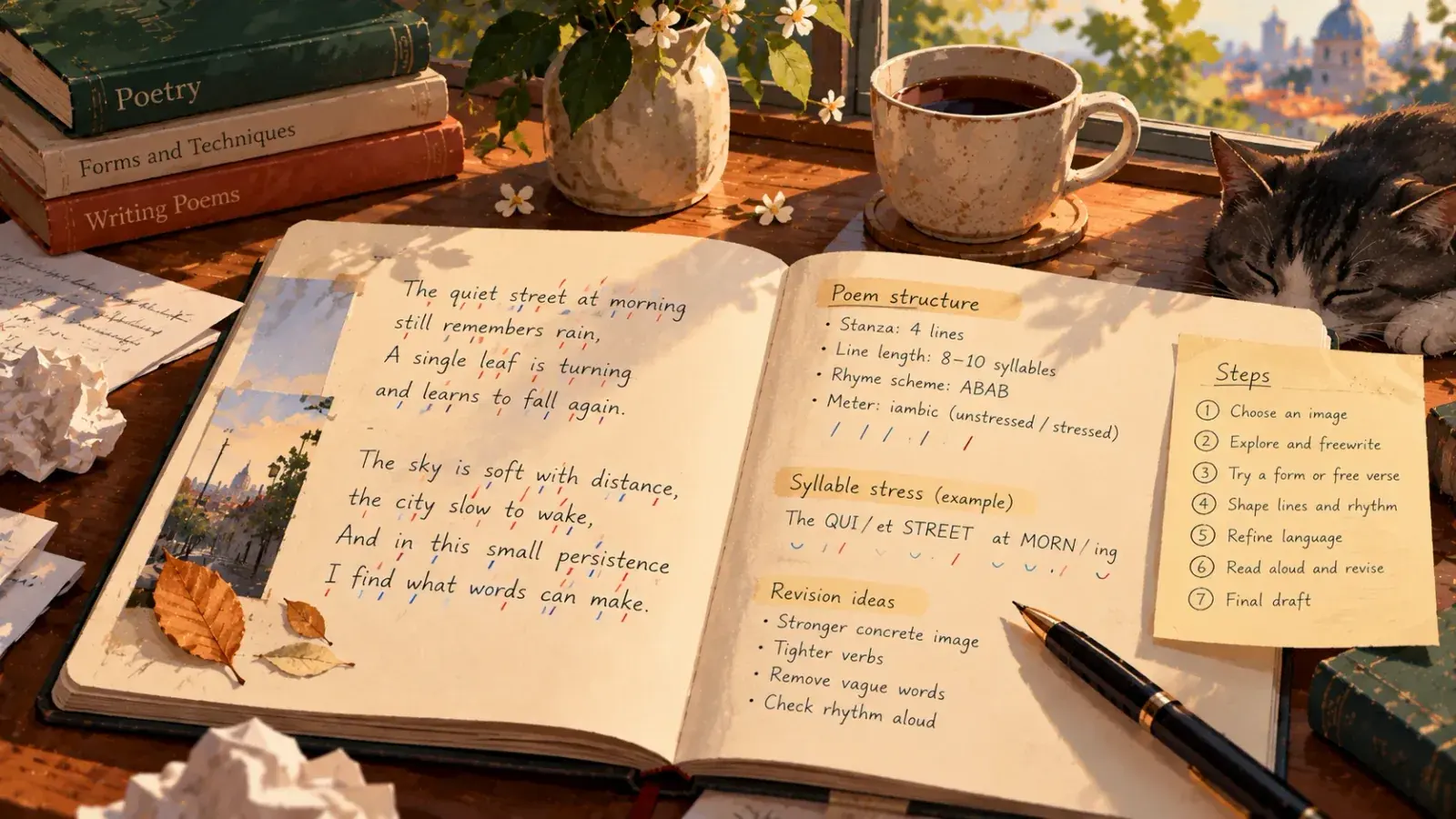
Here are 100 original poetry prompts, grouped by the way into a poem each one offers: an object, a memory, a place, a form, a constraint, a work of art, a first line. Pick one that brings something specific to mind, set a timer for fifteen minutes and write without stopping to judge. If the draft wanders away from the prompt, follow it. The form prompts include each form's rules, and the last section shows how to turn a rough draft into a finished poem, with a worked example.
Image and object prompts
Start with a thing you can see or hold. The Imagists' first principle, printed in Poetry magazine in March 1913, was “direct treatment of the ‘thing.’” A month later Ezra Pound's fourteen-word “In a Station of the Metro” set a crowd of faces beside “petals on a wet, black bough” and let the juxtaposition do the arguing.
- Empty the junk drawer in your kitchen onto the table. Write one object per line, and in the last line name the thing you were looking for.
- A coat hangs on the hook by the door. Write about the person who wears it without saying whether they are coming back.
- Look at your hands for one full minute. Write only what you see, then one line about what they did today.
- One orange on a windowsill in winter. Eight lines, and the word “orange” may appear only once.
- Choose something you have owned for more than ten years and write its biography, from the day it arrived to where it is now.
- Write about a key that no longer opens anything.
- Set two unrelated objects side by side, a dentist's chair and a beehive, a violin case and a lunch box, and write until they start to explain each other.
- Choose one square inch of something, a rusted fender or a scarred cutting board, and describe it at the scale of a landscape.
- A light left on in an empty room. Who left it on, and who will turn it off?
- List what is in the grocery cart ahead of you in line, then guess one true thing about that person's week.
- A broken umbrella in a city trash can. Give it the dignity of an elegy.
- Describe a color without naming it. Use temperature, taste and sound instead.
- Borrow the shape of Wallace Stevens's “Thirteen Ways of Looking at a Blackbird” (1917): thirteen short numbered sections, each looking at one bus stop from a different angle.
- Write an ode to a kitchen tool as if it were a musical instrument: the whisk, the grater, the pepper mill.
Memory and family prompts
Memory poems go flat when they summarize a whole childhood. Pick one afternoon, one room or one sentence someone said, and stay there. If you want private writing that is not trying to be a poem yet, our journal prompts are a gentler place to dig.
- The first phone number you memorized. Write the house it rang in.
- A dish a relative made without measuring. Write the poem as the recipe, with the measurements they actually used: “until it looks right,” “a handful,” “not that much.”
- Write a letter poem to someone you lost touch with that mentions only one detail you never told them.
- Your childhood bedroom, described from the ceiling looking down.
- A word your family used that nobody else understood. Define it, then tell where it came from.
- Write about a scar in the present tense, as if the minute it happened is still happening.
- The family car when you were ten, using only what you could see from the back seat.
- An argument you overheard through a wall. Write only the words that came through.
- Speak as your mother or father at the age you are now, in the year they were that age.
- Something you were told never to touch. Write about the day you touched it.
- A smell that takes you back to a particular year. Put the year in the title and do not name the smell until the last line.
- A game you and a sibling or friend invented. Write down its rules, then the day you stopped playing.
- The last time you saw a place before it was sold, torn down or remodeled.
- A song that played at a family wedding or funeral. Write about the room, never the song.
Nature and place prompts
Nature poems turn into postcards when they stay general. Name the species, the street and the month. A field guide or a weather report will give you better material than your memory of “trees.”
- Go outside for ten minutes and write down every sound you hear. Write the poem about the one you could not identify.
- A weed growing through a crack in a parking lot.
- A tree you have walked past for years. Find out its species, then write as if you just learned its name.
- The hour before a thunderstorm, from a dog's point of view.
- A bird that keeps visiting your window. Give it the problem you cannot solve.
- A creek in late summer, almost dry. Write it from the stones' point of view.
- The last snow of the year, half melted and gray at the curb.
- Your city at 4 a.m.: who is awake, and what are they carrying?
- A garden left alone for one summer. Write the poem as an inventory of what took over.
- The moon seen from somewhere inconvenient: a hospital parking lot, the end of a night shift, the shoulder of a highway.
- Your street as a map, one stanza per house.
- Moths around a porch light. Write about attraction without mentioning a single person.
- A place you have seen only in photographs. Walk through it in the poem, then add one line admitting you have never been.
- The view from a window you looked out of every day for years: a classroom, an office, a kitchen sink.
Poetic form prompts
Rules give a draft something to push against, and a form often finds a line you would not have reached on your own. Each prompt below gives the form's rules in brief and a subject to try. Our guides to writing a haiku and writing a sonnet go deeper into those two.
- Haiku. Three lines, traditionally 5, 7 and 5 syllables, catching one moment in one season. Many English-language haiku poets treat the count as optional. Write two versions about the first cold morning of fall, one counted and one shorter.
- Tanka. Five lines of 5, 7, 5, 7 and 7 syllables. Put an image in the first lines, your response in the last two, and let the third line pivot between them. Subject: a text you never answered.
- Haibun. A paragraph of prose followed by a haiku, the pairing Matsuo Bashō made famous in his travel journal The Narrow Road to the Deep North. Write about a commute you have made a thousand times.
- Shakespearean sonnet. Fourteen lines, usually in iambic pentameter, rhymed ABAB CDCD EFEF GG. Argue with yourself about moving to another city and let the final couplet decide.
- Petrarchan sonnet. An octave rhymed ABBAABBA, then a sestet rhymed CDECDE or CDCDCD, with a turn at line 9. Spend eight lines on a houseplant you keep failing to keep alive and six on what it says about you.
- Villanelle. Nineteen lines: five tercets and a quatrain on two rhymes. Lines 1 and 3 return in turn as refrains and close the poem together. Make the refrain something you say too often.
- Ghazal. At least five couplets, each complete on its own. The first couplet sets a rhyme and a refrain, and every later couplet ends its second line with both. Sign the last couplet with your name or its meaning. Subject: things lost in airports.
- Pantoum. Quatrains in which lines 2 and 4 of each stanza become lines 1 and 3 of the next, and the last line often repeats the first. Use it for something that keeps coming back: insomnia, a family argument, a commute.
- Sestina. Six six-line stanzas and a three-line envoi. No rhyme. Instead, the six end words of stanza one return in every stanza, each new order taken from the last as 6, 1, 5, 2, 4, 3. The envoi uses all six. Try door, salt, blue, Tuesday, hands and call for forty years of one kitchen.
- Triolet. Eight lines on two rhymes, ABaAabAB. Line 1 returns as lines 4 and 7, line 2 as line 8. Write one about a phrase a small child repeats all day.
- Abecedarian. Each line begins with the next letter of the alphabet, A to Z. Write about moving house, packed in alphabetical order.
- Bop. Created by Afaa Michael Weaver at a Cave Canem retreat: three stanzas of six, eight and six lines, each followed by the same refrain. The first states a problem, the second explores it, the third resolves it or records the attempt. Take the refrain from something your family always says.
- Aubade. A dawn poem, traditionally for lovers parting at sunrise. Write one for a night-shift worker coming home as everyone else leaves for work.
- Prose poem. One block of text, no line breaks, a form Charles Baudelaire took up in his Petits poèmes en prose (1869). Set it in a laundromat on a Sunday night and let the sentences do the work that line breaks usually do.
Constraint prompts
A constraint works because it takes choices away, which pushes you off the first word that comes to mind. Oulipo, the French group founded in 1960 by Raymond Queneau and François Le Lionnais, built a whole practice on rules like these.
- N+7. Take a paragraph from a public-domain book, say the opening of a Dickens novel, and replace each noun with the seventh noun after it in a dictionary. Keep the best accidents and build a poem from them.
- Lipogram. Describe your morning without the letter e. Georges Perec wrote an entire novel, La Disparition, under that rule.
- Univocalic. Ten lines using a as the only vowel. (“A cat sat apart. A man ran past.” It gets harder.)
- Snowball. One word per line, each word one letter longer than the last. See how far you get before it breaks.
- Golden shovel. Take one line from a poem you love and use each of its words, in order, as the end words of your lines. Terrance Hayes invented the form with “The Golden Shovel,” built on Gwendolyn Brooks's “We Real Cool,” in Lighthead (2010). Credit the source line in an epigraph.
- Cento. Build a poem entirely from other poets' lines, credited in a note. Working only from public-domain poets (Dickinson, Whitman, Keats, Christina Rossetti) keeps it simple if you later share it.
- Erasure. Print a page of a public-domain book or an old appliance manual and black out everything except the words of a new poem.
- At least twelve lines that make up one grammatical sentence. Subject: the drive home from somewhere you should not have gone.
- Every line is a question, and none of them gets answered.
- No adjectives and no adverbs. Make the nouns and verbs carry an afternoon of moving out of an apartment.
- Only words of one syllable, about something complicated: a tax form, a diagnosis, a custody schedule.
- Start every line with the same two words, such as “Because you,” “I was” or “Not the.” Christopher Smart did this in his lines on his cat Jeoffry, written between 1759 and 1763, where each line begins “For.”
- Exactly fifty words, title not included. Write long, then count, cut and count again.
- Write the poem as instructions, in the imperative: How to Leave a Party Early, How to Hold a Newborn, How to Forget a Phone Number.
Ekphrastic prompts
Ekphrasis, from the Greek for “description,” is writing in response to a work of art. John Keats dated “Ode on a Grecian Urn” May 1819. W. H. Auden's “Musée des Beaux Arts” (1938) looks at Landscape with the Fall of Icarus, a painting long credited to Pieter Bruegel the Elder, where the falling boy is a pair of legs in a corner while a farmer keeps plowing. Many museums put their collections online, so you can start from your desk.
- Choose a painting with a crowd. Write from one figure at the edge who is not looking at the main event.
- Write as the museum guard who stands beside one painting eight hours a day.
- Find a portrait titled only “Portrait of a Woman” or “Young Man.” Give the sitter back a name and one ordinary worry.
- Describe a painting to someone who cannot see it. Then write a second stanza about what you left out.
- A still life with fruit. Write what happened to the fruit after the painter finished.
- A news photograph at least fifty years old. Write the minute after the shutter closed.
- A statue in your town. Write a letter to its sculptor about who sits at its feet now.
- Listen to a piece of instrumental music twice. The first time, write only nouns. The second time, build the poem from them.
- A child's drawing on a refrigerator. Review it as seriously as a critic reviews a retrospective.
- A quilt, a rug or a piece of embroidery: the hands that made it and the hours it took.
- An abstract painting, all color fields or a single line. Write the story it refuses to tell.
- An old map of a place that now goes by another name. Write the poem in its margins.
- Write the wall label for a painting: title, date, medium, then three lines that go somewhere a label never would.
- A painting of an interior. Write what is just outside the frame: the door, the noise, the person who just left.
First lines to start from
Take a line, write what follows, then decide whether the poem still needs it. Many finished poems drop the line that started them. Every line here is original, and you are welcome to keep it.
- The house kept the shape of us after we left.
- Nobody tells you the ocean is mostly waiting.
- I learned to drive on a road that is now a parking lot.
- My grandmother counted in a language she would not teach me.
- This is the hour when the bakery lights come on.
- I have kept your voicemail through three phones.
- The orchard was sold in parcels, like a story told out of order.
- Here is what the river took, in the order it took it:
- All winter the dog next door barked at one corner of the yard.
- We called it the blue room even after we painted it.
- If you had asked me then, I would have said the moon was ours.
- The doctor said the word gently, as if it might break.
- There is a version of this morning where I call you back.
- My father fixed everything with the same three tools.
- The last bus leaves the station empty and lit.
- Begin with what the light did.
How to turn a prompt into a poem
A prompt gets you a page of material. The poem is usually hiding in about a third of it, and revision is how you find which third. These steps work for any prompt above.
- Write fast and judge later
Give the first draft ten to fifteen minutes and do not stop to fix anything. Bad lines are fine. Stopping to judge is what turns a prompt back into a blank page.
- Find the line with the most heat
Read the draft and mark the one line you would keep if everything else had to go. It is often in the middle, after you warmed up. Start the second draft from that line.
- Trade abstractions for things
Words like grief, love, beauty and memory ask the reader to feel something without giving them a reason. Swap each for an object, a gesture or a number: the poetry version of show, don't tell. If one image keeps returning across drafts, let it become the poem's motif.
- Break lines on purpose
The end of a line is the strongest position in a poem. Break where you want the reader to pause, or on a word that changes meaning when the next line arrives. Read the draft aloud and listen for where your breath actually stops.
- Cut the first and last lines
Drafts often clear their throat before the poem starts and explain it after it ends. Cover the first and last lines with your hand and read again. If nothing is missing, delete them.
- Let it rest, then revise
Put the draft away for a day or a week and reread it cold. If you write in Strokes, version history saves versions automatically as you go, so you can cut hard, preview an earlier version with the changes marked and restore it in one click if the cut went too far.
Here are the first five lines of a poem from prompt 4, before and after those steps:
First draft:
The orange sits on the windowsill
and it is so beautiful in the cold.
It reminds me of summer and happiness
and everything I have lost this year.
I think about how all things end.
Second draft:
One orange on the sill since Sunday,
the only lit thing in the kitchen.
Outside, the yard has gone to paper.
I turn it so the bruise faces the glass.
Nobody in this house is hungry yet.
What changed: “Beautiful,” “happiness” and “everything I have lost” became a weekday, a bruise and a kitchen. The explaining last line is gone, and the loss shows up in who is not eating. “Orange” still appears once.
In Strokes, each poem is a file on your own machine, so a project folder with one document per poem works as a notebook that exports to PDF or Word when you submit. The AI Assistant can read a draft and point to abstract words or lines that explain too much. Ask it questions rather than asking it for lines, and the poem stays yours.How to write a poem walks through the whole process from blank page to finished poem.
Frequently asked questions
How do you write a poem from a prompt?
Write for ten to fifteen minutes without stopping. Then find the strongest line, start a second draft from it, replace abstract words with concrete things and cut the lines that explain. Once the poem finds its own subject, you can leave the prompt behind.
How long should a poem from a prompt be?
Free verse has no set length. Stop when cutting another line would cost the poem something. Fixed forms set their own: a sonnet has 14 lines, a villanelle 19, a sestina 39, and a haiku three.
Which poetry prompts are best for beginners?
Start with object prompts and first lines, which give you something concrete straight away. Among the forms, the haiku, the abecedarian and the aubade are forgiving. Save the sestina and the villanelle for when you want a puzzle, because their repeating lines take planning.
Is there a poem-a-day challenge I can use these prompts for?
Yes. National Poetry Writing Month (NaPoWriMo) asks poets to write a poem a day through April. The poet Maureen Thorson started it on her blog in April 2003. With 100 prompts you can run it with plenty to spare, or work through the list at your own pace.
Can I publish poems I write from these prompts?
Yes. A prompt is only a starting point, and the poem is your own work. For found forms such as the cento, the golden shovel and erasure, credit the source text. Before you post a poem online, check the guidelines of journals you might submit to, because some treat a blog or social media post as previously published.