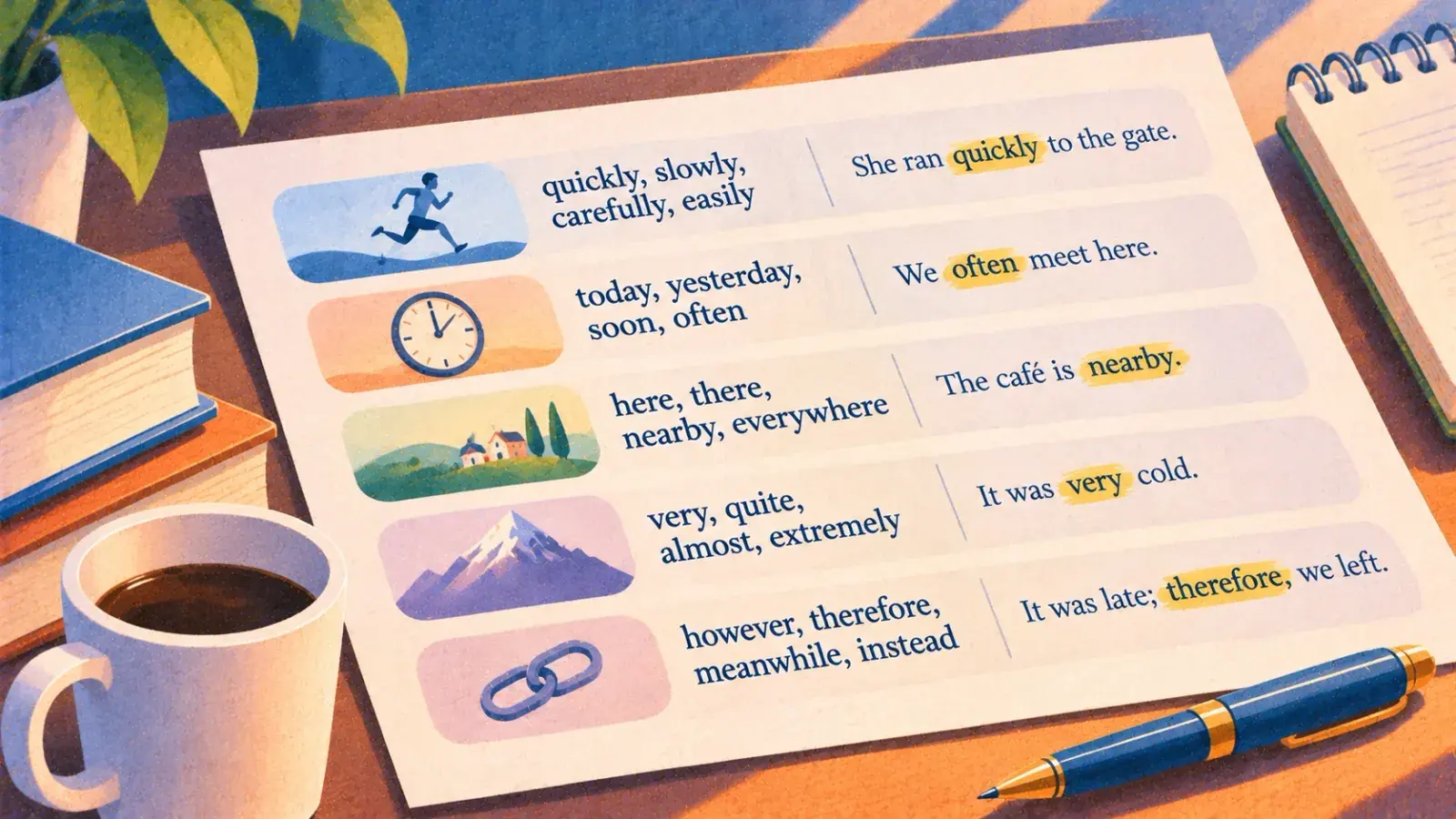
An adverb is a word that modifies a verb, an adjective, another adverb or a whole sentence. It answers how (quietly), when (yesterday), where (upstairs), how often (rarely) or how much (almost). Many adverbs end in -ly, but plenty don't: often, soon, very, well, fast. The 320 below are sorted by type, each in an example sentence written for this list. A word’s part of speech depends on the job it does in the sentence, so entries that also work as an adjective, a noun, a preposition or a conjunction carry a short note: fast is an adverb in drive fast and an adjective in a fast car.
After the list: when adverbs weaken prose and when you need them, where to put one in a sentence, and the mistakes that catch even practiced writers.
| Type | Answers | Look under | Adverbs |
|---|---|---|---|
| TypeManner | AnswersHow? | Look underAdverbs of manner | Adverbs1–90 |
| TypeTime | AnswersWhen? For how long? | Look underAdverbs of time | Adverbs91–135 |
| TypePlace | AnswersWhere? In which direction? | Look underAdverbs of place | Adverbs136–175 |
| TypeFrequency | AnswersHow often? | Look underAdverbs of frequency | Adverbs176–210 |
| TypeDegree | AnswersHow much? To what extent? | Look underAdverbs of degree | Adverbs211–250 |
| TypeFocusing | AnswersWhich part? | Look underFocusing adverbs | Adverbs251–265 |
| TypeViewpoint | AnswersWhat does the writer think? | Look underViewpoint adverbs | Adverbs266–300 |
| TypeConjunctive | AnswersHow does this follow? | Look underConjunctive adverbs | Adverbs301–320 |
Adverbs of manner
Manner adverbs say how something is done. They're the ones writing advice warns about, because a precise verb can often do their job. They're sorted here by what they describe.
Speed and effort
- quickly — She quickly signed the form before she could change her mind.
- slowly — The ferry slowly turned into the wind.
- rapidly — The water rose rapidly after midnight.
- swiftly — The council acted swiftly once the bridge was closed.
- hastily — He hastily packed and forgot his charger.
- hurriedly — They ate hurriedly, standing at the counter.
- briskly — She walked briskly to keep warm.
- promptly — The landlord promptly fixed the boiler, for once.
- gradually — The fog gradually lifted off the bay.
- steadily — Sales grew steadily through the spring.
- sluggishly — The old laptop started up sluggishly.
- effortlessly — The dancer lifted her partner effortlessly.
- laboriously — He laboriously copied the ledger by hand.
- energetically — The kids energetically rearranged the furniture.
- wearily — She climbed the stairs wearily after the night shift.
- smoothly — The handover went smoothly.
- abruptly — The music stopped abruptly.
- suddenly — The lights suddenly went out.
- fast — He drives too fast on the coast road. (Also an adjective: a fast car.)
- hard — They worked hard all summer. (Also an adjective: a hard chair.)
Care and skill
- carefully — Carry the tray carefully; the soup is full to the brim.
- carelessly — He carelessly left the gate open.
- cautiously — The deer stepped cautiously onto the road.
- warily — The cat eyed the vacuum cleaner warily.
- deliberately — She deliberately left the last question blank.
- accidentally — I accidentally replied to everyone.
- precisely — The train left at precisely 7:04.
- neatly — He folded the map neatly along its creases.
- clumsily — She clumsily knocked the vase off the shelf.
- deftly — The chef deftly boned the fish.
- skillfully — The pilot skillfully landed in the crosswind.
- awkwardly — He shook hands awkwardly, still holding his coffee.
- thoroughly — The inspector thoroughly checked every weld.
- methodically — She worked methodically through the archive, box by box.
- haphazardly — Books were stacked haphazardly on every chair.
- well — She writes well under pressure. (Also an adjective: I feel well.)
Sound and voice
- loudly — The neighbors argued loudly until two.
- quietly — He quietly closed the door behind him.
- softly — He spoke softly so he wouldn't wake the baby.
- silently — They walked silently past the sleeping guard.
- noisily — The kettle boiled noisily in the kitchen.
- audibly — The audience audibly gasped.
- hoarsely — He spoke hoarsely after the match.
- shrilly — The whistle blew shrilly across the field.
- gruffly — The farmer answered gruffly, without looking up.
- sharply — The teacher spoke sharply to the back row.
- tunelessly — He whistled tunelessly while he worked.
Mood and attitude
- happily — They lived happily in two rooms above the shop.
- wistfully — She looked wistfully at the old photograph.
- angrily — He angrily tore up the parking ticket.
- calmly — The pilot calmly announced the diversion.
- nervously — She laughed nervously at the joke she didn't get.
- anxiously — They waited anxiously for the results.
- eagerly — The dog waited eagerly by the door.
- reluctantly — He reluctantly agreed to chair the meeting.
- grudgingly — She grudgingly admitted the plan had worked.
- willingly — They willingly gave up their Saturday.
- cheerfully — The porter cheerfully carried our bags up four flights.
- gloomily — He stared gloomily at the rain.
- bitterly — She laughed bitterly at the offer.
- fondly — He remembered the old house fondly.
- tenderly — She tenderly wrapped the bandage around his wrist.
- coldly — The receptionist looked at him coldly.
- warmly — The host greeted us warmly.
- proudly — He proudly showed us the shed he had built.
- smugly — She pointed smugly at the scoreboard.
- shyly — The boy shyly held out his drawing.
- boldly — She boldly asked for twice the fee.
- bravely — He bravely admitted the mistake to the whole team.
- patiently — The nurse patiently explained it a third time.
- impatiently — He tapped impatiently on the counter.
- politely — She politely declined a second helping.
- rudely — He rudely interrupted the speaker.
- sarcastically — He clapped sarcastically when the projector failed.
- sheepishly — He grinned sheepishly and handed back the keys.
- sweetly — The child smiled sweetly and lied.
Honesty and secrecy
- honestly — She answered every question honestly.
- openly — They talked openly about money for the first time.
- truthfully — He told the inspector truthfully where he had been.
- secretly — He had secretly applied for the job in Oslo.
- furtively — She glanced furtively at her phone under the table.
- slyly — He slyly moved his piece while she was looking away.
- innocently — She innocently asked where the money had gone.
- sincerely — He sincerely believed the bridge would hold.
- candidly — The mayor spoke candidly about the deficit.
- discreetly — The waiter discreetly slipped her the bill.
Force and grip
- gently — She gently lifted the bird out of the net.
- roughly — He roughly pushed the drawer shut.
- firmly — Hold the ladder firmly while I climb.
- tightly — She held the railing tightly on the icy steps.
Adverbs of time
Time adverbs say when something happens or for how long. Many are short words with no -ly, and most can go at the start or the end of a sentence.
- now — The bakery is open now.
- then — We lived in Ohio then.
- today — The results come out today. (Also a noun: Today is Friday.)
- tonight — The storm should reach the coast tonight. (Also a noun: Tonight is the final.)
- yesterday — The package arrived yesterday. (Also a noun: yesterday's news.)
- tomorrow — The movers come tomorrow at eight. (Also a noun: Tomorrow is a holiday.)
- soon — The doctor will see you soon.
- later — I'll call you later. (Also an adjective: a later train.)
- already — The train had already left.
- still — She still lives in the house she grew up in. (Also an adjective: still water.)
- yet — The results aren't in yet. (Also a conjunction: small yet strong.)
- recently — They recently moved to Lisbon.
- lately — He's been sleeping badly lately.
- once — This was once a cinema. (Also a conjunction: once you're done.)
- formerly — The bookshop was formerly a bank.
- previously — She previously worked for the city council.
- afterward — We went for a walk afterward. (Afterwards in British English.)
- beforehand — Read the chapter beforehand.
- eventually — The bus eventually came.
- finally — The rain finally stopped at noon.
- immediately — Call me immediately if the fever rises.
- instantly — The ice cream melted instantly on the hot pavement.
- meanwhile — Meanwhile, the soup boiled over.
- overnight — The town's population doubled overnight. (Also an adjective: an overnight bag.)
- early — She arrived early to get a seat. (Also an adjective: an early start.)
- late — The flight landed late. (Also an adjective: a late train.)
- first — First, heat the oven. (Also an adjective: the first day.)
- next — Next, fold in the egg whites. (Also an adjective: next week.)
- last — I last saw him at the wedding. (Also an adjective: last night.)
- briefly — The sun appeared briefly between showers.
- temporarily — The library is temporarily closed.
- permanently — The road is permanently closed to trucks.
- forever — The smell of that cellar stays with you forever.
- long — Have you waited long? (Also an adjective: a long wait.)
- nowadays — Nowadays almost nobody carries cash.
- someday — Someday I'll learn to sail.
- sometime — Let's have lunch sometime next week.
- presently — The doctor will be with you presently. (It can mean “soon” or “now”, so let the context decide.)
- currently — She's currently writing her second novel.
- since — I haven't seen him since. (Also a preposition and a conjunction: since May; since you asked.)
- ago — The shop closed three years ago.
- momentarily — The lights flickered momentarily.
- shortly — The film starts shortly.
- belatedly — He belatedly sent a birthday card.
- punctually — The meeting started punctually at nine.
Adverbs of place and direction
Place adverbs say where something happens or which way it moves. Many of them double as prepositions: in “She stayed inside,” inside is an adverb; in “She stayed inside the car,” it's a preposition.
- here — Put the boxes here.
- there — The keys are over there.
- everywhere — Sand got everywhere.
- nowhere — The cat was nowhere to be found.
- somewhere — I left my glasses somewhere.
- anywhere — You can sit anywhere.
- elsewhere — Try elsewhere; this shop's closed.
- nearby — There's a pharmacy nearby. (Also an adjective: a nearby pharmacy.)
- far — We didn't walk far. (Also an adjective: the far end.)
- away — The birds flew away. (Also an adjective: an away game.)
- back — Go back to the beginning. (Also a noun and a verb: my back; back the car up.)
- abroad — She studied abroad for a year.
- overseas — The parts are made overseas. (Also an adjective: overseas students.)
- home — We drove home in the snow. (Also a noun: a new home.)
- indoors — The kids played indoors all week.
- outdoors — The wedding was held outdoors. (Also a noun: the great outdoors.)
- inside — Come inside; it's freezing. (Also a preposition: inside the car.)
- outside — The dog sleeps outside in summer. (Also a preposition: outside the gate.)
- upstairs — The bathroom is upstairs. (Also an adjective: an upstairs room.)
- downstairs — Someone was moving around downstairs. (Also an adjective: the downstairs bathroom.)
- underground — The cables run underground. (Also an adjective: an underground garage.)
- above — Clouds gathered above. (Also a preposition: above the door.)
- below — The valley spread out below. (Also a preposition: below the bridge.)
- ahead — The road ahead was flooded.
- behind — She stayed behind to lock up. (Also a preposition: behind the shed.)
- around — He looked around for a waiter. (Also a preposition: around the corner.)
- aside — She stepped aside to let him pass. (Also a noun: a whispered aside.)
- apart — They live two streets apart.
- along — Come along, we're late. (Also a preposition: along the river.)
- aboard — All passengers are now aboard. (Also a preposition: aboard the ship.)
- ashore — The crew went ashore at dawn.
- inland — The storm moved inland overnight. (Also an adjective: an inland lake.)
- uphill — The path climbs steeply uphill. (Also an adjective: an uphill climb.)
- downhill — The bike rolled downhill. (Also an adjective: a downhill run.)
- upstream — Salmon swim upstream to spawn. (Also an adjective: the upstream bank.)
- sideways — The crab scuttled sideways. (Also an adjective: a sideways look.)
- backward — She stepped backward into the hedge. (Backwards is also common. Also an adjective: a backward step.)
- forward — Please step forward when your name is called. (Also an adjective and a verb: a forward pass; forward the email.)
- homeward — The commuters streamed homeward at six. (Also an adjective: the homeward journey.)
- westward — The storm tracked westward across the gulf. (Also an adjective: the westward road.)
Adverbs of frequency
Frequency adverbs say how often. Most go before the main verb (“She always reads the last page first”) but after a form of be (“He is always late”).
- always — She always reads the last page first.
- constantly — The phone rang constantly.
- continually — He continually interrupted the speaker. (Again and again.)
- continuously — The pump ran continuously for three days. (Without stopping.)
- usually — We usually eat at seven.
- normally — The office normally closes at five.
- generally — Trains generally run on time here.
- typically — Typically, the river freezes in January.
- often — They often walk to work.
- frequently — The road frequently floods in spring.
- regularly — She regularly backs up her files.
- routinely — The ward routinely checks every patient at midnight.
- habitually — He habitually arrives ten minutes early.
- sometimes — Sometimes the tram doesn't come at all.
- occasionally — We occasionally see deer in the garden.
- periodically — The alarm is tested periodically.
- intermittently — It rained intermittently all afternoon.
- sporadically — Fighting continued sporadically through the night.
- seldom — He seldom talks about the war.
- rarely — She rarely takes a day off.
- hardly ever — We hardly ever eat out.
- never — I've never seen snow in April.
- again — Try again tomorrow.
- repeatedly — He repeatedly ignored the warnings.
- twice — The mail carrier rang twice.
- daily — The museum is open daily. (Also an adjective: a daily walk.)
- weekly — The paper comes out weekly. (Also an adjective: a weekly paper.)
- monthly — Rent is paid monthly. (Also an adjective: monthly rent.)
- yearly — The fair takes place yearly in June. (Also an adjective: a yearly checkup.)
- annually — The report is published annually.
- hourly — Buses leave hourly. (Also an adjective: an hourly wage.)
- nightly — The show runs nightly through August. (Also an adjective: the nightly news.)
- invariably — The meeting invariably overruns.
- perpetually — He seemed perpetually tired.
- ever — Have you ever been to Porto?
Adverbs of degree
Degree adverbs say how much, and they usually sit in front of an adjective or another adverb: almost empty, very slowly. The intensifiers here (very, really, totally) are the first words to check in a hunt for filler.
- very — The soup is very hot.
- extremely — The roads are extremely icy this morning.
- really — I really want this job.
- quite — The film was quite good. (In American English usually “very”; in British English often “fairly”.)
- rather — It's rather cold for May.
- fairly — The exam was fairly easy.
- pretty — The house is pretty old. (Informal. Also an adjective: a pretty garden.)
- somewhat — The results were somewhat disappointing.
- slightly — The pie was slightly burnt.
- mildly — The audience seemed mildly amused.
- moderately — The treatment is moderately effective.
- barely — She barely caught the train.
- hardly — I could hardly hear him.
- scarcely — There was scarcely any milk left.
- almost — The tank is almost empty.
- nearly — We nearly missed the turn.
- completely — The village was completely cut off.
- totally — I totally forgot the meeting.
- entirely — The decision is entirely yours.
- absolutely — You're absolutely right.
- utterly — The plan was utterly impractical.
- fully — The hotel is fully booked.
- partly — The road is partly flooded.
- partially — The view is partially blocked by a crane.
- wholly — The project is wholly funded by donations.
- deeply — She was deeply moved by the letter.
- highly — The book is highly recommended.
- greatly — Your help is greatly appreciated.
- enormously — The show was enormously popular.
- incredibly — The water was incredibly clear.
- terribly — I'm terribly sorry.
- awfully — It's awfully quiet in here.
- exceptionally — The harvest was exceptionally good this year.
- remarkably — The patient recovered remarkably fast.
- unusually — It was unusually warm for November.
- too — The coffee is too hot to drink.
- enough — Is the room warm enough? (As an adverb, enough follows its adjective. Before a noun it's an adjective: enough chairs.)
- so — I was so tired I fell asleep on the bus. (Also a conjunction: It rained, so we stayed in.)
- virtually — The town was virtually empty in August.
- practically — The tickets were practically free.
Focusing adverbs such as only
Focusing adverbs pick out one part of a sentence. Move one and the meaning moves with it. Here is only in three positions, and each one changes who did what:
- Only I locked the back door. (Nobody else did.)
- I only locked the back door. (I didn't also bolt it, or I did nothing else.)
- I locked only the back door. (Not the front.)
In speech, people often put only before the verb and stress the word they mean. The page has no stress, so in writing put only, just and even right before the word they limit.
- only — Only Maria knew the code. (Also an adjective: the only exit.)
- just — I just wanted to say thanks. (Also an adjective: a just cause.)
- even — Even the dog looked guilty. (Also an adjective: an even surface.)
- also — She also speaks Portuguese.
- alone — The decision was hers alone. (Also an adjective: alone in the office.)
- merely — It was merely a suggestion.
- simply — I simply forgot.
- solely — The decision was based solely on cost.
- exclusively — The shop sells exclusively secondhand books.
- mainly — The audience was mainly students.
- mostly — The garden is mostly weeds now.
- chiefly — He's chiefly known for his bridges.
- primarily — The grant is primarily for travel.
- especially — I love the coast, especially in winter.
- particularly — The second act is particularly strong.
Viewpoint and comment adverbs
These comment on the whole sentence: how the writer feels about it, how sure they are, or the angle it's seen from. They usually open the sentence and take a comma. Grammars also call them sentence adverbs or disjuncts.
- fortunately — Fortunately, the bridge held.
- unfortunately — Unfortunately, the tickets had sold out.
- luckily — Luckily, nobody was home.
- sadly — Sadly, the bakery closed in March.
- thankfully — Thankfully, the rain held off for the wedding.
- surprisingly — Surprisingly, the cheaper model lasted longer.
- predictably — Predictably, the meeting overran.
- ironically — Ironically, the fire station burned down.
- oddly — Oddly, nobody mentioned the missing chair.
- strangely — Strangely, the dog didn't bark.
- interestingly — Interestingly, sales rose during the strike.
- naturally — Naturally, she wanted to see the contract first.
- obviously — Obviously, we can't open the pool in January.
- clearly — Clearly, the map is out of date.
- evidently — Evidently, someone had been sleeping in the barn.
- apparently — Apparently, the director resigned this morning.
- seemingly — The seemingly endless line moved in ten minutes.
- presumably — Presumably, the keys are still in the car.
- supposedly — The house is supposedly haunted.
- allegedly — The money was allegedly moved offshore.
- arguably — It is arguably the best bridge in the city.
- certainly — She'll certainly win the next round.
- definitely — I'll definitely be there.
- undoubtedly — The storm was undoubtedly the worst in years.
- probably — The shop's probably closed by now.
- possibly — The match could possibly be delayed.
- perhaps — Perhaps the letter was never sent.
- maybe — Maybe we should take the train.
- frankly — Frankly, the plan won't work.
- admittedly — Admittedly, the sample was small.
- personally — Personally, I'd take the earlier flight.
- ideally — Ideally, the report should be under ten pages.
- hopefully — Hopefully, the rain will stop before the match.
- technically — Technically, the shop is closed, but they'll serve you.
- legally — Legally, the landlord must give a month's notice.
Conjunctive adverbs that link ideas
Conjunctive adverbs link a clause to the one before and say how the ideas relate. When one joins two complete sentences, put a semicolon or a period before it, never just a comma; the comma splice guide shows why. As openers for essay sentences, they're also in the sentence starters.
- however — The plan was cheap; however, it was slow.
- therefore — The road is closed; therefore, the bus will go around.
- thus — The bridge was too narrow for trucks, and thus the town stayed small.
- hence — The soil is acid; hence the blueberries.
- consequently — The order came late. Consequently, the launch slipped a week.
- accordingly — The rules changed, and we adjusted the budget accordingly.
- moreover — The apartment is cheap. Moreover, it's five minutes from the station.
- furthermore — The data are old. Furthermore, the sample is tiny.
- besides — I don't want to go. Besides, it's raining. (Also a preposition: besides the cost.)
- additionally — Additionally, applicants need two references.
- likewise — The first test failed; likewise the second.
- similarly — Similarly, the second survey found no effect.
- instead — He didn't call. Instead, he wrote a letter.
- otherwise — Leave now; otherwise, you'll miss the ferry.
- nevertheless — The odds were poor; nevertheless, they tried.
- nonetheless — It was a long shot. Nonetheless, she applied.
- conversely — Prices rose in the south. Conversely, they fell in the north.
- alternatively — Alternatively, we could rent a van.
- indeed — The reviews were good; indeed, the run was extended.
- incidentally — Incidentally, your sister called.
When adverbs weaken writing
Stephen King's case against adverbs in On Writing (2000) is the one many writers know. He takes a plain sentence about a man closing a door firmly, allows that it isn't a terrible sentence, and asks whether firmly needs to be there: if the scene has already shown how the door was closed, the adverb is redundant. He compares adverbs to dandelions, pretty enough one at a time and a lawn full of weeds if you let them spread, and sums up his position by declaring that “the road to hell is paved with adverbs.” He also concedes that firmly does say something; his real question is whether the scene has already said it.
You don't have to share the zeal to use the test. Adverbs weaken prose in four recurring ways.
- They repeat the verb. Whispered softly, shouted loudly, sprinted quickly, crept quietly, clenched tightly. The verb already contains the adverb, so cut it.
- They prop up a weak verb. Walked slowly, ate quickly, looked angrily. One precise verb does it better: ambled, wolfed, glared. The strong verbs list pairs 290 verbs with the weak verb and adverb each one replaces.
- They tell the reader how to take a line. “I don't care,” she said angrily. If the words are angry, the adverb is redundant; if they aren't, it won't make them so. The dialogue tag adverb is so familiar it has a joke named after it, the Tom Swifty: “We must hurry,” said Tom swiftly. The name comes from the Tom Swift adventure books, published from 1910 by the Stratemeyer Syndicate under the pen name Victor Appleton; the pun caught on with a 1963 book of them. The words to use instead of said show how to replace a tag adverb with an action beat.
- They inflate. Very tired, really important, completely finished, totally unique. An intensifier on a weak word asks for a stronger word (exhausted, vital); on an absolute word (finished, unique) it adds nothing at all.
| Redundant | Cut to | Why |
|---|---|---|
| Redundantwhispered softly | Cut towhispered | WhyA whisper is soft. |
| Redundantsprinted quickly | Cut tosprinted | WhySprinting is fast. |
| Redundantclenched tightly | Cut toclenched | WhyClenching is tight. |
| Redundantcompletely surrounded | Cut tosurrounded | WhySurrounded means on all sides. |
| Redundanttotally unanimous | Cut tounanimous | WhyUnanimous means everyone. |
| Redundantsuddenly burst | Cut toburst | WhyBursting is sudden. |
| Redundantsmiled happily | Cut tosmiled | WhyUnless the smile is the surprise. |
| Redundantreturn back | Cut toreturn | WhyReturn means go back. |
Before: She quickly walked into the kitchen and angrily slammed the door. “Where were you?” she asked loudly. He smiled nervously and slowly put his keys on the very cluttered table. Suddenly the phone rang.
After: She marched into the kitchen and slammed the door. “Where were you?” He laid his keys on the cluttered table, carefully, as if they might go off. The phone rang.
Marched replaces quickly walked, and slammed is already angry. The line is sharp enough without loudly, and a ringing phone is sudden without suddenly. The one adverb that stays, carefully, is odd for a man putting down keys, and that oddness is what shows his nerves.
Searching a draft for “ly” finds the adverbs and a lot of noise: family, reply, July, friendly, Italy. A better pass looks for adverbs by job. Ask the Strokes Assistant to review a chapter for manner adverbs attached to verbs of speech and movement, listing the redundant pairs (whispered softly) separately from the ones that add something (smiled sadly).
When adverbs earn their place
The no-adverbs rule is a revision habit, not a law of grammar, and it's aimed at manner adverbs. Time, place and frequency adverbs are information: you can't cut yesterday, upstairs or twice without losing a fact. Keep a manner adverb when it adds a second feeling that pulls against the verb (smiled sadly, laughed bitterly) and no single verb holds both. Agreed reluctantly is borderline: conceded comes close. And keep sentence adverbs that state your position (admittedly, arguably) or an honest level of certainty (probably, possibly), which in research writing is accuracy, not hedging for its own sake.
The cold passed reluctantly from the earth, and the retiring fogs revealed an army stretched out on the hills, resting.
“The cold passed” is a weather report. “Reluctantly” gives the cold a will of its own, in an opening where the army it uncovers is resting too, waiting to move. There's no common single verb for passing unwillingly, which is the test.
…whenever I find myself involuntarily pausing before coffin warehouses, and bringing up the rear of every funeral I meet…
Take out involuntarily and Ishmael is a man who likes funerals. Leave it in and his feet are making the choice for him, which is both funnier and sadder.
He smiled understandingly—much more than understandingly. It was one of those rare smiles with a quality of eternal reassurance in it, that you may come across four or five times in life.
So we beat on, boats against the current, borne back ceaselessly into the past.
In the first passage Fitzgerald uses the adverb, finds it too thin, and says so, then writes the description it was standing in for. It's a good model for revision: when an adverb feels weak, write the sentence it's pointing at. In the book's last line, ceaselessly does two jobs. It stretches the rhythm just before the sentence ends, and it takes away any hope that the current will stop.
Where to put an adverb
English gives adverbs three main positions, and each type has a favorite.
| Position | Usual types | Examples |
|---|---|---|
| PositionFront, before the subject | Usual typesViewpoint, conjunctive, time | ExamplesFortunately, the bridge held. Yesterday the bridge reopened. |
| PositionMiddle, before the main verb | Usual typesFrequency, focusing, some degree | ExamplesShe always reads the last page first. I have never seen snow in April. |
| PositionMiddle, after be | Usual typesFrequency | ExamplesHe is always late. |
| PositionEnd, after the verb and object | Usual typesManner, place, time | ExamplesShe closed the door quietly. They met upstairs. The parcel came yesterday. |
When several adverbs stack up at the end, the usual order is manner, then place, then time: “She sang beautifully at the festival last night.” And keep a manner adverb out of the gap between a verb and a short object. “He closed quietly the door” sounds like a translation; write “He quietly closed the door” or “He closed the door quietly.” (With a long object, the adverb can come first: “She read aloud every letter her grandfather had sent from the front.”)
Focusing adverbs follow their own rule, shown with only in the focusing section above: put only, just and even right before the word they limit.
Squinting adverbs and split infinitives
An adverb squints when it sits between two things it could modify: “Editors who read manuscripts quickly reject most of them.” Is the reading quick or the rejecting? Move it to the side you mean: “Editors who quickly read manuscripts…” or “…reject most of them quickly.”
Split infinitives are a different matter: an old rule that most modern guides have dropped. An adverb inside “to go” is fine, and sometimes necessary; “to more than double” can't be unsplit without changing the meaning. The classic example, “to boldly go where no man has gone before,” from the opening of Star Trek, would be weaker as “to go boldly.”
Common adverb mistakes
| Mistake | Example | Fix |
|---|---|---|
| MistakeAn -ly adjective used as an adverb | ExampleShe smiled friendly. | FixShe gave a friendly smile. (Also: lovely, lonely, costly, elderly, silly.) |
| MistakeGood for well | ExampleShe writes good. | FixShe writes well. (But “The soup tastes good” is right: tastes is a linking verb.) |
| MistakeBadly after a linking verb | ExampleThe milk smells badly. | FixThe milk smells bad. (Smells badly would mean the milk is bad at smelling.) |
| MistakeReal or sure in formal writing | ExampleThe plan worked real well. | FixThe plan worked really well. |
| MistakeA double negative with hardly | ExampleI can't hardly hear you. | FixI can hardly hear you. |
| MistakeA comma before however | ExampleThe plan was cheap, however it was slow. | FixThe plan was cheap; however, it was slow. |
| MistakeContinually for continuously | ExampleThe pump ran continually for three days. | FixContinuously, if it never stopped; continually means again and again. |
Two things that look like mistakes aren't. Flat adverbs, which have the same form as their adjective, are standard English: drive slow, work hard, think fast. Merriam-Webster notes that slow is almost always used with verbs of movement or action and usually follows the verb, as in “go slow.” And hopefully at the start of a sentence (“Hopefully, the rain will stop”) drew a wave of criticism after it became popular in the 1960s, but Merriam-Webster treats it as an ordinary sentence adverb, grammatically sound and standard.
Frequently asked questions
Do all adverbs end in -ly?
No. Many common adverbs have no -ly: often, soon, now, then, here, there, very, quite, too, well, fast, hard, late and never. Some adverbs have the same form as the adjective, such as fast, hard and straight, and these flat adverbs are standard. And some -ly words are adjectives, not adverbs: friendly, lovely, lonely, costly, elderly and ugly.
Can a word be an adverb and an adjective?
Yes. Part of speech depends on the job a word does in the sentence. Fast is an adverb in drive fast and an adjective in a fast car; daily is an adverb in open daily and an adjective in a daily walk. Inside is an adverb in come inside but a preposition in inside the car, because there it has an object. The notes in the list mark the common double duties.
Is very an adverb?
Yes. Very is an adverb of degree: it modifies adjectives and other adverbs, as in very cold or very slowly. It can't modify a verb on its own, so you write very much enjoyed, not very enjoyed. In editing, very is a good first word to check, because a precise word often replaces both: very tired is exhausted, very big is huge.