An informative speech explains something so the audience understands it: an object, a process, an event, a person, a concept or a debated issue. It doesn't argue for anything. Below are seven complete original speeches covering the six common types, each with a note on why it works.
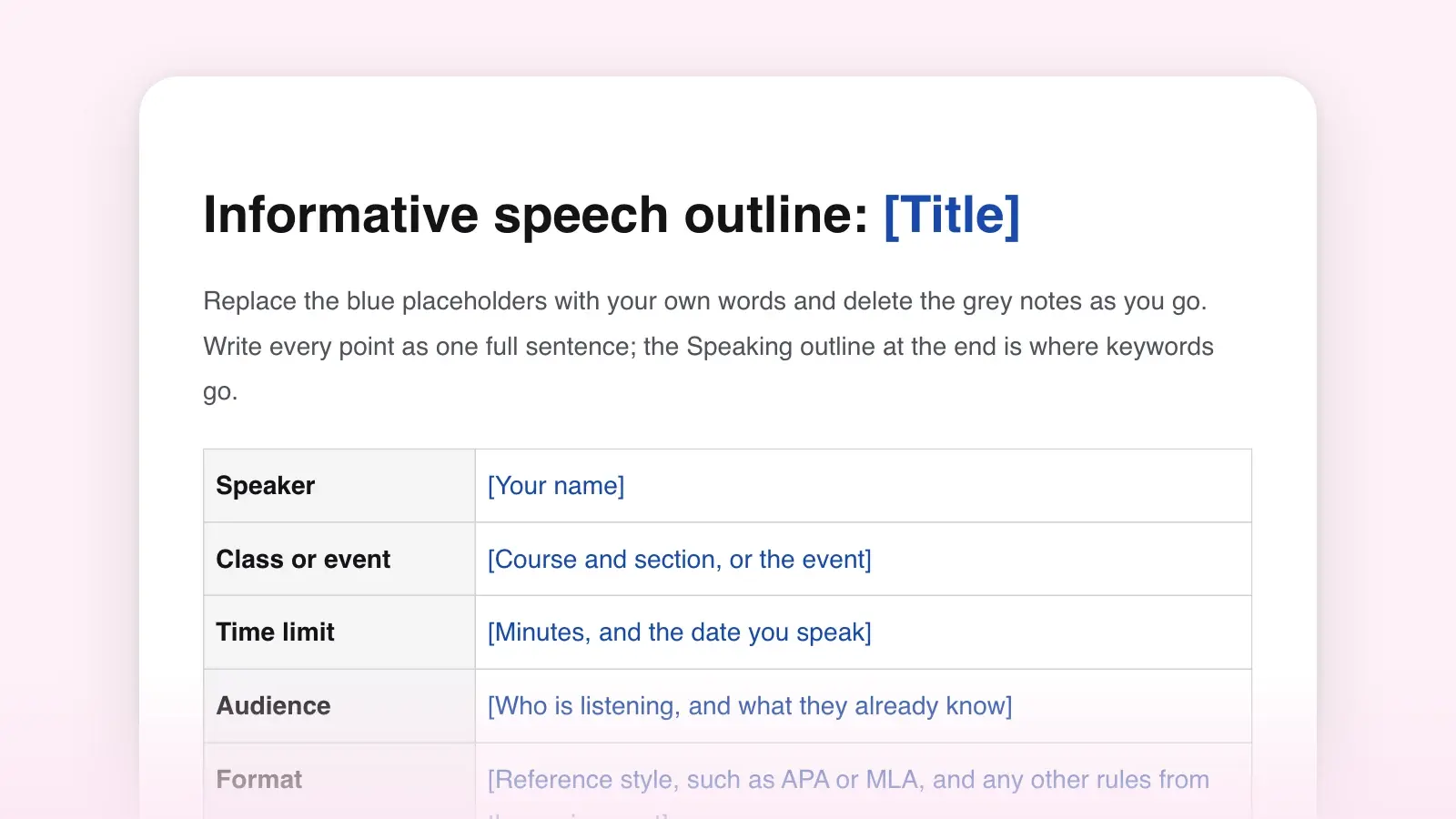
All seven share one spine: a hook, a one-sentence preview, two to four main points in an order that suits the subject, and a recap. What changes from speech to speech is the order and the one concrete thing each point hangs on. If you still need a subject, start with these informative speech topics. For the outline your instructor may want first, use the informative speech outline template.
Seven speeches at a glance
| Speech | Type | Setting | Organized by | Length |
|---|---|---|---|---|
| SpeechChecking a $100 bill | TypeObject | SettingCashier training | Organized byWhat your hands do, in order | LengthAbout 3 minutes |
| SpeechHow a word gets into the dictionary | TypeProcess | SettingA library writers' group | Organized byTime order | LengthAbout 3½ minutes |
| SpeechCurbside compost in 90 seconds | TypeProcess | SettingNeighborhood meeting | Organized byOne rule, then the details | LengthAbout 1½ minutes |
| SpeechHow the Rosetta Stone was read | TypeEvent | SettingClass speech | Organized byThe listener's questions, in order | LengthAbout 3 minutes |
| SpeechMary Anning | TypePerson | SettingClass speech | Organized byStages of a life | LengthAbout 3 minutes |
| SpeechHow inflation is measured | TypeConcept | SettingCompany all-hands | Organized byThree questions | LengthAbout 2½ minutes |
| SpeechDaylight saving time, all sides | TypeIssue | SettingClass speech | Organized byHistory, rules, then each position | LengthAbout 3½ minutes |
Objects and processes
An object speech explains a thing: what it is, how it works, how to recognize it. A process speech explains how something happens or gets done, so it nearly always runs in time order. Both get easier when the audience can see the thing, which is why two of the three below are built around a demonstration or a picture.
Checking a $100 bill: an object speech
Audience: new cashiers on their first morning. Afterward they can: check a $100 bill in about ten seconds, without a pen or a machine, and know what to do if it fails.
Good morning. Sometime this week, a customer will hand you a hundred-dollar bill, and you'll have about ten seconds to decide whether it's real. I'm Teresa, I run the cash office, and in the next three minutes I'll show you three checks that fit inside those ten seconds: feel it, tilt it and hold it up to the light. You won't need a pen or a machine for any of them.
First, feel it. Run your fingernail up and down Benjamin Franklin's shoulder, on the left side of the note. On a genuine bill it feels rough, because the ink there is raised. If it feels smooth all over, stop and look closer.
Second, tilt it. Find the blue ribbon on the front of the note. It isn't printed on the paper. It's woven into it. Tilt the note back and forth, and the little bells in the ribbon change into 100s and slide from side to side. Tilt it side to side, and they move up and down. While you're tilting, look at the copper inkwell. The bell inside it changes from copper to green. So does the large 100 in the bottom right corner.
Third, hold it up to the light. Two things appear that you can't see while the note lies flat on the counter. In the blank space to the right of the portrait, there's a faint second Franklin. That's the watermark, and you can see it from either side. And to the left of the portrait, a thin thread runs from top to bottom, printed with “USA” and “100.” Under the ultraviolet lamp in the cash office, that thread glows pink.
While it's in your hand, turn it over. The big gold 100 on the back is there to help people with visual impairments tell which bill they're holding.
Everything I've shown you comes from the government's currency site, uscurrency.gov, which also has a short video on checking a hundred if you want to see it again tonight.
So: feel the shoulder. Tilt for the ribbon, the bell and the 100. Hold it to the light for the face and the thread. If a note fails any one of those, our rule is simple. Don't hand it back. Keep it, stay polite and call a supervisor.
I've got a real hundred here. Let's pass it around and do all three.
Why it works. It's organized by what a cashier's hands do, in the order they do it, rather than by the government's list of features, so the structure is the skill. Each point opens with the verb from the preview (feel, tilt, hold), which is enough signposting for a three-minute talk. The hardest thing to picture, a ribbon whose bells move one way when you tilt the note the other, gets two short sentences, one per direction, so the trainees can follow with their hands. The source gets one sentence, said the way a person would say it. And the speech ends with a demonstration instead of “any questions?”, so the trainees leave having done it once.
How a word gets into the dictionary: a process speech
Audience: a library writers' group. Afterward they can: explain how a word earns a place in Merriam-Webster's dictionary, and why writers' usage decides it.
Every word in the dictionary got there the same way. Somebody saw it in print and wrote it down.
Tonight I want to show you how that works at Merriam-Webster, using the dictionary's own description of the process. There are three stages: how the editors collect words, how they decide a word has arrived, and what happens once it's in.
First, collecting. Most of Merriam-Webster's editors spend an hour or two a day doing what they call “reading and marking.” They read books, newspapers, magazines and online publications, and they mark anything interesting: a new word, a new use of an old one, a spelling that's starting to shift. Each marked example becomes a citation. A citation is three things: the word, the passage it appeared in, and where that passage was published. For most of the dictionary's history, citations went onto three-by-five slips of paper. Today they're kept on computer as well, and the files hold 15.7 million of them. Picture the biggest pile of sticky notes you've ever seen, each one stuck to a single word in a real sentence.
Second, deciding. A word doesn't get in because an editor likes it, or because it's clever. It gets in when it turns up in a large number of citations, from a wide range of publications, over a considerable period of time. In the dictionary's own words, there have to be “enough citations to allow accurate judgments about its establishment, currency, and meaning.” Establishment means people keep using it. Currency means they're using it now. Meaning means the editors can tell, from the sentences, what it means. Once in a while a word clears that bar fast. Merriam-Webster's example is AIDS, which became established very quickly in the 1980s. Most words take much longer.
Third, defining. The editors who write the entries are called definers, and they don't work one word at a time. They take a stretch of the alphabet, say everything from “gri” to “gro,” and go through the citations for it. For each word, they decide: does the entry stay as it is, does it need revising, should it be dropped, and is there a new word here that has earned an entry of its own? So words leave the dictionary as well as enter it. When people stop writing a word down, the citations dry up.
That's the whole path. Editors read and mark. Citations pile up. A word with enough of them, from enough places, over enough time, gets a definition the next time a definer works through its part of the alphabet.
Which means the dictionary doesn't decide what counts as a word. Writers do, by using it, and the editors keep the receipts. The next time you put a new word into something you publish, you may be making a citation.
Why it works. Time order suits a process, and the speech names its three stages up front and repeats them as signposts. One concrete object, the three-by-five slip, carries the abstract idea, and the one big number gets a picture the room can hold. The hardest idea, the editors' test for a word, is quoted once in the dictionary's own terms and then explained one term at a time: establishment, currency, meaning, a plain sentence each. Everywhere else the source is paraphrased. The ending ties the process to the people in the room, which is relevance rather than advocacy: nobody is asked to do anything.
Curbside compost in 90 seconds: a briefing
Audience: neighbors at an association meeting, with other business waiting. Afterward they can: sort their scraps with one rule and know when pickup starts.
Thanks for having me. I'm Luis Ortega from the city's recycling office, and I have ninety seconds on the new green carts, so here's the one rule to take home tonight: if it grew, it goes in green.
That means food scraps of every kind, including meat, bones and dairy. Coffee grounds and tea bags. Leaves, grass and garden trimmings. And one exception that surprises people: paper that food has soaked into, like greasy pizza boxes and used napkins, goes in green too.
What stays out is plastic of any kind, including bags that say “compostable.” Our site can't tell them apart from ordinary plastic, so please leave them out.
Pickup is weekly, on your regular trash day, starting the first week of April. The carts arrive the week before, with a sticker on the lid that shows all of this in pictures.
And here's where it goes. The truck takes everything to the city's composting site on Route 9, where it becomes compost. In the spring, residents can pick that compost up for free.
So: if it grew, it goes in green. Weekly, on trash day, from April. And the compost comes back to you. What can I answer?
Why it works. A short briefing depends on one rule people can remember, and this one arrives in the first paragraph and again at the end. The tricky part is the exceptions, greasy paper in and “compostable” bags out, so each gets its own sentence, and the one people resist, leaving out the bags, comes with its reason. The details come in the order residents will meet them: what goes in, when it's collected, where it goes. The inverted pyramid of a news story works the same way, most important first.
Events and people
Events and lives come with a built-in order, and the trap is following it too faithfully: a speech that starts at a birth and marches year by year runs out of time before it reaches anything interesting. Both speeches below open on the most vivid moment and then step back to explain it.
How the Rosetta Stone was read: an event speech
Audience: classmates who know the name but not the story. Afterward they can: explain why a stone with three scripts let scholars read hieroglyphs.
In July 1799, French soldiers digging foundations at a fort near the Egyptian port of Rashid, which Europeans called Rosetta, found a broken slab of dark stone covered in writing in three different scripts. The officer in charge, Pierre-François Bouchard, recognized that it mattered. It would take twenty-three years, and scholars in two countries, before anyone could read all of it.
I'll cover three things: what the stone says, why its three scripts made it a key, and how the code was finally broken.
First, what it says. The stone is part of a larger slab carved in 196 BC. Its text is a decree from a council of Egyptian priests, issued on the first anniversary of the coronation of the king, Ptolemy V, and honoring him as a divine ruler. In other words, it's an official announcement.
Second, the three scripts. The decree is written three times. At the top are hieroglyphs, the sacred script, the right choice for a decree from priests. In the middle is Demotic, the script Egyptians used for everyday writing. At the bottom is ancient Greek, the language of the Greek-speaking Macedonian kings who ruled Egypt at the time. In 1799, nobody could read hieroglyphs. But plenty of scholars could read Greek. So the stone held the same message in a language they knew and in a script they didn't. That's what made it a key.
Third, how it was broken. After the French were defeated in Egypt, the stone passed to the British under the Treaty of Alexandria in 1801, and it went to the British Museum in 1802. The English physicist Thomas Young was one of the first to show that some of the hieroglyphs spelled out sounds: the sounds of Ptolemy's name. But the breakthrough came from Jean-François Champollion in France. He realized that hieroglyphs recorded the sounds of the Egyptian language, not only pictures of ideas, and he announced it in Paris on the twenty-seventh of September, 1822.
So: a priests' decree from 196 BC, written three ways, dug up by soldiers in 1799, and read at last in 1822, because the Greek told scholars what the hieroglyphs had to say.
If you're ever in London, you can see it. It has been on display at the British Museum since 1802, except for two years during the First World War, when it was taken to a postal railway station underground at Holborn to keep it safe from bombing.
Why it works. It opens in medias res, with soldiers digging, and then a span of twenty-three years that sets up the question the speech answers. The main points are the questions a listener would ask, in the order they'd ask them, and time order inside the third point keeps a tangled story straight. The hard idea, why three scripts made the stone readable, comes down to one sentence (the same message in a language scholars knew and a script they didn't) and one plain comparison: a key. The last paragraph gives the curious somewhere to go next, which is the informative speech's version of a call to action.
Mary Anning: a speech about a person
Audience: classmates who have probably never heard of her. Afterward they can: say who she was, what she found and why her name was so often left out.
In the autumn of 1811, on the beach below the cliffs at Lyme Regis in the south of England, a boy named Joseph Anning found a skull nobody could identify. His sister Mary was twelve. About a year later, she found the rest of the animal, a skeleton roughly five meters long, and dug it out of the rock. People in town said she'd found a monster. Scientists thought it was a crocodile. It was neither.
Today I'll tell you who Mary Anning was, in three parts: how she learned, what she found, and why her name so often went missing from the science she made possible.
First, how she learned. Mary Anning was born in Lyme Regis in 1799. Her father, Richard, was a cabinetmaker who collected fossils on the side and sold them from his shop, and he taught her how to find them and clean them. When he died in 1810, he left the family in debt. Selling fossils was how they paid it off.
Second, what she found. That first animal was later named Ichthyosaurus, a reptile that lived in the sea. In December 1823 she found the first complete skeleton of a Plesiosaurus, a sea reptile with an astonishingly long neck. It looked so strange that the French anatomist Georges Cuvier suggested it might be a fake. It wasn't. In 1828 she found the first pterosaur, a flying reptile, ever discovered outside Germany. She also pioneered the study of coprolites, which is the polite word for fossilized dung.
Third, the missing name. The men who bought her fossils wrote the scientific papers about them, and they often left her out, even for the ichthyosaur. When the Geological Society of London met to discuss her plesiosaur, she wasn't invited. The Society didn't admit women. She died in 1847, at forty-seven.
Recognition came slowly. In 2022, after a campaign started by a schoolgirl named Evie Swire, a statue of Mary Anning and her dog was unveiled in Lyme Regis. And some of her specimens are on display today at the Natural History Museum in London.
So: a cabinetmaker's daughter who learned the beach from her father, found an ichthyosaur, the first complete plesiosaur and the first pterosaur outside Germany, and was left out of the papers about them. Next time you stand in front of a sea reptile in a museum, read the label and look for her name.
Why it works. A life has its own order, but the speech doesn't march from birth to death. It opens on the find that made her name, then uses three stages (learning, finding, credit) as main points. The third point carries the hardest idea, how a finder could be left out of her own discoveries, and explains it with one mechanism: the men who bought the fossils wrote the papers. It still doesn't turn into an argument; it reports what happened and lets the room draw its own conclusion. The close sends the audience to a museum label, a small, specific thing to do with what they just learned.
Concepts and issues
Concepts are the hardest subjects to explain aloud, because there is nothing to point at. The fix is to give the idea a body: a shopping cart, a map, a clock. Issues add a second problem, because the audience may already have a side. The second speech below shows how to explain a live argument without joining it.
How inflation is measured: a concept speech
Audience: employees whose January raise is tied to the inflation figure. Afterward they can: say what the index measures, how its prices are collected and what it can't tell them about their own costs.
Every January we raise salaries by at least the rate of inflation, and every January somebody asks me where that number comes from. So here are three minutes on how inflation is measured in the United States: what goes in the basket, how the prices get collected, and what the number can't tell you.
First, the basket. The number in our pay policy is the Consumer Price Index, which the Bureau of Labor Statistics publishes every month. The Bureau describes it as a measure of the average change over time in the prices consumers pay for a basket of goods and services. Picture one enormous shopping cart holding a little of everything households buy: groceries, rent, gas, haircuts, doctor's visits, phone bills. How much of each goes into the cart comes from a separate national survey of what people actually spend.
Second, the prices. Every month, the Bureau records prices for about 80,000 items, from thousands of stores, service businesses, rental units and doctors' offices. Then it asks a simple question: what does the same cart cost now, compared with before? If the cart cost a hundred dollars a year ago and costs a hundred and three today, prices rose three percent. That's the kind of figure you hear on the news.
Third, the limits. The index covers what people buy to live, not what they invest, so stocks, bonds and real estate are left out, and so are income taxes. It's also an average, and your own cart may look different. If you drive an hour to work, gas prices hit you harder than the index shows. If you work from home, maybe less. And the version we use, the index for urban consumers, covers over 90 percent of the population, not everyone.
So: one big cart, about 80,000 prices a month, and an average that may not match your own spending. When December's figure comes out, we'll post it on the intranet next to the raise it sets.
Why it works. It starts from the audience's own question, one of the strongest reasons to listen a workplace speech can offer. The hard idea is the index itself, which is abstract, so the speech turns it into a shopping cart and does the arithmetic once, with round numbers. The third point states the limits plainly, which earns more trust than overselling the figure would. In the terms of ethos, pathos and logos, the agency's definition supplies the authority and the caveats show the speaker is being straight with the room.
Daylight saving time, all sides: an issue speech
Audience: classmates who already have opinions about changing the clocks. Afterward they can: explain the history, the rules and the main positions, without being told which one to pick.
At two o'clock in the morning on the second Sunday in March, most of the United States skips an hour. At two o'clock on the first Sunday in November, we get it back. And around both of those Sundays, the same argument comes back too: should we keep doing this?
I'm going to explain where daylight saving time came from, how the rules work today, and what the main positions in the argument are. I'm not going to tell you which one to pick.
First, where it came from. Daylight saving time was introduced in the United States in 1918. The schedule we use now dates from 2007, when the Energy Policy Act of 2005 took effect and made daylight saving time longer. The stated goal was to reduce energy use. Moving the clocks doesn't create any daylight, of course. It shifts an hour of it from the early morning to the evening during the warmer months.
Second, how the rules work. Time zones and daylight saving time are regulated by the US Department of Transportation, under a federal law called the Uniform Time Act. A state can pass a law to opt out and stay on standard time all year. Hawaii does, and so does most of Arizona, though the Navajo Nation in Arizona does observe daylight saving time. Puerto Rico, Guam, the US Virgin Islands, American Samoa and the Northern Mariana Islands stay on standard time too. But a state that observes daylight saving time has to use the federal dates. Under current law, no state can stay on daylight saving time all year on its own.
Third, the positions. There are three. The first is to keep switching, which is current law. Its supporters point to long, light evenings in spring and summer, and to the energy savings Congress was aiming for in 2005. The second is permanent standard time. That's the position of the American Academy of Sleep Medicine, which in 2020 called for ending the seasonal change in favor of standard time all year. The Academy argues that standard time fits the body's internal clock better, and it links the spring change to short-term risks, including more car crashes. The third position is permanent daylight saving time: light evenings all year, at the cost of darker winter mornings. Because federal law doesn't allow it, that one would take an act of Congress. In July 2026 the House passed a bill to do it, the Sunshine Protection Act. As I speak, the Senate hasn't.
So: introduced in 1918, on today's schedule since 2007, overseen by the Department of Transportation, and argued over by three camps. Next time the clocks change, you'll know who decided, who opted out, and what each side wants instead. Which side you're on is up to you.
Why it works. This is the hardest kind of informative speech to keep informative, and it shows how: a preview that maps the debate instead of taking a side, each position credited to the people who hold it, and no loaded words in the speaker's own sentences. Saying outright that no verdict is coming can let skeptical listeners relax. The hard idea, why a state may keep standard time all year but not daylight saving time, is explained before any position is named, so each position makes sense when it arrives. A live bill also dates fast: check its status the week you speak.
Two speeches from history
Unlike the seven above, these are excerpts, not complete speeches. Both are in the public domain and worth reading whole, and each shows one move that turns a hard subject into something a general audience can follow.
Franklin D. Roosevelt explains the banks, 1933
“I want to talk for a few minutes with the people of the United States about banking—with the comparatively few who understand the mechanics of banking but more particularly with the overwhelming majority who use banks for the making of deposits and the drawing of checks.”
“I want to tell you what has been done in the last few days, why it was done, and what the next steps are going to be.”
“First of all, let me state the simple fact that when you deposit money in a bank the bank does not put the money into a safe deposit vault. It invests your money in many different forms of credit—bonds, commercial paper, mortgages and many other kinds of loans. In other words, the bank puts your money to work to keep the wheels of industry and of agriculture turning around.”
Roosevelt gave the first of his radio fireside chats eight days after taking office, with the country's banks shut for a nationwide bank holiday and due to start reopening the next morning. Look at the moves. He picks his audience out loud: not the few who understand banking, but the many who only deposit and write checks. His second sentence is a three-part preview, done, why, next, that any class outline would accept. Then he explains by correcting the picture in the listener's head: your money isn't sitting in a vault. And “in other words” may be the most useful phrase in informative speaking. Say it once accurately, then again plainly. The broadcast had a persuasive purpose, since people had to trust the banks enough to leave their money in them, but its method was explanation. He ends on a lift, “Together we cannot fail,” only after the explaining is done.
Thomas Henry Huxley starts under the audience's feet, 1868
“If a well were sunk at our feet in the midst of the city of Norwich, the diggers would very soon find themselves at work in that white substance almost too soft to be called rock, with which we are all familiar as ‘chalk.’”
“A great chapter of the history of the world is written in the chalk.”
Huxley's subject was the history of the earth, and he began with the ground under the room. The first sentence puts the audience on top of the evidence before he has explained anything. Later he states the lecture's whole claim in one sentence a listener could repeat on the way home. Michael Faraday made the same move with a candle, in the lectures quoted among these speech examples. It works for many abstract subjects: find the ordinary thing in the room that holds it.
How to write your own
Start with the type of subject, because the type suggests the order. Here is how the seven speeches above map onto the usual types.
| Type | A natural order | Example above |
|---|---|---|
| TypeObject | A natural orderBy what you see or do first, or part by part | Example aboveChecking a $100 bill |
| TypeProcess | A natural orderTime order, one stage per main point | Example aboveThe dictionary; curbside compost |
| TypeEvent | A natural orderThe listener's questions, with time order inside them | Example aboveThe Rosetta Stone |
| TypePerson | A natural orderStages of a life, starting from the vivid moment | Example aboveMary Anning |
| TypeConcept | A natural orderA set of questions, each answered with one concrete picture | Example aboveInflation |
| TypeIssue | A natural orderBackground, the rules, then each position in turn | Example aboveDaylight saving time |
- Narrow the subject to one question
“Egypt” is a subject. “How did scholars learn to read hieroglyphs?” is a speech. If you can't state the answer in one sentence, keep narrowing until you can.
- Write the purpose and the central idea
Finish “To inform my audience how…” and then write the answer as one sentence that names your main points. That sentence becomes your preview, and the informative speech outline has a slot for both.
- Signpost with the preview's own words
If the preview says “feel it, tilt it and hold it to the light,” each point should open with those words. Listeners can't flip back a page, and repeated labels are how they find their place after drifting for ten seconds.
- Give every point one thing to hold
An object, a story, a comparison or one round number. The slip of paper, the shopping cart and the soldiers digging are what the audience will remember, and the facts ride along with them.
- Say your sources aloud
Once per source, in a phrase: “according to the British Museum.” Then put the full references in your outline if the assignment asks for them.
- Recap, give a next step and time it
Close with the main points in one breath and somewhere to go next: a label to read, a site to visit, a thing to try. Then read the draft aloud with a timer. At about 130 words a minute, three minutes is roughly 400 words and five minutes about 650. For more ways to close, see how to end a speech.
If the subject is a skill you can show with your hands, you may be writing a demonstration speech, a process speech with props; these demonstration speech topics list what to bring for each.
Mistakes that weaken informative speeches
Many problems in informative drafts come from writing for a reader instead of a listener. These are the ones that show up most, with the kind of line that gives each one away.
| Mistake | What it sounds like | Fix |
|---|---|---|
| MistakeA subject, not a question | What it sounds like“Today I'm going to talk about inflation.” | Fix“Here's how inflation is measured, in three steps.” |
| MistakeNo map | What it sounds likePoints arrive unannounced, in whatever order you found them | FixA one-sentence preview, then the same words as signposts |
| MistakeOpinion leaking in | What it sounds like“…which is why we should all…” | FixAttribute views to the people who hold them, or write a persuasive speech instead |
| MistakeA number dump | What it sounds like“15,700,000 citations, 70 million words, 3-by-5 inches…” | FixOne round number per point, with a picture attached |
| MistakeUndefined terms | What it sounds like“The CPI-U excludes investment items.” | FixDefine the term in plain words the first time you say it |
| MistakeEnding on “any questions?” | What it sounds likeSilence, then shuffling | FixRecap in one breath, then a next step or a demonstration |
To catch undefined terms before your audience does, attach your sources and ask the Strokes Assistant which words in the draft a classmate would need defined, and whether the draft says anything the sources don't.
The opinion problem deserves a second look. You can give an informative speech on a contested subject, as the daylight saving time example does, but the moment you build toward “and that's why,” the speech has changed jobs. If that's the speech you want to give, these persuasive speech examples show the structures that suit it.
Frequently asked questions
How do you start an informative speech?
With a reason to listen, then a map. Open on a concrete moment, an object or a question from the audience's own life, then say in one sentence what the main points will be. The preview matters more in a speech than on paper, because listeners can't skim ahead to see where you're going.
How many words is a 5-minute informative speech?
About 650 words at a typical pace of 130 words a minute with pauses. A three-minute speech is roughly 400 words. Speaking rates vary, so read your draft aloud with a timer and aim to finish a little under the limit, since nerves and a slow start both eat time.
Can an informative speech include opinions?
It can report them, credited to the people who hold them, as the daylight saving time speech on this page does with three positions. What it shouldn't do is argue for one. If your draft builds toward “and that's why we should,” you're writing a persuasive speech, which needs a different structure.
Can I use these speeches for my class?
Use them as models for structure, length and tone, then write your own on your own topic with your own sources. Instructors expect a speech built from your research, and a borrowed speech is easy to spot when you're asked a follow-up question.