To write a press release, put the news in the first sentence and stack everything else beneath it in order of importance. The standard format runs top to bottom: a release line (FOR IMMEDIATE RELEASE, or an embargo time), a headline, a one-sentence subhead, a dateline, a lead that says who did what, when, where and why, a few short paragraphs of detail with one or two quotes, a boilerplate paragraph about the organization, a media contact, and ### to mark the end. Keep it to about a page. A complete example, a book launch from a small press, is below.
Start with the news, not the company
A press release is a news story written by the people it is about, laid out so a journalist can check it, quote it and turn it into a piece of their own. The form is more than a century old. In October 1906 the publicist Ivy Lee put out a statement on a Pennsylvania Railroad accident in Atlantic City, and The New York Times printed it. The reader on the other end has not changed much since: an editor with more announcements than space, who looks at the headline and the first paragraph and decides.
So the first question is whether you have news. Something happened, or will happen on a date: a launch, an opening, a hire, a grant, a result, a book. A release about your values, or a feature nobody outside the company will notice, is a blog post wearing a dateline. Ask what a reader of the outlet you are sending it to would learn. If the answer is nothing, write the blog post instead.
News is also local and specialized. A bookstore's author event is news in its town; a new accounting feature is news in an accounting trade journal. Name the outlets before you write, and write for their readers. The rules are the same ones reporters use for a news article, because that is what you are drafting for them.
Press release format, part by part
| Part | What it does | Length |
|---|---|---|
| PartRelease line | What it doesFOR IMMEDIATE RELEASE, or EMBARGOED UNTIL a date, time and time zone | LengthOne line |
| PartHeadline | What it doesThe news in plain words, most important words first | LengthOne line |
| PartSubhead | What it doesThe key detail the headline left out | LengthOne sentence |
| PartDateline | What it doesCity, state and the date the release goes out | LengthOpens the lead |
| PartLead | What it doesWho did what, when, where and why | LengthOne or two sentences |
| PartBody | What it doesDetails in falling order of importance, then context and what happens next | LengthTwo to four short paragraphs |
| PartQuotes | What it doesReasons, opinion and reaction from named people | LengthOne or two |
| PartBoilerplate | What it doesThe standard "About" paragraph used on every release | LengthUnder 100 words |
| PartMedia contact | What it doesA person a reporter can reach this week | LengthName, email, phone |
| PartEnd mark | What it does### (or the older -30-) so no one wonders if a page is missing | LengthOne line |
The dateline trips people up. Most US newsrooms follow AP style, the style guide of the Associated Press: the city in capitals, then the state in AP's abbreviation rather than the postal code (DULUTH, Minn., not DULUTH, MN), then the date. AP spells out a few states, Texas and Ohio among them, and lets major cities such as NEW YORK and CHICAGO stand alone. With a date, only Jan., Feb., Aug., Sept., Oct., Nov. and Dec. are abbreviated, so it is Feb. 10 but March 2. Nobody requires AP style in a release, but every fix a reporter has to make is a small reason to cover someone else.
How to write a press release
- Write the news as one sentence
Before any formatting, finish this sentence: who is doing what, when, where, and why it matters to this outlet's readers. If you cannot, the news is not settled yet. Find out what is actually happening and on what date.
- Turn it into a dateline and lead
Open with the dateline, then answer the five Ws in one or two sentences. Lead with the person or organization and the action, not with history. A date, a price, a number or a place does more work than any adjective.
- Compress the lead into a headline
Keep the lead's subject and verb and cut the rest. Then give the subhead the most useful fact that did not fit: a date, a price, where it happens.
- Build the body in descending order
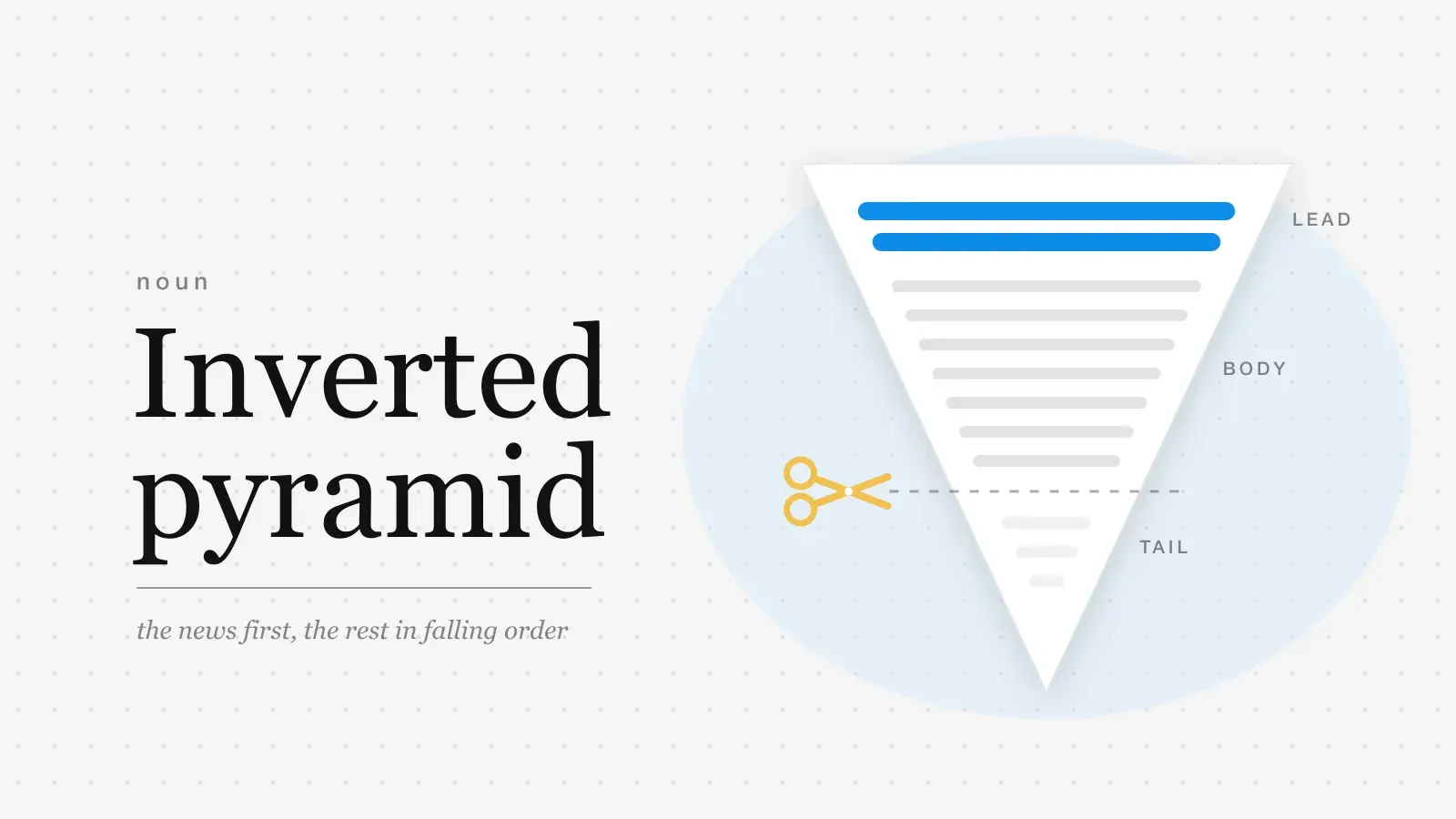
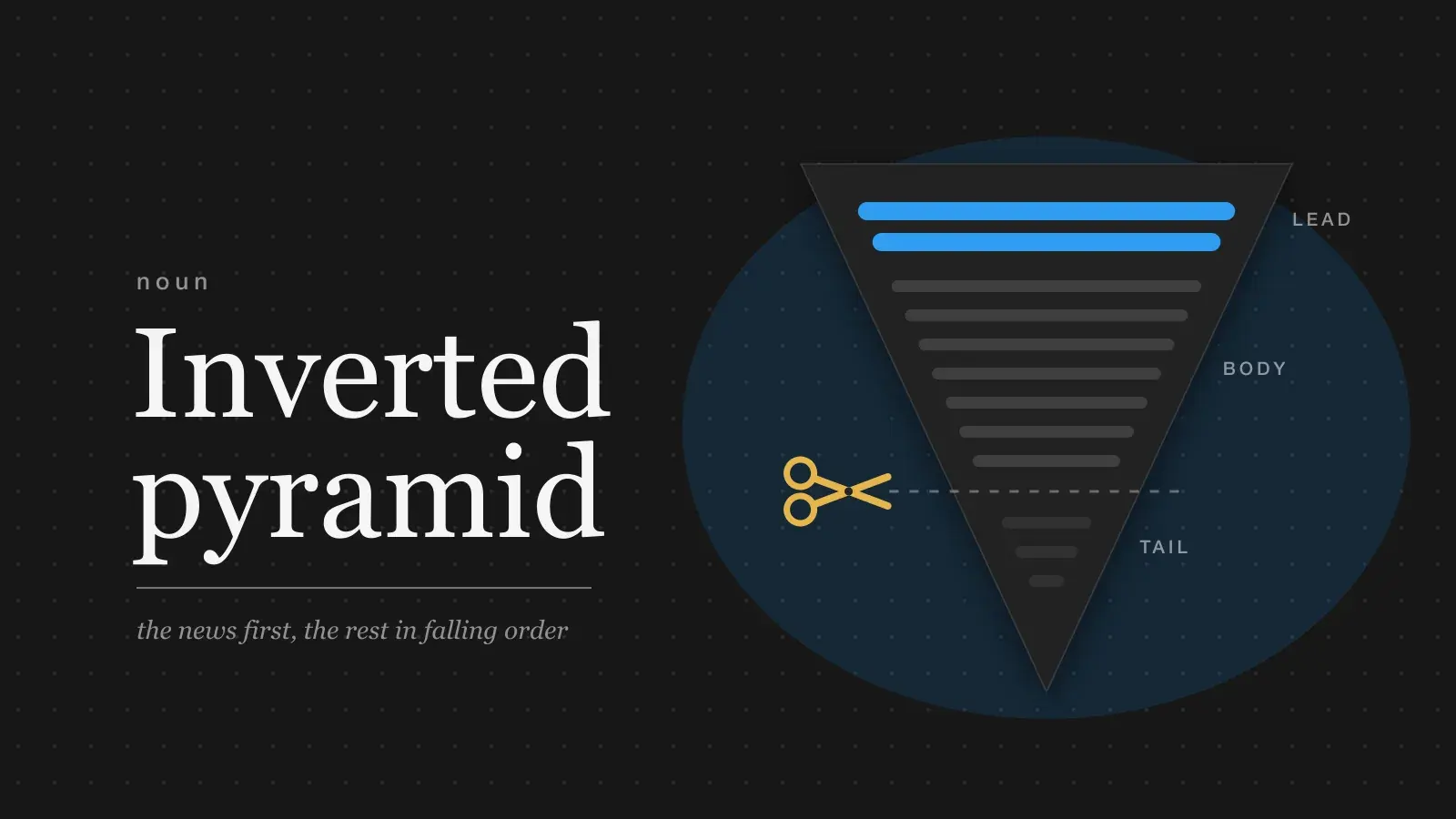
Each paragraph should matter less than the one before it, so an editor can cut from the bottom without losing the story. That is the inverted pyramid. A typical order: the facts a reader needs to act, the best quote, context and evidence, then what happens next.
- Get quotes someone actually said
Talk to the person you are quoting for five minutes and use their words, trimmed. Send the quote back to them and get approval in writing before the release goes anywhere.
- Add the boilerplate, contact and end mark
Reuse your standard About paragraph word for word. Name a person with a direct email and phone number, then close with ###.
- Cut, check and read it aloud
Delete the words a reporter would delete: innovative, leading, world-class, exciting. Check every name, title, date, time, price and spelling against its source. Read it aloud and split any sentence you stumble on.
Lead, headline and quote, rewritten
Three parts decide whether a release gets used. Here is each one in the version most people write first, and the version a reporter can use. All of the organizations are invented.
The lead
Before: Tamarack Lane Press, an award-winning independent publisher dedicated to amplifying the voices of the Upper Midwest since 2019, is excited to announce the upcoming release of a powerful and moving new novel.
After: DULUTH, Minn. — Feb. 10, 2027 — Marta Kos, a night-shift nurse in Duluth, will publish her first novel, The Night Galley, on March 2 with Tamarack Lane Press and read from it at a free launch at Lantern Books on March 6. The book follows a ship's cook through the last season of a Lake Superior ore boat.
The first version spends 32 words and never names the author, the book or the date. The second answers who, what, when and where in two sentences, and gives a reporter a reason to keep reading: a nurse wrote a novel about a ship's kitchen. The same shape works for any kind of news.
Product: PORTLAND, Ore. — May 4, 2027 — Fernhill Audio today released the Fernhill One, a $149 desk microphone that filters out keyboard noise on the device itself, with no software to install. It ships in the U.S. and Canada this week.
Event: AUSTIN, Texas — March 15, 2027 — The East Austin Zine Fair returns April 10 with 90 independent publishers, twice last year's number, and moves to a larger hall. Admission is free.
Hire: CHICAGO — Jan. 12, 2027 — Halvorsen Reyes Architects has named Priya Nandakumar its first director of sustainability. She starts Feb. 1 and will set energy targets for every building the 40-person firm designs.
Grant: TACOMA, Wash. — Sept. 8, 2027 — The Tideline Literacy Project has received $250,000 from the Morrow Family Foundation to train 60 volunteer reading tutors for adults over the next two years.
The headline
Says what happened
- Duluth nurse publishes debut novel set aboard a Lake Superior ore boat
- Fernhill's $149 desk microphone filters keyboard noise without software
- Austin zine fair doubles to 90 publishers and moves to a larger hall
Says that something happened
- Tamarack Lane Press Announces Exciting New Release
- Fernhill Audio Unveils Innovative Next-Generation Audio Solution
- East Austin Zine Fair Returns Bigger and Better Than Ever
A working headline has a subject, an active verb and one concrete detail. Skip "announces": everything in a press release is announced. Put the specific words at the front, because inboxes and search results cut long lines off. Title case and sentence case are both common; pick one and keep it. There is more on the craft in how to write a headline.
The quote
Everything else in a release is fact. The quote is the one place for a reason, a hope or a surprise, which is why reporters skip any quote that could be pasted into another company's release.
Before: "We are thrilled to bring this powerful story to readers everywhere," said Dan Okafor, founder of Tamarack Lane Press. "It reflects our deep commitment to authentic regional voices."
After: "Most freighter novels are about storms," said Dan Okafor, founder of Tamarack Lane Press. "This one is about making breakfast for 24 people in a kitchen the size of a closet. That's what made us want to publish it."
The quote is also where an organization's tone of voice shows, so it should sound like the person when read aloud. Attribute it to a named person with a title. A second quote from a customer, partner or author adds a point of view, but only with their permission and in their words.
A complete press release example
Here is the whole release, built from the steps above. It runs a little over 300 words, which is plenty for most news.
FOR IMMEDIATE RELEASE
Duluth nurse publishes debut novel set aboard a Lake Superior ore boat
Marta Kos reads from The Night Galley at a free launch at Lantern Books on March 6. The novel is out March 2 from Tamarack Lane Press.
DULUTH, Minn. — Feb. 10, 2027 — Marta Kos, a night-shift nurse in Duluth, will publish her first novel, The Night Galley, on March 2 with Tamarack Lane Press and read from it at a free launch at Lantern Books on Saturday, March 6. The book follows a ship's cook through the last season of a Lake Superior ore boat before it is sold for scrap.
Kos, 41, wrote most of the novel on her phone during breaks on 12-hour shifts, drawing on four summers she spent as a galley hand on Great Lakes freighters in her twenties. The Night Galley runs 312 pages and will be available in paperback ($18) and as an ebook ($9.99) from Lantern Books, other independent bookstores and online retailers.
"I wrote it in the break room at 3 a.m., between rounds," Kos said. "Galley work and night nursing turned out to be the same job. You keep people going while everyone else is asleep."
Tamarack Lane Press found the manuscript in its open submissions window, which runs each January. It is the first debut novel the two-person press has published.
"Most freighter novels are about storms," said Dan Okafor, the press's founder. "This one is about making breakfast for 24 people in a kitchen the size of a closet. That's what made us want to publish it."
The launch reading begins at 7 p.m. at Lantern Books, 118 Harbor St., Duluth, followed by a signing. Seating is first come, first served. Review copies, the cover image and an author photo are available from the contact below.
About Tamarack Lane Press
Tamarack Lane Press is an independent publisher in Duluth, Minnesota, founded in 2019. It publishes four books a year of fiction and nonfiction set in the Upper Midwest.
Media contact
Dan Okafor, Founder, Tamarack Lane Press
dan@example.com, (218) 555-0142
###
What makes it work:
- The headline names the person, the hook and the place, and the subhead carries both dates.
- The second paragraph holds what a books editor needs to run a listing: format, length, price and where to buy it.
- Both quotes give a reason and a concrete detail. Neither contains an adjective about the book.
- Event logistics come late. A reporter needs them, but they are not what makes the story.
- State names in the body are spelled out (Minnesota), as AP style asks; only the dateline abbreviates.
To start your own, the press release template has the same parts with placeholders, as a Word or Markdown file.
Sending it to journalists
A release does nothing in a folder. Send it to the specific people who cover the subject: the books editor at the local paper, the producer of the public radio arts show, the reporter at the trade site who wrote about your last product. A short list of the right names does more than a long list of strangers, and an email with a hundred addresses in the To: line ends the relationship before it starts.
Subject: Duluth nurse's debut novel set on an ore boat, launch March 6
Hi Jenna,
You reviewed two Lake Superior novels last fall, so this might suit your weekend books page. Marta Kos, a night-shift nurse here, wrote her first novel on her phone during 3 a.m. breaks. It comes out March 2, and she is free for interviews the week before.
The release is below. I can send a review copy today.
Dan Okafor
Tamarack Lane Press, (218) 555-0142
- Paste the release into the email body under a note of two or three sentences written to that person. Many reporters will not open attachments from senders they do not know, so link to photos instead.
- Use the headline, or a shorter version of it, as the subject line.
- Embargo only by agreement. Send an embargoed release to reporters who have agreed to hold it, and state the date, time and time zone: EMBARGOED UNTIL 9 a.m. ET, March 2, 2027. An embargo is a courtesy, not a contract; a journalist who never agreed to it is not bound by it.
- Post it on your own site, on a news or press page, so reporters who search later find the facts on record. If they will want photos, bios and a fact sheet, gather them in a press kit and link to it.
- Use a wire service when reach matters. Paid wires such as PR Newswire and Business Wire push a release to newsrooms and news sites at scale. They suit public companies and national news; prices depend on reach, so check current rates.
- Follow up once, a few days later, and only with something new: an interview slot, a photo, a local angle.
If you want one outlet to run a feature, rather than many outlets to report the news, you need a pitch instead. See how to pitch an article to an editor.
Mistakes that sink a release
- Burying the news. Mission statements, history and "we are excited to announce" come before the news in a surprising number of releases. Cut until the first words are the news.
- Adjectives instead of facts. "Innovative" and "leading" are claims a reporter cannot print. A price, a date, a number or a name they can.
- Missing logistics. If a reporter has to email you to ask the time, the price or how a name is spelled, the story may go to someone who did not make them ask.
- Quotes that say nothing. If a quote could appear in anyone's release, cut it or ask the speaker why they did this.
- Jargon. Write for the outlet's readers, not your colleagues. Internal product names and acronyms mean nothing to a general-news editor.
- Two pages of detail. A long release usually has a fact sheet trapped inside it. Move the detail to a linked page.
- No one to call. A shared inbox, or a contact who is away the week of the launch, wastes the one moment a reporter is interested.
Drafting a release in Strokes
Strokes is a desktop editor that keeps documents as files on your machine, with an AI Assistant beside the page. Paste your notes into a document and ask the Assistant to draft a lead from them, then compare it with your own. Select a quote and press ⌘K to ask for a plainer version that still sounds like the speaker. Before you send, ask the Assistant to list every name, date, price and number in the release so you can check each one; it can also proofread the final draft. Version history shows exactly what changed since the speaker approved the quote, and the release exports to Word or PDF for anyone who has to sign off.
Frequently asked questions
How long should a press release be?
One page is the usual target: a body of around 400 words and a boilerplate under 100. Two pages is the outer limit. If you need more room, put the extra detail in a fact sheet or on a linked page.
Is a press release written in the first or third person?
Third person. A release reads like a news story about the organization, so it says "Tamarack Lane Press," not "we." First person belongs only inside quotes, where a named person is speaking.
How do I write a press release for a book?
Hang it on a date and a hook: the publication date, a launch event, or an angle such as the author's job or the book's setting. Include the title, author, publisher, publication date, formats, prices, page count and where to buy it, and offer review copies and an author photo. Send it to local outlets and to the editors and reviewers who cover the genre, well before publication.
What is the difference between a press release and a pitch?
A press release is a formal announcement any journalist can use. A pitch is a short personal email proposing a story to one journalist. When you email a release, the two usually travel together: a two- or three-sentence pitch on top, the release pasted below.
Do I need a wire service to send a press release?
No. Wire services such as PR Newswire and Business Wire distribute releases widely for a fee, which suits public companies and national announcements. For a local or specialist story, emailing a short list of reporters who cover the subject and posting the release on your own site is usually the better use of time and money.