Essay format is the shape an essay takes, inside and on the page. Inside, a standard essay has an introduction that ends in a thesis, body paragraphs that each prove one point, and a conclusion. On the page, most academic essays use 1-inch margins, double-spaced text, a readable 12-point font, page numbers and one citation style, usually MLA, APA or Chicago.
“Format” means two different things, so start with the one you need. If your question is how to organize the essay (what the introduction does, how a body paragraph works, how many paragraphs to write), start with the structure. If it's how the pages should look (margins, the first-page heading or title page, citations in MLA 9, APA 7 or Chicago), go to the page format table and the sections after it. Wherever your instructor's instructions differ from a style guide, follow the instructor.
The basic structure of an essay
Style guides leave the inside of the essay to you. A standard academic essay has three parts, and each one has a job.
Introduction
The introduction moves the reader from the general to your claim in three steps: a hook that gives them a reason to read (these essay hook examples show forty ways in), a few sentences of context that the reader needs before the argument makes sense, and the thesis, usually the last sentence. In a short essay the introduction is one paragraph; in a long paper it can be two. A common rule of thumb is about a tenth of the essay.
Body paragraphs
Each body paragraph proves one point that supports the thesis. It opens with a topic sentence that states the point, brings in evidence (a quotation, a fact, data, an example), explains what the evidence shows, and ends by tying the point back to the thesis. Paragraphs are ordered so that each one builds on the last: often the strongest point last, or in the order the reader needs to understand them. A counterargument, with your answer to it, often sits just before the conclusion.
Conclusion
The conclusion restates the thesis in new words, now that the reader has the evidence, shows what the points add up to together, and ends on what follows from the argument: a consequence, a question that remains, a wider context. It usually brings in no new evidence, and it doesn't need to announce itself with “In conclusion”. If the conclusion could have been written before the essay, it isn't finished.
How to format a body paragraph
A body paragraph has four moves: the point, the evidence, what the evidence means, and the link back. Here is the first body paragraph of an original 900-word essay arguing that a town's Saturday farmers market should stay on Main Street, with the moves marked afterward.
The market is the busiest day of the week for the shops around it, not a rival to them. When the Main Street Business Association counted receipts last summer, its twelve member stores took in more on market Saturdays than on any other day of the week, and the café beside the stalls sold out of pastries by eleven. Shoppers who come for tomatoes stay for coffee, a haircut or a birthday card, because the market gives them a reason to park once and walk. Moving it to the fairground would keep the farms busy but send those shoppers home without passing a single store.
Sentence 1 is the topic sentence: the point, in one claim. Sentence 2 is the evidence. Sentence 3 is the analysis, explaining why the evidence shows the point. Sentence 4 ties the point back to the thesis, the case for keeping the market where it is.
The analysis sentence is the one that goes missing most easily. A paragraph that goes from evidence straight to the next point reports facts without arguing anything. If you can delete a sentence of analysis and the paragraph still makes its case, the evidence was doing all the work, and the reader has to guess what you meant by it.
If your course allows assistant tools, you can ask the Strokes Assistant to review a finished draft for exactly this: which body paragraphs have no topic sentence, and which go from evidence to the next point without saying what the evidence shows.
Five-paragraph essay format
The five-paragraph essay is a common format for timed exams and short assignments: one introduction, three body paragraphs and a conclusion. Here is the farmers market essay from the example above, planned out in five paragraphs.
| Paragraph | What it does | In the example |
|---|---|---|
| Paragraph1. Introduction | What it doesHook, context and a thesis that names three reasons | In the exampleThesis: “The market should stay on Main Street, because it brings shoppers to downtown stores, gives local farms their best day of sales, and costs the town almost nothing to run.” |
| Paragraph2. Body paragraph | What it doesFirst reason, with evidence and analysis | In the exampleWhat downtown shops take in on market Saturdays compared with other Saturdays |
| Paragraph3. Body paragraph | What it doesSecond reason | In the exampleThree farm stands on what the Main Street location earns them |
| Paragraph4. Body paragraph | What it doesThird reason, plus the strongest objection | In the exampleThe town's costs, and the traffic complaint with a detour plan |
| Paragraph5. Conclusion | What it doesThe thesis in new words, and what follows | In the exampleWhat Main Street would lose if the market moved to the fairground |
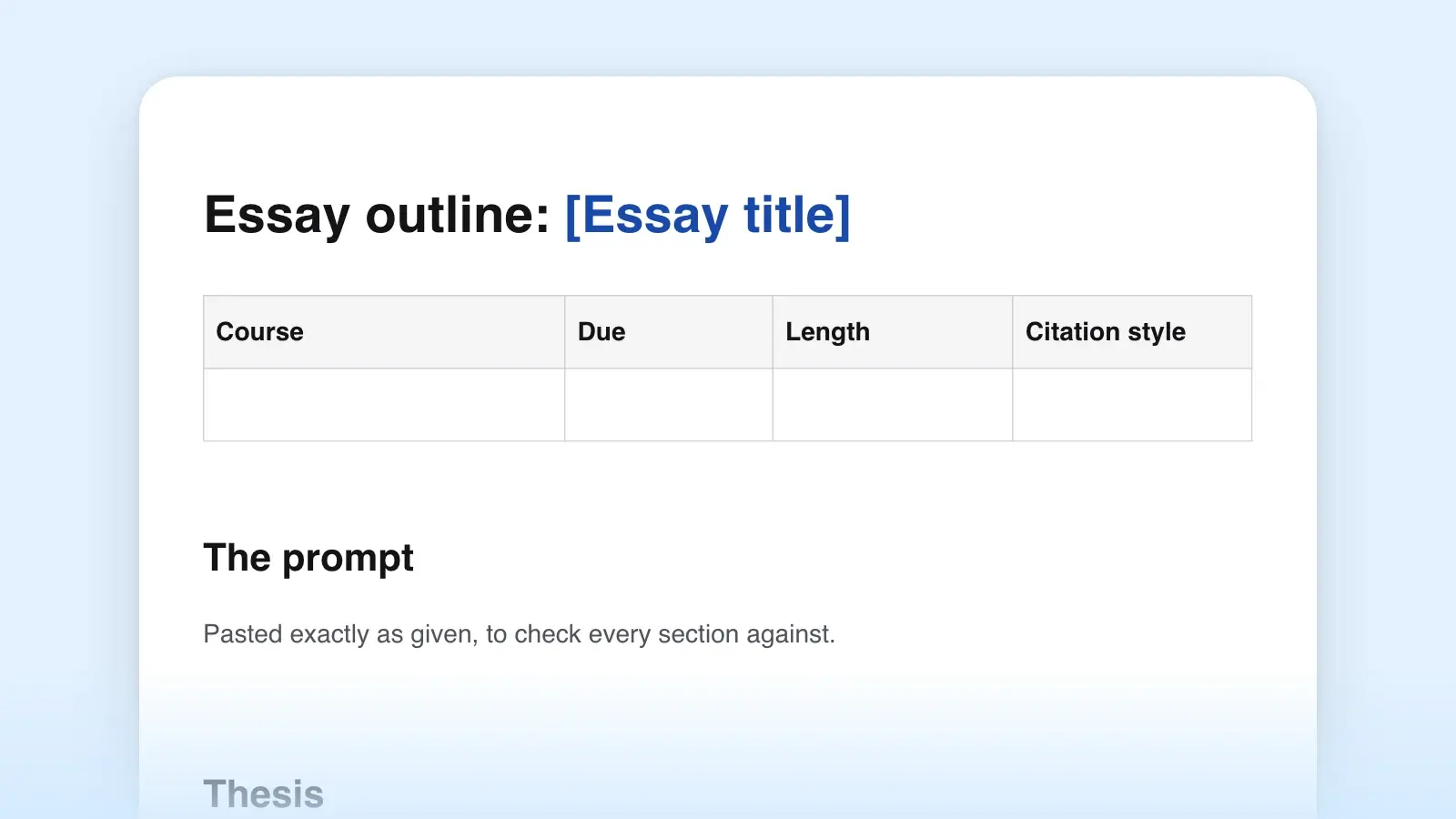
The format is a scaffold, not a rule. It suits a claim with three clear reasons and a short word limit. An essay with one complex reason, or a topic that needs background, will read better with a different number of paragraphs, and many college instructors expect a different shape for anything longer than a few pages. The essay outline template works for both.
Format for a longer essay
An essay of 2,000 to 5,000 words keeps the same three parts but replaces single body paragraphs with sections of several paragraphs each. Here is a plan for a 3,000-word research essay on the same market question:
- Introduction (300 words). The weekly closure of Main Street, the council's proposal to move the market, and the thesis.
- Background (300 words). How long the market has run, who sells there, and what the proposal would change.
- Section 1: Downtown businesses (700 words). Sales data, interviews with shop owners, and what similar towns found after moving their markets.
- Section 2: The farms (600 words). What the vendors earn, and why a fairground location draws fewer shoppers on foot.
- Section 3: Costs and traffic (600 words). The town's actual costs, the traffic complaint, and the detour plan.
- Counterargument (300 words). The strongest case for moving the market, and why the evidence still favors Main Street.
- Conclusion (200 words). What the sections add up to, and what the council should decide.
Longer essays often use section headings. Ask whether your instructor allows them; when they do, the style guide sets their format (APA's heading levels are below). An empirical paper that reports your own study follows a different structure, IMRaD, with the research paper outline template as a starting point.
Page format at a glance
The page layout is the part a style guide sets. Here are the three common styles side by side; the sections after the table give each one's rules and a laid-out sample.
| Rule | MLA (9th edition) | APA (7th edition, student paper) | Chicago (Turabian) |
|---|---|---|---|
| RuleMargins | MLA (9th edition)1 inch on all sides | APA (7th edition, student paper)1 inch on all sides | Chicago (Turabian)At least 1 inch |
| RuleFont | MLA (9th edition)A legible font such as Times New Roman, 12 pt | APA (7th edition, student paper)Options include Times New Roman 12, Aptos 12, Calibri 11, Arial 11 and Georgia 11 | Chicago (Turabian)A readable font such as Times New Roman, 12 pt preferred |
| RuleSpacing | MLA (9th edition)Double-spaced throughout, Works Cited included | APA (7th edition, student paper)Double-spaced throughout, references included | Chicago (Turabian)Text double-spaced; notes, block quotations and bibliography entries single-spaced |
| RuleTitle page | MLA (9th edition)None unless your instructor asks or it's a group project | APA (7th edition, student paper)Required | Chicago (Turabian)Optional for class papers |
| RuleFirst page | MLA (9th edition)Four-line heading at top left, then the title, centered | APA (7th edition, student paper)The title repeated at the top, centered and bold | Chicago (Turabian)The title, if there is no title page, then the text |
| RulePage numbers | MLA (9th edition)Last name and page number, top right | APA (7th edition, student paper)Page number top right; no running head unless asked | Chicago (Turabian)Top right or bottom center; none shown on the title page |
| RuleIn-text citations | MLA (9th edition)Author and page: (Okafor 12) | APA (7th edition, student paper)Author and year: (Okafor, 2023) | Chicago (Turabian)Numbered footnotes or endnotes |
| RuleSource list | MLA (9th edition)Works Cited | APA (7th edition, student paper)References | Chicago (Turabian)Bibliography |
Which style to use depends on the subject. English, languages and other humanities courses usually ask for MLA; psychology, education, nursing and most social sciences use APA; history and some other humanities use Chicago's notes and bibliography style. If the assignment sheet doesn't say, ask before you start, because changing the citation style afterward means touching every source.
MLA format (9th edition)
MLA style comes from the MLA Handbook, now in its ninth edition (2021). It is the usual format for essays in English and the humanities, and its first page is the one most students picture when they hear “essay format”.
- Standard letter-size paper (8½ × 11 inches), 1-inch margins on all sides.
- A legible font in which regular and italic type look clearly different, such as Times New Roman, at 12 points.
- Double spacing throughout, including the heading, block quotations and the Works Cited list, with no extra space between paragraphs.
- The first line of each paragraph indented half an inch.
- No title page unless your instructor asks for one or the paper is a group project. Instead, four lines at the top left of the first page: your name, your instructor's name, the course, and the date, usually written day month year (10 November 2026).
- The title centered on the next line, in title case, with no bold, italics, underlining or quotation marks (other than for the title of a work mentioned in it).
- Your last name and the page number in the top right corner of every page, half an inch from the top. Some instructors ask you to leave it off the first page.
- Headings are optional in an essay. MLA has no required heading system; if you use them, give each level one consistent style and keep them flush left.
Here is how the first page is laid out (double spacing not shown):
MLA first page
                                                        Okafor 1
Adaeze Okafor
Professor Lindqvist
English 102
10 November 2026
                  Why the Market Belongs on Main Street
     Every Saturday from May to October, the farmers market closes
three blocks of Main Street, and every Saturday the same complaint
reaches the town council: drivers cannot get through. The complaint
is fair, but it misses what the market does for the street itself.
The Works Cited page
The list of sources starts on a new page at the end, with the title Works Cited centered at the top in plain type. Entries are double-spaced, alphabetized by the first word of each entry (usually the author's last name, ignoring “A”, “An” and “The” when an entry starts with a title), and given a half-inch hanging indent, so every line after the first is indented. The entries below are invented, to show the shape:
MLA Works Cited entries
Lindqvist, Mara. Streets for People: Markets and the Modern Town. Midland UP, 2019.
Okafor, Daniel. "Saturday Traffic and the Downtown Market." Journal of Small-Town Planning, vol. 14, no. 2, 2023, pp. 33-48.
In the paper itself, book and journal titles are italic, which plain text can't show. In the text, MLA cites the author and the page with no comma between them: (Lindqvist 44).
APA format (7th edition) for students
APA style comes from the Publication Manual of the American Psychological Association, seventh edition (2020), which sets separate formats for student and professional papers. Most class essays use the student format:
- 1-inch margins; text left-aligned with a ragged right edge, not justified.
- One of the fonts APA lists, such as 12-point Times New Roman, 12-point Aptos, 11-point Calibri, 11-point Arial or 11-point Georgia, used throughout.
- Double spacing everywhere, with no extra space before or after paragraphs, and the first line of each paragraph indented half an inch.
- A page number in the top right corner of every page, starting with 1 on the title page. Student papers have no running head unless the instructor asks for one.
- A title page, then the text on a new page, with the title repeated at the top in bold and centered. Don't label the first section “Introduction”: the opening paragraphs are understood to be the introduction.
- Student papers usually skip the abstract unless the instructor asks for one.
The student title page lists, from three or four lines below the top margin: the title in bold, a blank double-spaced line, then your name, your department and university, the course number and name, the instructor and the due date, each centered on its own line.
APA student title page
                                                                1


          The Saturday Market and the Shape of Main Street

                           Adaeze Okafor
      Department of Urban Studies, Midland State University
             URB 210: Introduction to Urban Planning
                         Dr. Mara Lindqvist
                         November 10, 2026
In the real page the title is bold and every line is double-spaced. The date follows the format common in your country.
APA heading levels
APA is the one style here with a fixed heading system. Most student papers need only the first two or three levels.
| Level | Format | Text starts |
|---|---|---|
| Level1 | FormatCentered, bold, title case | Text startsOn a new line, as a new paragraph |
| Level2 | FormatFlush left, bold, title case | Text startsOn a new line, as a new paragraph |
| Level3 | FormatFlush left, bold italic, title case | Text startsOn a new line, as a new paragraph |
| Level4 | FormatIndented, bold, title case, ending with a period | Text startsOn the same line as the heading |
| Level5 | FormatIndented, bold italic, title case, ending with a period | Text startsOn the same line as the heading |
The reference list
References start on a new page, with the label References in bold and centered at the top. The list is double-spaced like the rest of the paper, with no extra space between entries, a half-inch hanging indent and entries alphabetized by the first author's last name. Every entry must be cited in the text, and every source you cite needs an entry, with one common exception: personal communications, such as an email or a conversation with an expert, are cited in the text only. In the text, APA gives the author and year, (Okafor, 2023), and adds the page for a direct quotation: (Okafor, 2023, p. 35).
Chicago style format
Chicago style comes from The Chicago Manual of Style, in its 18th edition since 2024. For student papers, most instructors mean the student version: Kate L. Turabian's A Manual for Writers of Research Papers, Theses, and Dissertations. Its ninth edition (2018) is the one the Turabian quick guide on the Chicago Manual of Style website follows, as of November 2026; check which edition your course uses. History courses usually use the notes and bibliography system:
- Margins of at least 1 inch, a readable font (Times New Roman at 12 points is the safe choice), and the main text double-spaced.
- A title page is optional for class papers. If you use one, center the title about a third of the way down the page, with your name, the course and the date several lines below. Without one, put the title at the top of the first page.
- Page numbers in the top right corner or centered at the bottom, with no number shown on the title page.
- Block quotations of five or more lines set off without quotation marks, indented and single-spaced.
- A superscript note number in the text after the punctuation of the clause or sentence (dashes are the exception). In the note itself, indent the first line half an inch, single-space each note and leave a blank line between notes.
- The first citation of a source in full, later ones shortened to the author's last name, a short title and the page. The two manuals differ on one detail: the Chicago Manual's 18th edition no longer requires the place of publication for books, while Turabian's ninth edition still puts the city before the publisher.
- A bibliography on a new page, titled Bibliography and centered, with entries single-spaced, a blank line between them, a half-inch hanging indent and alphabetical order.
Chicago notes and bibliography, 18th edition (invented source)
Full note:
1. Mara Lindqvist, Streets for People: Markets and the Modern Town (Midland University Press, 2019), 44.

Shortened note:
2. Lindqvist, Streets for People, 51.

Bibliography entry:
Lindqvist, Mara. Streets for People: Markets and the Modern Town. Midland University Press, 2019.
If your course follows Turabian's ninth edition, add the city: (Midland: Midland University Press, 2019) in the note, and Midland: Midland University Press, 2019 in the bibliography. As in the MLA sample, the book title is italic in the real paper. Chicago also has an author-date system, close to APA's in-text format, which some science and social science courses use instead of notes.
Essay formatting checklist
The title gets its own rules for capitalization in each style; the guide to how to title an essay covers them, and the thesis statement examples cover the sentence the whole format is built around.
Frequently asked questions
Does an essay need a title page?
It depends on the style. MLA essays don't use a title page unless the instructor asks or it's a group project; they start with a four-line heading at the top left of page one. APA student papers always start with a title page. In Chicago style a title page is optional for class papers, and many instructors ask for one.
How many paragraphs should an essay have?
As many as the argument needs. Five paragraphs (an introduction, three body paragraphs and a conclusion) suit short essays and timed exams of about 500 to 1,000 words. Longer essays group body paragraphs into sections, and a 3,000-word paper might have fifteen or more paragraphs.
Should an essay be double-spaced?
Yes, in MLA, APA and Chicago the main text is double-spaced, with no extra space between paragraphs. MLA and APA double-space everything, including the source list. Chicago, following Turabian, single-spaces footnotes, block quotations and bibliography entries, with a blank line between them.