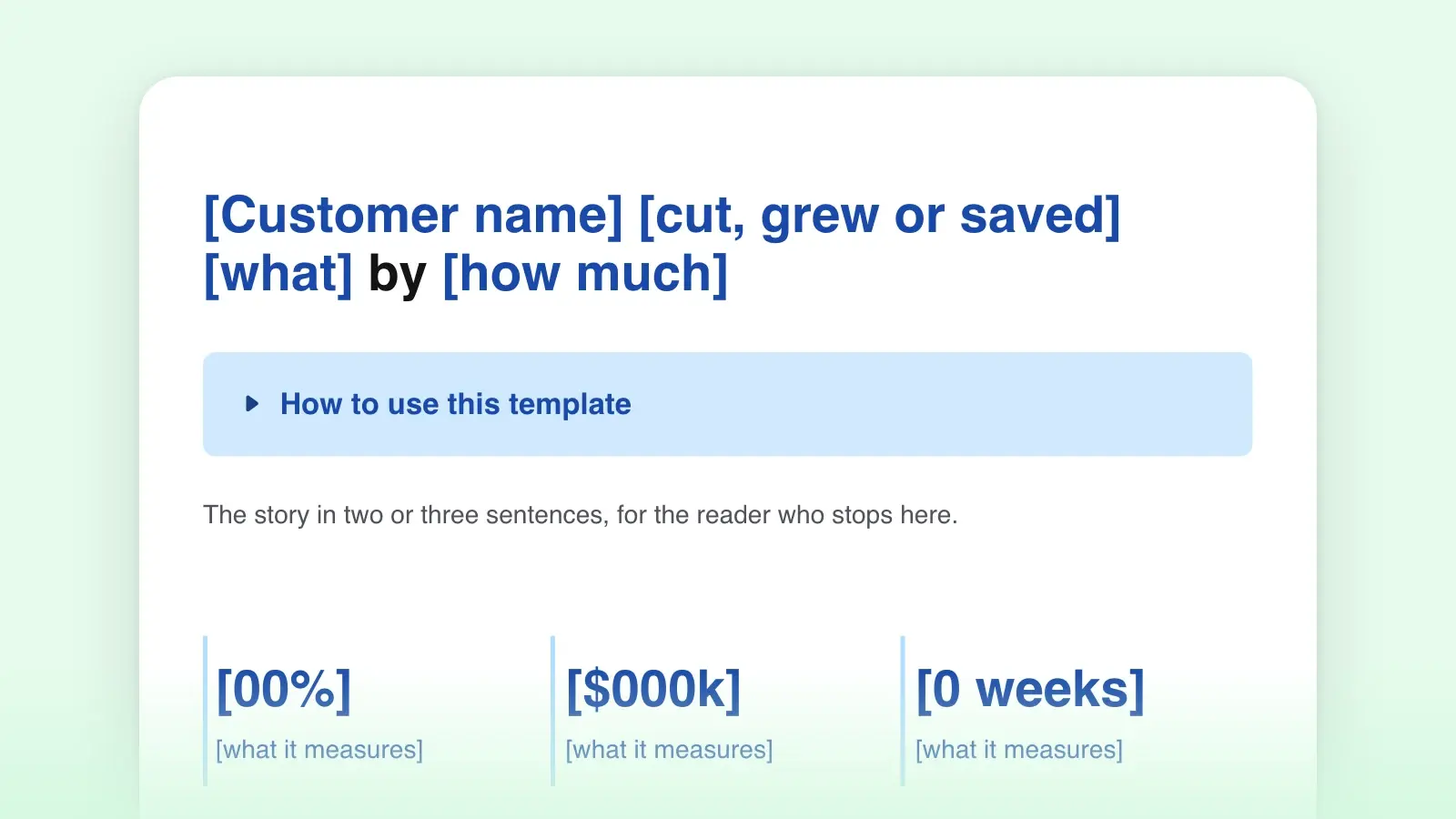
A case study is a short, true account of one situation: who was involved, what problem they faced, what they did and what changed, backed by numbers and people's own words. In business it is usually a customer story. In a classroom it is a case to analyze, or a single case examined in depth. Below are 12 case study examples, one per format: eight from business and four from the classroom.
The two kinds do different jobs. A business case study persuades a buyer, funder or colleague with evidence; an academic one either investigates a single case with a stated method or sets up a decision for a class, and it follows your instructor's or journal's rules. If you're writing for a course, start at the academic examples. The businesses, people and figures in the original examples are invented, results included. For the full business method (choosing the customer, running the interview, getting approval), see how to write a case study. For a blank structure to fill in, start from the case study template.
| Example | Format | Best for |
|---|---|---|
| Example1. A packaging supplier | FormatWeb customer story | Best forProduct pages and sales follow-ups |
| Example2. An online tea shop | FormatExperiment write-up | Best forCompany blogs, peer readers |
| Example3. A dental clinic | FormatOne-page sales sheet | Best forAttachments, trade shows, leave-behinds |
| Example4. A family law firm | FormatFreelance portfolio piece | Best forWinning the next client |
| Example5. A city permit form | FormatUX case study | Best forDesign portfolios and interviews |
| Example6. A food distributor | FormatConsulting engagement | Best forProposals and credentials decks |
| Example7. A mobile food pantry | FormatImpact case study | Best forFunders and annual reports |
| Example8. A CRM migration | FormatInternal lessons learned | Best forThe next team, leadership |
| Example9. A bakery's expansion | FormatTeaching case | Best forBusiness school classes |
| Example10. A rural library | FormatResearch case study | Best forTheses and journal articles |
| Example11. The bakery, analyzed | FormatStudent case study report | Best forCoursework |
| Example12. Phineas Gage | FormatClassic medical case | Best forPsychology and research methods |
Customer case study examples
The case study most companies publish: a customer's problem, the change and the result, written for buyers who look like that customer.
1. Web customer story: shipping breakage
How Fennick Clayworks cut shipping breakage from 1 order in 14 to 1 in 90
Customer: Fennick Clayworks, a nine-person ceramics studio in Asheville, North Carolina, selling tableware online.
Challenge: Plates and mugs breaking in transit. Refunds and reshipping cost about $3,100 a month.
Solution: Pulpwright's fold-to-fit molded pulp inserts, tested on 400 orders before the switch.
Results, March to June vs. the same months last year: 35 of 3,150 orders arrived broken (about 1 in 90), down from 210 of 2,940 (1 in 14). Packing time down from 11 minutes an order to 6, timed on 50 orders each way. No plastic in the box.
In the studio's busiest month last year, 61 orders arrived broken. “I'd open the morning email and count the photos of shards before I'd had coffee,” says Lena Hart, who runs the studio with her brother. They had tried double boxing, which doubled the shipping cost, and bubble wrap, which customers complained about in reviews.
Pulpwright sent inserts cut for Fennick's six best-selling shapes. The studio packed the next 400 orders with them and logged every damage claim. Two arrived broken, both mugs packed in the wrong insert. The rest of the switch took a week.
Why it works. The headline turns a percentage into a ratio a shop owner can picture, and the results line gives the counts behind each ratio and the months compared, so a reader can see the claim isn't one good week. The summary box puts the cost of the problem in dollars a month, the number a buyer's own spreadsheet would show. The quote is a scene rather than praise, and the switch rests on a stated test (400 orders) with an honest note on the two failures. These figures are invented to show where each number goes; in a real case study, each one needs a source the customer can confirm.
2. Experiment write-up: a free-shipping threshold
We raised our free-shipping threshold from $35 to $50. Orders got bigger, and more carts were abandoned
For six weeks this spring, we showed half of the visitors to Larchmere Tea's shop a $50 free-shipping threshold and the other half the old $35, about 12,000 visitors in each group. Everything else stayed the same: prices, emails, the homepage. Figures come from the shop's order reports.
- Orders: 410 in the $35 group, 352 in the $50 group.
- Average order: $41.20 in the $35 group, $52.80 in the $50 group.
- Checkout abandonment: 58% of 976 carts that reached checkout in the $35 group, 64% of 978 in the $50 group.
- Revenue per visitor: $1.41 in the $35 group, $1.55 in the $50 group, about 10% higher.
What didn't work: The “$7.20 away from free shipping” bar sat under the fold on phones, where most of our traffic is. Mobile shoppers in the $50 group didn't see it until we moved it above the cart total in week three.
What we'd do next: Test $45, and offer a sample tin as the item that tips a cart over the line.
Why it works. It reports a mixed result honestly, which tells other shop owners more than a clean win would. The method comes before the numbers (six weeks, a 50/50 split, nothing else changed), and each percentage comes with the count behind it, so a reader can judge how much a six-point gap in abandonment means. The “what didn't work” paragraph is the part other shop owners are most likely to use. This format suits a company blog, where the reader is a peer rather than a buyer.
Sales, portfolio and UX examples
Three formats built for a particular moment: the attachment after a sales call, the page a freelancer sends a prospect, and the piece a designer walks through in an interview.
3. One-page sales sheet: appointment reminders
Brindle Street Dental cut no-shows from 11% to 4% in one quarter
Who: Brindle Street Dental, Fairhaven. Three dentists, two hygienists, about 360 appointments a month.
The problem: About 40 missed appointments a month, each one an empty chair the clinic still paid for. Reminder calls took the front desk around nine hours a week.
What they did: Replaced phone reminders with Nudgewell two-way texts, sent two days and two hours before each visit. Patients reply C to confirm or R to reschedule.
The results (January to March vs. October to December): No-shows from 11% to 4%. Reminder work from nine hours a week to under one. 23 canceled slots refilled from the waiting list in March alone.
“The two-hour text is the one that works. People forget in the car, not the night before.” — Dr. Amira Haddad, owner
Why it works. A one-pager gets printed, attached or left behind after a meeting, so every block has to stand alone. The comparison periods are on the page, so a skeptical office manager can hold the claim against their own numbers. The quote adds the one thing numbers can't: which reminder does the work. The one-pager template has the same blocks for other uses.
4. Freelance portfolio piece: website copy
Alder & Quinn Family Law: from “full-service firm” to the first phone call
The client: A four-attorney family law firm in Sacramento. Consultation requests had been flat at about 12 a month for two years.
The problem: The site described the firm, not the clients. Every page opened with the firm's history and the word “excellence.”
What I did: Interviewed the four attorneys and two former clients (with their permission), then rewrote the homepage, three practice pages and the contact page. I replaced “Contact us” with “Book a 20-minute call” and added three lines on what happens during the call.
Before: “We are a full-service family law firm committed to excellence.”
After: “Divorce is hard enough. Our job is to make the legal part predictable: what it costs, how long it takes, what happens next.”
Results: Consultation requests averaged 19 a month in the six months after launch, from the firm's intake records. The firm also added evening appointments that quarter, which likely helped.
Why it works. A portfolio case study sells the writer, so it shows the thinking (who was interviewed), the work (one before-and-after line) and a result the client can confirm. The note about evening appointments costs nothing and makes the rest more believable. A prospect reads it to answer one question: would this person understand my business? More ways to present work like this are in the writing portfolio examples.
5. UX case study: a parking permit form
Parking permits in five minutes, not five days
Role: Lead designer, with a product manager, two developers and the city's permits office. Ten weeks.
Problem: Residents applied on a four-page PDF. 38% of applications came back incomplete, and approval took a median of five business days.
Research: Two days beside the permit clerks and nine resident interviews. The most common error wasn't on the form at all: residents attached utility bills older than the 60 days the rules allow.
Options: (A) a fillable PDF, (B) an online form with document upload, (C) an online form that checks the address against the city's property records. We built C, and kept upload as a fallback for renters whose names aren't on the records.
A trade-off: We cut the vehicle color field, which clerks said they never used, and kept the plate number, which enforcement officers need.
Results, first three months: Median time to complete an application, about five minutes. Incomplete applications from 38% to 9%. 71% of permits approved the same day. Figures from the form's analytics and the permits office's records.
Why it works. A UX case study is judged on process and decisions, so it shows the research finding that changed the plan and the options that lost. The trade-off line shows the designer made calls, not just screens. The results come from the client's own records, with the period stated.
Consulting, nonprofit and internal examples
Three case studies whose readers are not buyers in the usual sense: a client choosing a method, a funder deciding whether to renew, and a team about to repeat your project.
6. Consulting engagement: delivery routes
Fewer miles, same deliveries: rebuilding routes for a regional food distributor
Client: A family-owned distributor serving 640 restaurants across Ohio and Indiana with 38 trucks.
Situation: Two dispatchers built routes from memory. Fuel costs were rising, and drivers regularly worked past eleven hours.
- Diagnose (weeks 1–4). Four weeks of GPS and delivery data showed 22% of customers were served by two different trucks in the same week.
- Redesign (weeks 5–9). Fixed zones, and delivery windows agreed with the 140 largest customers.
- Hand over (weeks 10–12). Trained the dispatchers to maintain the zones, then reviewed the routes monthly for a quarter.
Results (first full quarter vs. the same quarter a year earlier): Miles driven down 14%. Two routes retired without losing a customer. On-time deliveries from 88% to 95%.
“The new routes weren't the hard part. Getting restaurants to agree to delivery windows was. They did, once we showed them their own late deliveries.” — Director of operations
Why it works. Consulting buyers are buying a method, so the phases are the backbone, each with what was found or done. The quote credits the client with the hardest step, which is both true and flattering, and shows the consultants know where change actually happens.
7. Impact case study: a mobile food pantry
Bringing the pantry to the people: Calder Food Bank's mobile pantry, year one
The need: Three rural townships with no grocery store within 15 miles, where most households the food bank served had no reliable car.
The program: A refrigerated truck visiting nine sites on a two-week loop, run by four staff and 60 volunteers and funded by a $180,000 grant from the Wrenfield Foundation.
Results, June 2025 to May 2026: 2,140 households served, 61% of them new to the food bank. 410,000 pounds of food, 38% of it fresh produce.
One visitor: Marion, 74, used to spend most of a Thursday on two buses to reach the main pantry. Now the truck stops at her church. (Shared with her permission.)
What we changed: Two sites drew few visitors in a school parking lot. After they moved to church lots on the same roads, attendance there tripled. Next year we will add a Saturday stop for working families.
Why it works. A funder reads an impact case study to see whether the money did what the proposal promised, so it reports outputs (households, pounds) against a stated period and says what changed in the plan. The one personal story is short and used with consent. The pairing is natural: the results here are what the next grant proposal will cite.
8. Internal lessons learned: a CRM migration
What our CRM move taught us: 14 weeks planned, 23 delivered
Summary: The sales team moved from spreadsheets and an old CRM to a new one. It took 23 weeks instead of 14 and came in 12% over budget. Six months on, 92% of reps log their calls every week, up from about half.
What went well: Cleaning the data before import (41% of contacts were duplicates or dead). Training by role instead of one session for everyone.
What didn't: We underestimated the billing integration, which caused six of the nine weeks of delay. Nobody owned the data until week 9.
Next time: Name a data owner on day one. Pilot with one region. Plan a 30% buffer for integrations.
Why it works. An internal case study is read by the next team facing the same project, so its value depends on honesty. Plan and outcome sit side by side in the title. The “didn't” list is as specific as the “went well” list, and every lesson is phrased as something the next team can do.
Academic case study examples
In a classroom, “case study” usually means one of three things: a teaching case to discuss, a research case study that examines one case in depth, or a report analyzing a case you were given. Your instructor's format comes first. Examples 9 and 11 use the same invented company, so you can see a case and its analysis together.
9. Teaching case: a bakery chooses how to grow
On a gray Monday, February 9, 2026, Rosa Delgado sat in the back office of the first Delgado's bakery in San Antonio with two offers on her desk and ten days to answer both. A regional supermarket chain wanted Delgado's conchas and bolillos in 140 stores by September. A developer was offering a lease on a fourth café, in a new mixed-use building across town, with three months free.
Delgado's bakers were already working six-day weeks, and the central kitchen ran at about 85% of capacity. Her father, who founded the business in 1994, thought the supermarket deal would cheapen the name. Her operations manager thought the café would stretch the kitchen past breaking. Both offers expired on Thursday, February 19.
Exhibits: 1. Income statements, 2023–2025. 2. Central kitchen capacity by shift. 3. Terms of the supermarket offer. 4. Sales by café location.
Why it works. A teaching case stops before the decision, because the class makes it. It sets the scene through one person with a deadline, gives data in exhibits that support both choices, and never hints at the answer. For real ones to study, MIT Sloan's Teaching Resources Library offers its case studies free, under a Creative Commons license.
10. Research case study: a rural library
Wi-Fi in the parking lot: how one rural library became its county's internet access point, 2020–2024
Abstract: This single-case study examines how a small public library in a rural county (Harlan Creek, a pseudonym) became the main source of public internet access for its residents between 2020 and 2024. Data came from 18 semi-structured interviews with staff, patrons and county officials, four years of Wi-Fi session logs, and library board minutes. The analysis identifies three conditions that made the change possible: a director willing to extend the signal past library hours, a county grant with flexible terms, and word of mouth through local churches. The study discusses what these conditions suggest for library policy, and what a single case cannot show.
- Introduction and research question
- Literature review: libraries and the digital divide
- Method: why this case, data sources, analysis
- Findings, by condition
- Discussion
- Limitations and further research
- References and appendices (interview guide, consent form)
Why it works. A research case study has to argue why this case deserves study, so the method section explains the choice of case before anything else. Each finding draws on more than one source, so interviews, logs and minutes check each other. The structure follows the familiar IMRaD order, with limitations stated outright. For how to write the method section itself, see the methodology example.
11. Case study report: the bakery, analyzed
Monash University's guide for students lists eight sections for a case study written as a report: executive summary or synopsis, introduction, findings, discussion, conclusion, recommendations, references and appendices. It adds that structures vary with the discipline and the assessment, and it splits student case studies into descriptive and problem-solving ones. Here is a problem-solving report on the Delgado's Bakery case, compressed to a line or two per section.
- Executive summary. Delgado's Bakery should accept the supermarket offer as a 40-store pilot, not 140, and decline the café lease for now. The kitchen can supply 40 stores without a second shift.
- Introduction. The two offers, the February 19 deadline, and the question: which path grows the business without breaking the kitchen?
- Findings. The kitchen has about 15% spare capacity (Exhibit 2). Supermarket margins are lower but need no new staff; a café needs a fit-out and a full team before its first sale (Exhibits 3 and 4).
- Discussion. Brand risk is real but testable in a pilot; capacity risk in the café option is not.
- Conclusion. A smaller supermarket deal grows revenue with the kitchen and staff Delgado's Bakery already has.
- Recommendations. Negotiate 40 stores for six months, with a review clause. Revisit the café after a second kitchen shift is staffed.
- References. The case and any course readings, in the citation style the course requires.
- Appendices. The capacity calculation and a month-by-month cash projection.
Why it works. The recommendation is in the first sentence, so a grader who reads only the summary knows the answer. Findings report what the exhibits show; discussion weighs it. Keeping the two apart is what separates analysis from description.
12. A classic: Phineas Gage, 1868
On September 13, 1848, near Cavendish, Vermont, a blasting accident on a railroad line drove a tamping iron 3 feet 7 inches long and 13¼ pounds in weight through the head of a foreman named Phineas Gage. He survived. His doctor, John Martyn Harlow, published a first report in 1848 and a fuller one twenty years later, after Gage's death in 1860. The second report contains the passage psychology students still read.
He is fitful, irreverent, indulging at times in the grossest profanity (which was not previously his custom), manifesting but little deference for his fellows, impatient of restraint or advice when it conflicts with his desires, at times pertinaciously obstinate, yet capricious and vacillating, devising many plans of future operation… In this regard his mind was radically changed, so decidedly that his friends and acquaintances said he was “no longer Gage.”
Why it works. It records one case in close detail, from someone who observed it over time, and it separates what the doctor saw from what others reported (“his friends and acquaintances said”). Its limits teach as much: a single observer, writing twenty years after the accident, about a patient who could no longer be examined.
The other classic is John Snow's study of the 1854 Broad Street cholera outbreak in London, set out in the 1855 second edition of On the Mode of Communication of Cholera. Snow mapped the deaths, which clustered around one public water pump, talked with residents with the help of the Reverend Henry Whitehead, and noted that workers at a nearby brewery, who had a beer allowance instead of drinking from the well, escaped. The pump handle was removed on September 8, 1854, and Snow himself noted that the outbreak may already have been declining by then. That is a case study built the way the business ones above should be: one place, evidence a skeptic can check, and an honest word on what the evidence can't prove.
What the strongest examples share
- A problem stated in the reader's units. Dollars a month, missed appointments, miles, days to approval. Not “inefficiencies.”
- Results with a baseline, a period and a source. “From 11% to 4%, January to March vs. October to December” can be checked. “Dramatically fewer no-shows” can't.
- One honest difficulty. Two broken mugs in the test, the progress bar nobody saw, the evening appointments that also helped, the nine-week delay. Each one makes the rest easier to believe.
- Quotes that sound spoken. “People forget in the car, not the night before” is a person talking. “We're delighted with the partnership” is a press office.
- A format chosen for the reader. The same project can be a one-pager, a web story and a section of a white paper, and each version leads with something different.
Pick the format for the reader
| Format | Typical length | Who reads it | Lead with |
|---|---|---|---|
| FormatWeb customer story | Typical length600–1,200 words | Who reads itBuyers comparing options | Lead withThe result, in the headline |
| FormatExperiment write-up | Typical length500–1,000 words | Who reads itPeers in the same trade | Lead withThe method, then the numbers |
| FormatOne-page sales sheet | Typical lengthAbout 250 words | Who reads itThe buyer's colleague who signs off | Lead withThe headline result and the period |
| FormatPortfolio piece | Typical length400–800 words | Who reads itProspective clients | Lead withThe client's problem |
| FormatUX case study | Typical length800–2,000 words, with images | Who reads itHiring managers and design leads | Lead withYour role and the problem |
| FormatConsulting case study | Typical length500–1,000 words | Who reads itClients choosing a method | Lead withThe situation, then the phases |
| FormatImpact case study | Typical length500–1,000 words | Who reads itFunders and board members | Lead withOutputs against the stated goal |
| FormatInternal lessons learned | Typical lengthOne to three pages | Who reads itThe next team, leadership | Lead withPlan versus outcome |
| FormatTeaching case | Typical lengthSeveral pages, with exhibits | Who reads itStudents in a class | Lead withA person and a deadline |
| FormatResearch case study | Typical lengthArticle or thesis chapter length | Who reads itResearchers, examiners | Lead withThe question and why this case |
| FormatCase study report | Typical lengthAs set by the assignment | Who reads itYour instructor | Lead withThe recommendation |
Whatever the format, the numbers usually start in an interview. If the transcript is in Strokes, attach it in the Strokes Assistant panel and ask for every number the customer mentioned, with the sentence it came from. Check each one against the recording, because transcripts mishear figures.
Frequently asked questions
What is the format of a case study?
A business case study usually runs headline, summary, customer, challenge, solution, results and a next step. A case study report for a course often follows the eight sections Monash University's writing guide lists: executive summary, introduction, findings, discussion, conclusion, recommendations, references and appendices. An instructor's or client's format always comes first.
Where can I find real case study examples?
Many companies publish customer stories on their websites. For teaching cases, MIT Sloan's Teaching Resources Library offers its case studies free under a Creative Commons license, and business schools such as Harvard sell theirs through their publishing arms. Classic research cases, like Phineas Gage and John Snow's 1854 cholera study, are in the public domain.
Can a case study be about a failure?
Yes, and internal ones often should be. A review that compares the plan with what happened, lists what went well and what didn't, and turns each lesson into an instruction helps the next team more than a success story. Published customer stories rarely feature failures, but one honest difficulty makes a success easier to believe.