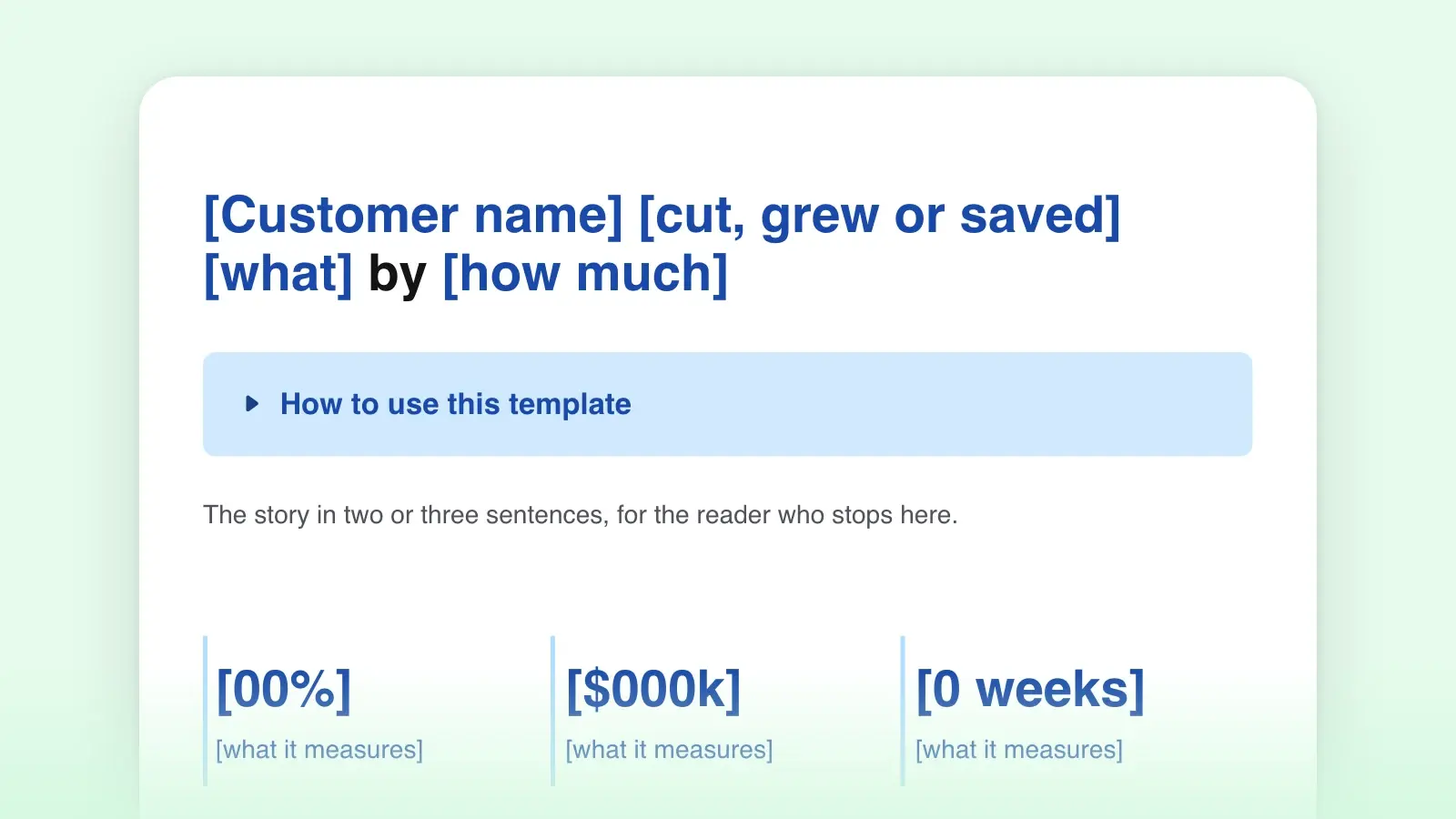
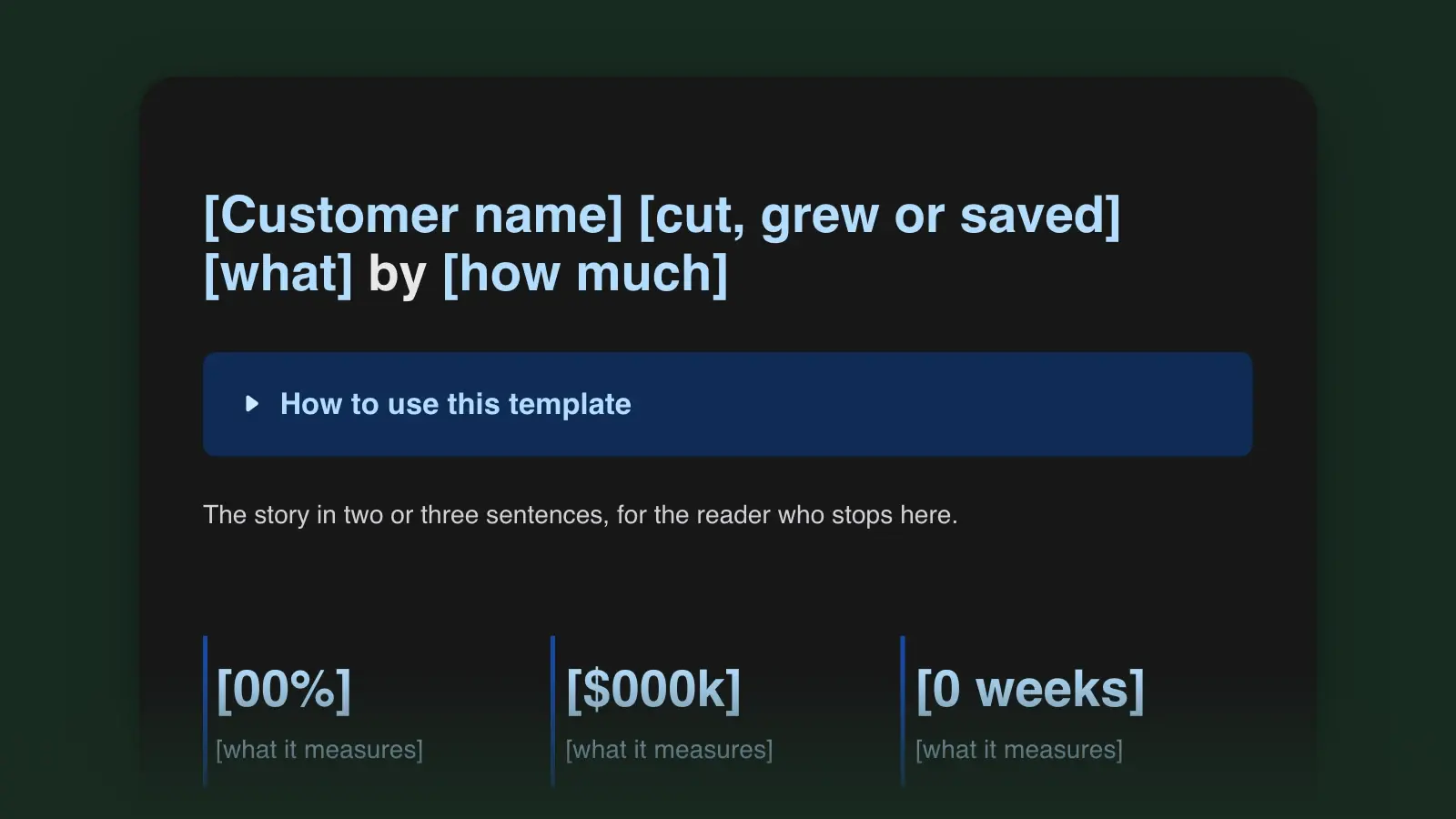
When to use it
- Customer success stories for your website, sales deck or proposals
- Showing a prospect a measured result from a company like theirs
- Agency and freelance portfolio pieces that show the client's outcome, not only the work
- Internal write-ups of what a project changed, for leadership or the next team
How to use this template
- Get a yes before you write
Ask your contact whether they will be named, and who on their side has to approve a published story. At larger companies that is often their marketing or legal team, and it takes longer than the writing. Agree early on what can be shared: the company name, the logo, the person's name, the numbers.
- Gather the numbers, then interview
Pull the before-and-after figures you already have, then book a short call with the customer to confirm them and hear the story in their words. Record it if they agree, so quotes come out exact. The interview notes template keeps the answers organized for the next step.
- Write the results first
The results table decides everything else: the headline, the summary, and what the challenge section has to set up. Fill it in, then write the challenge so a reader sees why those numbers mattered. Write the summary and the headline last, when you know which result is the strongest.
- Send it back for approval
The customer approves the final text, every quote and every number. Send a clean draft with a deadline, and keep each round so you can show what changed between them. In Strokes, version history keeps those rounds without a folder of files named "final-v3".
Questions for the customer interview
One or two good questions per section are enough. Ask for amounts, dates and examples, because a story built from specifics needs specifics in the notes.
- Customer. What does your team do, and what are you personally responsible for?
- Challenge. What was happening that made you look for something new? What did it cost you in a typical week? What had you already tried?
- Solution. Which other options did you look at, and why did you pick this one? What did the first month look like?
- Results. What is different now, and how do you know? If you had to show your manager one number, which would it be?
- Quote. What would you tell a peer who has the same problem? The answer to this one is often the quote you use.
For follow-up questions, how to run the call and a complete example, see how to write a case study.
Results people believe
Readers skip adjectives and look for evidence. A result is credible when it has a baseline, a time frame and a source, and a quote is credible when it sounds like something a person said out loud.
Believable
- Invoice disputes fell from 41 to 12 a month between January and June
- New clients are onboarded in 8 days instead of 3 weeks
- "I used to write proposals on Sunday nights."
Skipped
- Dramatically improved efficiency
- Saved countless hours across the team
- "We're thrilled with the partnership and highly recommend it."
Give the raw numbers next to any percentage. "Leads up 200%" sounds large until the reader learns it went from three to nine. If a price change or a new hire also helped, say so in a sentence. A reader who spots the omission stops trusting the rest. Tidying a quote is normal (dropping the "um", fixing a false start), but paraphrasing it into words the customer never said is not, and they will notice when they approve it.
Harbor & Pine cut proposal turnaround from six days to two in one season
Harbor & Pine, a 14-person landscape design studio in Portland, Maine, was losing bids because each proposal took a week to assemble from spreadsheets and old PDFs. After moving its estimates and proposal library into Quotewell in January, the studio sends most proposals within two business days and won 9 of its 22 spring bids, up from 5 of 20 the spring before.
- Average proposal turnaround: 6 business days → 2 (October to December vs. February to April, from the studio's CRM)
- Spring bids won: 5 of 20 → 9 of 22 (2025 vs. 2026 season)
- Principal's hours on proposals: about 10 a week → about 3 (her own estimate)
"I used to write proposals on Sunday nights. Now I write them Tuesday morning and they go out Tuesday afternoon." — Dana Whitlock, principal
Notice the last result is labeled as an estimate. That costs nothing and makes the two measured numbers more convincing. The summary follows the inverted pyramid: everything a busy reader needs is in the first paragraph, and the sections below are for anyone who wants the detail.
Before you publish
One approved story can run in several places. Export a PDF for the sales team, put the full text on your website, and lift the summary and the results table onto a slide. If they are written well, they work on their own.
Frequently asked questions
How long should a case study be?
Long enough to show the problem, the change and the proof. For most customer stories that is one or two printed pages. Write the summary and the results table so they stand on their own, because many readers will read only those.
What is the difference between a case study and a testimonial?
A testimonial is a quote. A case study is the story around it: who the customer is, what was wrong, what they did and what changed, with numbers. A good case study usually yields two or three quotes you can reuse elsewhere, with the customer's permission.
Can I publish a case study without naming the customer?
Yes, as an anonymized case study that describes the customer instead of naming them, such as a regional logistics company with 300 drivers. It persuades less, and details can still identify the company, so get the customer's agreement either way and check your contract with them for publicity terms.
Does this template work for an academic or UX case study?
Not as it stands. A business-school teaching case usually ends on an open decision rather than a result, and a UX portfolio case study centers on your process: research, options and design decisions. Keep the challenge and results sections and rebuild the rest, and for coursework follow the format your school sets.