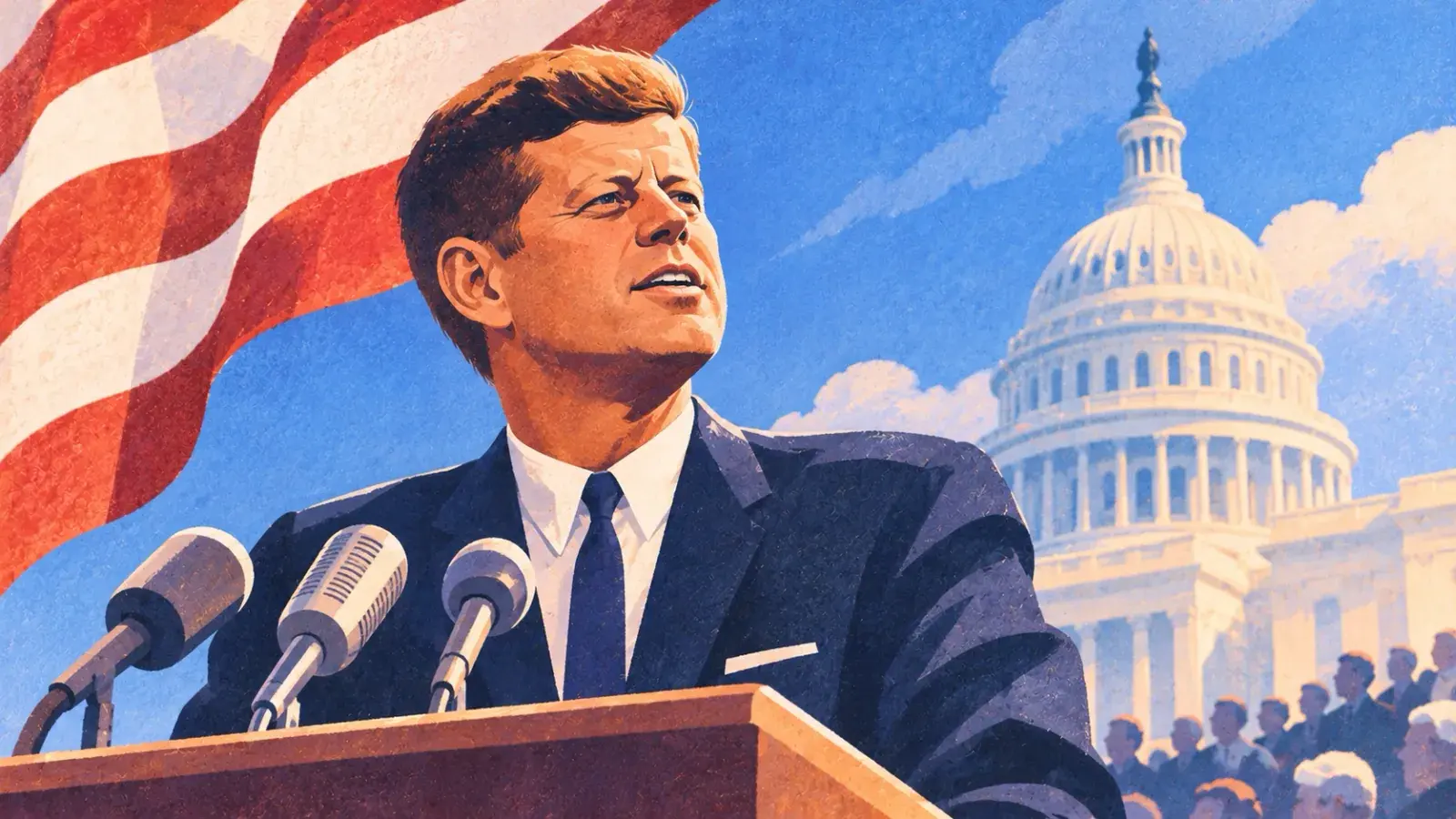
John F. Kennedy's inaugural address was delivered on January 20, 1961, on the East Portico of the US Capitol, right after Chief Justice Earl Warren administered the oath. In 1,366 words it reframes the day as “not a victory of party but a celebration of freedom,” turns to six audiences around the world with five pledges and a request, and ends by turning the obligation back on the listener: “ask not what your country can do for you—ask what you can do for your country.” Its engine is the reversal, two clauses that trade the same words or set opposites side by side.
Below are the facts of the day, how the speech was drafted, how it is built, its antitheses and repeated openings, its images, and why so many of its lines are still quoted. Inaugural addresses are the work of a federal official in office and in the public domain, so the address is quoted at length, from the Public Papers text as published by the American Presidency Project.
The address at a glance
| Fact | Detail |
|---|---|
| FactDate | DetailFriday, January 20, 1961 |
| FactPlace | DetailEast Portico, US Capitol, Washington, DC |
| FactOath | DetailAdministered by Chief Justice Earl Warren |
| FactWeather | DetailSnow into the early morning left 8 inches on the ground; about 22°F at noon |
| FactLength | Detail1,366 words, shorter than either of Eisenhower's inaugurals (2,459 and 1,658) |
| FactSpeaker | DetailKennedy, 43, succeeding Dwight D. Eisenhower |
| FactOn the program | DetailMarian Anderson sang the national anthem; Robert Frost, the first poet on an inaugural program, recited “The Gift Outright” |
| FactPapers | DetailThe JFK Library holds drafts, among them one in Kennedy's hand, and the reading copy |
How Kennedy drafted it
The National Archives' account of the drafting starts with a brief. Kennedy wanted the speech short and clear, free of partisan rhetoric and focused on foreign policy. He began in late November 1960, working from a file of speech material his secretary kept and asking friends and advisers for suggestions. Colleagues sent ideas and drafts. Clergymen sent lists of biblical quotations. Kennedy wrote his own thoughts “in his nearly indecipherable longhand on a yellow legal pad,” and his aides said every sentence was “worked, reworked, and reduced.”
Ted Sorensen, Kennedy's speechwriter and adviser, worked with him on the text, and how much of this one is Sorensen's has been debated since. The JFK Library's exhibition on the address notes that the earliest surviving draft was prepared by Sorensen and carries Kennedy's handwritten notes. The Archives' account calls the final product Kennedy's own. It traces the most famous line to an idea about sacrifice that Kennedy had held for years and expressed in various ways in campaign speeches. On January 19, the day before the inauguration, the Archives notes, Kennedy compared his text with an inaugural address by Thomas Jefferson. “It was better than mine,” he said.
A speech famous for its phrases was built by subtraction: worked, reworked and reduced.
How the speech is built
The address moves outward from the ceremony to the world and comes home at the end. The audience it speaks to changes at almost every turn, and the changes are the structure.
| Movement | Audience | What it does | Key line |
|---|---|---|---|
| Movement1. The occasion | AudienceEveryone watching | What it doesRecasts an election win as a shared ritual and states the stakes | Key line“not a victory of party but a celebration of freedom” |
| Movement2. The generation | AudienceFriend and foe | What it doesIntroduces the new leadership as heirs to the founders | Key line“the torch has been passed to a new generation of Americans” |
| Movement3. The promise | AudienceEvery nation | What it doesCommits the country to the survival of liberty, at any cost | Key line“This much we pledge—and more.” |
| Movement4. Five pledges and a request | AudienceAllies, new states, the poor, Latin America, the UN, adversaries | What it doesMakes a specific promise to each of the first five, then a request to the sixth | Key line“we offer not a pledge but a request” |
| Movement5. Terms of peace | AudienceThe adversary | What it doesStrength first, then negotiation, then five things “both sides” could do | Key line“let us never fear to negotiate” |
| Movement6. The time scale | AudienceEveryone | What it doesAdmits the work will outlast the administration | Key line“But let us begin.” |
| Movement7. The charge | Audience“My fellow citizens” | What it doesHands responsibility to the listeners | Key line“I do not shrink from this responsibility—I welcome it.” |
| Movement8. The asks | AudienceAmericans, then the world | What it doesTurns every pledge into an obligation for the audience | Key line“ask not what your country can do for you” |
Two things stand out. The pledges in the middle are the spine: Kennedy spends the center of a ceremonial speech making specific promises to specific groups, which is what keeps it from being only ceremony. And the ending reverses the direction of the middle. For most of the speech the new government promises things to the world. In the closing paragraphs it asks things of the people listening, at home first and then abroad: “My fellow citizens of the world: ask not what America will do for you, but what together we can do for the freedom of man.”
Antithesis and reversal
Many of the best-known sentences in the address are built from two halves that push against each other. Some set opposites side by side, which is antithesis. Some repeat the same words in reverse order, which is chiasmus, or antimetabole when the words return exactly. The rhetorical devices list defines both. Here they are in the order the speech uses them.
| Line | Device | What it does |
|---|---|---|
| Line“not a victory of party but a celebration of freedom—symbolizing an end as well as a beginning—signifying renewal as well as change” | DeviceThree paired contrasts in one sentence | What it doesTurns a partisan win into a national ritual before any policy is mentioned |
| Line“the rights of man come not from the generosity of the state but from the hand of God” | DeviceAntithesis | What it doesSets the speech's first principle, which the last sentence returns to |
| Line“United, there is little we cannot do … Divided, there is little we can do” | DeviceAntithesis with mirrored syntax | What it doesMakes the case for alliance in two mirrored sentences |
| Line“If a free society cannot help the many who are poor, it cannot save the few who are rich.” | DeviceAntithesis: many and few, poor and rich, help and save | What it doesAdds an argument from interest to the moral case for aid |
| Line“civility is not a sign of weakness, and sincerity is always subject to proof” | DevicePaired maxims | What it doesAnswers in advance the charge that talking is weakness |
| Line“Let us never negotiate out of fear. But let us never fear to negotiate.” | DeviceAntimetabole | What it doesStates a whole policy, firm and open, in two short sentences |
| Line“ask not what your country can do for you—ask what you can do for your country” | DeviceAntimetabole | What it doesReverses the direction of obligation |
Why does the device suit this speech? Kennedy's address had to do things that pull against each other: reassure allies and warn rivals, promise strength and offer talks, honor the past and announce a change. Antithesis lets a speaker hold both sides of a choice in one sentence without sounding undecided. The negotiate line is a policy of firmness and openness at once, and the shared words make the two halves sound like one idea instead of a compromise.
That line resolves a tension the speech sets up a few sentences earlier. Before any offer of talks, Kennedy says of the adversary: “We dare not tempt them with weakness. For only when our arms are sufficient beyond doubt can we be certain beyond doubt that they will never be employed.” He describes both sides as “overburdened by the cost of modern weapons” and racing to alter “that uncertain balance of terror.” Only then does he turn to talks, “remembering on both sides that civility is not a sign of weakness.” Strength comes first, so the offer to negotiate is harder to hear as weakness, and the maxim about civility answers that objection before anyone can make it.
The device also does structural work. The first sentence turns on “not … but,” and so does one of the last. The speech also starts and ends with the same principle: rights that come “from the hand of God,” and a closing in which “here on earth God's work must truly be our own.” Like the reversals inside its sentences, the whole address hands back at the end what it set out at the start, now as the listener's job.
Repeated openings and changing audiences
The address repeats openings the way older oratory did, and each repetition brings something new: a new audience, a new verb or a longer span of time.
“To those”: five pledges and a request
The middle of the speech turns to six audiences, each introduced the same way. The first five get a pledge: “To those old allies whose cultural and spiritual origins we share, we pledge the loyalty of faithful friends.” Then come the new states, the peoples “in the huts and villages of half the globe struggling to break the bonds of mass misery,” the “sister republics south of our border” and the United Nations. The sixth breaks the pattern on purpose: “Finally, to those nations who would make themselves our adversary, we offer not a pledge but a request.” After five pledges, the switch to a request is the news.
Several pledges carry a warning inside them. The new states are promised support, and reminded “that, in the past, those who foolishly sought power by riding the back of the tiger ended up inside.” The sentence is a joke with a threat in it, and it may be the most vivid image in the speech.
“Let both sides”
The phrase comes five times: four sentences begin with it, and a fifth brings it in mid-sentence. The verbs climb from talk to action: explore, formulate, seek, unite, join. “Let both sides explore what problems unite us instead of belaboring those problems which divide us.” “Let both sides seek to invoke the wonders of science instead of its terrors.” The run ends on the longest version: “And if a beach-head of cooperation may push back the jungle of suspicion, let both sides join in creating a new endeavor, not a new balance of power, but a new world of law, where the strong are just and the weak secure and the peace preserved.” A military image, a beach-head, is put to work for peace.
The ladder of time
All this will not be finished in the first one hundred days. Nor will it be finished in the first one thousand days, nor in the life of this Administration, nor even perhaps in our lifetime on this planet. But let us begin.
Four rungs, each longer than the last: a hundred days, a thousand days, a term of office, a lifetime. The ladder is a climax in the old rhetorical sense, and it does something unusual for an inauguration: it admits the program will not be finished. Then four words put the listener back on the bottom rung. The short sentence after the long one is the speech's rhythm in miniature. The guide to parallel structure takes apart another of its runs, the five phrases of “pay any price, bear any burden.”
Images that carry the argument
The abstractions in the address (freedom, peace, responsibility) are carried by a few concrete pictures, and the most important one returns. Near the start, “the torch has been passed to a new generation of Americans—born in this century, tempered by war, disciplined by a hard and bitter peace, proud of our ancient heritage.” Near the end, the torch has become a fire: “The energy, the faith, the devotion which we bring to this endeavor will light our country and all who serve it—and the glow from that fire can truly light the world.” The image passes through the speech the way the torch passes between generations, a motif in miniature.
The other images come from war and scripture, fitting for the generation the speech calls “tempered by war” and for a country in the middle of the Cold War. “Now the trumpet summons us again—not as a call to bear arms, though arms we need—not as a call to battle, though embattled we are—but a call to bear the burden of a long twilight struggle, year in and year out, ‘rejoicing in hope, patient in tribulation’—a struggle against the common enemies of man: tyranny, poverty, disease and war itself.” The quotation inside it is from Paul's letter to the Romans (12:12 in the King James Version). Earlier, the speech names its other scriptural source outright, “the command of Isaiah,” and quotes Isaiah 58:6: to “undo the heavy burdens” and “let the oppressed go free.”
Notice the inverted word order in “though arms we need” and “though embattled we are.” Ordinary English would say “though we need arms.” Putting the object first slows the clause and gives it the sound of ceremony, which is why it can sit beside a quotation from the King James Bible without sounding out of place.
Why the lines lasted
Many of the address's lines are still quoted: the “ask not” reversal, the torch passed to a new generation, “pay any price, bear any burden,” the negotiate line, “a long twilight struggle,” the ladder of time and the tiger. Three habits help explain why. The words are short: the “ask not” line is seventeen words, and every one but “country” has a single syllable; the negotiate line is fourteen. The structure is audible: you can hear the hinge in each line, the “but” or the reversal, which makes it easier to repeat after one hearing. And the lines are spread out, one or two to most movements of the speech, so no long stretch of policy goes by without one to carry away.
Kennedy also kept himself out of the way. The pronoun “I” appears four times, in three sentences: the oath, and the acceptance of the job. “I do not shrink from this responsibility—I welcome it. I do not believe that any of us would exchange places with any other people or any other generation.” Everything else is “we,” “us” and “our,” and even the second “I” sentence turns back to “us” within a few words.
What speechwriters can take from it
- Use antithesis where you face a real tension. Kennedy's reversals sit on real choices: strength and talks, pledges and requests. A reversal with nothing at stake sounds like a slogan.
- Name your audiences one at a time. A repeated opening (“To those …”) signals each new audience and lets you make a specific promise to each group.
- Admit the scale of the job, then start it. The ladder of time concedes the work will outlast the speaker. The four words after it keep the concession from sounding like defeat.
- Bring one image back, and cut until the hinge shows. The torch at the start and the fire at the end make a long speech feel like one thought. A reversal is easiest to hear when nothing else in the sentence competes with it.
Before: We need to make sure that our budget reflects our priorities for students and that we keep the needs of students in mind when we make decisions about money.
After: We will not ask what our students can do for this budget. We will ask what this budget can do for our students. That is why the $1.2 million we save by closing the Elm Street annex will pay for a reading specialist in each of our nine elementary schools.
The reversal borrows Kennedy's shape and frames the choice. The sentence after it is the part a listener can check: without a commitment like that, the line is a memorable framing and little more. Use a reversal when it clarifies a real tension; cut it when the sentence merely echoes a familiar slogan.
To check your own draft, ask the Strokes Assistant in Strokes to list every sentence that sets two ideas against each other, and every repeated opening with what follows it. A pair whose halves don't really oppose, or a refrain with nothing new behind it, stands out in that list.
For the techniques in general, see persuasive techniques. If you are writing about the address for a class, the rhetorical analysis example includes a sample paragraph on Kennedy's reversals, and the persuasive speech outline will hold a draft of your own. For a farewell written to be read rather than heard, compare our analysis of Washington's Farewell Address.
Frequently asked questions
Who wrote JFK's inaugural address?
Kennedy, with help. Ted Sorensen, his speechwriter and adviser, worked with him on it, and the JFK Library notes that the earliest surviving draft was prepared by Sorensen with Kennedy's handwritten notes; how much of the text is Sorensen's has long been debated. The National Archives calls the final product Kennedy's own: he drafted in longhand, gathered suggestions and had every sentence worked, reworked and reduced.
Is “ask not” chiasmus or antimetabole?
Both labels are used. Antimetabole is the narrower term: the same words come back in reverse order, “country … you” and then “you … country.” Chiasmus is the broader name for a reversed, mirror-image structure, and many textbooks use it for this line too. The negotiate line works the same way, with “negotiate” and “fear” trading places.
What rhetorical devices are in JFK's inaugural address?
Mostly antithesis and antimetabole, opposites or reversed words in balanced clauses, as in the negotiate line. The speech also uses anaphora (“To those …”, “Let both sides”), a climax of time spans ending in “But let us begin,” allusions to Isaiah and Romans, inverted word order such as “though arms we need,” and a torch image that returns as a fire at the end.
How long was JFK's inaugural address?
The text in the Public Papers runs 1,366 words, according to the American Presidency Project at UC Santa Barbara. That made it shorter than both of Eisenhower's inaugural addresses, which ran 2,459 and 1,658 words, and close to the length of Washington's first, at 1,431. For comparison, Lincoln's second inaugural runs 700 words and William Henry Harrison's, the longest, 8,460.