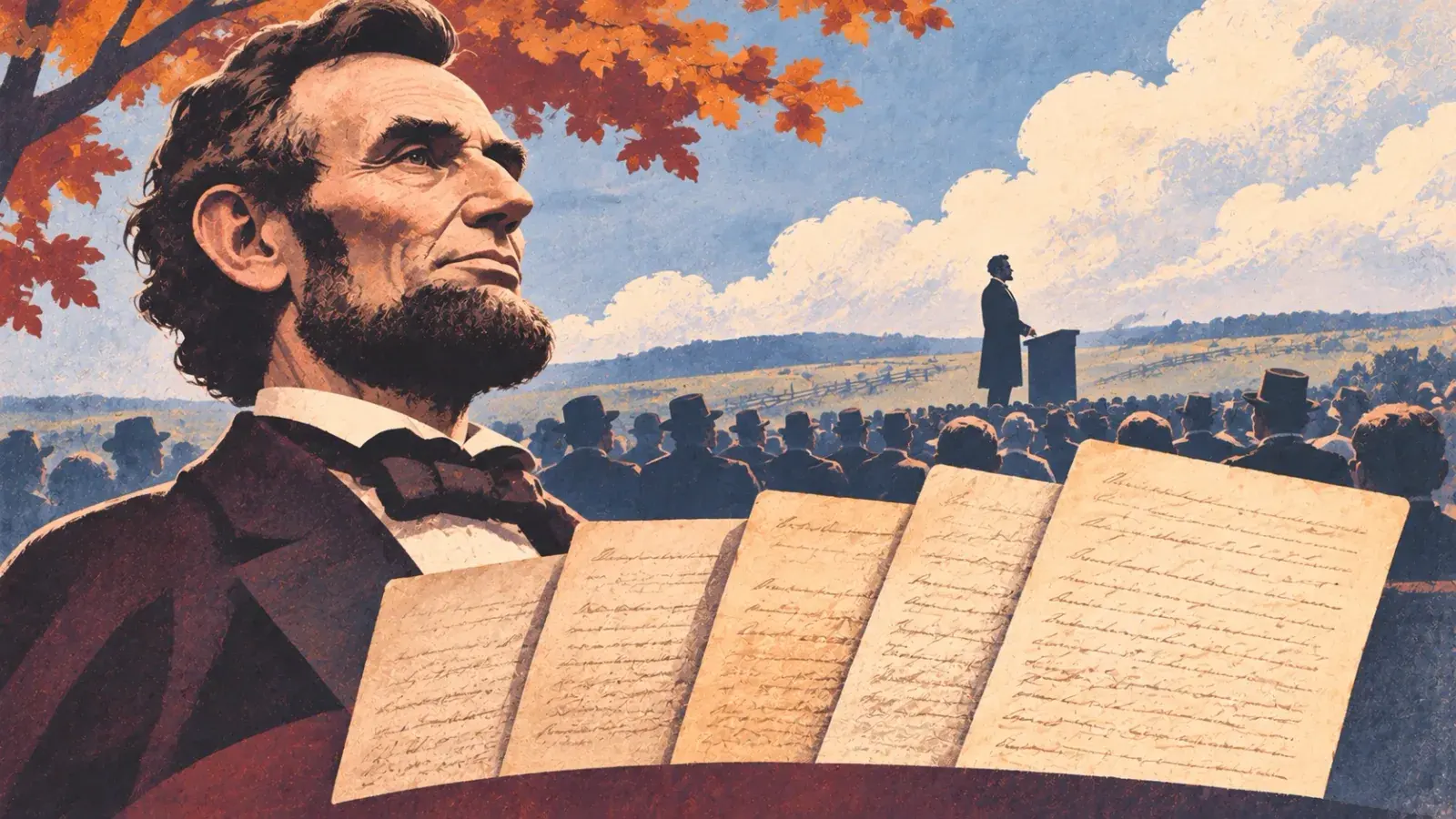
A Gettysburg Address analysis starts with its shape: ten sentences that move from the nation's birth in 1776, through the war being fought in 1863, to a “new birth of freedom” that the listeners must secure. Abraham Lincoln gave it on November 19, 1863, at the dedication of the Soldiers' National Cemetery in Gettysburg, Pennsylvania, and spoke for about two minutes. The standard text, the Bliss copy, is 271 words long, and its argument turns on one move: the crowd came to dedicate a cemetery, and Lincoln tells them the dead have already done it, so the living must dedicate themselves instead.
Below are the facts of the day, then the speech one sentence at a time, then the five copies Lincoln wrote out, how their wording differs, and what the counts show. The text is in the public domain. For a model essay built on the speech, see the rhetorical analysis example; this page is the close reading underneath it.
The address in brief
| Fact | Detail |
|---|---|
| FactDate | DetailThursday, November 19, 1863 |
| FactOccasion | DetailDedication of the Soldiers' National Cemetery, Gettysburg, Pennsylvania |
| FactThe battle | DetailJuly 1–3, 1863; more than 51,000 killed, wounded or missing |
| FactThe invitation | DetailDavid Wills, November 2, 1863, asked Lincoln to set the grounds apart “by a few appropriate remarks” |
| FactMain oration | DetailEdward Everett, about two hours |
| FactLincoln | DetailAbout two minutes |
| FactStandard text | DetailThe Bliss copy, written out in March 1864: 271 words, ten sentences |
| FactCopies in Lincoln's hand | DetailFive: Nicolay, Hay, Everett, Bancroft, Bliss |
The invitation explains the brief. Wills, writing as agent for Pennsylvania's governor and for all the states with soldiers buried there, asked that “after the Oration, you, as Chief Executive of the Nation, formally set apart these grounds to their Sacred use by a few appropriate remarks.” The main event was Everett's oration. The burials were still going on: Cornell's account notes that by the day of the dedication fewer than half of the Union dead had been moved from their field graves into the new cemetery. The day after, Everett wrote to Lincoln that he would be glad to think “I came as near to the central idea of the occasion, in two hours, as you did in two minutes.”
The speech, line by line
Each passage below is quoted from the Bliss copy, the last of the five copies Lincoln wrote out and the standard text, as transcribed by Abraham Lincoln Online. The ten sentences fall into four movements: the founding, the present, the turn, and the charge. Where the earliest copy, the Nicolay copy, reads differently, the note says so; the copies are compared in full after the reading.
Sentence 1: the founding
Four score and seven years ago our fathers brought forth on this continent, a new nation, conceived in Liberty, and dedicated to the proposition that all men are created equal.
Eighty-seven years before 1863 is 1776, so Lincoln dates the nation from the Declaration of Independence, not the Constitution, and makes its founding idea the Declaration's line on equality. “Four score” is the counting of the King James Bible, which measures a life in “threescore years and ten” (Psalm 90:10). The verbs are the language of birth: “brought forth,” “conceived.” And a “proposition” is something put forward to be proved, which sets up the next sentence.
Sentences 2 to 5: the present
Now we are engaged in a great civil war, testing whether that nation, or any nation so conceived and so dedicated, can long endure. We are met on a great battle-field of that war. We have come to dedicate a portion of that field, as a final resting place for those who here gave their lives that that nation might live. It is altogether fitting and proper that we should do this.
Sentence 2 turns on “Now” and on the word “testing.” Lincoln presents the war as a test of whether a nation founded on that proposition can endure, and the stakes widen at once to “any nation so conceived and so dedicated,” repeating both verbs from the first sentence. Sentence 3 is the shortest in the speech, ten words that bring the whole argument down onto the ground the audience is standing on, a field where the reburials were still going on. Sentence 4 names the purpose of the day and plants the speech's central paradox: men died so that a nation “might live.” It is also the first sentence with the word “here,” which comes eight times in all, six of them in the last three sentences. Sentence 5 is pure ceremony, the assent everyone expects. Its job is to be overturned.
Sentences 6 to 8: the turn
But, in a larger sense, we can not dedicate—we can not consecrate—we can not hallow—this ground. The brave men, living and dead, who struggled here, have consecrated it, far above our poor power to add or detract. The world will little note, nor long remember what we say here, but it can never forget what they did here.
Sentence 6 denies the occasion its own verb. The three verbs climb from the civic to the sacred, dedicate, consecrate, hallow, each set off by a dash where a speaker would pause, and the object, “this ground,” is held back to the end. Sentence 7 gives the reason: the soldiers have already done it. “Living and dead” honors the survivors as well as the buried. In the Nicolay copy they had “hallowed” the ground; in the Bliss copy they have “consecrated” it, picking up the middle verb of the triad. “Poor power” is a rare bit of alliteration, and “add or detract” is the language of an account book, as if the soldiers' deed were a sum that speeches cannot change.
Sentence 8 is the famous antithesis: saying against doing, “we” against “they,” “here” at the end of both halves. It is a juxtaposition that ranks the speaker below the dead, and it contains the one prediction in the speech that turned out wrong. The world has noted and remembered what was said there, starting with Everett's letter the next day.
Sentences 9 and 10: the charge
It is for us the living, rather, to be dedicated here to the unfinished work which they who fought here have thus far so nobly advanced. It is rather for us to be here dedicated to the great task remaining before us—that from these honored dead we take increased devotion to that cause for which they gave the last full measure of devotion—that we here highly resolve that these dead shall not have died in vain—that this nation, under God, shall have a new birth of freedom—and that government of the people, by the people, for the people, shall not perish from the earth.
Sentence 9 brings “dedicate” back with a new object. The ground cannot be dedicated, but “us the living” can be, and the phrase answers “the brave men, living and dead” two sentences earlier: the living who fought there have done their part, and the living who are listening have not. “Unfinished work” makes the war a job left half done, which is harder to walk away from than a cause.
Sentence 10 is 82 words, and it is built as a ladder of four pledges, each opened by a dash and “that.” Watch the word “devotion,” used twice in one clause: the living are to take “increased devotion” from the dead, who gave “the last full measure of devotion,” so the soldiers' sacrifice becomes the unit the living are measured by. The third pledge returns to the first sentence's birth imagery. The nation that was “brought forth” and “conceived” in 1776 is to have “a new birth of freedom,” a second founding. The fourth pledge ends the speech on its widest stakes, a three-part phrase that repeats “the people” in the stressed position, and a biblical cadence, “perish from the earth,” the same words Job 18:17 uses in the King James Version. The guide to repetition in literature covers that closing phrase as epistrophe.
What the close reading shows
The speech tells the life of a nation. Birth in the first sentence, a test in the second, and in the last a promised rebirth set against the danger of perishing. The cemetery is the setting, but the subject is a nation that could still die.
The key words change meaning as they return. “Dedicate” moves from the ground to the listeners. “Consecrate” moves from what the crowd cannot do to what the soldiers did. “Living” moves from the veterans to the audience. Repetition in this speech is rarely just emphasis. Each return carries the argument one step on.
It names nothing it does not need. There is no Gettysburg, no Union, no Confederacy and no “I” in the text, which is part of why later readers can stand inside it. The revisions between the copies show the same instinct: Lincoln kept working on the text after he had delivered it, and most of his changes make the language plainer or more exact. For how the speech fits the commemorative tradition, from funeral orations to anniversary toasts, see the guide to tribute speeches; for the rhetorical devices by name, see the glossary.
How the five copies differ
Lincoln wrote the speech out five times. Two copies went to his private secretaries, John Nicolay and John Hay, and are the earliest. The other three he wrote in 1864 for charitable causes.
| Copy | Written | Now held by | “Under God” |
|---|---|---|---|
| CopyNicolay | Written1863; presumed the only working draft before delivery | Now held byLibrary of Congress | “Under God”No |
| CopyHay | Written1863; probably soon after Lincoln's return to Washington | Now held byLibrary of Congress | “Under God”No |
| CopyEverett | Written1864, at Everett's request, to benefit Union soldiers | Now held byAbraham Lincoln Presidential Library, Springfield, Illinois | “Under God”Yes |
| CopyBancroft | WrittenFebruary 1864, for a facsimile volume sold at the Baltimore Sanitary Fair | Now held byCornell University | “Under God”Yes |
| CopyBliss | WrittenMarch 1864, to replace the Bancroft copy in that volume | Now held byThe Lincoln Room of the White House | “Under God”Yes |
The Nicolay copy is the most revealing. Its first page is on Executive Mansion stationery, and its second on a different paper, loosely described as foolscap. The Library of Congress, which holds it, has read the change of paper as a sign that Lincoln was not fully satisfied with the ending and rewrote it in Gettysburg, at Wills's house, on November 18, the day before the ceremony. The grammar shows a join too, in the Library's transcription of the Nicolay copy: “It is rather for us, the living, we here be dedicated to the great task remaining before us,” a sentence that does not quite hold together. Scholars still disagree about whether this was the sheet Lincoln held at the podium.
The Bliss copy exists because of a printing problem, which Cornell University Library tells in its account of its own copy. On February 23, 1864, the historian George Bancroft asked Lincoln for a copy on behalf of his stepson, Colonel Alexander Bliss, who was gathering manuscripts for a lithographed volume to be sold for soldiers' aid. Lincoln sent one with a letter dated February 29, but he had written on both sides of the paper, and the lithograph needed blank backs. Shortly after March 7 he wrote another. That fifth copy, the only one reproduced in the volume, became the standard text. It sold at auction in 1949 for $54,000 to Oscar B. Cintas, who later willed it to the American people.
What Lincoln changed
| Nicolay copy (1863) | Bliss copy (1864) |
|---|---|
| Nicolay copy (1863)“brought forth, upon this continent” | Bliss copy (1864)“brought forth on this continent” |
| Nicolay copy (1863)“for those who died here, that the nation might live” | Bliss copy (1864)“for those who here gave their lives that that nation might live” |
| Nicolay copy (1863)“This we may, in all propriety do.” | Bliss copy (1864)“It is altogether fitting and proper that we should do this.” |
| Nicolay copy (1863)“have hallowed it” | Bliss copy (1864)“have consecrated it” |
| Nicolay copy (1863)“what we say here; while it can never forget” | Bliss copy (1864)“what we say here, but it can never forget” |
| Nicolay copy (1863)No “unfinished work” sentence | Bliss copy (1864)“It is for us the living, rather, to be dedicated here to the unfinished work which they who fought here have thus far so nobly advanced.” |
| Nicolay copy (1863)“that the nation, shall have a new birth of freedom” | Bliss copy (1864)“that this nation, under God, shall have a new birth of freedom” |
Read as an editor would, the changes go in one direction. “Died” becomes “gave their lives,” which turns a death into a gift. “The nation” becomes “that nation,” pointing back to the one conceived in the first sentence. The stiff “This we may, in all propriety do” becomes the plain “It is altogether fitting and proper that we should do this.” And the sentence that hands the soldiers' “unfinished work” to the living, arguably the hinge of the whole speech, is not in the earliest draft at all. In the Hay copy that work is “carried on”; by the Bliss copy it is “advanced,” a soldier's verb.
The sentence that hands the work to the living is missing from Lincoln's earliest draft.
How long is the Gettysburg Address?
The Bliss copy runs 271 words if “battle-field” counts as one word and 272 if it counts as two, which is why both numbers appear in print. Lincoln wrote “can not” as two words three times; texts that modernize it to “cannot,” or print “Fourscore” as one word, come out shorter. Whatever the count, the shape is the same.
| Sentence | Opens | Words |
|---|---|---|
| Sentence1 | OpensFour score and seven years ago | Words30 |
| Sentence2 | OpensNow we are engaged | Words24 |
| Sentence3 | OpensWe are met on a great battle-field | Words10 |
| Sentence4 | OpensWe have come to dedicate | Words27 |
| Sentence5 | OpensIt is altogether fitting and proper | Words11 |
| Sentence6 | OpensBut, in a larger sense | Words19 |
| Sentence7 | OpensThe brave men, living and dead | Words21 |
| Sentence8 | OpensThe world will little note | Words21 |
| Sentence9 | OpensIt is for us the living | Words26 |
| Sentence10 | OpensIt is rather for us to be here dedicated | Words82 |
A few counts tell you how the speech works. The last sentence holds 82 of the 271 words, nearly a third. About 200 words have one syllable. Only twenty have three or more, and eight of those twenty are forms of “dedicate” and “consecrate,” the words of the ceremony itself. The pronoun “we” appears ten times and “us” and “our” five more; “I” never appears. And “that” comes thirteen times, six of them in the last sentence, where it introduces one pledge after another.
Revise like Lincoln
The five copies are a record of a writer revising a short text before and after delivering it. Four habits are visible in the changes.
- Trade the stiff phrase for the plain one. “This we may, in all propriety do” became “It is altogether fitting and proper that we should do this.”
- Make the verb carry the meaning. “Died” became “gave their lives”; “carried on” became “advanced.”
- Point back. “The nation” became “that nation,” a small word that ties the fourth sentence to the first.
- Add the sentence the argument was missing. The “unfinished work” sentence turns the speech from the dead to the living. It was not in the first draft.
First draft: We are here to honor the firefighters who died in the Mill Street fire and to open this station in their name.
Revised: We have come to open a station in the name of three firefighters who gave their lives on Mill Street. The work they began, keeping this side of the river safe, is ours now.
The revision does two of Lincoln's things: “died” becomes “gave their lives,” and the dead are given unfinished work that passes to the listeners. If you are writing a memorial or dedication speech of your own, the eulogy template and the speech outline template give you the frame.
To compare two drafts of your own the way this page compares the Nicolay and Bliss copies, attach the earlier version in the Strokes Assistant panel in Strokes and ask what changed and which changes make the language plainer.
Frequently asked questions
What is the main point of the Gettysburg Address?
That the living must finish what the soldiers died for. Lincoln says the nation was founded on the proposition that all men are created equal and that the war is testing whether such a nation can long endure. The crowd cannot truly dedicate the cemetery, he says, because the dead already have, so the listeners must dedicate themselves instead, to a “new birth of freedom.”
How many words is the Gettysburg Address, and how long did it take?
About two minutes to deliver, after Edward Everett's two-hour oration. The Bliss copy, the standard text, has 271 words if “battle-field” counts as one word and 272 if it counts as two, in ten sentences; the last runs 82 words. Other copies and modernized texts, which print “cannot” or “Fourscore” as one word, give slightly different counts.
Did Lincoln say “under God” in the Gettysburg Address?
Probably. The phrase is missing from the two earliest manuscripts, the Nicolay and Hay copies, but contemporary newspaper reports, including the Associated Press text, have it, and so do all three copies Lincoln wrote in 1864. The editors of his Collected Works concluded he added it as he spoke. Since no one knows which text, if any, he read from, the delivered wording can't be fixed with certainty.