When to use it
- College and university courses, from first-year seminars to graduate classes
- High school courses that hand out a syllabus or course expectations on the first day
- Online and hybrid courses, where the syllabus has to answer the questions students would ask in person
- Workshops, bootcamps and community education classes that run on a fixed calendar
How to use this template
- Start with the outcomes and the graded work
Write three to six outcomes, each with a verb you could see in a student's work: write, solve, compare, design. Then list the assignments and check that every outcome is graded somewhere. An outcome nothing measures is a wish. An assignment that matches no outcome is busywork. This is backward design, the order Yale's Poorvu Center for Teaching and Learning recommends: goals first, then assessments, then the activities that prepare students for them.
- Build the schedule from the academic calendar
Before you place a single topic, copy in the fixed dates: holidays, the add and drop deadlines, the final exam slot your registrar assigns. Then set the major due dates, and keep them out of the week after a break, when some of the class is still on the road. Leave one class in the second half unassigned. You will need it.
- Paste the required statements word for word
Most institutions supply wording for accessibility and academic integrity, and many US colleges also require statements on Title IX reporting and student support. Copy them from your provost's or teaching center's syllabus page rather than paraphrasing. The exact wording points students to the right office and often has legal weight. Then add a sentence in your own voice saying what the policy means in this course.
- Read it as a student, then publish
Try to answer five questions from the syllabus alone: What is due next? What happens if it's late? How is my grade calculated? How do I reach you? Can I use AI on this assignment? If any answer takes more than a minute to find, fix the layout. Post the syllabus on the course site with a PDF copy, and give a short, open-book syllabus quiz in week one. It costs you ten minutes and saves a semester of emails asking what's on the syllabus.
Put the workload in hours
"About nine hours a week" tells a student more than "this is a demanding course." The number has a source. The US Department of Education's definition of a credit hour (34 CFR 600.2) sets a minimum of one hour of classroom or direct faculty instruction and two hours of out-of-class work each week, over roughly 15 weeks, for one semester credit, or 10 to 12 weeks for a quarter credit. Institutions write their own policies within that definition, with their accreditor's approval, so check your catalog for the local version.
| Semester credits | In class | Outside class | Total per week |
|---|---|---|---|
| Semester credits1 | In class1 hour | Outside class2 hours | Total per week3 hours |
| Semester credits3 | In class3 hours | Outside class6 hours | Total per week9 hours |
| Semester credits4 | In class4 hours | Outside class8 hours | Total per week12 hours |
Then test the number against your schedule. Time yourself doing one week's reading and one typical assignment, and add it up for the heaviest week. If week 4 asks for 90 pages of reading, a response and a paper draft, the arithmetic will tell you before your students do.
Grading students can calculate
A student with the syllabus and a calculator should be able to work out their current grade. Grade disputes tend to start wherever the syllabus was vague, so write these four rules down:
- Weights that add to 100. One table, every graded item, no "other." If you drop the lowest quiz, say so in the table.
- The rounding rule. Is an 89.5 a B+ or an A−? Decide in August, not in December with the student in your office.
- What participation means. "Assessed holistically" invites an argument. "One point a week for speaking in discussion or posting a question to the forum by Thursday" does not.
- When grades appear. A turnaround time, such as within ten days of the due date, stops the "did you get my paper?" emails.
Extra credit is the fifth rule if you offer it: say what it is, what it's worth, and that everyone gets the same chance at it. If you don't offer it, say that too.
Write the AI policy
Students will ask whether they can use AI, usually in the first week. Harvard's Office of Undergraduate Education publishes three draft syllabus policies that cover the options: a maximally restrictive one that forbids generative AI at every stage, a fully encouraging one that allows it everywhere with acknowledgment, and a mixed one that disallows it by default and opens it up for named assignments. Whichever you pick, describe tasks rather than products. "Using AI to generate text you submit" still means something when the tools change their names. These three statements are written for this page. Adapt them freely.
Not allowed. You may not use generative AI tools, such as chatbots and AI writing assistants, at any stage of the work in this course, including brainstorming, outlining and revising. The thinking you do while drafting is what the assignments are for. Spelling checkers are fine.
Allowed for named tasks. You may use AI tools to brainstorm topics, to get feedback on a draft you wrote, and to check grammar. You may not submit text, code or images a tool produced as your own. If you used AI on an assignment, add a note at the end: which tool, what you asked it, and what you kept.
Allowed with disclosure. You may use AI tools on any assignment. Cite them as you would any source and add a short note on what you used them for. You are responsible for everything you submit, including mistakes, quotations and sources the tool got wrong.
The last sentence of the third statement matters in every version. Language models sometimes produce confident, specific citations to sources that don't exist, a failure known as hallucination, and a student who pastes one into a bibliography has a source problem, whatever your AI policy says. If your course uses MLA style, point students to the MLA's guidance on citing generative AI, first published in March 2023 and updated in August 2025.
Syllabus example: first-year writing
Parts of a filled-in syllabus for an invented three-credit course that meets Monday, Wednesday and Friday. The description promises three pieces of writing, and each outcome below is graded by at least one of them.
Every place has a story someone is telling about it: a real estate listing, a city council, your grandmother. In this course you will read writing about places, from travel essays to zoning hearings, and write three pieces about a place you know: a description, a profile built on an interview, and a researched argument about what should happen to it.
By the end of this course, you will be able to:
- Describe a place so that a reader who has never been there can picture it, using details you observed yourself.
- Find, evaluate and cite at least five sources, including an interview you conduct.
- Revise a draft in response to feedback, and explain in a cover memo what you changed and why.
- Argue for a decision about your place and answer the strongest objection to it.
| Assignment | Weight | Due |
|---|---|---|
| AssignmentPlace description, 1,000–1,200 words, with cover memo | Weight15% | DueWeek 4 |
| AssignmentProfile with interview, 1,500–1,800 words | Weight20% | DueWeek 9 |
| AssignmentResearched argument, 2,000–2,500 words | Weight30% | DueFinals week |
| AssignmentWeekly responses, best 10 of 12 | Weight20% | DueFridays, 11:59 p.m. |
| AssignmentWorkshop participation | Weight10% | DueWeeks 3, 8 and 13 |
| AssignmentSyllabus quiz and one conference | Weight5% | DueWeeks 1 and 6 |
| Week | Topic | Before class | Due |
|---|---|---|---|
| Week1 | TopicWhat makes a place a place | Before classThe syllabus; two short place descriptions | DueSyllabus quiz, Friday |
| Week2 | TopicSeeing versus knowing | Before classField notes from one visit to your place | DueResponse 1 |
| Week3 | TopicDraft workshop | Before classFull draft of the description, three copies | DueResponse 2 |
| Week4 | TopicRevision and the cover memo | Before classYour workshop comments | DuePlace description, Friday |
| Week5 | TopicInterviews that get stories | Before classA list of ten questions for your interview | DueResponse 3 |
Two choices make this syllabus work. Every writing assignment gives a word range, so nobody has to email to ask how long it should be. And the schedule shows the work leading up to each deadline (field notes, a draft, a workshop), not only the deadline itself, so students can see that the description is due in week 4 but starts in week 2.
Make it readable and accessible
Yale's Poorvu Center calls clear expectations the single best strategy for a syllabus, and recommends a student-centered, welcoming tone. In practice that means "you" and "I," reasons for the rules that need them, and policies written as what students can do rather than a list of prohibitions.
Clear and firm
- You have two 48-hour extensions this term. Email me before the deadline; no explanation needed.
- I answer email within one business day. For a grade question, come to office hours with the assignment.
Hostile or vague
- NO LATE WORK WILL BE ACCEPTED UNDER ANY CIRCUMSTANCES.
- Contact the instructor as needed.
Accessibility is mostly structure. Use real headings (Heading 1 and Heading 2 styles in Word, not bold text), build the schedule as a real table, write link text that says where the link goes, and give images alt text. Export the PDF from that source file instead of scanning a printout, so the headings survive. At US public colleges and universities this is also a legal question: a 2024 Justice Department rule under Title II of the ADA sets WCAG 2.1 Level AA as the standard for their web content, including the documents they post. An interim final rule in April 2026 moved the compliance dates to April 2027 for state and local governments serving 50,000 or more people and to April 2028 for smaller ones, so ask your accessibility office what applies to you. One more point from Yale's guidance: list what each required item costs and name a free alternative where one exists. That is what the cost column in the template is for.
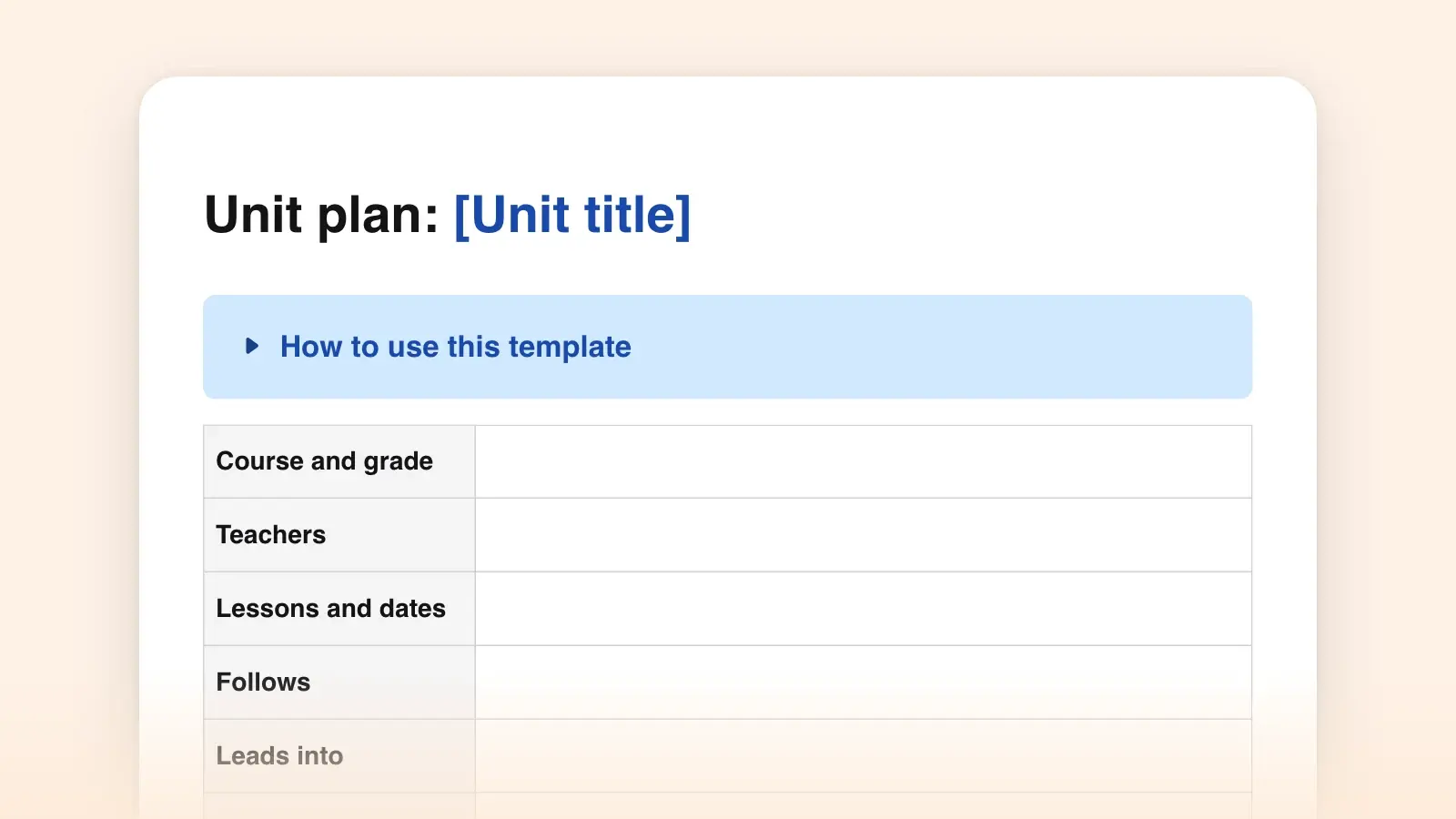
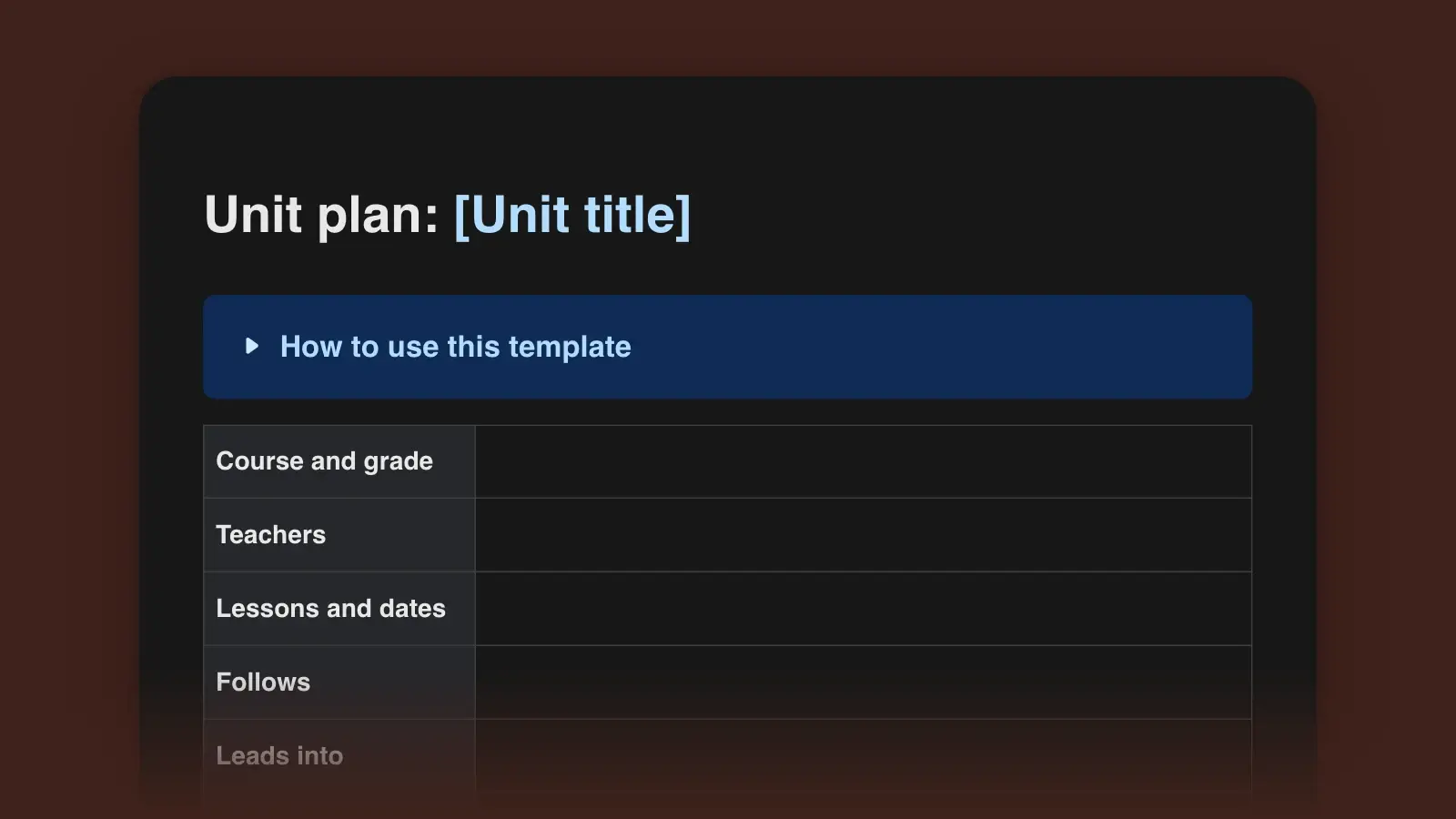
A syllabus is the term at a glance. The unit plan template breaks it into weeks of teaching, and the lesson plan template into single class periods. If your department asks for a formal course outline as well, most of it comes straight from the description, outcomes and grading sections above. Download the .docx for Word or Google Docs, or the Markdown file for a course site that accepts it.
Frequently asked questions
What should a syllabus include?
Course and instructor information, a course description, learning outcomes, required materials and their cost, the graded assignments and their weights, the grading scale, course policies (attendance, late work, academic integrity, AI use), accessibility and support statements, and a week-by-week schedule. Many institutions require specific statements as well; check your teaching center's syllabus page.
How long should a syllabus be?
There is no standard length. Spend the pages on what students act on: the schedule, the grading and the policies. Move background material and long policy text to links. If a student cannot find the late-work rule in under a minute, the syllabus is too long or badly organized.
What is the difference between a syllabus and a course outline?
The terms overlap, and at some institutions and in some countries a course outline is simply the syllabus. Where they differ, the course outline is the official description of a course, with its outcomes, topics and assessment methods, used for approval and transfer. The syllabus is one instructor's plan for one section in one term, with dates, policies and contact details.
Can I change the syllabus after the term starts?
Usually, if you say how changes will be announced and the change does not hurt students. Yale's Poorvu Center advises against moving due dates or exam times to students' disadvantage or adding costs after students have set their schedules. Check whether your institution has its own rule.