When to use it
- Daily lessons for one class period or block, in any subject from kindergarten to 12th grade
- Formal plans for student teaching, observations and evaluations
- Plans a substitute or co-teacher can follow without you in the room
- Workshops, tutoring sessions and trainings with a fixed time and one skill to teach
How to use this template
- Start from the standard and the exit ticket
Copy the standard's code and wording exactly from your state or district document: Common Core in many states, the TEKS in Texas, the B.E.S.T. standards in Florida. Then write the objective and the exit ticket before you plan a single activity. This is backward design, the approach Grant Wiggins and Jay McTighe set out in Understanding by Design (1998): decide what students should be able to do, decide what evidence will show it, and only then plan the lesson that gets them there.
- Budget the minutes
Fill in the Time column before the activities. Count from the bell, not from the moment the room settles, and leave two or three minutes unassigned for handing out papers and moving desks. If the phases don't fit, cut an activity now, at your desk, rather than at minute 44 with the exit tickets still in your hand.
- Write what you and the students do
The procedure has separate columns for the teacher and the students because a plan that lists only your actions hides how long the class sits and listens. Give every phase a check, a question or a quick look at work, that tells you whether to move on or go back.
- Fill in the reflection the same day
Sort the exit tickets into three piles: met, almost, not yet. Write the counts under "After the lesson," along with the one change you would make. Tomorrow's plan starts from that section, and next year's version of this lesson starts from all of it.
Write an objective you can check
An objective names what students will do, in a form you can see or hear before they leave. "Understand" and "learn about" fail that test, because nobody can watch understanding happen. Robert Mager's long-standing format for instructional objectives has three parts: the performance (what the learner does), the conditions (given what, using what) and the criterion (how well). Many teacher-preparation programs teach the same idea as ABCD: audience, behavior, condition, degree.
Checkable
- Given a sentence that names a feeling, students will rewrite it as a paragraph of at least five sentences that uses three senses and never names the feeling.
- Students will label evaporation, condensation and precipitation on a blank water-cycle diagram and explain one in their own words.
- Using fraction strips, students will compare two fractions with unlike denominators and justify each comparison in writing, correct on 4 of 5.
Vague
- Students will understand sensory details.
- Students will learn about the water cycle.
- Students will explore fractions.
The verbs come from the revised version of Bloom's taxonomy (Anderson and Krathwohl, 2001), whose levels run remember, understand, apply, analyze, evaluate and create. "Understand" is a real level. The trick is to name the visible action that shows it, such as explain, summarize, classify or compare. Pick the verb for the level the lesson actually reaches. A lesson where students copy definitions is a remember lesson, whatever the objective claims. Then turn the objective into two or three "I can" statements that students can read on the board and check their own work against.
Budget the minutes by phase
The procedure follows a shape most teachers will recognize: warm-up, hook, the teacher models, the class practices together, students practice alone, and the lesson closes with a check. Lesson models differ more in vocabulary than in substance, so if your school or program asks for a named model, relabel the phases rather than starting over.
| This template | Madeline Hunter | Gradual release | 5E (science) |
|---|---|---|---|
| This templateWarm-up and hook | Madeline HunterAnticipatory set | Gradual release— | 5E (science)Engage |
| This templateModel | Madeline HunterInput, modeling, checking for understanding | Gradual releaseFocus lesson (I do) | 5E (science)Explain |
| This templateGuided practice | Madeline HunterGuided practice | Gradual releaseGuided instruction (we do) | 5E (science)Explore, which comes before Explain |
| This templateIndependent practice | Madeline HunterIndependent practice | Gradual releaseCollaborative, then independent (you do) | 5E (science)Elaborate |
| This templateClosure and exit ticket | Madeline HunterClosure | Gradual release— | 5E (science)Evaluate |
Gradual release of responsibility was described by P. David Pearson and Margaret Gallagher in 1983. Douglas Fisher and Nancy Frey later split the "you do" stage into collaborative and independent work. Whatever the labels, the minutes decide whether the lesson works. Use these splits as a first draft and adjust them to the skill.
| Phase | 45 min | 50 min | 60 min | 90-min block |
|---|---|---|---|---|
| PhaseWarm-up | 45 min4 | 50 min5 | 60 min5 | 90-min block8 |
| PhaseHook and objective | 45 min3 | 50 min3 | 60 min4 | 90-min block5 |
| PhaseModel | 45 min8 | 50 min10 | 60 min12 | 90-min block15 |
| PhaseGuided practice | 45 min9 | 50 min10 | 60 min13 | 90-min block20 |
| PhaseIndependent practice | 45 min12 | 50 min13 | 60 min17 | 90-min block27 |
| PhaseClosure and exit ticket | 45 min6 | 50 min7 | 60 min7 | 90-min block10 |
| PhaseUnassigned | 45 min3 | 50 min2 | 60 min2 | 90-min block5 |
Protect two phases when the lesson runs long. Closure is the first thing to vanish, and without it you find out tomorrow which students didn't get it. Independent practice is where students show what they can do without you. If the model runs over, shrink guided practice to one shared example instead.
Lesson plan example: 7th-grade ELA
A 50-minute writing lesson on show, don't tell, the fourth lesson in a personal narrative unit. The class, the sentences and the results are invented. The standard is real.
- Standard: CCSS.ELA-Literacy.W.7.3.d. Use precise words and phrases, relevant descriptive details, and sensory language to capture the action and convey experiences and events.
- Objective: Given a sentence that names a feeling, students will rewrite it as a paragraph of at least five sentences that uses details from three senses and never names the feeling.
- Success criteria: I can show a feeling through what a character sees, hears, touches, smells or tastes. I can leave the feeling's name out and a reader can still guess it.
- Exit ticket: Underline each sensory detail in your paragraph and label the sense. Then answer in one sentence: which detail does the most work?
- Materials: A blank five-senses chart for each student, 12 "telling" cards ("The bus was crowded." "Ms. Ortiz was angry."), exit ticket slips.
| Time | Phase | Teacher | Students |
|---|---|---|---|
| Time0–5 | PhaseWarm-up | TeacherBoard: "Jonah was scared." beside a showing version of the same moment | StudentsWrite which one they can picture, and the words that did it |
| Time5–8 | PhaseHook and objective | TeacherTakes three answers; reads the objective and success criteria | StudentsRestate the goal to a partner |
| Time8–18 | PhaseModel | TeacherRevises "The cafeteria was loud." aloud, filling the senses chart first | StudentsCopy the chart; call out a detail for one sense |
| Time18–28 | PhaseGuided practice | TeacherPairs revise "Ms. Ortiz was angry."; circulates; two pairs read aloud | StudentsDraft together; the class names the senses each pair used |
| Time28–41 | PhaseIndependent practice | TeacherConfers with the three students who stalled in pairs | StudentsPick a telling card or a sentence from their own draft; write the paragraph |
| Time41–48 | PhaseClosure | TeacherOne student reads a paragraph aloud; the class guesses the feeling | StudentsLabel the senses; answer the exit question |
| Time48–50 | PhaseUnassigned | TeacherCollects exit tickets at the door | Students— |
Before: The cafeteria was loud.
After: Trays slammed down on every table at once. Someone near the windows yelled "Marco!" and three different Marcos turned around. The milk carton sweated in my hand, and the smell of fish sticks clung to my sweatshirt. I had to lean so close to hear Priya that her hair tickled my ear, and I still caught only every other word.
The model is written to be taken apart: sound in the first two sentences, touch and smell in the third, touch and sound in the last, and the word "loud" nowhere. That night the teacher sorted 26 exit tickets: 18 met the objective, 5 named the feeling anyway ("she was nervous, her hands shook"), and 3 used only one sense. The next lesson opened with two of the five, names removed, as a revision warm-up, and the three students got a sentence-frame card. That is what the "After the lesson" section is for.
Differentiation that fits one page
Differentiation changes the content, the process, the product or the learning environment for some students while the objective stays the same. The template keeps it to four rows, because a plan with a paragraph for every learner doesn't get read in the middle of a lesson. Here are the rows from the example.
| Students | In the example lesson |
|---|---|
| StudentsNeed more support | In the example lessonSentence frames on the chart ("I hear… My hands…"), a target of three sentences and two senses, a check-in at minute 32 |
| StudentsEnglish learners | In the example lessonA word bank of sensory verbs with pictures; may plan in their home language first; a partner who shares their language in pair work |
| StudentsIEP or 504 plan | In the example lessonWhat each plan specifies: here, a typed paragraph for one student and the telling cards read aloud for another |
| StudentsReady for more | In the example lessonWrite the same moment twice, from two characters' points of view, using no adjectives |
Two rules keep the rows honest. Accommodations in an IEP or 504 plan are requirements, not suggestions, so copy them from the plan rather than from memory. And the extension for early finishers should be harder, not longer. A second paragraph of the same kind teaches students that finishing early earns more work. When you hand out a reading, match its level to the student rather than the grade. Readability formulas give a rough first guess, and your own read of the passage gives a better one.
Where lesson plans go wrong
- The activity comes first. A plan built around a fun activity ends with students who enjoyed the period and an exit ticket that measures nothing in particular.
- Only the teacher column is filled in. If the plan says what you will say for 25 minutes, the class will listen for 25 minutes. The students column shows how long they actually work.
- No check before moving on. One question that every student answers at the same moment, on whiteboards or with fingers held up for A, B, C or D, tells you whether guided practice should start or the model should run again.
- The closure gets cut. It is the last phase, so it is the one that disappears. Put the exit ticket on the plan as a fixed time, not "if there's time."
- Only you can read it. Observation copies and sub plans need full sentences: "Pairs revise the sentence on slide 4," not "pairs → S4."
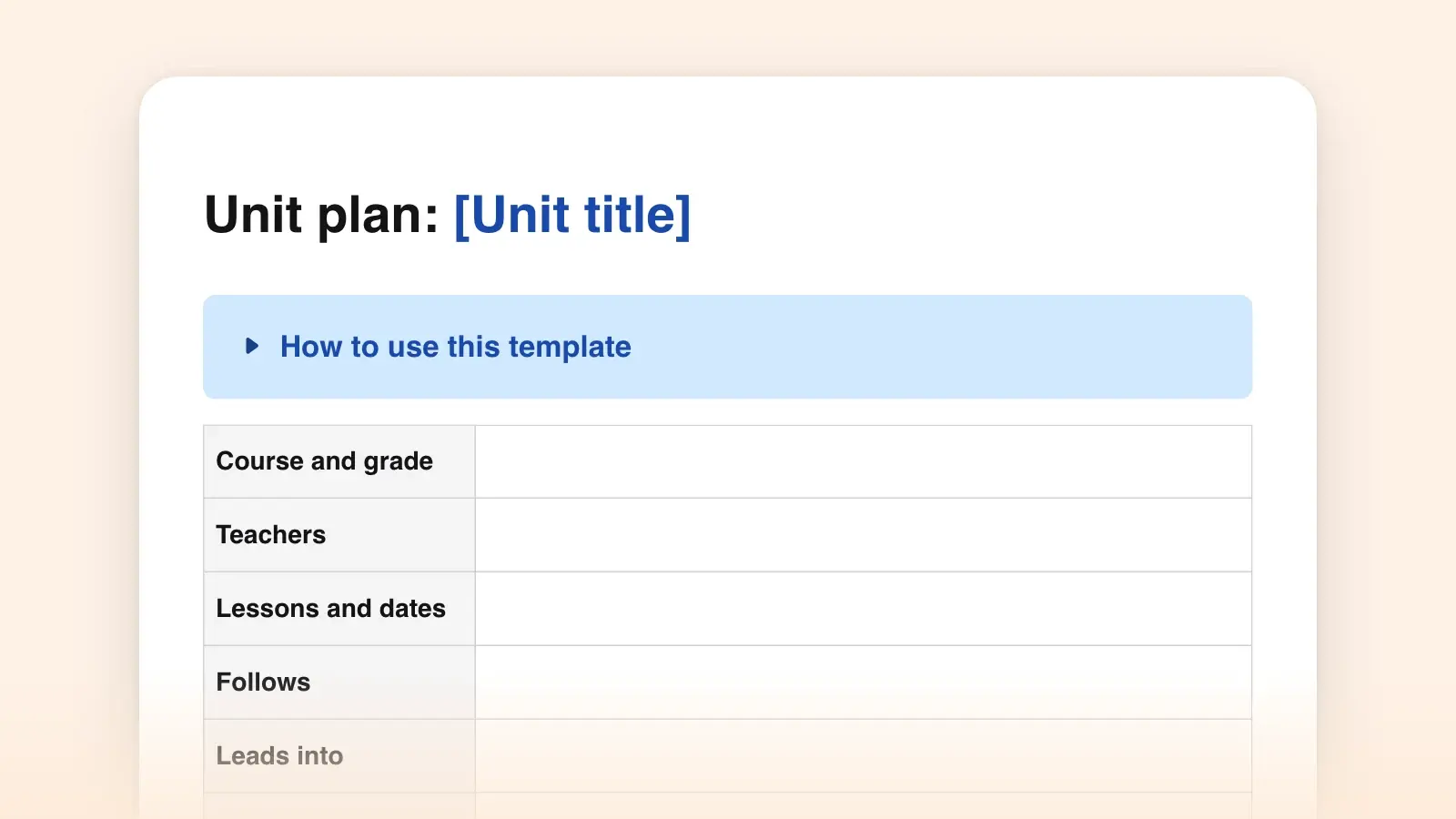
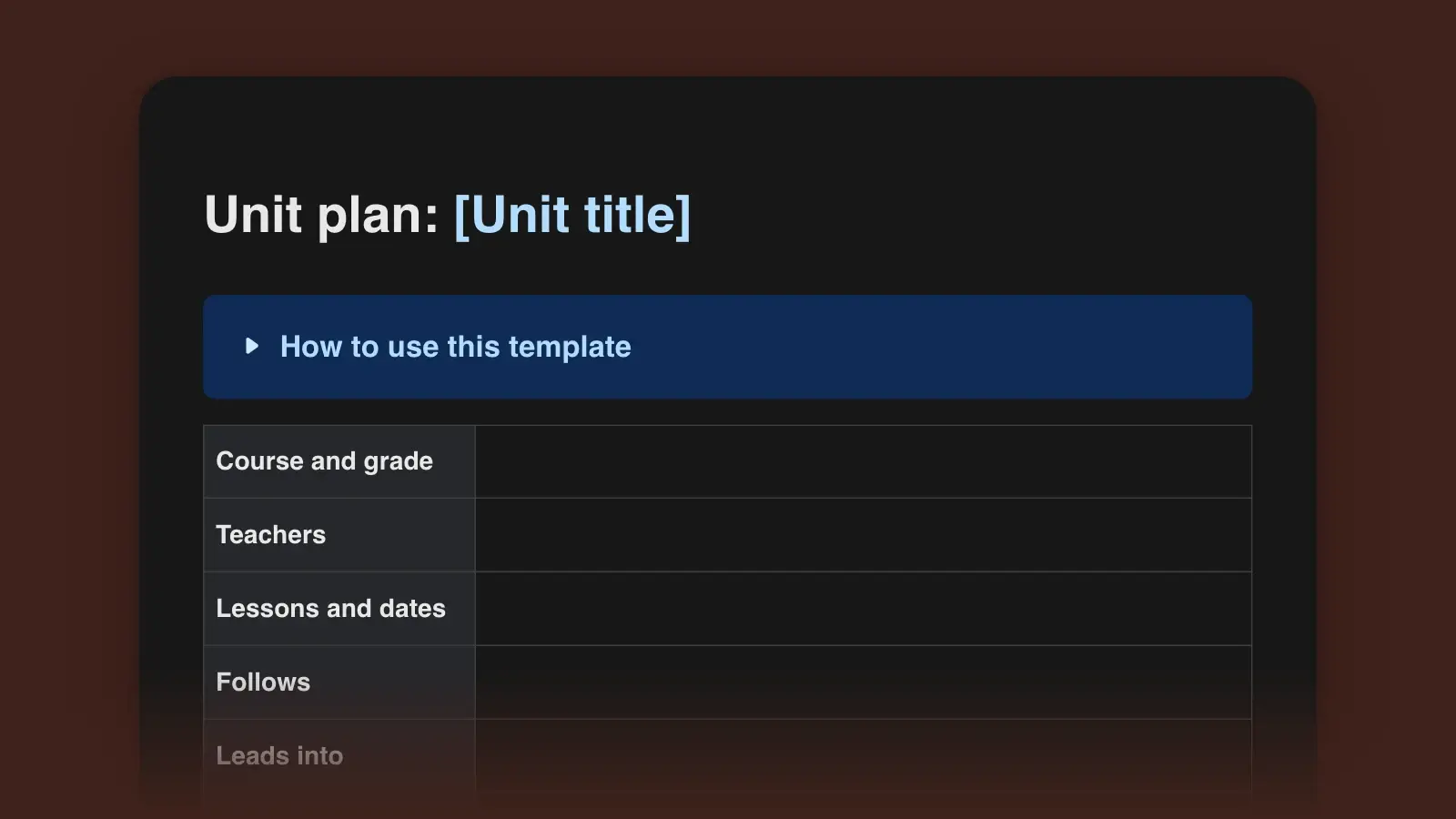
A single lesson is one step in a longer sequence, and the unit plan template lays out the weeks around it. For the comments you write on exit tickets and drafts afterward, see these student feedback examples.
Frequently asked questions
What are the main parts of a lesson plan?
The standard, a measurable objective, materials, a timed procedure (warm-up, instruction, guided practice, independent practice, closure), an assessment such as an exit ticket, and notes on differentiation. Many plans end with a short reflection written after the lesson is taught.
How detailed should a daily lesson plan be?
Detailed enough that another teacher could teach from it: the times, what the teacher and the students do, and the exact prompts and questions. Experienced teachers often write less for their own use, while plans for observations and student teaching usually need every section. Check your district's or program's required format.
What is the difference between a lesson plan and a unit plan?
A unit plan covers several weeks: the standards, the big questions, the final assessment and the order of lessons. A lesson plan covers one class period or block and shows, minute by minute, how one step of that unit gets taught.
Can I use this lesson plan template in Word or Google Docs?
Yes. Download the .docx and open it in Word, or upload it to Google Drive and open it with Google Docs. The procedure and differentiation tables come through as real tables. The Markdown file suits plain-text editors and note apps.