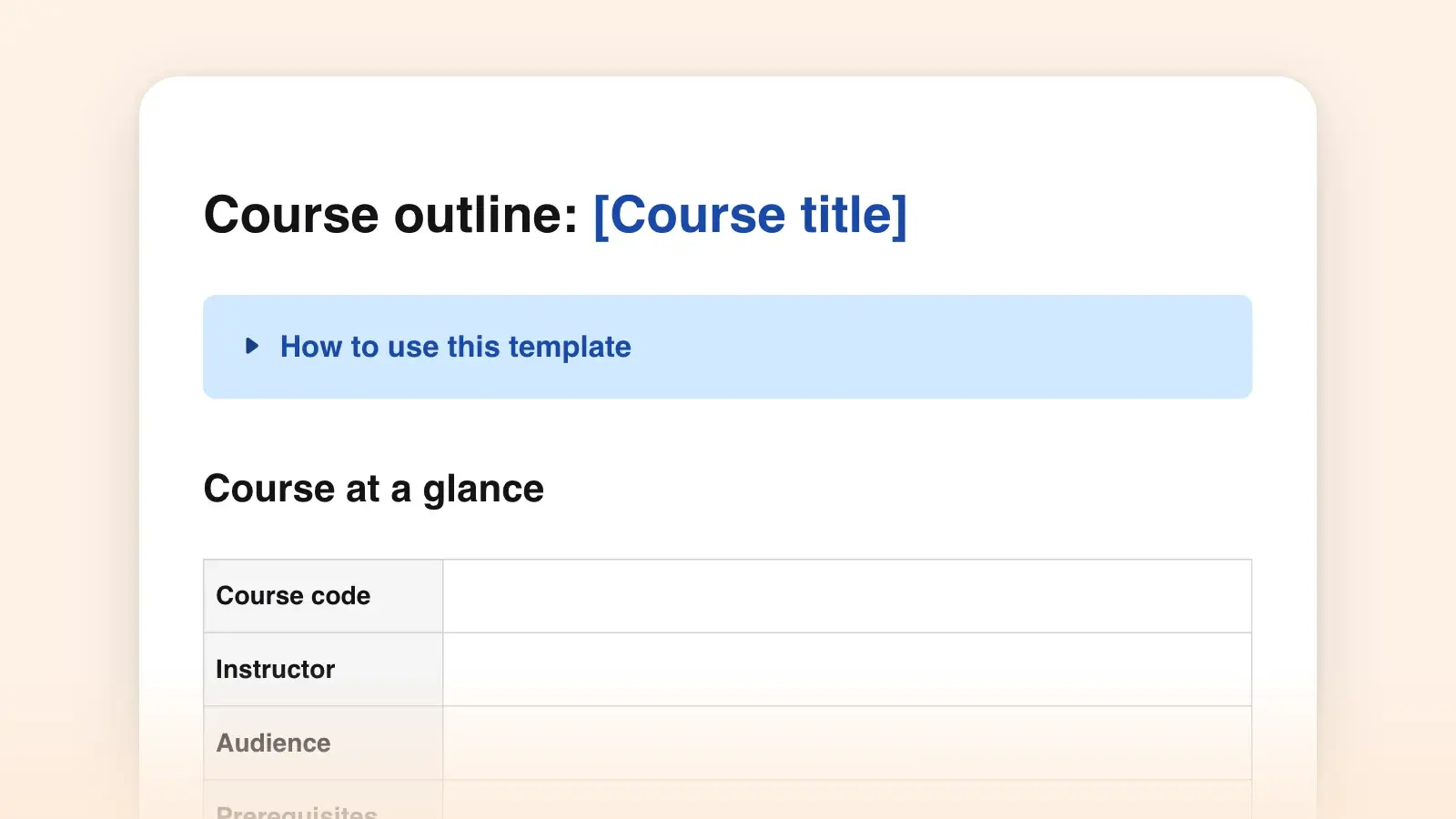
When to use it
- A new college or continuing-education course that needs outcomes and a module plan before the syllabus
- Online and self-paced courses, where the modules carry the structure a live class would
- Writing workshops, bootcamps and training programs that run over several weeks
- Course proposals and program reviews that ask how each outcome is taught and assessed
How to use this template
- Write the outcomes before the modules
Start with what students will be able to do when the course ends, not with the topics you want to cover. Write each outcome as one sentence built on a verb you could watch someone do: draft, revise, compare, design, explain. This is backward design, the order Grant Wiggins and Jay McTighe argued for in Understanding by Design (1998): results first, then the evidence, then the teaching. Three to five outcomes cover most courses of six to ten weeks. A list of twelve is usually a topic list in disguise.
- Turn the topics into modules
Group the material into modules of one to three weeks, and give each a title that says what students do in it: "Write the scene," not "Scene." Fill in the Outcomes column of the module map as you go. Every module should serve at least one outcome, and the last one usually serves all of them.
- Give every outcome an assessment
Fill in the assessment table next. An outcome with no assessment has no evidence behind it, and an assessment with no outcome raises the question of why it is graded. Let the weights follow importance: a final project that shows every outcome deserves more of the grade than a reading quiz.
- Run the alignment check, then build the rest
Work through the checklist at the end of the outline. Once it passes, the outline is the stable core of the course. The syllabus adds this term's dates, office hours and room on top of it, and the catalog entry or course page borrows the description and outcomes. Download the .docx for a committee or co-teachers who work in Word, or the Markdown file for a plain-text editor or notes app.
Course outline vs. syllabus
The two names overlap, and institutions use them differently. At most American colleges the syllabus is the document students get on the first day, and the course outline is the plan underneath it. At some universities, UNSW Sydney among them, "course outline" is the name of the student-facing document itself. California's community colleges keep a formal course outline of record for each credit course, and state regulations (Title 5, section 55002) list what it must specify, from unit value and contact hours to objectives, content, assignments and methods of evaluation.
| Course outline | Syllabus | |
|---|---|---|
| Answers | Course outlineWhat is taught, in what order, and how learning is measured | SyllabusHow this term's class will run |
| Main parts | Course outlineOutcomes, module map, assessments and weights | SyllabusDates, contact details, office hours, policies, calendar |
| Changes | Course outlineWhen the course is redesigned | SyllabusEvery term, sometimes every section |
| Read by | Course outlineInstructors, designers, reviewers and students | SyllabusStudents |
This template ends with short Materials and Policies sections so it can stand alone for a workshop or an online course. For a credit course with a separate syllabus, move those two sections there and keep the outline to outcomes, modules and assessments.
Write outcomes you can assess
An outcome says what a student can do at the end, in a form someone else could check. "Understand," "appreciate" and "be familiar with" fail that test, since nobody can watch appreciation happen. The usual source of better verbs is the revised Bloom's taxonomy (Anderson and Krathwohl, 2001), whose six levels run remember, understand, apply, analyze, evaluate and create. Pick the verb for the level the course actually reaches. A course that ends in a portfolio reaches create. A course that ends in a multiple-choice exam rarely gets past apply, whatever its outcomes claim.
Assessable
- Draft a personal essay of 2,000–3,500 words that moves between scene and reflection.
- Compare the structures of two published essays and explain which suits a given story.
- Give written workshop feedback that names one strength and one revision priority, with lines from the draft.
Vague
- Understand the personal essay.
- Be familiar with essay structures.
- Appreciate the workshop process.
Course outcomes and module objectives are two sizes of the same idea. Many teaching centers call the course-level statements outcomes and the smaller module-level steps objectives, although plenty of people use the words interchangeably. "Write a 750-word scene in the present tense" is a step toward "draft a personal essay." Tag each objective with the outcome it serves, as the template does with (CLO 2), and the module map nearly fills itself in.
The test that matters is whether the outcome, the activity and the assessment ask for the same thing. John Biggs, whose Teaching for Quality Learning at University is built on the idea, calls this constructive alignment. If the outcome says "revise" and the only assessment is a quiz on revision terms, students will learn the terms.
Course outline example: an eight-week essay course
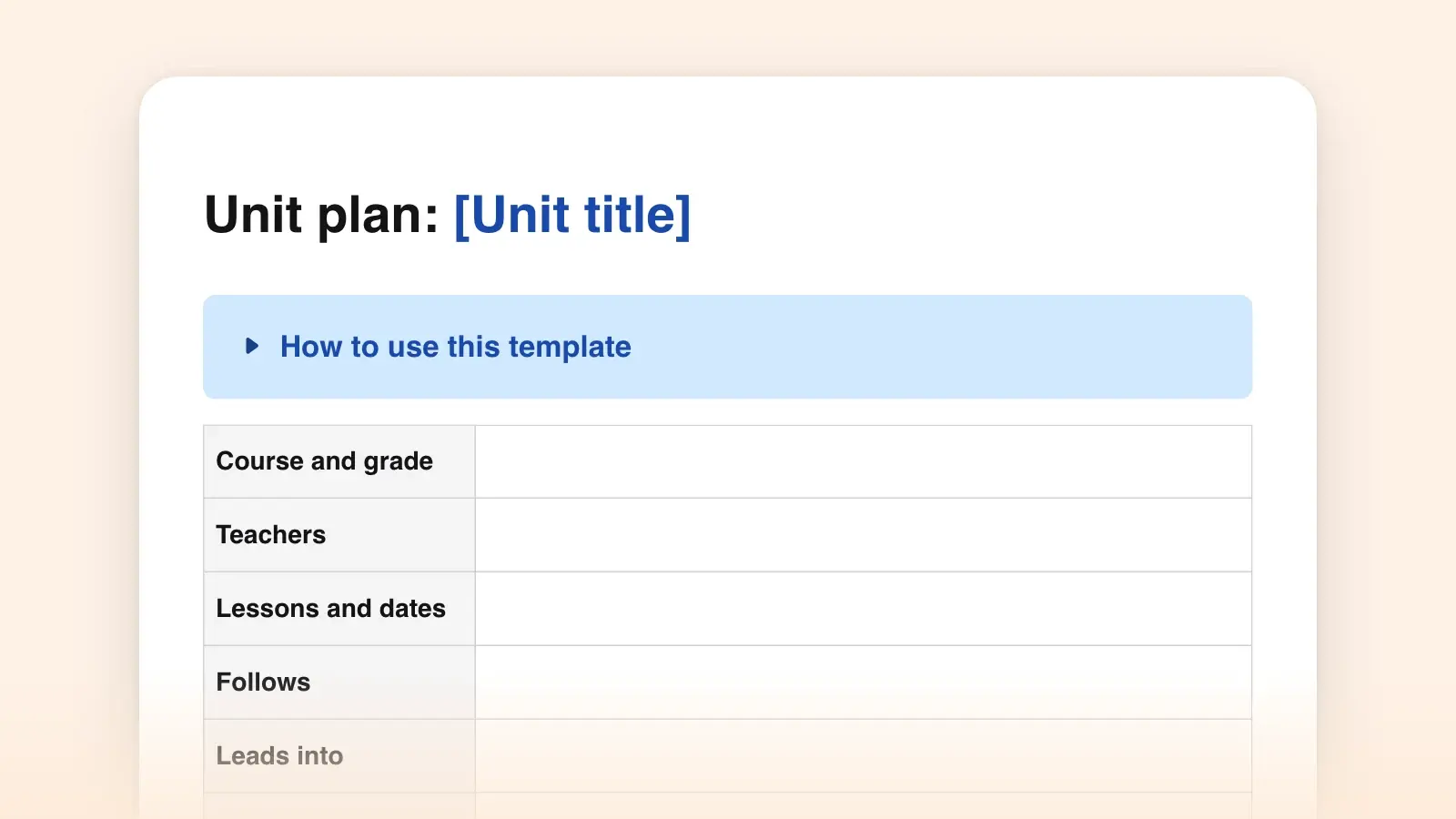
An online, non-credit course for adult writers: one 90-minute live session a week plus about three hours of reading and writing. The course is invented, and it has the shape of the illustration at the top of this page: three outcomes, five modules, and a final module that covers all three.
- Course: Writing the Personal Essay
- For: Adults with an idea or a rough draft. No workshop experience needed.
- Format: Online. One live session a week, plus independent reading and writing.
- Length: 8 weeks, about 4.5 hours a week, 36 hours in all
By the end of this course, students will be able to:
- Compare the structures of published personal essays and choose one that suits a given story. (CLO 1)
- Draft a personal essay of 2,000–3,500 words that moves between scene and reflection. (CLO 2)
- Revise the essay in response to workshop feedback, and give written feedback that names a strength and a revision priority. (CLO 3)
| Module | Weeks | Outcomes | Students | Assessed by |
|---|---|---|---|---|
| Module1. Find the essay | Weeks1 | OutcomesCLO 1 | StudentsRead three model essays; list five possible subjects | Assessed byPractice only |
| Module2. Write the scene | Weeks2–3 | OutcomesCLO 1, 2 | StudentsMap the scenes in a model essay; write a 750-word scene | Assessed byScene draft (15%) |
| Module3. Add the reflection | Weeks4 | OutcomesCLO 2 | StudentsWrite the present-day voice that interprets the scene | Assessed byScene with reflection (15%) |
| Module4. Draft and workshop | Weeks5–6 | OutcomesCLO 2, 3 | StudentsChoose a structure; finish a full draft; critique two classmates | Assessed byFull draft (20%), two critique letters (15%) |
| Module5. Revise | Weeks7–8 | OutcomesCLO 1, 2, 3 | StudentsPlan a revision, carry it out, explain the choices | Assessed byFinal essay and revision memo (35%) |
- Week: 4. Student time: 1.5 hours live, about 3 hours independent.
- Objectives: Students will mark where a model essay shifts from the voice of the person who lived the events to the voice of the person writing now (CLO 2). Students will write 200–400 words of reflection that interpret their Module 2 scene without retelling it (CLO 2).
- Topics: The two voices of a personal essay, where reflection goes, endings that interpret instead of summarizing.
- Readings: Two model essays chosen by the instructor, and an annotated sample with the reflection highlighted.
- Activities: 20 minutes on the two voices, 30 minutes in breakout pairs marking reflection in a model essay, 40 minutes of writing and reading aloud.
- Assessment: Scene with reflection, due at the end of week 4, 15% of the grade. Three criteria: the reflection interprets rather than retells, it speaks from the present, and it stays under 400 words.
A few choices are visible from the map alone. Module 1 has no graded work, so students can write badly in week one without it costing them. Module 2 is the essayist's version of show, don't tell, and Module 3 is its counterweight: reflection gets a week of its own because it is what turns an anecdote into an essay. The workshop sits in weeks 5 and 6, late enough that everyone has a full draft and early enough to leave two weeks for revision.
Budget the hours per module
Outcomes decide what goes in. Hours decide whether it fits. Add up what each module asks of students, live time plus reading, writing and practice, and compare it with the weekly time promised at the top of the outline. A module that asks for eight hours in a course that promised four gets skimmed, and the part that gets skipped is usually the reading.
Credit-bearing courses in the US have a federal yardstick. The Department of Education defines a credit hour as at least one hour of classroom or direct faculty instruction plus a minimum of two hours of out-of-class work each week, for about fifteen weeks for a semester hour or ten to twelve weeks for a quarter hour. For a semester course, that works out as follows.
| Semester credits | Instruction a week | Outside work a week (minimum) | Total over 15 weeks |
|---|---|---|---|
| Semester credits1 | Instruction a week1 hour | Outside work a week (minimum)2 hours | Total over 15 weeks45 hours |
| Semester credits3 | Instruction a week3 hours | Outside work a week (minimum)6 hours | Total over 15 weeks135 hours |
| Semester credits4 | Instruction a week4 hours | Outside work a week (minimum)8 hours | Total over 15 weeks180 hours |
For a non-credit course, run the same arithmetic with your own numbers: the example above is 8 weeks at 4.5 hours, or 36 hours. Then time a module by doing its work yourself, and assume students will need longer. You wrote the materials.
Where course outlines go wrong
- The topic list is the outline. Twelve weeks named after textbook chapters say what you will cover, not what students will be able to do. Write the outcomes first and let the topics settle into modules around them.
- Too many outcomes. If every week has its own course outcome, those are module objectives. Merge them into a few that the final assessment can show.
- An outcome nobody assesses. Often the one about collaboration or ethics. Add a task that produces evidence, or move the line into the description.
- The verb and the task disagree. An outcome that says "design," tested by a multiple-choice exam. Change the task or change the verb.
- No time to use feedback. A capstone due the week after the last new material leaves students no room to revise. End new content a module or two before the course does.
Once the outline holds up, the other course documents grow out of it. The syllabus template adds the term's dates and policies, and each module breaks down into class sessions with the lesson plan template. For a single day rather than a whole course, use the workshop outline template instead.
Frequently asked questions
What should a course outline include?
A short description, a few learning outcomes, a module map that shows which outcome each module serves, an assessment plan with weights, and the materials. If there is no separate syllabus, add the main policies. Many institutions require more fields, such as credit hours or prerequisites, so check your program's format.
What is the difference between a course outline and a syllabus?
The course outline is the plan of the course: outcomes, modules and assessments, which stay the same from term to term. The syllabus is the version for one class in one term, with dates, contact details and policies. Some universities use "course outline" for the student-facing document, so check local usage.
How many learning outcomes should a course have?
There is no fixed number. Three to five suits most short courses, and longer courses may need a few more. If you have more outcomes than modules, some of them are probably module objectives.
How do I outline an online or self-paced course?
Use the same structure. Modules matter more without live sessions, because students work through them alone. Give each module a time estimate, one clear task, and a way for students to check their own work before the graded assessment.