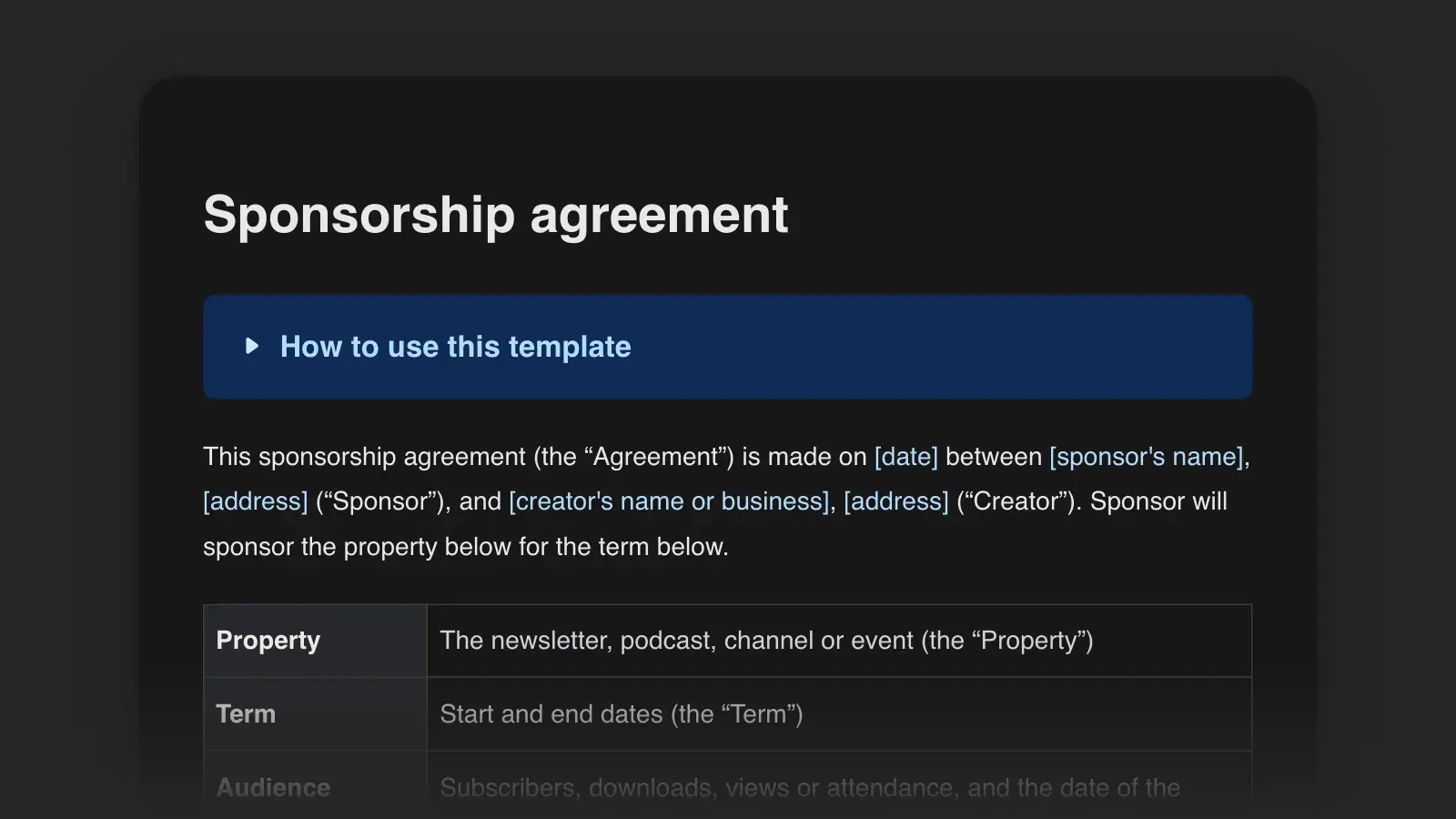
When to use it
- A brand sponsoring issues of your newsletter or episodes of your podcast
- Sponsored videos, posts or live streams with a set list of deliverables
- A company sponsoring a reading series, book festival, writing conference or contest
- Renewing a returning sponsor, with the new dates and fee in one table
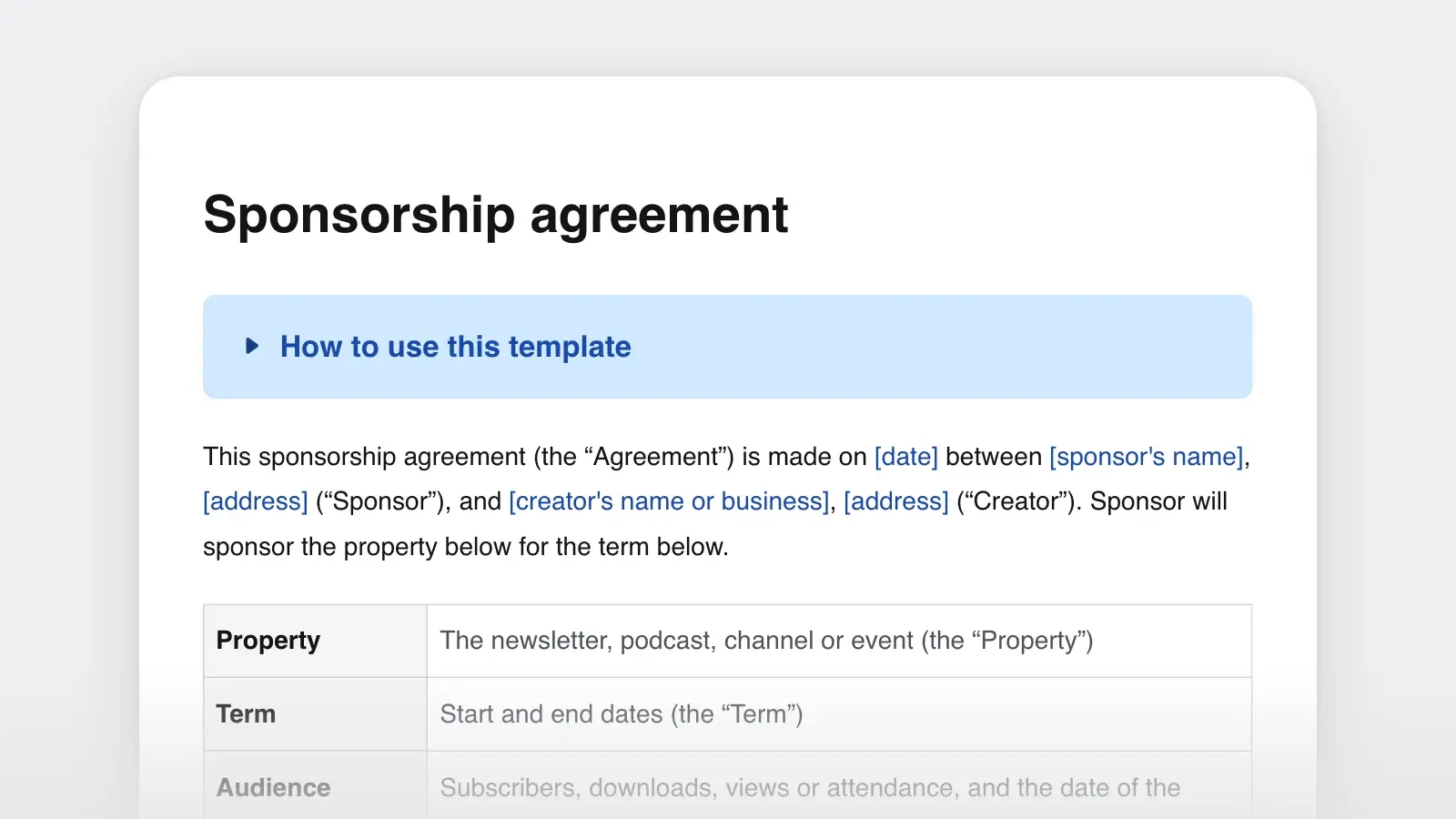
Most sponsorship agreement templates are written for sports teams and charity events. This one is built around what sponsors of writers and creators actually buy: placements. A newsletter slot, a host-read ad, a logo on a festival program, each with a date, an approval window and a price. For writing a client commissions from you, use a freelance writing contract instead.
How to use this template
- Fill in the deliverables table first
Every other clause hangs off it: the payment schedule, the approval dates, the make-goods. Give each placement its own row and a date. If the sponsor's email says "a few mentions in the spring", turn that into rows before you talk about money.
- Cut it to fit the deal
For an event, rename "Creator" to "Organizer" and list benefits instead of placements: signage, a booth, tickets, a speaking slot. For a single sponsored post, delete what does not apply, such as exclusivity, rather than leaving brackets empty.
- Send it as Word and keep every round
Contracts tend to go back and forth as Word files with tracked changes, so download the .docx. Save each returned draft as a new version. A diff between rounds shows exactly which clause someone quietly rewrote. Strokes keeps version history for every document and marks the changes when you preview an older draft.
- Review, sign, then file it with the invoices
Have a lawyer read the final draft. Sign before the first materials are due, and keep the signed copy as a PDF with the invoices and the performance reports.
Clauses worth making specific
A clause that sounds reasonable in general terms leaves a question open, and someone will ask it after the money has moved. Write the specific version.
| Clause | Vague | Specific |
|---|---|---|
| ClauseApproval | VagueSponsor approves all content | SpecificDraft 5 business days ahead; 2 days to reply; silence is approval |
| ClauseUsage | VagueSponsor may use the content | SpecificReposts with credit until Dec 31; paid ads need a new fee |
| ClauseExclusivity | VagueNo competing sponsors | SpecificNo other note-taking apps from May 1 to 31 |
| ClauseResults | VagueStrong performance | SpecificReport within 7 days; no click guarantee |
| ClauseCancellation | VagueEither party may cancel | Specific30 days' notice; 50% kill fee inside 14 days |
| ClauseMistakes | VagueCreator will fix errors | SpecificReplacement placement within 30 days, or a refund |
Two clauses deserve a second look. Usage: a sponsor that wants to run your post as an ad from your own account is buying more than a placement, so give that its own fee and end date. If the sponsor wants to own the content outright, you are closer to a work-for-hire agreement and should price it that way. Exclusivity: name the category and the dates. "No competitors" with no end date can keep a newsletter empty of sponsors for a year.
What the disclosure clause covers
In the United States, paid endorsements fall under the Federal Trade Commission's Endorsement Guides, which the FTC revised in 2023. Its guidance for influencers comes down to a few rules:
- A material connection includes free products and perks, not only money.
- The disclosure goes with the endorsement, not on a profile page, at the end, or behind a "more" link.
- In video, disclose in the video itself, both spoken and on screen. In a live stream, repeat it.
- Plain words work: "Ad", "Advertisement", "Sponsored", or clearer still, "Sponsored by" and the brand. Shorthand like "spon" or a bare "collab" does not.
- Don't rely on a platform's built-in paid-partnership label alone. Add your own words.
The FTC also expects advertisers to monitor what their endorsers say, so a sponsor asking to see drafts is reasonable. The approval clause gives that review a deadline. The FTC does not mandate exact wording, and other countries have their own rules (in the UK, CAP and the CMA publish a guide for influencers). For how an ad read sounds once the disclosure is in it, see the podcast script template.
A filled-in newsletter deal
Property: Lantern & Ledger, a weekly newsletter about historical fiction, sent on Thursdays. 18,400 subscribers as of April 1, 2027.
- May 6, 13 and 20: primary placement at the top of the issue, about 120 words, one link, Copperleaf Notebooks logo.
- June 3: a one-line thank-you in the closing notes.
Fee: $2,100 in total, with $1,050 on signing and $1,050 within 30 days after the May 20 issue.
Approval: drafts go out five business days before each issue. Copperleaf replies within two business days or the draft stands. One round of changes is included.
Exclusivity and usage: no other notebook or stationery sponsors in May. Copperleaf may repost the placements with credit until November 30, 2027. Ads that use the newsletter's name need a new agreement.
Events and nonprofit sponsors
If the sponsored party is a US tax-exempt organization, such as a nonprofit literary festival, the wording of the thank-you can matter for tax. Under the Treasury regulation on qualified sponsorship payments (26 CFR 1.513-4), an acknowledgment may include the sponsor's name, logo, slogans that don't praise or compare, locations, phone number and web address, and may call it the exclusive sponsor. Qualitative or comparative language, prices, endorsements and inducements to buy count as advertising, and a deal that keeps competitors' products out of the event is generally treated as a benefit to the sponsor. Payments tied to attendance figures do not qualify. Ask your accountant before "Proud sponsor, now 20% off" goes on the festival banner.
Frequently asked questions
What should a sponsorship agreement include?
The parties, what is sponsored and for how long, a dated list of deliverables, the fee and payment schedule, review and approval, disclosure, exclusivity, who owns the content and how the sponsor may use it, what happens when a placement is missed, cancellation and kill fees, and general terms such as liability, confidentiality and governing law.
Do I need a contract for one sponsored post?
A short one, yes. A single placement still has a date, a fee, a link, a disclosure and an approval step, and each of them can go wrong. Fill in the deliverables table and the fee section, and delete the clauses that do not apply.
Who owns sponsored content?
Whoever the agreement says. This template keeps ownership with the creator and gives the sponsor a limited right to repost the placements with credit until a set date. Paid ads that use the creator's name or content need separate approval and a separate fee.
What is a kill fee in a sponsorship agreement?
A payment the sponsor owes when it cancels a placement late, because the creator has already held the slot and often written the copy. This template sets it as a share of the placement's fee when the cancellation comes less than a set number of days before the date.