When to use it
- Articles, blog posts and web copy for a client that has no contract of its own
- One-off projects such as a white paper, case study or e-book, where scope and revision rounds need limits
- A first project with a new client, where a deposit and a payment date protect the first invoice
- Checking a contract a client sends you: compare it clause by clause and note what is missing
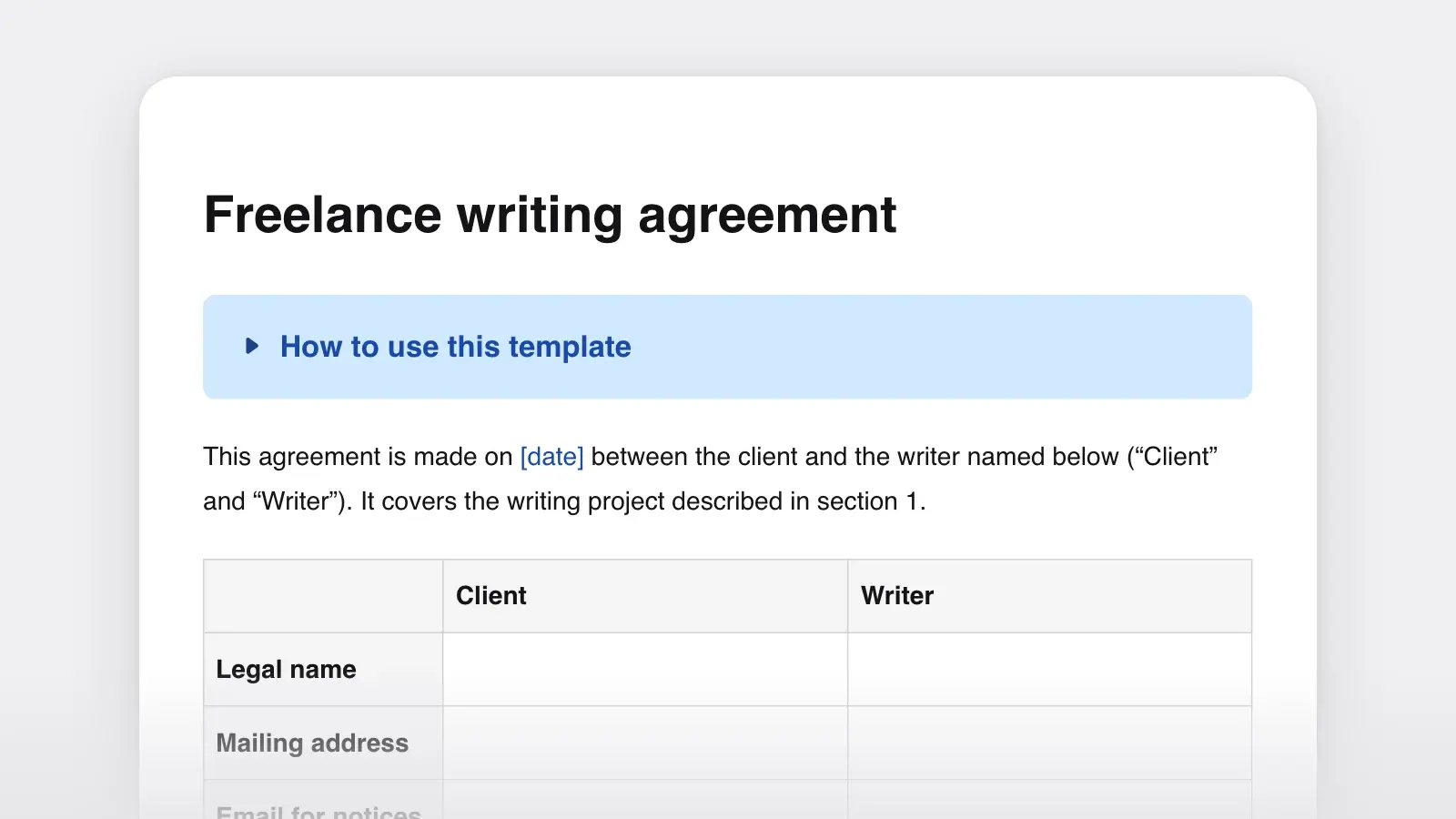
How to use this template
- Agree on the project first
A contract records a deal; it is a poor place to negotiate one. Settle the topic, length, deadline and fee by email or on a call, then fill in section 1 from that. "1,200–1,500 words, two interviews, first draft on March 3" leaves nothing to argue about. "A blog post" leaves everything. Name the client's style guide if it has one, so house-style fixes count as edits rather than revision rounds.
- Choose one rights option
Section 5 offers three. Keep one, delete the other two and the bracketed instruction. If you are unsure which fits, read the rights table below; it is the clause with the longest consequences.
- Set money terms you will enforce
Fill in the deposit, the payment window, the late fee and the kill fee. Pick numbers you are willing to put on an invoice: a late fee you never charge only teaches the client that your terms are optional.
- Send it, sign it, keep the signed copy
Delete every unused bracket, export to PDF, and send it for signature before any work starts. In the US, the federal E-SIGN Act says a contract cannot be denied legal effect solely because it was signed electronically, so an e-signature service or a signed PDF exchanged by email is normal. File the countersigned copy with the project.
What each clause protects you from
Freelance writing disputes tend to start in four places: work that grows, feedback that never ends, money that arrives late, and rights nobody defined. Each section of the template closes one of them.
| Clause | The problem it prevents | What to write |
|---|---|---|
| Clause1. The work | The problem it prevents“Can you also do the social posts?” | What to writeWhat is included and what is not |
| Clause2. Revisions | The problem it preventsA fifth round of small tweaks | What to writeA number of rounds and a feedback window |
| Clause2. Approval | The problem it preventsA client who goes quiet and never signs off | What to writeApproval after a set number of days |
| Clause3. Deposit | The problem it preventsFinishing the work and never being paid | What to writePart of the fee before you start |
| Clause3. Payment | The problem it preventsAn invoice paid three months late | What to writeA due date and a late fee |
| Clause4. Kill fee | The problem it preventsA project canceled after you wrote it | What to writeWhat is owed, and that rights return to you |
| Clause5. Rights | The problem it preventsYour article reused in a book you never priced | What to writeWhich rights transfer, and when |
Rights, in plain English
Under US copyright law, the person who writes a work owns it, and a transfer of copyright is valid only if it is in writing and signed. So the rights clause decides what the client actually gets. With no written agreement at all, a magazine that runs your article is presumed to get only limited rights: to publish it in that issue, in revisions of that issue and in later collective works in the same series. These are the three arrangements you will meet most often.
| Option | The client gets | You keep | Typical fit |
|---|---|---|---|
| OptionAll rights | The client getsThe copyright: it can edit, reuse and resell the work | You keepOnly what the contract reserves, such as portfolio use | Typical fitWeb copy and brand content the client will update |
| OptionExclusive license | The client getsSole use for a set period or medium | You keepThe copyright, and the right to republish later | Typical fitEssays and features with resale value |
| OptionFirst rights | The client getsThe right to publish first | You keepEverything after first publication | Typical fitMagazines and literary journals |
Client contracts often say the work is "made for hire." For a freelancer, as opposed to an employee, US law treats a commissioned work as made for hire only when it falls into one of nine categories (a contribution to a collective work such as a magazine, a translation and an instructional text are three of them) and both sides sign a written agreement saying so. Many contracts add a fallback: if the work is not made for hire, the writer assigns all rights anyway. Either way the client ends up with everything, so price the job as an all-rights sale. The work-for-hire agreement template covers that setup, and a licensing agreement suits reprints of work you already own.
A filled-in example
Here is how sections 1, 3 and 4 read once the brackets are gone, for a single long article.
The work. One guide, "Choosing payroll software for a five-person firm," 1,800–2,000 words, delivered as a .docx. First draft due March 6; final due March 20.
Included: research, two customer interviews arranged by the Client, three headline options and a list of sources. Not included: images, uploading to the Client's website, and a newsletter version, which the Writer will quote separately if wanted.
Fee. $1,200 flat. $600 deposit on signing; $600 on approval. Invoices are due within 15 days.
Kill fee. The greater of the deposit or 25% before the first draft is delivered; 75% after. Rights in a canceled piece stay with the Writer.
When the client sends its own contract
Larger clients usually have a standard agreement and expect you to sign it. Read it against this template and raise the gaps before you start, when you still have leverage.
Frequently asked questions
Do I need a written contract for a small writing job?
A written agreement prevents most disputes, even if it is only an email both sides confirm, covering scope, fee, deadline and rights. Some places require one: New York State's Freelance Isn't Free Act, for example, requires a written contract when a client pays a freelancer $800 or more, counting all their work together over the previous 120 days. Check the rules where you and your client are based.
What is a fair kill fee?
There is no single standard; publications set their own, and most are negotiable. A sliding scale is easy to defend: a smaller share if the project is canceled before you deliver a draft, most or all of the fee once you have. Whatever the number, the contract should return the rights to you, so you can sell the piece elsewhere.
Is work made for hire the same as assigning copyright?
No. A work made for hire belongs to the client from the start, and for freelancers in the US it applies only to nine categories of work and only with a signed written agreement. An assignment transfers a copyright you own as the author, and it also has to be in writing and signed. Both leave the client with the rights, but the legal mechanics differ, so ask a lawyer which one a contract uses before you sign.
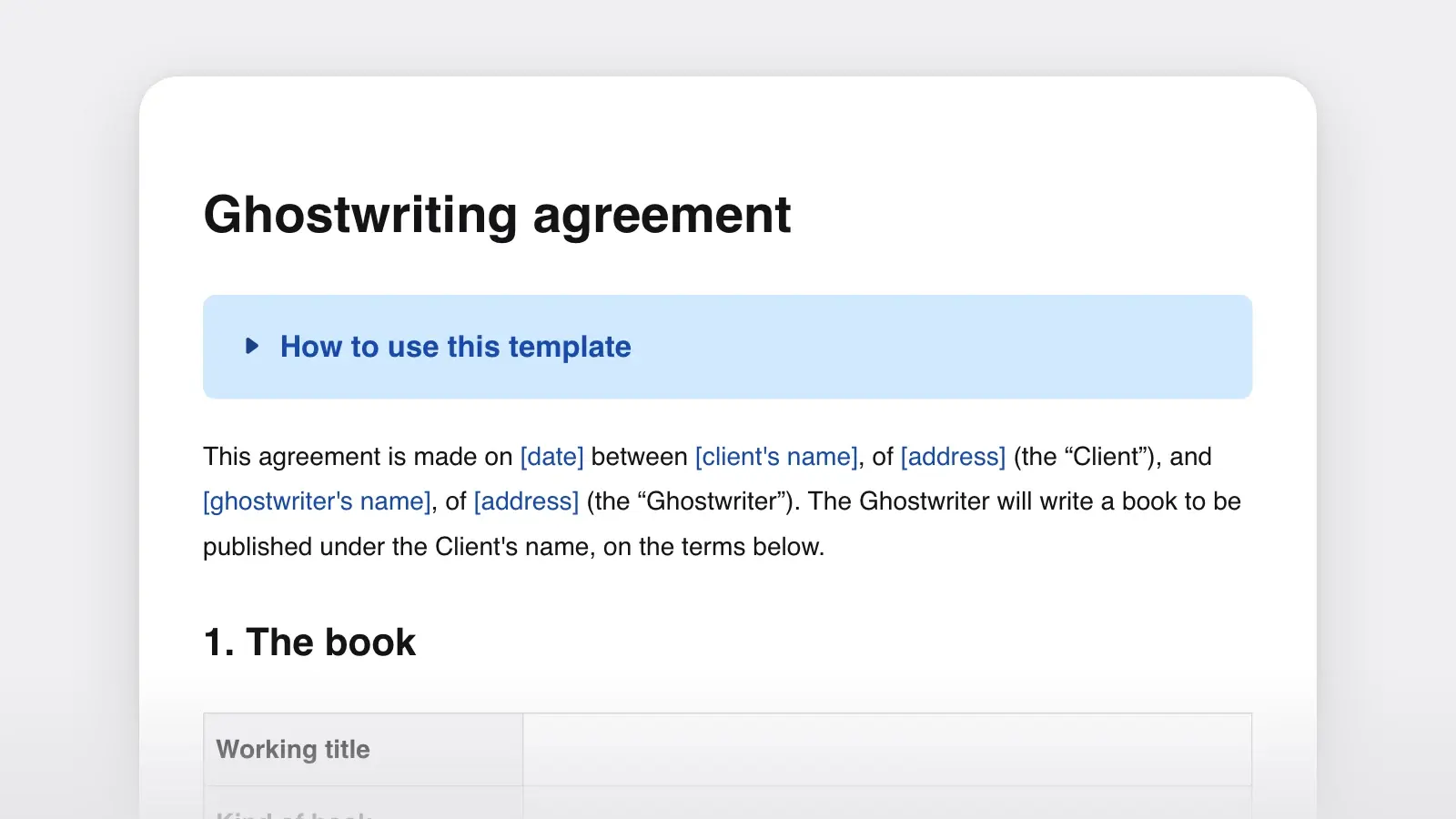
Can I use this template for ghostwriting or a monthly retainer?
The structure works, but both need extra terms. Ghostwriting needs a clause about who is named as the author and how far confidentiality extends; a retainer needs a monthly scope, rules for unused hours and a notice period. Add those clauses, or start from a dedicated ghostwriting contract or retainer agreement template.