When to use it
- Class persuasive speeches that require Monroe's motivated sequence or a problem–solution outline
- Public comment at a city council, school board or neighborhood association meeting
- Proposing a pilot, a policy or a budget line to a leadership team
- Fundraising and volunteer appeals that end with a sign-up
- Speeches that argue a claim of fact or value rather than an action
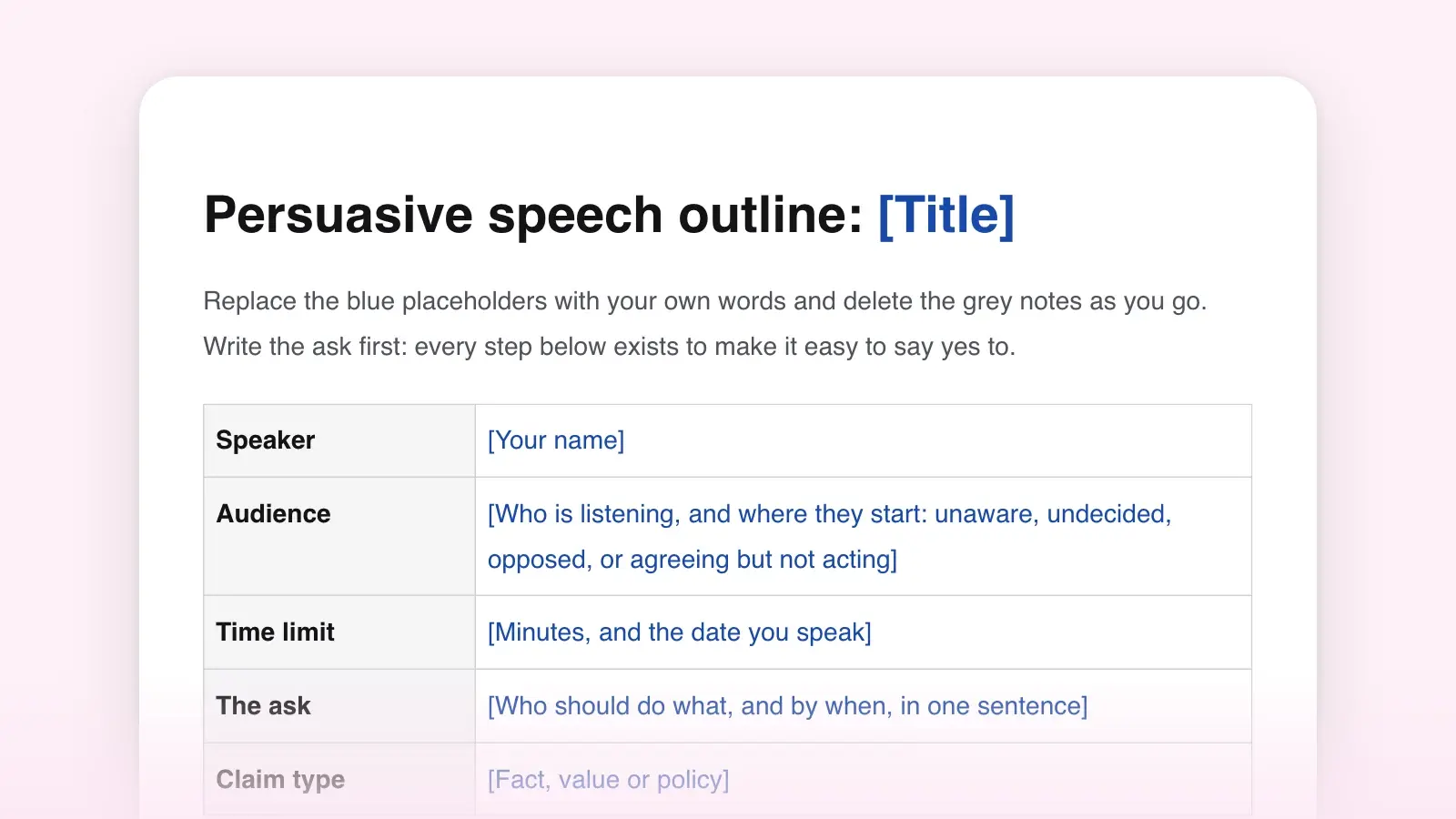
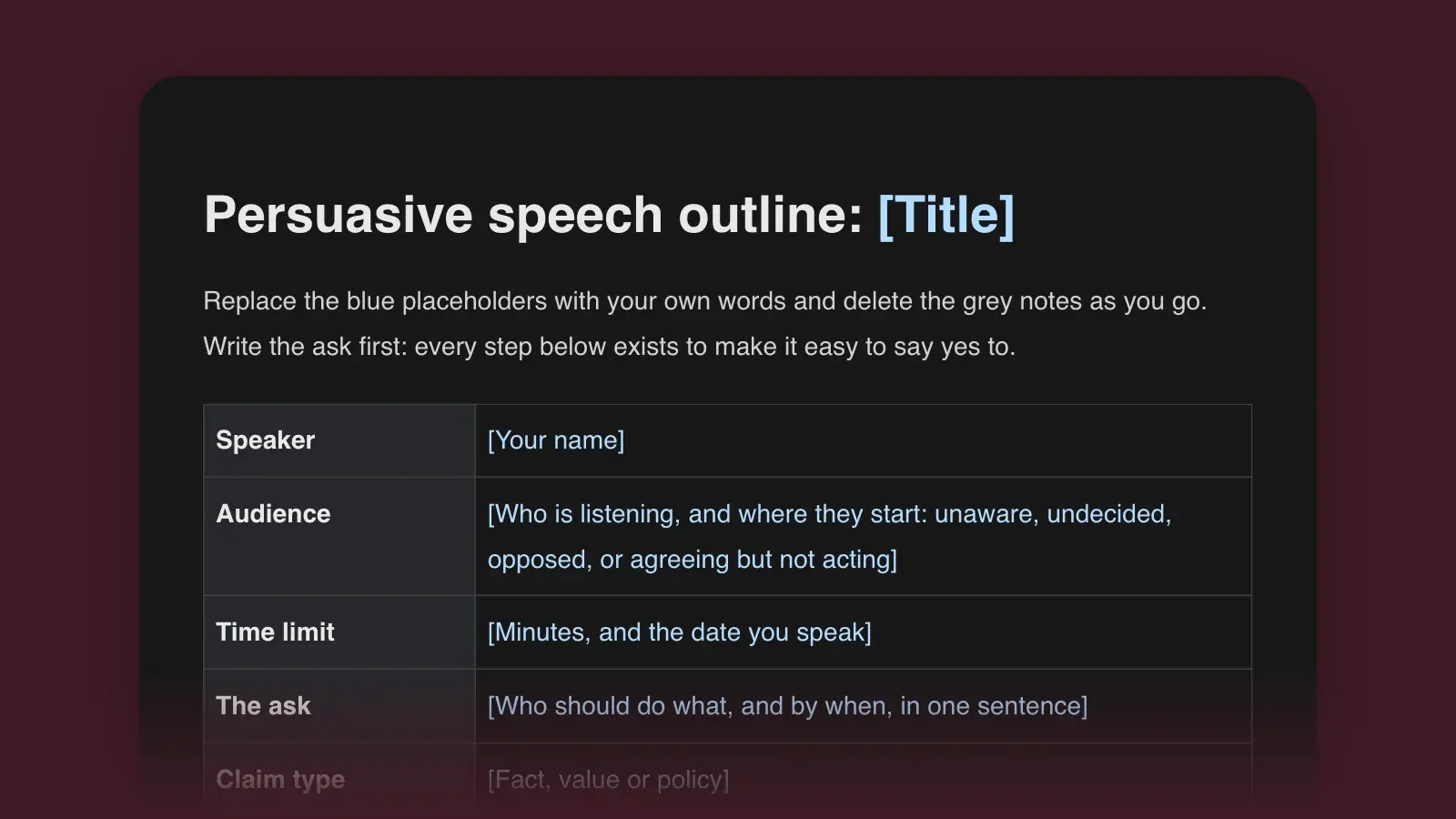
A persuasive speech outline plans a speech that asks the audience to believe or do one specific thing. This template uses Monroe's motivated sequence, the five-step pattern the speech professor Alan H. Monroe developed at Purdue University in the 1930s: attention, need, satisfaction, visualization and action. Each step answers the question the previous one raised, which makes it a good fit for a speech that ends with a request.
The example right below fills the template in for a five-minute class speech, with each step's job named. Two shorter samples follow: a two-minute problem–solution outline and patterns for claims of fact or value.
Persuasive speech outline example
A five-minute class speech asking classmates to give blood at a campus drive, outlined with the template. The facts in the need step come from the American Red Cross; the drive, the speaker and the details of the day are invented.
General purpose: To persuade
Specific purpose: To persuade my classmates to sign up for a slot at the campus blood drive next Thursday.
Claim: Everyone in this room who is eligible should give blood on Thursday, because the supply depends entirely on volunteers and very few of them give.
Audience: Twenty-four classmates, most of whom have never given blood.
Step 1: Attention (job: a reason to listen)
I. Every two seconds, someone in the United States needs blood, according to the American Red Cross; in the five minutes I'm up here, that's about 150 people.
II. I gave blood for the first time in September, at the last drive in the student union, and I'm afraid of needles.
III. I'll show you why the supply is always short and how Thursday's drive helps, and then I'll ask you to pick a Thursday slot before you leave this room.
Transition: So why is there never enough?
Step 2: Need (job: prove the problem is real and reaches this room)
I. Blood has to come from volunteers, and very few of them give.
A. Blood and platelets can't be manufactured; they can only come from volunteer donors (American Red Cross, n.d.).
B. Only about 3 percent of age-eligible people give blood in a year (American Red Cross, n.d.).
II. The supply has to be refilled constantly.
A. Red cells must be used within 42 days and platelets within 5, so the red cells on a hospital shelf today were given within the last six weeks (American Red Cross, n.d.).
B. A single car accident victim can need as many as 100 units of blood (American Red Cross, n.d.).
C. If any of us is ever that person, the blood we need will be blood someone gave a few weeks before.
Transition: We can't fix the whole supply. We can fix Thursday.
Step 3: Satisfaction (job: show the fix works, and answer the fear)
I. Thursday's drive turns that need into something we can do this week.
A. It runs from 10 to 4 in the student union ballroom, with 60 slots.
B. One donation can help save more than one life (American Red Cross, n.d.).
II. Objection: “I'm afraid of needles.”
A. Concede: so am I, and the fear is real.
B. Answer: I looked at the ceiling and talked to the woman in the next chair the whole time; bring a friend and do the same.
Transition: Now picture Thursday afternoon.
Step 4: Visualization (job: let them see the result, with and without them; no ask yet)
I. If this room signs up: by four o'clock, about twenty of the drive's sixty chairs have been filled from one class, and every one of those donations is on its way to be tested and sent to hospitals.
II. If we don't: those twenty chairs sit empty, and the supply keeps resting on the same small share of people who always give.
Transition: Here's how to make it the first one.
Step 5: Action (job: one act, where and by when, with no excuse left)
I. The ask: Pick a Thursday slot before you leave this room: sign the sheet by the door or scan the code on this slide.
II. Make it easy: Slots run from 10 to 4 in the student union ballroom; bring a friend and an ID. If you can't give, write a friend's name in the sheet's second column and bring them instead.
III. Closing line: In the five minutes I've been talking, about 150 people in this country needed blood. Pick a Thursday slot before you leave this room, and let's be the reason some of them get it.
References
American Red Cross. (n.d.). Facts about blood supply in the U.S. Retrieved November 10, 2026, from https://www.redcrossblood.org/donate-blood/how-to-donate/how-blood-donations-help/blood-needs-blood-supply.html
The attention step turns a national figure into the room's own five minutes, and the closing line repeats it, so the speech ends where it began. The ask is worded the same way in the preview, the action step and the closing line. The need is all sourced, the only objection that matters to this audience gets its own main point, and the speaker's fear of needles does double duty as credibility and as the answer to that objection.
Visualization and action do different jobs. Visualization shows Thursday at four with and without this class, and asks for nothing. Action says exactly what to do, where and by when, and gives anyone who can't give a way to help. Both stay inside what one class can actually do: about twenty of sixty slots, signed for before anyone leaves the room.
What goes in each step
Each step answers a question in the listener's head. If you can't say what that question is, the step is probably doing the wrong job.
| Step | The listener is asking | What you give them | In a 5-minute speech |
|---|---|---|---|
| Step1. Attention | The listener is asking“Why should I listen?” | What you give themA fact, a story or a question that touches this audience, then who you are and what's coming | In a 5-minute speechAbout 30 seconds |
| Step2. Need | The listener is asking“Is this really my problem?” | What you give themThe problem, with evidence and an example, and how it reaches the people in the room | In a 5-minute speechAbout 1½ minutes |
| Step3. Satisfaction | The listener is asking“What's the fix, and will it work?” | What you give themYour proposal, how it works, evidence that it works, and the main objection answered | In a 5-minute speechAbout 1½ minutes |
| Step4. Visualization | The listener is asking“What changes if I say yes?” | What you give themThe future with your proposal and the future without it | In a 5-minute speechAbout 45 seconds |
| Step5. Action | The listener is asking“What exactly do I do?” | What you give themOne specific act, where and by when, then a closing line | In a 5-minute speechAbout 45 seconds |
Two steps cause the most trouble. Need stays abstract (“blood donation is important”) when it should be specific and sourced. Visualization gets skipped because it feels repetitive on paper, but it's the moment listeners picture themselves inside your solution, and the action step builds on it. Keep the ask out of visualization: its job is the picture, and the request belongs to the next step. The opening matters more than its thirty seconds suggest; these attention getters are sorted by type.
How to use this template
- Write the ask in one sentence
Who should do what, and by when: “Pick a Thursday slot at the blood drive before you leave this room.” Write it before anything else. Every step of the sequence exists to make that sentence easy to say yes to, and a vague ask (“get involved,” “think about it”) gives the other four steps nothing to aim at.
- Decide where the audience starts
Monroe's sequence works best when listeners could agree in principle but haven't acted. If they don't see the problem yet, a problem–solution outline is simpler. If they already lean against you, start from their objection. These persuasive speech examples show a full speech in each of those structures.
- Fill the need with evidence they accept
One figure with a source they trust, one example with a person in it, and a sentence on how the problem reaches this audience. Name the source aloud. That is where the speech earns its ethos, and an unnamed statistic can sound invented even when it isn't.
- Answer the main objection inside satisfaction
Write the objection the way the audience would say it, concede whatever is true in it, then answer the rest. A solution that skips the obvious objection can lose the listeners who were thinking it the whole time.
- Picture both futures, then make the action easy
Visualization shows life with your proposal and without it, in concrete detail. Then the action step removes every excuse: where, when, how long, what to bring. End on a line that calls back to the opening, so the speech sounds finished.
- Write it out, then time it
Turn each step into full sentences, write the transitions as the questions the next step answers, and read it aloud with a timer. At about 130 words a minute, a five-minute speech is roughly 650 words.
Problem–solution outline sample
The three-part version is the better match in three situations: you have three minutes or less; the people listening are the ones who decide, and they need the problem, the price and the ask more than a picture of the future; or the audience doesn't see the problem yet, so the time has to go to proving it. Public comment at a council meeting is the classic case: two or three minutes, and the people who can say yes are sitting in front of you.
Specific purpose: To persuade the city council to fund a pedestrian signal at Alder Street and 9th Avenue in next year's budget.
I. Problem: The crossing at Alder and 9th is not safe for the children who walk to Harbor View Elementary.
A. The school counts about 140 children crossing there each morning.
B. Parents have logged 11 near misses since September.
C. The nearest signal is three blocks away, and few children walk three blocks out of their way at 7:45.
II. Solution: A push-button pedestrian signal at the corner.
A. The city engineer estimates it at $85,000.
B. Objection: “The budget is tight this year.” Answer: the city's traffic-safety fund has $210,000 unspent.
III. Action: Add the signal to next year's budget at the June vote.
Closing line: Eleven near misses is a warning. Please act on it before the twelfth.
The three parts map onto Monroe's sequence: the problem is need, the solution is satisfaction, and the action is action. What drops out is the long attention step and the visualization, which a two-minute slot can't afford. If the cause of the problem is in dispute, add a middle point for it and you have a problem–cause–solution outline. Go back to the five steps when you have five minutes or more and a room that agrees in principle but hasn't acted; that is when the picture of the result earns its time.
Outlines for fact and value claims
Monroe's sequence is built for policy: speeches that ask for an action. Some persuasive speeches argue that something is true, or that it is good or bad, and those need a different spine. Public speaking courses usually sort persuasive claims into these three types.
| Claim type | Sample claim | An outline that fits |
|---|---|---|
| Claim typeFact: is it true? | Sample claimOur town's recycling rate has fallen since the program changed. | An outline that fitsStatement of reasons: three reasons, strongest last, each with evidence; or refutation: the other side's claim, the evidence against it, your claim |
| Claim typeValue: is it good or right? | Sample claimGraphic novels belong on the school's summer reading list. | An outline that fitsCriteria, then application: what makes a summer book good, then how graphic novels meet each test |
| Claim typePolicy: what should we do? | Sample claimThe library should end overdue fines. | An outline that fitsMonroe's motivated sequence, problem–solution or problem–cause–solution |
You can still use the template for a fact or value speech: keep the attention step, put your reasons or criteria where need and satisfaction go, and turn the action step into a request for belief (“Next time someone says the program is working, ask to see the numbers.”). For the individual techniques inside each step, from concession to the rule of three, see persuasive techniques.
Tips for a stronger outline
- Keep the ask identical. Say it the same way in the preview, the action step and the closing line. Paraphrasing it each time makes it sound like three different requests.
- Source every number in the need. Put the citation in the outline and say the source aloud the first time you use it. One figure the audience trusts beats four it doesn't.
- Make the visualization concrete. A time, a place and a person: “sixty donors by four o'clock” works better than “a better future.”
- Follow the assignment's format. The full-sentence rules are the same as for any class outline: one idea per symbol, every A with a B, references in the style your class uses. The informative speech outline explains them in detail.
If you still need a subject, these persuasive speech topics are sorted by theme and level. For more ways to close on the ask, see how to end a speech.
Frequently asked questions
What are the parts of a persuasive speech outline?
A heading with the general purpose, specific purpose and claim; an introduction that gains attention, establishes credibility and previews the points; a body organized by the structure you chose, including the objection and your answer; a conclusion with the action or final appeal and a closing line; and a list of references.
What is the difference between problem–solution and Monroe's motivated sequence?
Problem–solution has three parts: the problem, the solution and the ask. Monroe's sequence adds an attention step at the start and a visualization step before the action, in which the audience pictures the future with and without your proposal. Use problem–solution when time is short and Monroe's sequence when the audience needs a push to act.
Can Monroe's motivated sequence work for a speech that doesn't ask for action?
Yes, with a change to the last step. For a claim of fact or value, the need and satisfaction steps carry your reasons or criteria, and the action step asks the audience to believe something, or to do something small with that belief, such as asking a question at the next meeting.