When to use it
- An MLA annotated bibliography for an English, literature, languages or humanities course
- The source list for a literary analysis, with the primary text and the criticism annotated differently
- An annotated list of works cited that a supervisor wants to see before you draft
- Reading notes kept in works-cited format from the first source, so the list is ready when the paper is
- Checking a finished bibliography against the MLA 9 indent and spacing rules before you submit
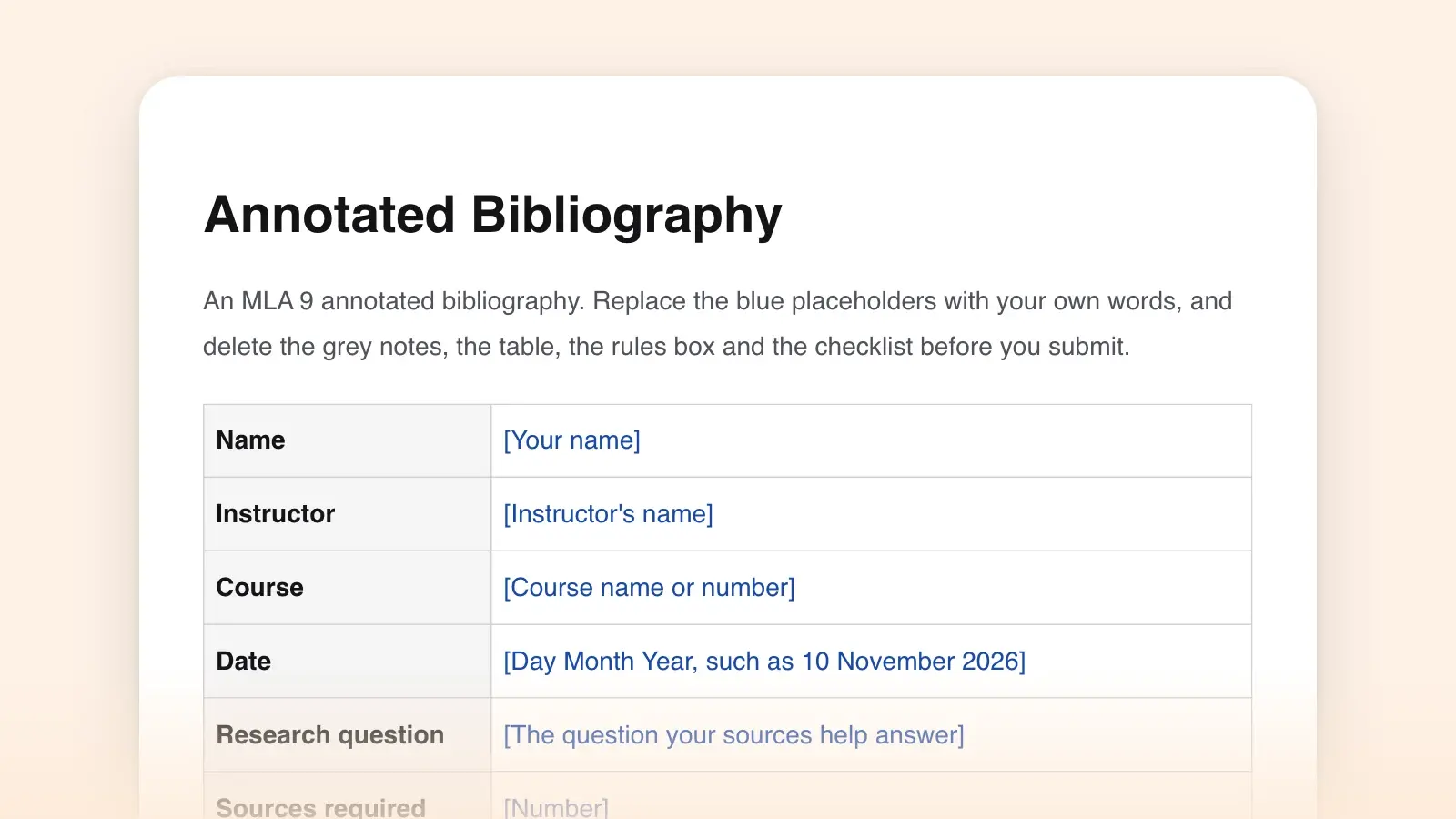
An MLA annotated bibliography is a works-cited list with a short paragraph, the annotation, under each entry: it sums up the source, judges it, or says how you will use it. In MLA 9 the entries keep the normal works-cited format, in alphabetical order, double-spaced, with a half-inch hanging indent. Each annotation starts on a new line below its entry and is indented one inch from the left margin. It can be written in concise phrases or in full sentences, and it usually runs no more than one paragraph.
The rules follow the ninth edition of the MLA Handbook (2021) as the MLA Style Center and the Purdue OWL present them, with a five-source example on Kate Chopin's “The Story of an Hour.” For APA, see the APA annotated bibliography example; for both styles side by side, the general annotated bibliography template.
How to use this template
- Check the assignment before the Handbook
Find out how many sources you need, how long each annotation should be, and whether it should summarize, evaluate or both. Your instructor's rules come before anything MLA says. Write the research question into the table at the top: it decides which sources make the list.
- Write the entry while the source is open
MLA builds every entry from the same core elements, in this order: author, title of the source, title of the container, other contributors, version, number, publisher, publication date and location. Copy them as soon as you decide to keep a source, and delete the template's patterns you don't need.
- Annotate in your own words
Fill in the three lines under each entry, then delete the labels so they read as one paragraph. For the text you analyze, the lines ask what it is, which edition you quote and which passages matter. Write every summary with the source closed: if you can't, you haven't understood it yet.
- Alphabetize, export and format
Order the entries by their first word, usually the author's last name. Export to Word, set the indents and spacing from the table below and check the italics, which the template marks. Work through the checklist, then delete the grey notes, the rules box and the checklist.
MLA annotated bibliography format
The ninth edition of the MLA Handbook, the style guide behind MLA style, came out in April 2021. Two kinds of rule meet in every entry. The works-cited entry is pure MLA: the core elements in order, with MLA's punctuation. The annotation is looser. The Purdue OWL's summary of MLA 9 puts it one inch from the left margin, half an inch further in than the second line of the entry above it, and the MLA Style Center says it should generally run no more than a paragraph. Beyond that, its length, its form and what it covers are usually your instructor's call.
Here is one entry with its annotation beneath it:
One MLA 9 entry, labeled (invented source)
[Works-cited entry: 0.5 in. hanging indent. It ends with the URL and a period.]
Arnaud, Celeste. “The Open Window: Weather and Will in Kate Chopin's Short
     Fiction.” The Calder Hill Review, vol. 38, no. 2, fall 2019, pp. 113-31.
     JSTOR, www.jstor.org/stable/xxxxxxxx.
[Annotation: starts on a new line; the whole annotation is indented 1 in.]
          Arnaud reads the open window in “The Story of an Hour” beside the
          windows in four other Chopin stories and argues that weather in
          Chopin's fiction stands for desires her characters can't yet name.
          Her reading of the spring details before Louise whispers “free” is
          the closest on my list. She says little about the ending, though,
          and treats the doctors' verdict as a plain twist. I use her in my
          first section, on the window, and argue against her reading of the
          last line.
In the paper, leave out the bracketed labels, set the journal and database names in italics, and double-space every line. MLA 9 lowercases seasons such as fall in works-cited entries.
| Element | Rule | Set by |
|---|---|---|
| ElementTitle | RuleAnnotated Bibliography or Annotated List of Works Cited, the two titles the MLA Style Center suggests, centered, with no italics or quotation marks | Set byMLA |
| ElementOrder | RuleAlphabetical by the first word of each entry, usually the author's last name, or the title when there is no author | Set byMLA by default; an instructor may ask you to group by subject or date |
| ElementSpacing | RuleDouble-spaced throughout, entries and annotations alike, with no blank lines between entries | Set byMLA |
| ElementEntry | RuleFormatted like any works-cited entry, with a 0.5 in. hanging indent | Set byMLA |
| ElementAnnotation layout | RuleStarts on a new line under the entry, the whole paragraph indented 1 in. from the left margin | Set byMLA 9 |
| ElementForm and length | RuleConcise phrases or complete sentences, generally no more than one paragraph | Set byYour instructor, within MLA's guidance |
| ElementWhat it covers | RuleSummary, evaluation, how you will use the source, or a mix | Set byYour instructor |
| ElementPage setup | Rule1 in. margins, a legible font such as Times New Roman at a standard size like 12 points, and your last name and the page number at the top right, half an inch from the top | Set byMLA |
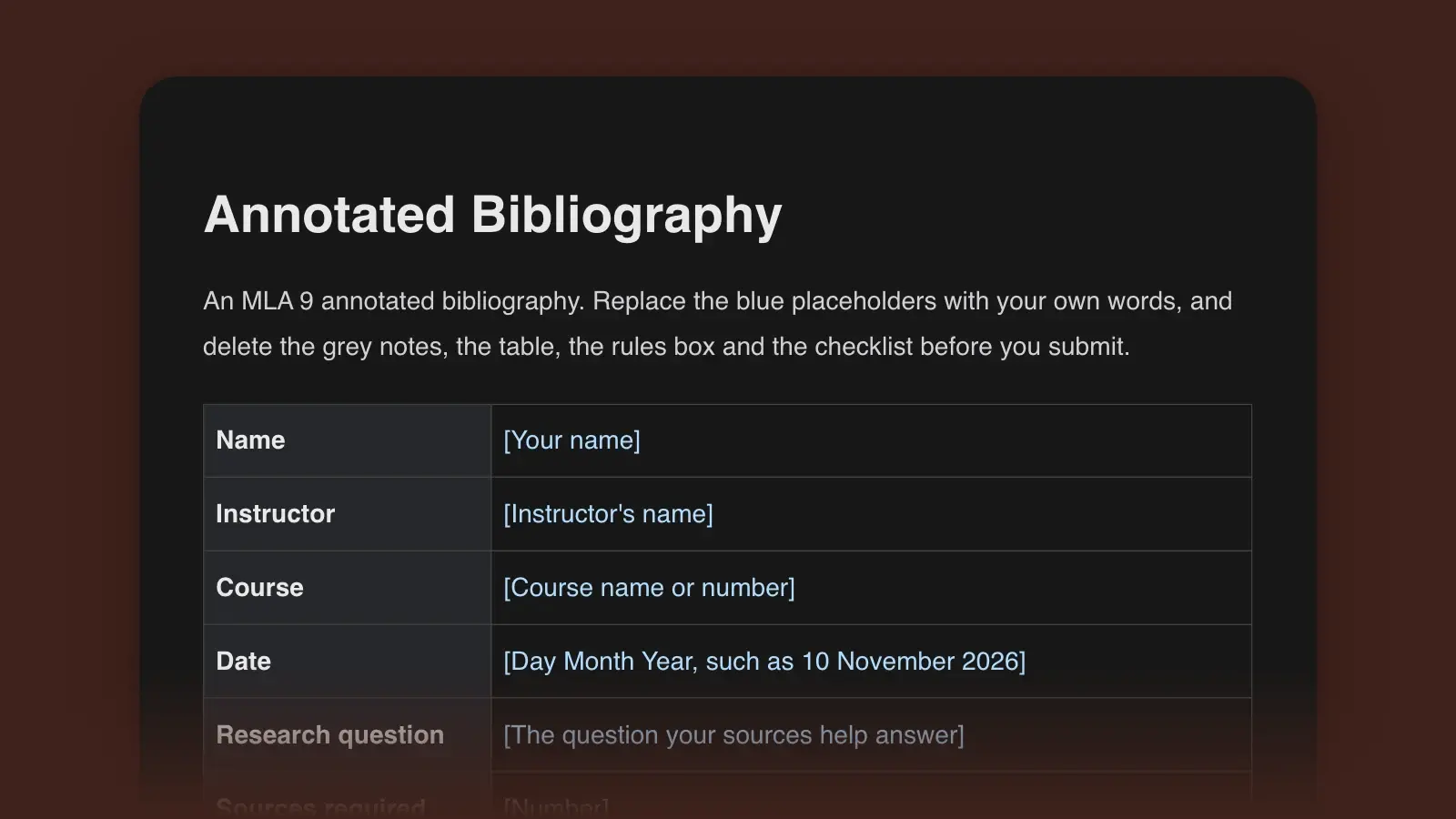
| ElementTitle page | RuleNone, unless your instructor asks for one or it is a group project; your name, instructor, course and date go at the top left of page 1 | Set byMLA |
Set the indents in the paragraph settings, not with spaces or tabs. In Word, select the entries, open the Paragraph dialog and choose Special: Hanging, By: 0.5". Select each annotation and set Left to 1" with Special set to (none). Use Double line spacing throughout. The heading and header follow the rules for any MLA paper, which the essay format guide shows on a sample first page.
MLA annotated bibliography example
A full example for one research question: Why do the doctors at the end of “The Story of an Hour” misread Louise Mallard's death, and what does their mistake say about her world? A humanities list like this mixes the primary text, the work you analyze, with secondary sources, the criticism about it (see primary vs secondary sources), and each kind needs a different annotation. Chopin's story is real. The four critics, their journals and publishers are invented, so copy the format and the moves, not the sources.
Annotated Bibliography
Arnaud, Celeste. “The Open Window: Weather and Will in Kate Chopin's Short Fiction.” The Calder Hill Review, vol. 38, no. 2, fall 2019, pp. 113-31. JSTOR, www.jstor.org/stable/xxxxxxxx.
Arnaud reads the open window in “The Story of an Hour” beside the windows in four other Chopin stories and argues that weather in Chopin's fiction stands for desires her characters can't yet name. Her reading of the spring details before Louise whispers “free” is the closest on my list. She says little about the ending, though, and treats the doctors' verdict as a plain twist. I use her in my first section, on the window, and argue against her reading of the last line.
Chopin, Kate. “The Story of an Hour.” 1894. KateChopin.org, Kate Chopin International Society, www.katechopin.org/story-hour/. Accessed 10 Nov. 2026.
The story covers the hour after Louise Mallard hears that her husband has been killed in a railroad disaster: grief, then a joy she can only whisper (“free, free, free!”), then his return through the front door, unhurt, and her death, which the doctors put down to “joy that kills.” It first appeared in Vogue in December 1894 as “The Dream of an Hour.” This online text includes two changes from an 1895 reprint, so I quote it throughout and say so in a note. I analyze the view from the window, the paragraph on “a private will,” and the last line.
Ferreira, Helena, et al. “What Readers Notice First: Student Responses to the Ending of ‘The Story of an Hour.’” Journal of Classroom Reading, vol. 12, no. 1, 2023, pp. 40-58, https://doi.org/10.xxxx/xxxxx.
Ferreira and her coauthors asked 212 first-year students at one university to write a paragraph after a single reading of the story. Most read the ending as a twist about the husband; fewer than a third connected Louise's death to the freedom she had just imagined. The sample comes from one campus and the coding is described only briefly, so I treat the numbers as an illustration, not a finding. The study opens my introduction: the irony depends on what a reader has noticed by the last line.
Marsh, Theodore. The Hour and the Life: Kate Chopin's Short Fiction and Its First Readers. Calder Hill UP, 2018.
Marsh, a historian of publishing, follows Chopin's stories through the magazines of the 1890s, using editors' letters and reviews, and argues that readers accepted in a short story what they would not accept in a novel. He reads the stories themselves only briefly, and his claims about what readers thought rest on a handful of reviews. I use his chapter on Vogue for background in my second section and nothing else.
Whitlock, Ama. “Locks and Latchkeys: The Married House in the 1890s Story.” The American Short Story at the Turn of the Century, edited by Jonah Pell and Ruth Albescu, Harbor and Finch, 2021, pp. 77-95.
Whitlock reads houses in American stories of the 1890s as maps of marriage and gives six pages to Chopin: the locked bedroom, Josephine at the keyhole, the latchkey Brently uses to let himself in. Her claim that the key marks the husband's ownership of the house rests on that one detail, and she ignores the window. Read with Arnaud, she gave me the frame for the paper: the window lets the world in, and the doors decide who comes and goes.
Look at what each annotation does. The one for the primary text doesn't ask whether Chopin is reliable; it names the version quoted and the passages that matter. Ferreira's says what the numbers can't carry. Whitlock's records how two sources became the plan of the paper, often the most useful sentence an annotation can hold.
MLA annotations in phrases or sentences
MLA accepts annotations in concise phrases as well as in full sentences, and the choice is often your instructor's. Phrases suit a long list or a working bibliography you keep for yourself; sentences suit an assignment that asks you to evaluate. Here is the Arnaud annotation in both forms, move by move:
| Move | In sentences | In phrases |
|---|---|---|
| MoveWhat the source argues | In sentencesArnaud reads the open window in “The Story of an Hour” beside the windows in four other Chopin stories and argues that weather in Chopin's fiction stands for desires her characters can't yet name. | In phrasesOpen window in “The Story of an Hour” read beside four other Chopin stories. Weather as desire not yet named. |
| MoveHow far it helps | In sentencesHer reading of the spring details before Louise whispers “free” is the closest on my list. She says little about the ending, though, and treats the doctors' verdict as a plain twist. | In phrasesClosest reading of the spring details before “free.” Thin on the ending. |
| MoveHow you'll use it | In sentencesI use her in my first section, on the window, and argue against her reading of the last line. | In phrasesSection 1; argue against her reading of the last line. |
What an annotation covers also depends on the kind of source. A literary paper often has all four of these on one list:
| Source | What the annotation covers |
|---|---|
| SourceThe primary text you analyze | What the annotation coversWhat it is, in two or three sentences; which edition you quote, and why; the passages or features your paper examines |
| SourceCriticism about the text | What the annotation coversThe critic's argument and evidence; where it is strong or thin; which part of your argument it supports or opposes |
| SourceHistorical background | What the annotation coversWhat context it gives; how reliable that context is; the one section of your paper that needs it |
| SourceStudies with data | What the annotation coversWho was studied, and how; what the method can't show; how much weight you give the result |
MLA 9 works-cited patterns
An annotation can't rescue a broken entry, and formatting slips are the easiest marks to lose on this assignment. Titles in italics here are italic in the paper; titles in quotation marks stay roman.
| Source | MLA 9 pattern |
|---|---|
| SourceBook, one author | MLA 9 patternLast, First. Title of Book. Publisher, Year. |
| SourceBook, two authors | MLA 9 patternLast, First, and First Last. Title of Book. Publisher, Year. |
| SourceThree or more authors | MLA 9 patternLast, First, et al. “Title of Article.” Journal Title, vol. 12, no. 1, Year, pp. 40-58, https://doi.org/10.xxxx/xxxxx. |
| SourceJournal article in a database | MLA 9 patternLast, First. “Title of Article.” Journal Title, vol. 38, no. 2, Season Year, pp. 113-31. Database Name, URL. |
| SourceStory, poem or essay in an edited collection | MLA 9 patternLast, First. “Title of Work.” Title of Collection, edited by First Last, Publisher, Year, pp. 77-95. |
| SourceTranslated book | MLA 9 patternLast, First. Title of Book. Translated by First Last, Publisher, Year. |
| SourcePage on a website | MLA 9 patternLast, First. “Title of Page.” Title of Website, Publisher, Day Mon. Year, URL. |
Five MLA 9 habits trip up writers who learned another style. Give each author's name as the source prints it, last name first, rather than cutting first names to initials as APA does, and join two authors with “and,” never an ampersand. Leave “https://” off URLs, but write a DOI as a full https://doi.org/ link. Abbreviate month names longer than four letters: Jan., Feb., Mar., Apr., Aug., Sept., Oct., Nov., Dec. Shorten University Press to UP and drop business words such as Inc. and Co. From three authors on, give the first author followed by et al.; the guide to et al. compares the rule across styles. An access date is optional, but add one for web pages, which can change or move.
Common MLA annotated bibliography mistakes
- The APA indent. An MLA 9 annotation sits 1 in. from the left margin. Half an inch is the APA and Chicago measurement.
- Titles in the wrong form. Italicize books, journals, websites and databases; put articles, essays, stories, poems and chapters in quotation marks. Capitalize the main words of every title.
- Extra space. Blank lines between entries, or an annotation that starts on the same line as its entry.
- Phrases in one entry, sentences in the next. Either form works; switching between them looks unfinished.
- Summary only. When the assignment asks you to evaluate, say how far to trust the source and what it does for your paper.
Frequently asked questions
How long should an MLA annotation be?
As long as your assignment says. Without a word count, aim for one paragraph: the MLA Style Center says annotations should generally be no more than one. A working list for your own research can use a few phrases per source, while an assignment that asks you to evaluate usually calls for full sentences.
Is an MLA annotation indented 1 inch or half an inch?
One inch from the left margin in MLA 9. The entry above it keeps the usual half-inch hanging indent, so the annotation sits half an inch further in than the entry's second line. APA and Chicago indent annotations half an inch, which is why the two are easy to mix up.
Does an MLA annotated bibliography need a title page?
No, unless your instructor asks for one or it is a group project. An MLA paper starts with a heading at the top left of the first page: your name, your instructor's name, the course and the date, each on its own double-spaced line. The title, Annotated Bibliography, is centered on the next line.
What is the difference between Works Cited and an annotated bibliography?
A Works Cited page lists only the sources you cite in a paper, with no annotations. An annotated bibliography adds a paragraph under each entry and can include sources you read but didn't quote. Both use the same entry format and order, so the annotated list becomes your Works Cited page once you delete the annotations and the sources you didn't cite.