When to use it
- A writers' group, literary nonprofit or school partnering with a library, bookstore or festival on a workshop or reading series
- Partners on a grant application whose funder asks for a signed MOU from each partner
- Two organizations or co-creators testing a collaboration before money or rights change hands
- Recording what early talks settled, before anyone drafts a full contract
- Departments or teams inside one organization agreeing who does what
A memorandum of understanding records what two or more parties intend to do together: the goal, who does what, what each side puts in, and how either can walk away. It is usually not a contract. That is its use and its risk. It lets a library and a writers' group, or two small presses, put a plan in writing before anyone is ready to sign enforceable promises.
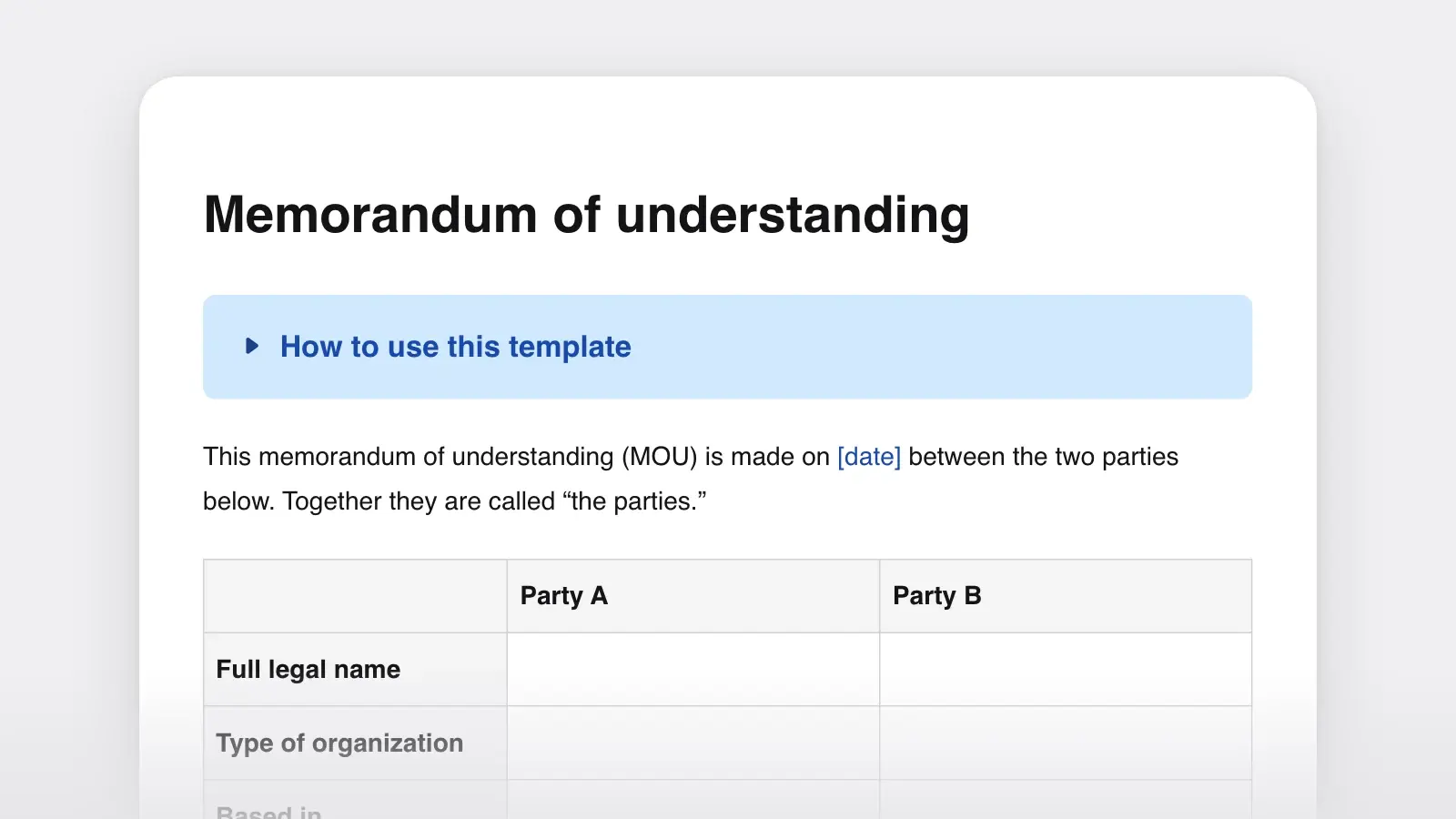
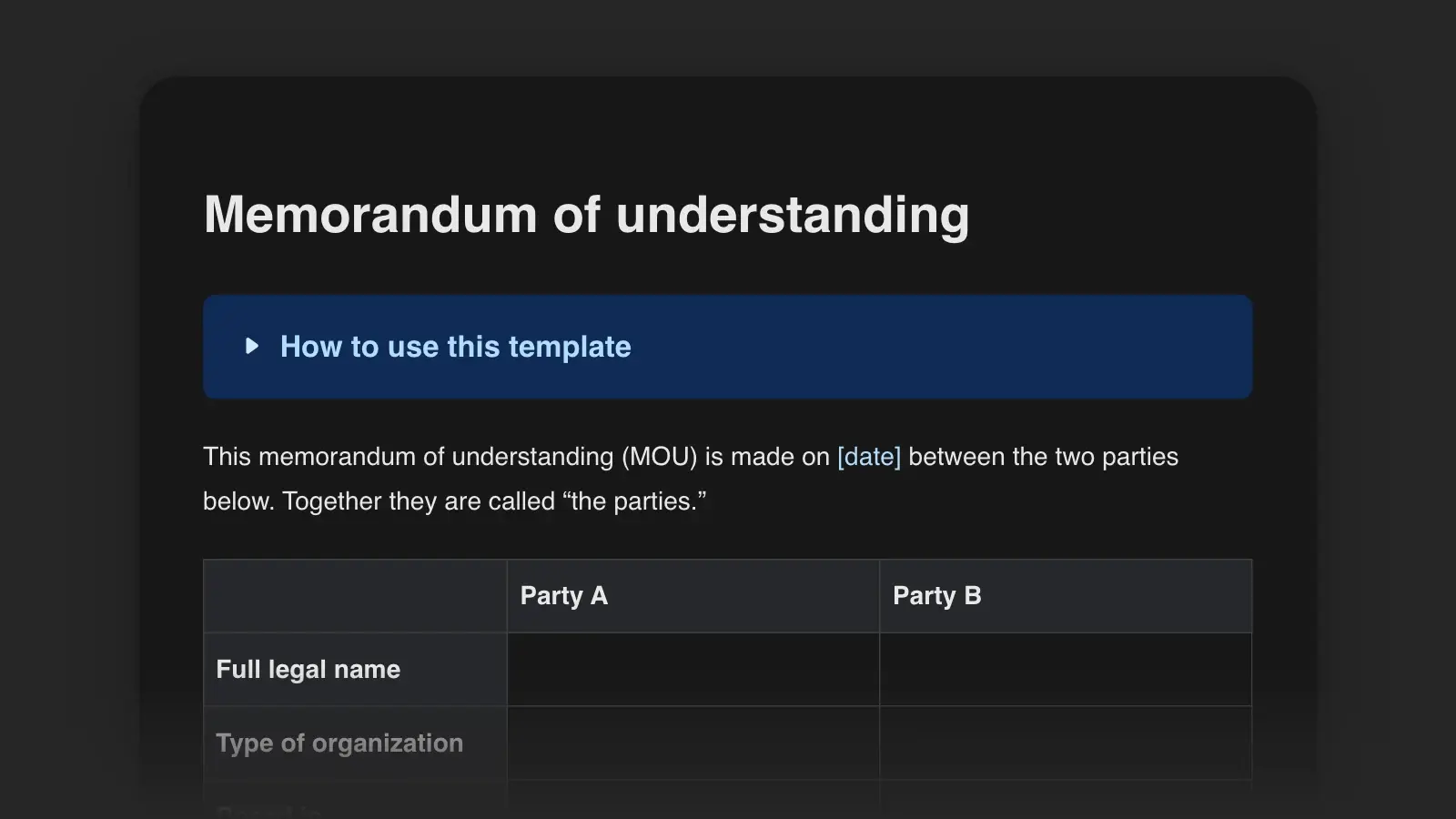
How to use this template
- Write the purpose in one sentence
If the parties cannot agree on one sentence, they are not ready for an MOU. Then fill in the background for a reader who was not in the room: a grant reviewer, or the library director who replaces the one who said yes.
- Fill in the roles table together
Do it in a meeting, out loud, and give every row one lead. "Both" is where tasks go to die: if the work is shared, one party still owns making sure it happens. Put a date or "ongoing" in the last column so the review has something to check.
- Decide what is binding, on purpose
Keep section 10. It says the MOU is a statement of intent and names the few parts that are meant to bind: costs and confidentiality. If money, rights or exclusive commitments change hands, stop and write a contract instead.
- Sign, file and set the review date
Have someone with authority sign for each side, keep the signed copy as a PDF, and put the review date and the end date in both calendars. MOUs rarely end in a fight. They fade, and a year later nobody remembers what was promised.
Binding or not: what decides it
The title does not. Under US contract law, a document becomes a contract when it has the elements of one: an offer and its acceptance, something of value exchanged, and an intent to be bound. An MOU with firm promises, a price and no clause saying otherwise can meet that test. Calling something preliminary is no guarantee either: in 1985 a jury found that Pennzoil's unsigned deal for Getty Oil was binding, and Pennzoil won a $10.53 billion verdict against Texaco, which had signed its own contract to buy Getty in the meantime.
So say what you intend, twice: once in a legal-effect clause like section 10, and again in the wording of every other section. The UK government is strict about the second part. Its guidance on treaties and MOUs lists words to avoid in an MOU, because they read as obligations, and the words to use instead:
| Reads as a binding promise | Reads as intent |
|---|---|
| Reads as a binding promiseshall | Reads as intentwill |
| Reads as a binding promiseagree, agreement | Reads as intentdecide, arrangement, understanding |
| Reads as a binding promiseobligations | Reads as intentcommitments |
| Reads as a binding promiserights | Reads as intentbenefits |
| Reads as a binding promiseenter into force | Reads as intentcome into effect |
| Reads as a binding promiseparties | Reads as intentparticipants |
| Reads as a binding promiseclause, article | Reads as intentparagraph |
Most business MOUs also make a few parts binding on purpose. Confidentiality is the usual one. Many add that each side pays its own costs, and name the law that governs those parts. Letters of intent work the same way and often add exclusivity, a promise not to negotiate with anyone else for a set period. Write the binding parts with plain obligation words ("must") so nobody mistakes them for wishes.
A filled-in example
Here is the core of a short MOU between a writers' group and a public library, condensed to the parts that matter most. The template above adds the contacts, confidentiality and signatures.
Purpose. The Larkspur Writers' Circle and the Cedar Hollow Public Library intend to run a free fiction workshop for adults on the second Saturday of each month, September through May.
Scope. Included: nine two-hour workshops for up to sixteen participants, and a reading night in May. Not included: publishing participants' work, and workshops for teens.
- Book the room and handle registration: the library leads, ongoing.
- Plan sessions and provide two facilitators: the Circle leads, with the session plan due August 15.
- Publicity, from August 20: the library leads, in its newsletter and on its website. The Circle supports with its mailing list.
Resources. The library expects to provide the community room, a projector and printing of up to 200 pages a month. The Circle's facilitators are volunteers. No money changes hands; each party pays its own costs.
Term. In effect from the last signature until the May reading night. The two contacts review attendance in January. Either party may end the MOU with 30 days' written notice.
MOU, letter of intent or contract
The names overlap, and organizations use them differently. Ask the other side which one their policy calls for, and read their definitions.
| Document | What it records | Binding? | Use it when |
|---|---|---|---|
| DocumentMemorandum of understanding (MOU) | What it recordsA shared goal, roles and contributions | Binding?Mostly no, except the parts it names | Use it whenPartners cooperate and no money or rights change hands |
| DocumentMemorandum of agreement (MOA) | What it recordsThe same, sometimes with more specific or conditional terms | Binding?Depends on the wording and each organization's definitions | Use it whenThe other side's policy asks for one |
| DocumentLetter of intent (LOI) | What it recordsThe main terms of a deal both sides expect to sign later | Binding?Mostly no; confidentiality and exclusivity often are | Use it whenA sale, lease, hire or acquisition is being negotiated |
| DocumentContract | What it recordsPromises each side can enforce, usually with payment | Binding?Yes | Use it whenMoney, rights or exclusive commitments change hands |
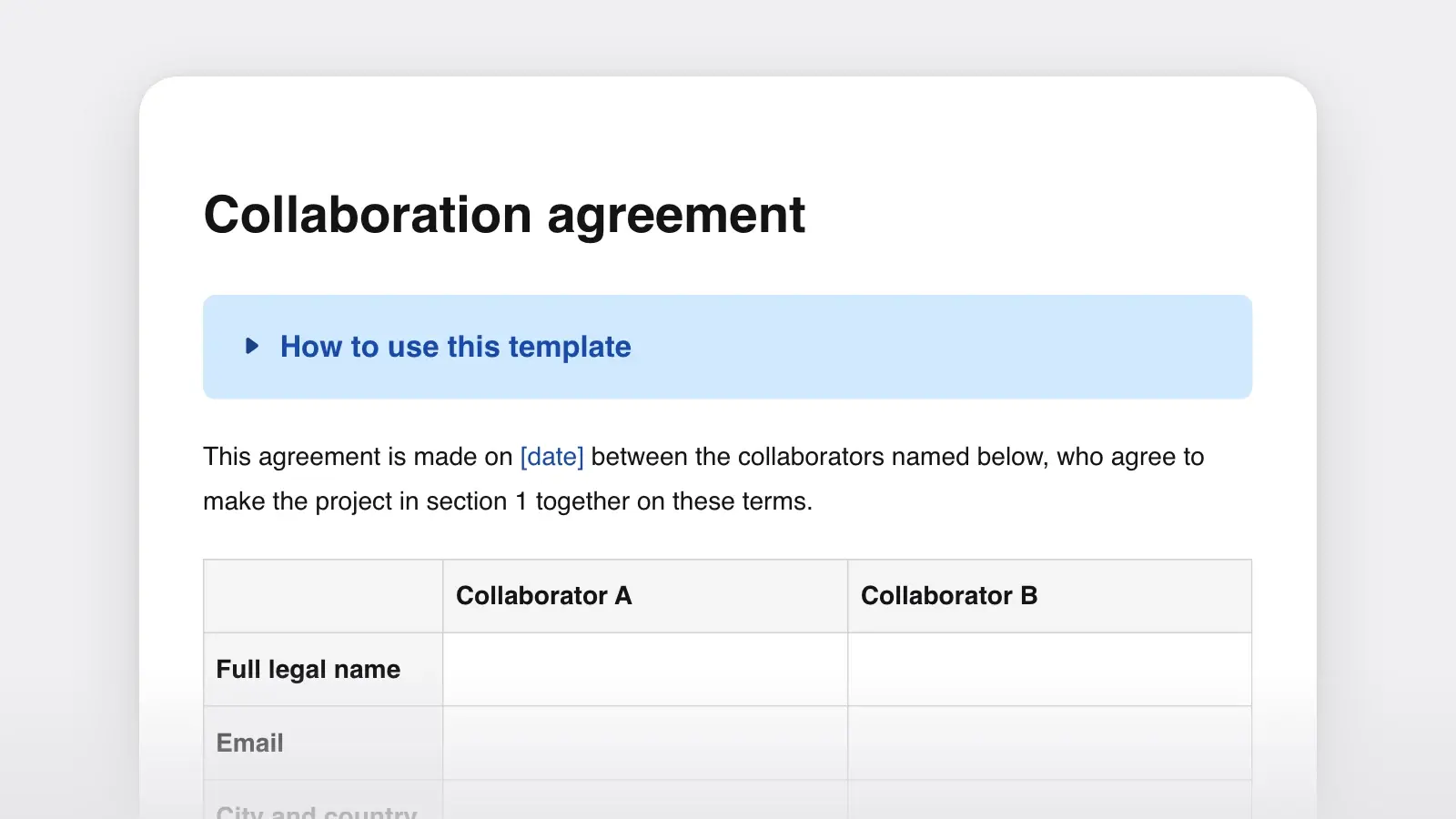
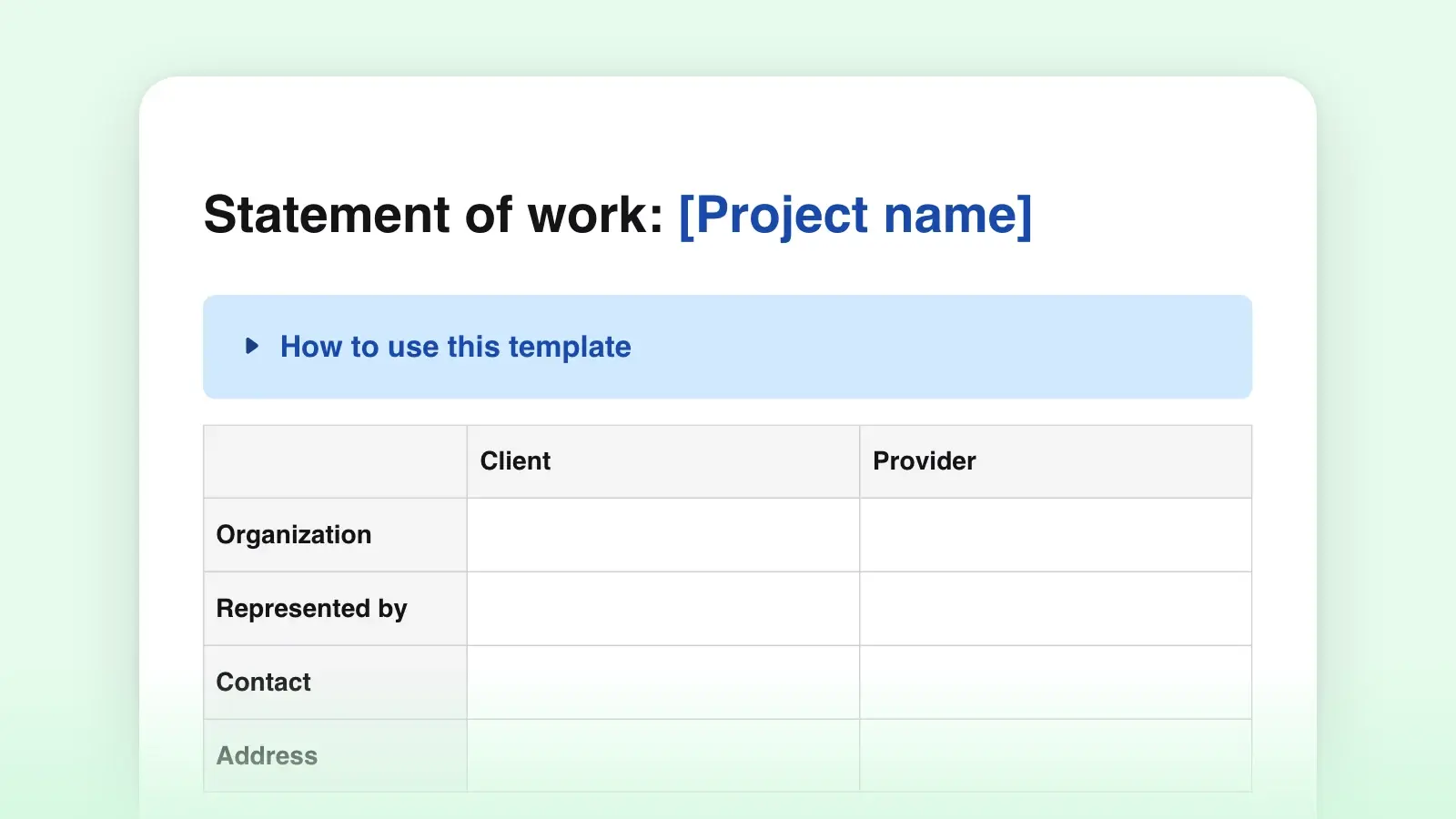
For two writers sharing a book or a podcast, where credit and income are at stake from day one, start from a collaboration agreement instead. When an MOU leads to paid work, the next documents are usually a freelance writing contract and a statement of work for each project.
Mistakes that make an MOU worse than none
- No legal-effect clause. Without one, a court reads the whole document to work out what you meant, and a detailed MOU with dates and amounts can look like a contract.
- Contract words in the non-binding parts. "Party B shall deliver" and "the parties agree to" undercut the clause that says nothing is binding. Write "expects to provide" and "intend to."
- Money in the MOU. If one side pays the other, even a small honorarium, put it in a contract or a separate written agreement, as section 5 says.
- The wrong signer. A program coordinator may not be allowed to sign for a library, a school district or a university. Ask who signs for the other side before the draft is final, since some institutions route MOUs through a central office or a board.
- No end date. An open-ended MOU outlives the people who wrote it. Tie the term to a season, a grant period or a project, and renew it in writing if the partnership continues.
Frequently asked questions
Is a memorandum of understanding legally binding?
Usually not, when it says so clearly and is written as a statement of intent. A court looks at the whole document, though, so an MOU with firm promises, a price and no non-binding clause may be treated as a contract. Parts you make binding on purpose, such as confidentiality, are meant to be enforceable. If anything important depends on it, have a lawyer review it.
Who should sign an MOU?
Someone with authority to commit each organization, such as an executive director, a department head, a dean or an owner. Ask the other side early who signs for them. Some public bodies and universities send MOUs through a central office or a board, which takes time.
Does an MOU need to be notarized?
Usually not. A notary confirms who signed a document; it does not make the document binding. Notarize only if a funder, a government office or the other party asks for it.
What is the difference between an MOU and an MOA?
Often very little. Some organizations use memorandum of agreement for a more detailed or conditional version, and others treat the two names as the same thing. What decides the legal effect is the wording, so read the other side's definitions and the legal-effect clause rather than the title.