When to use it
- Freelance and agency projects where the client wants scope and price in writing before work starts
- A new project under a master services agreement you have already signed
- Consulting billed by the hour that needs a cap and a clear list of what the hours buy
- Work with a vendor or another department where someone has to own acceptance and sign-off
- Turning an accepted proposal into the document both sides sign
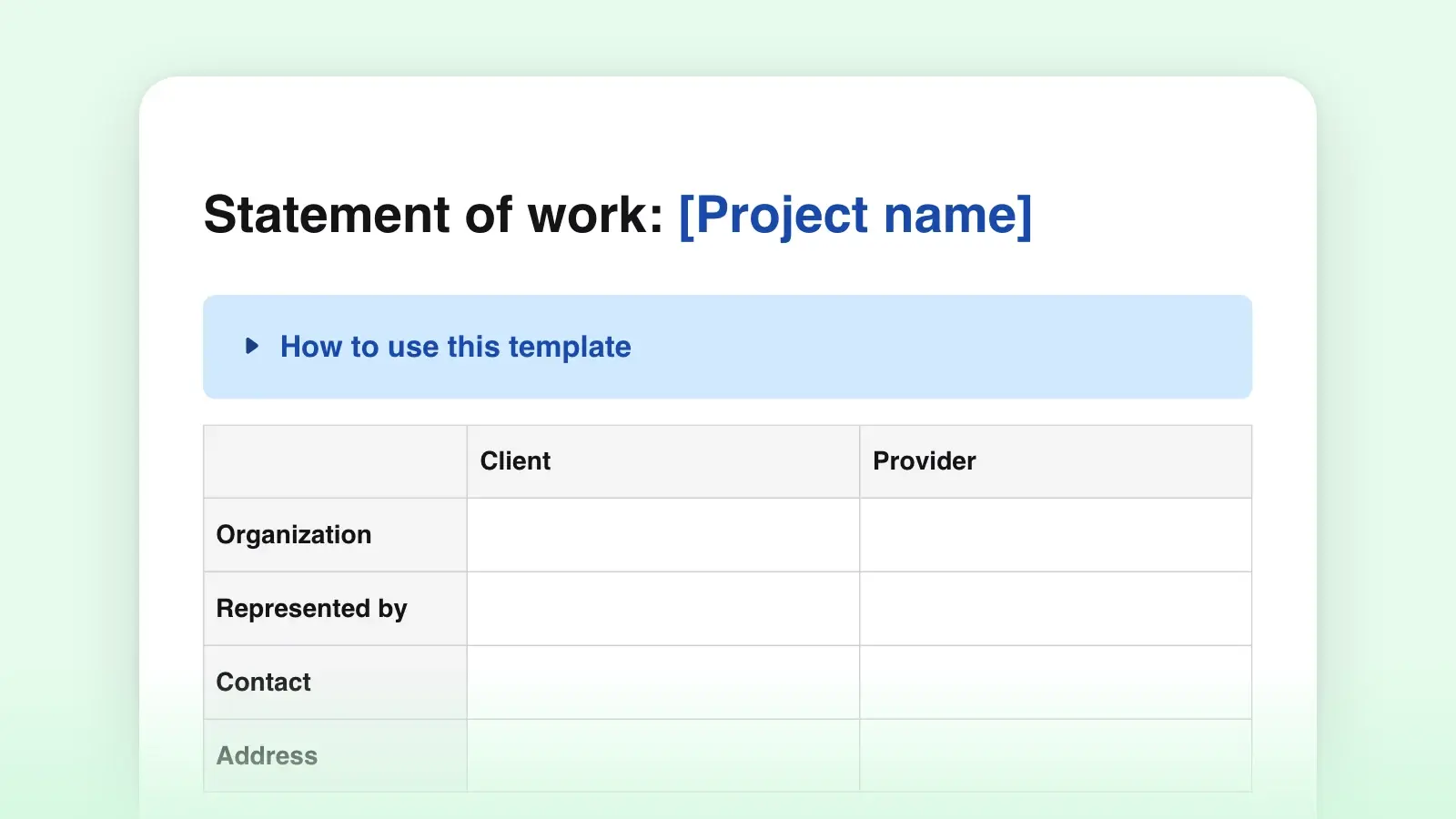
How to use this template
- Decide what the SOW sits under
If you and the client have signed a master services agreement (MSA), it holds the legal terms: confidentiality, who owns the work, liability, termination. The SOW then covers one project, and the "Governing agreement" line points to the MSA. With no MSA, this SOW stands alone without those terms, so pair it with a contract such as a freelance writing contract or have them added.
- Write scope and deliverables together
Every in-scope line should produce something in the deliverables table, and every deliverable should trace back to a scope line. Put numbers on both: eight articles, not "articles"; two rounds of revisions, not "revisions." Then write the out-of-scope list, naming the work a reasonable client might assume is included.
- Give each deliverable a test
The "Accepted when" column decides when the work is finished and, usually, when an invoice is due. Fill it in before you agree to any date. The next section shows what a usable test looks like.
- Tie dates and money to events
Give each milestone its dependency as well as its date: final delivery depends on feedback arriving by a given day. Attach each payment to something that happens, such as signing or acceptance of D2. Then both parties sign, and you keep the signed copy as a PDF.
Acceptance criteria someone can check
A criterion works when a third person could look at the deliverable and say yes or no without asking what you meant. U.S. federal contracting rules push in the same direction: FAR 37.602 asks agencies to describe work "in terms of the required results," not by method or hours. The habit works just as well for a two-person freelance job.
Testable
- Eight articles of 600–900 words, one per feature on the launch list
- Every step checked against the current beta build
- Uses the product names and terms in the client's style guide
- Two rounds of edits per article, each returned within three business days
Open to argument
- Help articles as needed
- High-quality, engaging content
- To the client's satisfaction
- Revisions until approved
Decide what silence means, too. Some SOWs treat a deliverable as accepted when the review window passes without comment; others require a written yes. Either can work. Leaving it unwritten is how an invoice sits unpaid for a month while nobody replies.
A filled-in example
The core of an SOW for a small freelance writing job: purpose, scope, deliverables and fees.
Purpose. Quillfern Software releases its scheduling app in May and has no help center. Dana Ruiz will write the first eight help articles; Quillfern's support team will publish them.
In scope. Eight help articles of 600–900 words, from an outline approved at kickoff. Two 45-minute interviews with the product lead. One round of edits after Quillfern's legal review.
Out of scope. Screenshots, translation, publishing in the help center, and any article beyond the eight.
- D1, outline of all eight articles, due April 4. Accepted when it covers every feature on the launch list and the product lead approves it in writing.
- D2, articles 1–4 as .docx files, due April 18. Accepted when every step matches the beta build and the text uses the terms in Quillfern's style guide.
- D3, articles 5–8, due May 2. Same test.
Fees. $4,800 fixed: $1,600 on signing, $1,600 when D2 is accepted, $1,600 when D3 is accepted, each due within 15 days of invoice. Extra articles are $550 each, by change request.
Dependency. If the interviews happen after March 28, D2 and D3 move by the same number of business days.
Where statements of work go wrong
- No out-of-scope list. The client assumes images are included and you assume they are not. Write it down while nobody is annoyed yet.
- "Unlimited revisions," or no number at all. A revision count with a turnaround time is the cheapest protection against scope creep you can write.
- A change process nobody uses. Small requests agreed in chat add up. Log each one in the change table, even at no charge, so the record matches the work.
- Terms that contradict the MSA. If the SOW says invoices are due in 15 days and the MSA says 30, someone has to decide which wins. The MSA should say; check that it does.
SOW, scope of work and MSA
The names overlap, and people use them loosely. This is how they are usually divided:
| Document | What it covers | When it is signed |
|---|---|---|
| DocumentMaster services agreement (MSA) | What it coversLegal terms for the whole relationship: payment terms, confidentiality, ownership, liability, termination | When it is signedOnce, at the start |
| DocumentStatement of work (SOW) | What it coversOne project: scope, deliverables, schedule, acceptance, fees | When it is signedOnce per project |
| DocumentScope of work | What it coversThe description of the work itself; a section of an SOW, or a short stand-alone document | When it is signedWith the SOW, or not at all |
| DocumentChange order | What it coversAn approved change to one SOW's scope, dates or fees | When it is signedEach time the scope changes |
If you only need the work described, without fees and signatures, start from the scope of work template. If the client has not said yes yet, write a project proposal first; the SOW comes after the yes.
Frequently asked questions
Is a statement of work legally binding?
It can be. Once both parties sign, an SOW may be a binding contract on its own or as part of a master services agreement. How it is treated depends on its wording and on local law, so have a lawyer review it before you sign.
Who writes the statement of work?
Either party. A client may attach one to a request for proposal. In freelance and agency work the provider often drafts it from the accepted proposal, since they know how the work breaks down, and the client edits it. Both sides should read every line before signing.
What is the difference between an SOW, a PWS and an SOO?
The three come from U.S. federal contracting. A traditional SOW tells the contractor what to do, often in detail. A performance work statement (PWS) describes the required results with measurable standards. A statement of objectives (SOO) sets out the purpose, scope and objectives at a high level, and bidders use it to propose their own PWS (FAR 37.602).