When to use it
- Two or more writers co-authoring a book, for a publisher or to self-publish
- An author and an illustrator making a picture book or graphic novel together
- Co-hosts starting a podcast, YouTube channel or newsletter they both run
- Contributors to an anthology, zine or shared-world fiction project
- Any creative project between friends, before the first chapter or episode exists
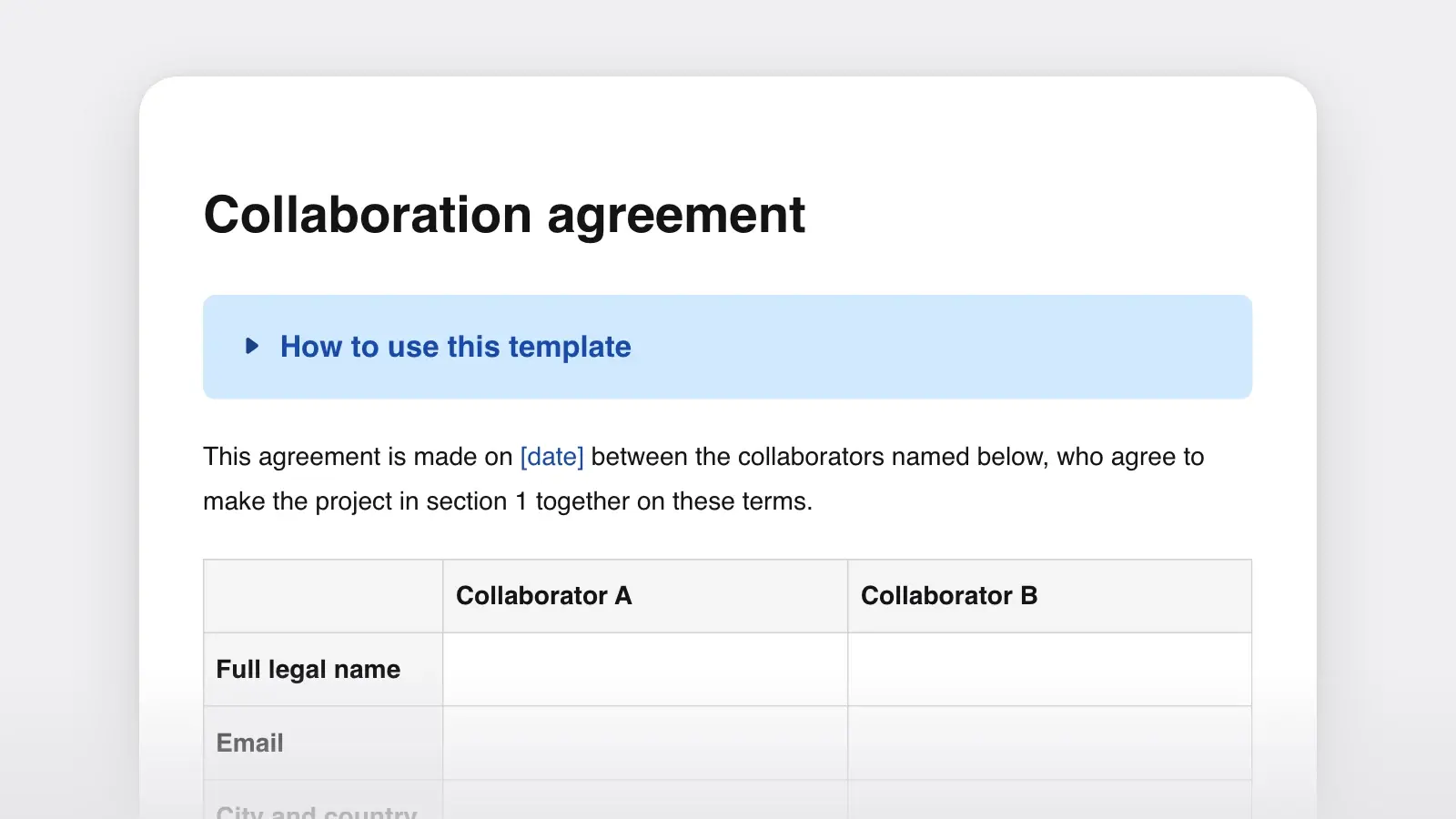
How to use this template
- Talk through money and leaving first
Sit down together and fill in sections 5 and 7 before anything else. They are the conversations friends put off, and the ones that end friendships when an offer or an argument finally arrives. Agreeing on how to split an imaginary advance is far easier than splitting a real one.
- Pick one ownership option
Section 4 offers joint ownership or separate ownership. Keep one and delete the other. The table below shows which fits your project. Then list anything either of you made before you started, so it stays with its maker.
- Put names and dates on the work
Fill the "Who does what" table with real numbers: chapters 1–6, not "half the book." If two of you are writing one manuscript, agree on a shared style sheet at the same time, so the two halves read as one book.
- Sign before the work starts
Both of you sign, and each keeps a signed copy as a PDF. Reread it at the moments that test it: an offer from a publisher or sponsor, the end of a season, a missed deadline. Change it in writing, never in chat.
Joint or separate ownership
Most of this agreement comes down to one question: does the finished work belong to both of you as a whole, or does each of you own your part?
| Option | Fits | Watch for |
|---|---|---|
| OptionJoint ownership | FitsCo-written prose where nobody could say who wrote which sentence; a show you host, script and edit together | Watch forWithout a consent clause, local law decides whether one of you can license the work alone |
| OptionSeparate ownership | FitsAuthor and illustrator; writer and composer; anthology contributors | Watch forEach license must be broad enough to cover new editions, translations and adaptations |
| OptionOne owner, one paid | FitsA ghostwriter, a hired editor or an illustrator paid a flat fee | Watch forNot a collaboration; use a work-for-hire or ghostwriting contract |
If you skip the agreement, the law fills the gaps, and it does not fill them the same way everywhere. In the US, a work prepared by two or more authors who intended their contributions to merge into one whole is a "joint work," and its authors co-own the copyright (17 U.S.C. §§ 101 and 201). Each co-owner can generally use or license it non-exclusively without asking the others, as long as the profits are shared. In the UK, licensing a jointly owned copyright takes the agreement of every owner (Copyright, Designs and Patents Act 1988, s. 173). The consent clause in Option 1 sets your own rule, so neither of you has to find out the default the hard way.
Separate ownership works when each part could stand alone: the text and the paintings, the scripts and the score. The license in Option 2 does the joining. In the US, an exclusive license counts as a transfer of copyright, and a transfer is valid only in a signed writing (17 U.S.C. §§ 101 and 204). If one of you is simply paying the other, this is the wrong document. Start from a work-for-hire agreement or a ghostwriting contract instead.
A filled-in example
The key clauses from an agreement between two journalists writing their first book together:
Project. A narrative nonfiction book of about 80,000 words on the last hand-cranked river ferries in the US, working title Slow Crossing. Proposal to agents by March 1.
Who does what. Ines Okafor: reporting trips, interviews, first drafts of chapters 1–6. Ruth Calloway: the proposal, first drafts of chapters 7–12, a final line edit of the whole manuscript.
Credit. "By Ines Okafor and Ruth Calloway," Ines first on every edition, because the project began with her reporting.
Ownership. Joint, in equal shares. No license, sale or option without both signatures.
Money. Advance and royalties split 50/50 after the agent's commission, and they ask the agency to pay each writer directly. Ines covers reporting travel up to $3,000. Anything above that is shared.
Leaving. If either writer leaves before the manuscript is delivered, the other may finish the book. The leaving writer is credited "with," and her share of income from the book drops to 25%.
If it stalls. If no publishing contract is signed by June 30, 2028, each takes back her own chapters and reporting notes.
Ruth can start the proposal from the book proposal template. The agreement gets signed before the proposal goes to anyone.
Adapting it to your project
| Project | Add or change |
|---|---|
| ProjectCo-written novel or series | Add or changeWho keeps the characters, the world and the series name if you split; whether you write under a shared pen name |
| ProjectAuthor and illustrator | Add or changeSeparate ownership; who approves sketches and final art; whether the art can be sold as prints or merchandise |
| ProjectPodcast or YouTube channel | Add or changeWho owns the feed, channel and show name; how sponsor money is split; who handles sponsor disclosures |
| ProjectNewsletter or blog | Add or changeWho owns the mailing list and domain; how paid subscriptions are split; who writes which issues |
| ProjectAnthology or zine | Add or changeEach contributor keeps copyright and grants a license for the collection; how the editor is paid |
On sponsor disclosures: the US Federal Trade Commission's guidance for creators says a paid relationship should be disclosed in the video itself, not only in the description. Decide which of you checks that before anything sponsored goes out.
Clauses people regret skipping
- Name order. It sounds petty until the cover proof arrives. Settle it while nobody minds.
- The accounts. Whoever registered the domain, the feed or the channel controls it in practice, whatever you both meant. Write down who owns each one and make sure both of you can log in.
- The half-finished project. Plenty of collaborations stall before release. Without a stall date, the chapters sit in limbo and neither of you can reuse them.
- How the money moves. When one of you receives the advance or the ad revenue, a payment deadline and a statement turn trust into a routine.
- Spin-offs. A sequel, a live show or a film option can be worth more than the original. Decide now that they need both of you.
Frequently asked questions
Is a collaboration agreement legally binding?
It can be. A signed agreement with clear terms is often treated as a contract, but whether it holds up depends on its wording and on local law. Have a lawyer review it, especially before a publisher, sponsor or real money is involved.
Who owns a co-written book if there is no agreement?
It depends on the country. In the US, if you both intended your contributions to merge into one work, it is a joint work and you co-own the copyright. Either of you can generally license it non-exclusively as long as you share the profits. In the UK, a joint owner needs the other owners' consent to license it. A signed agreement replaces those defaults with terms you chose.
What is the difference between a collaboration agreement and a work-for-hire agreement?
In a collaboration, the partners share credit, ownership and income. In a work-for-hire arrangement, one side pays and owns the result. In the US, work commissioned from a non-employee counts as made for hire only in certain categories, such as a contribution to a collective work or a translation, and only if both sides sign a written agreement saying so.
Do friends really need a written agreement?
Friends need it most, because they are the people least likely to raise money and credit out loud. Filling in the template together takes an evening and leaves you with answers you both remember the same way.